Tuesday, November 07, 2006

Cicero (106-43 BC) the father of ID?

Here are two quotes from the Roman orator- philosopher- lawyer- statesman Marcus Tullius Cicero's (106-43 BC) "The Nature of the Gods" (De Natura Deorum).

[Graphic: Cicero and his "On Friendship and Old Age," Glyn Hughes]

They sound like they could have been written by a modern ID theorist (indeed Bill Dembski refers to both of them in his books).

They are from an oration that Cicero puts in the mouth of an imaginary Stoic philosopher, Quintus Lucius Balbus in a three-cornered dialogue between Gaius Valleius, an imaginary Epicurean, and Cicero himself.

The first quote foreshadows (and may have influenced) Paley's a-watch-implies-a-watchmaker design argument from contrivance. That is, when anyone sees the arrangement of parts for a purpose (e.g. when one sees "a sundial or a water-clock ... that it tells the time") then one intuitively infers it was put together "by design and not by chance." And this applies even to a "one of those barbarians " who had never seen that contrivance before, e.g. on seeing "a globe which in its revolution shows the movements of the sun and stars and planets" a barbarian would not "fail to see that it was the product of a conscious intelligence." Therefore, how can one "imagine that the universe as a whole is devoid of purpose and intelligence" given that "it embraces everything, including these artefacts themselves and their artificers?" (my emphasis):

"When you look at a picture or a statue, you recognize that it is a work of art. When you follow from afar the course of a ship, upon the sea, you do not question that its movement is guided by a skilled intelligence. When you see a sundial or a water-clock, you see that it tells the time by design and not by chance. How then can you imagine that the universe as a whole is devoid of purpose and intelligence, when it embraces everything, including these artefacts themselves and their artificers? Our friend Posidonius as you know has recently made a globe which in its revolution shows the movements of the sun and stars and planets, by day and night, just as they appear in the sky. Now if someone were to take this globe and show it to the people of Britain or Scythia would a single one of those barbarians fail to see that it was the product of a conscious intelligence?" (Cicero, "The Nature of the Gods," [1972], McGregor, H.C.P., transl., Penguin: Harmondsworth UK, 1986, reprint, pp.158-159)

Although I had at the time never heard of Cicero's (or any other design arguments) a version of this occurred to me in my late teens and converted me from atheism to deism. I stepped outside the chess club where I was playing one night to have a cigarette and I looked up at the night sky. The thought came to me with overwhelming force, how could there be so much design witin the Universe (e.g. the laws of nature), and yet the Universe as a whole be not designed? When the question came to me that way, my atheism (which I had become increasingly troubled with by its meaninglessness) seemed to be so implausible, that I there and then became what I later found out was a deist (i.e. I believed there was a God who created the Universe but could not see how one could know anything more about Him from the evidence of nature).

It is interesting that Darwin himself at times had the same "conviction in the existence of God, connected with the reason and not with the feelings" from "the ... impossibility of conceiving this immense and wonderful universe, including man ... as the result of blind chance or necessity" and at those times Darwin felt "compelled to look to a First Cause having an intelligent mind in some degree analogous to that of man (my emphasis):

"Another source of conviction in the existence of God, connected with the reason and not with the feelings, impresses me as having much more weight. This follows from the extreme difficulty or rather impossibility of conceiving this immense and wonderful universe, including man with his capacity of looking far back wards and far into futurity, as the result of blind chance or necessity. When thus reflecting I feel compelled to look to a First Cause having an intelligent mind in some degree analogous to that of man; and I deserve to be called a Theist." (Darwin, C.R., in Barlow, N., ed., "The Autobiography of Charles Darwin, 1809-1882: With Original Omissions Restored," [1958], W.W. Norton & Co: New York NY, 1969, reprint, pp.92-93).

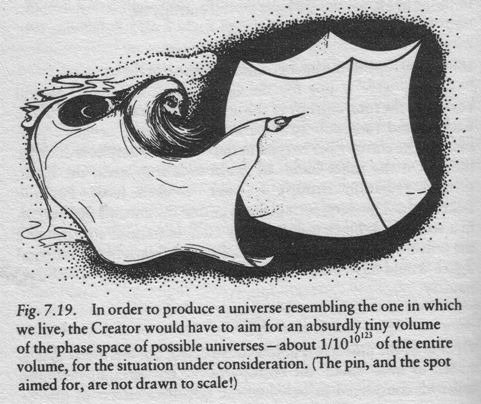
The second quote is in some ways more remarkable than the first, in that against the Epicurean materialist claim that "if an infinite" (i.e. "countless" in other translations) "number of examples of the twenty-one letters of the alphabet ... were shaken together and poured out on the ground it would be possible for them to fall so as to spell out, say, the whole text of the Annals of Ennius," Cicero doubts "whether chance would permit them to spell out a single verse" (my emphasis):

"`Is it not a wonder that anyone can bring himself to believe that a number of solid and separate particles by their chance collisions and moved only by the force of their own weight could bring into being so marvellous and beautiful a world? If anybody thinks that this is possible, I do not see why he should not think that if an infinite number of examples of the twenty-one letters of the alphabet, made of gold or what you will, were shaken together and poured out on the ground it would be possible for them to fall so as to spell out, say, the whole text of the Annals of Ennius. In fact I doubt whether chance would permit them to spell out a single verse! `So how can these people bring themselves to assert that the universe has been created by the blind and accidental collisions of inanimate particles devoid of colour or any other quality? And even to assert that an infinite number of such worlds are coming into being and passing away all the time. If these chance collisions of atoms can make a world, why cannot they build a porch, or a temple, or a house or a city? A much easier and less laborious task.'" (Cicero, Ibid., pp.161-162).

What is so remarkable about this is that, as we shall see, Cicero's intuition was right, even though a physicist of the stature of Sir Arthur Eddington assumed that, "If an army of monkeys were strumming on typewriters they might write all the books in the British Museum" (his emphasis):

"There is a faint possibility that at one moment all the molecules might in this way happen to be visiting the one half of the vessel. You will easily calculate that if n is the number of molecules (roughly a quadrillion) the chance of this happening is (1/2)n. The reason why we ignore this chance may be seen by a rather classical illustration. If I let my fingers wander idly over the keys of a typewriter it might happen that my screed made an intelligible sentence. If an army of monkeys were strumming on typewriters they might write all the books in the British Museum. The chance of their doing so is decidedly more favourable than the chance of the molecules returning to one half of the vessel." (Eddington, A.S., "The Nature of the Physical World," [1928], The Gifford Lectures 1927, Cambridge University Press: Cambridge UK, 1933, reprint, p.72. Emphasis original)

as did a lesser but more recent physicist, Paul Davies (whose latest book, The Goldilocks Enigma I hope to get for my 60th birthday tomorrow!) assume that "a monkey tinkering with a typewriter will eventually type Shakespeare":

"However, just as a monkey tinkering with a typewriter will eventually type Shakespeare, so somewhere among that vast stack of realities will be worlds that are partially ordered, just by chance." (Davies, P.C.W., "The Unreasonable Effectiveness of Science," in Templeton, J.M., ed., "Evidence of Purpose: Scientists Discover the Creator," Continuum: New York NY, 1994, p.53)

But as origin of life theorist Robert Shapiro pointed out, for a chimpanzee at a normal 45-key typewriter, who "never gets tired, and types out one line per second, completely at random," to produce merely the 18-character phrase in Shakespeare's Hamlet, "to be or not to be," the odds would be "1 in 4518, or 1 in 6 x 109" which means "At one try per second, it will take ...more than 1022 years to do that number of tries," i.e. the chimp would "still be typing away long after the stars have ceased to shine and all the planets have been dispersed into space"!:

"J.B.S. Haldane recognized that the chances of obtaining a self-replicating machine depended on the number of parts to it. If the number was small, there was no problem: `"By mere shuffling you will get the letters ACEHIMN to spell 'machine' once in 5040 trials on an average.' If you could shuffle at the rate of once per second, it would require only 84 minutes to run that many tries. This analogy suggests that it should not be hard to put together a smallish replicator, so we must look more closely at it. We will stay with the metaphor of language, but set aside the letters on cards in favor of another much-used situation: the monkey at the typewriter. Let's call him Charlie the Chimp. Charlie is special. He never gets tired, and types out one line per second, completely at random. ... Now let us give Charlie a normal keyboard with, say, 45 keys. The odds suddenly escalate to 1 in 457, or 1 in 370 billion tries. It would take Charlie (or his descendants) 11,845 years to run that many attempts. The word `machine' does not arise as readily as Haldane's first analogy would suggest. Things get rapidly worse when we use longer messages. We will let Charlie try for a bit of Hamlet. The phrase `to be or not to be' has 18 characters, if we count the spaces as characters. The chances that our chimp will type this out are 1 in 4518, or 1 in 6 x 10⁹. At one try per second, it will take poor Charlie more than 1022 years to do that number of tries. Should the open model for the universe be correct, Charlie will still be typing away long after the stars have ceased to shine and all the planets have been dispersed into space through stellar near-collisions. But now we have developed a real thirst for Shakespeare. We want our monkey to type out `to be or not to be: that is the question,' which has 40 characters. The chances then become 4540, or about 1066, to 1. This is a number 10 million times greater than the number of trials maximally available for the random generation of a replicator on the early earth. There we have it. If the chances of getting the replicator at random from a prebiotic soup are less than that of striking `to be or not to be: that is the question' by chance on a typewriter, we had best forget it. The replicator would have about 600 atoms. The chances of Charlie typing a 600-letter message (twice the size of this paragraph) correctly are 1 in 10992." (Shapiro, R., "Origins: A Skeptic's Guide to the Creation of Life on Earth," Summit Books: New York NY, 1986, pp.168-169).

I have read (but don't have the time or space to quote) that Cicero's arguments for design in these quotes, may have influenced the design arguments of Aquinas and Paley. If that were the case, it would be arguable that Cicero (106-43 BC) was the father of ID!

These two quotes alone refute the Darwinists' claim that ID is simply "religion" or "creationism." These arguments above were written by Cicero in ~45 BC (i.e. nearly a century before Christianity existed) and presented by him in the mouth of a Stoic philosopher, Stoicism being not a religion but a "school of philosophy." If even ancient philosophy which makes arguments for design based solely on the evidence of nature, is eventually ruled to be "religion" and "creationism" by the US Supreme Court, then that effectively would confirm that Atheism is the established religion of America!

Stephen E. Jones, BSc (Biol).


Genesis 9:20-28. 20Noah, a man of the soil, proceeded to plant a vineyard. 21When he drank some of its wine, he became drunk and lay uncovered inside his tent. 22Ham, the father of Canaan, saw his father's nakedness and told his two brothers outside. 23But Shem and Japheth took a garment and laid it across their shoulders; then they walked in backward and covered their father's nakedness. Their faces were turned the other way so that they would not see their father's nakedness. 24When Noah awoke from his wine and found out what his youngest son had done to him, 25he said, "Cursed be Canaan! The lowest of slaves will he be to his brothers." 26He also said, "Blessed be the LORD, the God of Shem! May Canaan be the slave of Shem. 27May God extend the territory of Japheth; may Japheth live in the tents of Shem, and may Canaan be his slave." 28After the flood Noah lived 350 years. 29 Altogether, Noah lived 950 years, and then he died.

Monday, November 06, 2006

Even if Dawkins' `blind watchmaker' evolution was true, it would not preclude design!

Here is another quote from a rediscovered article in my previously unclassified pile of photocopies.

[Graphic: Watchmaker's tools, WatchDoc.]

In it the late Australian philosopher Alan Olding pointed out that even if Dawkins' `blind watchmaker' evolution was true (i.e. the science not the philosophy), it would not preclude design.

Because that in turn depends on the "stuff of the universe" being "just right for life" and in fact "marvel piles on marvel as we contemplate just how suitable in general the constituents of the universe are for putting together living things"!

Indeed, Olding cited the late leading Neo-Darwinist mathematician-geneticist J.B.S. Haldane who said that " if we postulate a `Director of our galaxy' then `His or her simplest method of producing a variety of forms of life may be to leave a few hundred million planets near suitable suns for three thousand million years in the confidence that within that time cellular life will have started on 90 per cent" (or even one planet) "`of those where the surface temperatures and so on are suitable':

"So then, taking the second argument first, the particulars of evolutionary history, according to Dawkins, do not require the hypothesis of intelligent design because matter, itself, in the right circumstances, is easily persuaded by natural selection's intimations to supply functional parts such as optically graduated lenses. Very well, but we should not leave the matter there so generally stated. In what way, precisely, is the stuff of the universe just right for life and how far does being made of the right stuff suggest design? The same questions are there, just begging to be asked, in relation to a theory once put by J.B.S. Haldane. In a classic article `The Origins of Life', in the long defunct journal New Biology in 1954, he wrote that if we postulate a `Director of our galaxy' then `His or her simplest method of producing a variety of forms of life may be to leave a few hundred million planets near suitable suns for three thousand million years in the confidence that within that time cellular life will have started on 90 per cent of those where the surface temperatures and so on are suitable.' [Haldane, J.B.S., "The Origins of Life," in Johnson, M.L., Abercrombie, M. & Fogg, G. E., eds, "The Origin of Life," New Biology, No. 16, Penguin Books: London, April 1954, p.24] Such a procedure for making life would be the simplest, and the `Director' could be confident of the outcome, only if matter, itself, has the properties apt for it. What, then, are these properties of matter which are so generously provisional on the supply side of biological manufacture? In fact, many years ago this question was asked and answered by the physiologist L.J. Henderson in a work, The Fitness of the Environment (1913), which has been relegated to the margins of biological thought albeit with some respect for its eccentric cleverness. However, the arguments contained in it have been kept flickering with fuel supplied by a number of knowledgeable scientists and now, with Michael J. Denton 's recent book Nature's Destiny (1998), we have a well written, detailed and up-to-date attempt to demonstrate just how astonishingly fit the cosmos is for life. ... Remarkable as it is that there was at hand as it were, appropriately transparent stuff of the right consistency to provide material for the evolution of good lenses for camera eyes, marvel piles on marvel as we contemplate just how suitable in general the constituents of the universe are for putting together living things." (Olding, A., "Maker of Heaven and Microbiology," Quadrant, Vol. 44, January - February 2000, pp.62-68, pp.62-63).

In fact Dawkins effectively conceded this point when he wrote, "the only watchmaker in nature is the blind forces of physics, albeit deployed in a very special way" (my emphasis):

"Paley's argument is made with passionate sincerity and is informed by the best biological scholarship of his day, but it is wrong, gloriously and utterly wrong. The analogy between telescope and eye, between watch and living organism, is false. All appearances to the contrary, the only watchmaker in nature is the blind forces of physics, albeit deployed in a very special way. A true watchmaker has foresight: he designs his cogs and springs, and plans their interconnections, with a future purpose in his mind's eye. Natural selection, the blind, unconscious, automatic process which Darwin discovered, and which we now know is the explanation for the existence and apparently purposeful form of all life, has no purpose in mind. It has no mind and no mind's eye. It does not plan for the future. It has no vision, no foresight, no sight at all. If it can be said to play the role of watchmaker in nature, it is the blind watchmaker." (Dawkins R., "The Blind Watchmaker: Why the Evidence of Evolution Reveals a Universe Without Design," W.W Norton & Co: New York NY, 1986, p.5. Emphasis original).

Indeed Dawkins' entire "blind watchmaker" analogy is question-beggingly and fatally flawed when he asserts "the only watchmaker in nature is the blind forces of physics" (my emphasis). But quite clearly a watchmaker is not physically "in" his watch, but is always external to it. Moreover, it is no objection that the watchmaker's tools are "blind" (which is what the "forces of physics" would be in Paley's watchmaker analogy). In fact if they `had a mind of their own' he would replace them for ordinary "blind" ones!

Therefore, even if one accepted Dawkins' thesis (which I don't) that there has been no supernatural intervention or guidance in nature since the Universe began, even that would not preclude intelligent design because then it it would come down to what (or who) ultimately "deployed in a very special way" (my emphasis) "the blind forces of physics"?

And as this quote from Haldane's 1954 article itself, he regarded that "Life originated on our planet by a supernatural event" (which he defined as "supernatural creation or guidance") as a legitimate scientific possibility:

"Most of the suggestions as to its origin can be classified as follows: (1) Life has no origin. Matter and life have always existed. When stars become habitable, they are colonized by `seeds' of life from interstellar space, perhaps spares of bacteria or simple plants. These may have been driven out of planetary atmospheres by radiation pressure, as Arrhenius suggested, or even launched into space by intelligent beings. (2) Life originated on our planet by a supernatural event, that is to say an event of a kind incapable of description in the terminology of natural science, and a fortiori incapable of prediction or control by man. (3) Life originated from `ordinary' chemical reactions by a slow evolutionary process. (4) Life originated as the result of a very `improbable' event, which however was almost certain to happen given sufficient time, and sufficient matter of suitable composition in a suitable state. ... The postulation of a rare chance (hypothesis 4) is not even incompatible with that of supernatural creation or guidance. To avoid postulating infinities let us merely postulate a Director of our galaxy. His or her simplest method of producing a variety of forms of life may be to leave a few hundred million planets near suitable suns for three thousand million years, in the confidence that within that time cellular life will have started on 90 per cent of those where the surface temperatures and so on are suitable." (Haldane, J.B.S., "The Origins of Life," in Johnson, M.L., Abercrombie, M. & Fogg, G. E., eds, "The Origin of Life," New Biology, No. 16, Penguin Books: London, April 1954, pp.12, 24)

although he wrongly claimed above that such "an event" would be "of a kind incapable of description in the terminology of natural science, and ... incapable of prediction or control by man."

But as Christian philosopher Norman L. Geisler observed, a "supernaturally guided event" (which he termed "a second class miracle") could be "one whose natural process can be described scientifically (and perhaps even reduplicated by humanly controlled natural means) but whose end product in the total picture is best explained by invoking the supernatural" (my emphasis):

"It may be that some things are so highly unusual and coincidental that, when viewed in connection with the moral or theological context in which they occurred, the label `miracle' is the most appropriate one for the happening. Let us call this kind of supernaturally guided event a second class miracle, that is, one whose natural process can be described scientifically (and perhaps even reduplicated by humanly controlled natural means) but whose end product in the total picture is best explained by invoking the supernatural. Providing that the theist can offer some good reasons (by virtue of the moral or theological context of the event) for not accepting a purely natural explanation, then there is no reason to rule out the evidential value of such unusual natural events." (Geisler, N.L., "Christian Apologetics," [1976], Baker: Grand Rapids MI, Ninth Printing, 1995, p.277).

Stephen E. Jones, BSc (Biol).


Genesis 9:18-19. 18The sons of Noah who came out of the ark were Shem, Ham and Japheth. (Ham was the father of Canaan.) 19These were the three sons of Noah, and from them came the people who were scattered over the earth.

Sunday, November 05, 2006

My critique of Dawkins' "The God Delusion" #2

Dear Professor Dawkins,

Continued from part #1.

Graphic: The Root of All Evil?, Wikipedia.

In the Preface of your book, "The God Delusion" you wrote:

"In January 2006 I presented a two-part television documentary on British television (Channel Four) called Root of All Evil? From the start, I didn't like the title. Religion is not the root of all evil, for no one thing is the root of all anything." (Dawkins, R., "The God Delusion," Bantam Press: London, 2006, p.1)

Thank you for conceding that "Religion is not the root of all evil" (my emphasis)! But then given that you profess that, "I care passionately about what is true and I never say anything that I do not believe to be right":

"In one respect I plead to distance myself from professional advocates. A lawyer or a politician is paid to exercise his passion and his persuasion on behalf of a client or a cause in which he may not privately believe. I have never done this and I never shall. I may not always be right, but I care passionately about what is true and I never say anything that I do not believe to be right. I remember being shocked when visiting a university debating society to debate with creationists. At dinner after the debate, I was placed next to a young woman who had made a relatively powerful speech in favour of creationism. She clearly couldn't be a creationist, so I asked her to tell me honestly why she had done it. She freely admitted that she was simply practising her debating skills, and found it more challenging to advocate a position in which she did not believe. Apparently it is common practice in university debating societies for speakers simply to be told on which side they are to speak. Their own beliefs don't come into it. I had come a long way to perform the disagreeable task of public speaking, because I believed in the truth of the motion that I had been asked to propose. When I discovered that members of the society were using the motion as a vehicle for playing arguing games, I resolved to decline future invitations from debating societies that encourage insincere advocacy on issues where scientific truth is at stake."(Dawkins R., "The Blind Watchmaker: Why the Evidence of Evolution Reveals a Universe Without Design," W.W Norton & Co: New York NY, 1986, p.xiv)

I am surprised that if you thought the title was false on a major international TV documentary that you were to present, you went along with it anyway. You sound no better (if not worse) than the "lawyer or ... politician" that you despise above for being "paid to exercise his ... persuasion on behalf of a client or a cause in which he may not privately believe."

But putting that aside, there are other problems with your claim that religion (if not "the root of all evil") is evil.

The first such problem is your use of the vague term "religion." The fact is that there is no such thing as religion in general, but only particular religions. As your fellow Oxford University professor, theologian Alister McGrath has pointed out, "it is seriously misleading to regard the various religious traditions of the world as variations on a single theme" since "There is no such thing as religion. There are only traditions, movements, communities, peoples, beliefs, and practices that have features that are associated by many people with what they mean by religion" (my emphasis):

"There is a growing consensus that it is seriously misleading to regard the various religious traditions of the world as variations on a single theme. `There is no single essence, no one content of enlightenment or revelation, no one way of emancipation or liberation, to be found in all that plurality' (David Tracy). John B. Cobb Jr also notes the enormous difficulties confronting anyone wishing to argue that there is an `essence of religion': `Arguments about what religion truly is are pointless. There is no such thing as religion. There are only traditions, movements, communities, peoples, beliefs, and practices that have features that are associated by many people with what they mean by religion.' [Cobb, J.B. Jr, "Beyond Pluralism," in D'Costa, G., ed., "Christian Uniqueness Reconsidered: The Myth of a Pluralistic Theology of Religions," Orbis: Maryknoll NY, 1990, pp. 81-84] Cobb stresses that the assumption that religion has an essence has bedeviled and seriously misled recent discussion of the relation of the religious traditions of the world. For example, he points out that both Buddhism and Confucianism have `religious' elements - but that does not necessarily mean that they can be categorized as `religions.' Many `religions' are better understood as cultural movements with religious components.The idea of some universal notion of religion, of which individual religions are subsets, appears to have emerged at the time of the Enlightenment. To use a biological analogy, the assumption that there is a genus of religion, of which individual religions are species, is a very western idea, without any real parallel outside western culture - except on the part of those who have been educated in the west, and uncritically absorbed its presuppositions." (McGrath, A.E., "Christian Theology: An Introduction," [1994], Blackwell: Cambridge MA, Second Edition, 1997, pp.531-532)

By the way, you may be interested in Professor McGrath's next book, "The Dawkins Delusion" announced on his website (although presumably that should be "February 2007"):

"MAJOR FORTHCOMING BOOK: The Dawkins Delusion - a response to Richard Dawkins' The God Delusion - will be published by SPCK in February 2006." [sic]

You can also hear an online lecture by Professor McGrath on your book at City Church of San Francisco: Open Forum with Alister McGrath, October 22 , 2006 "Is God a Delusion? Atheism and the Meaning of Life." There is also another version of basically the same lecture at Berkeley University: Alister McGrath on Richard Dawkins' "The God Delusion" although I have not listened to that particular lecture.

A second problem for you in your claim that religion is evil is that of your own personal rational consistency (or irrational inconsistency). According to you, while "Theologians worry away at the `problem of evil'" in fact for atheists like you, "The universe we observe has ... at bottom, no design, no purpose, no evil and no good" (my emphasis):

"Theologians worry away at the `problem of evil' and a related `problem of suffering.' ... On the contrary, if the universe were just electrons and selfish genes, meaningless tragedies ... are exactly what we should expect, along with equally meaningless good fortune. Such a universe would be neither evil nor good in intention. It would manifest no intentions of any kind. In a universe of blind physical forces and genetic replication, some people are going to get hurt, other people are going to get lucky, and you won't find any rhyme or reason in it, nor any justice. The universe we observe has precisely the properties we should expect if there is, at bottom, no design, no purpose, no evil and no good, nothing but blind, pitiless indifference. As that unhappy poet A.E. Housman put it: `For Nature, heartless, witless Nature Will neither care nor know.' DNA neither cares nor knows. DNA just is. And we dance to its music." (Dawkins, R., "River out of Eden: A Darwinian View of Life," Phoenix: London, 1996, pp.154-155. Emphasis original).

So according to you, religion cannot be evil (let alone "the root of all evil") because "there is, at bottom ... no evil"! (my emphasis)

I will deal with a third problem of your claim that religion is evil, namely your physical determinism (e.g. "we dance to its [DNA's] music" above), in a future post.

Continued in part #3.

Stephen E. Jones, BSc (Biol).


Genesis 9:8-17. 8Then God said to Noah and to his sons with him: 9"I now establish my covenant with you and with your descendants after you 10and with every living creature that was with you-the birds, the livestock and all the wild animals, all those that came out of the ark with you-every living creature on earth. 11I establish my covenant with you: Never again will all life be cut off by the waters of a flood; never again will there be a flood to destroy the earth." 12And God said, "This is the sign of the covenant I am making between me and you and every living creature with you, a covenant for all generations to come: 13I have set my rainbow in the clouds, and it will be the sign of the covenant between me and the earth. 14Whenever I bring clouds over the earth and the rainbow appears in the clouds, 15I will remember my covenant between me and you and all living creatures of every kind. Never again will the waters become a flood to destroy all life. 16Whenever the rainbow appears in the clouds, I will see it and remember the everlasting covenant between God and all living creatures of every kind on the earth."17So God said to Noah, "This is the sign of the covenant I have established between me and all life on the earth."

Saturday, November 04, 2006

Re: Schroeder Science

AN

[Graphic: Amazon.ca]

Thanks for your message and apologies for the delay in replying. As is my long-standing policy when I receive a private message on a Creation, Evolution or Design issue, I am posting my reply to my blog CED after removing your personal identifying information.

----- Original Message -----
From: AN
To: Stephen E. Jones
Sent: Wednesday, November 01, 2006 11:51 AM
Subject: Schroeder Science

>Stephen, I hope all is well. Do you have thoughts on "The Science of God" by Dr. Gerald Schroeder...

Thanks. I have Schroeder's "The Science of God" (1997), as well as his earlier "Genesis and the Big Bang" (1990) and his later "The Hidden Face of God" (2001). I have only dipped into these three books, and I found much (but not all) that I agree with.

I like how the math formula he uses incorporates accepted science data and creation days 1 - 6 to give a time frame to each creation day-age, i.e., old earth. Those ages relate the sciences to each creation day very well, both descriptively, and within the accepted time lines. It seems an accountable testable model, one that gives explicit Bible-science matches, better than implicit hermeneutic models.

Even if one accepts (for the sake of argument only) Schroeder's relativistic "time dilation" theory that "In terms of days and years and millennia, this stretching of the cosmic perception of time by a factor of a million million, the division of fifteen billion years by a million million reduces those fifteen billion years to six days":

"Since biblical time takes hold with the appearance of matter, the biblical clock starts at bohu, that instant just after the big bang when stable matter as we know it formed from energy. The age of all matter in the universe dates back to bohu, the moment of quark confinement. We know the temperature and hence the frequency of radiation energy in the universe at quark confinement. It is not a value extrapolated or estimated from conditions in the distant past or far out in space. It is measured right here on Earth in the most advanced physics laboratories and corresponds to a temperature approximately a million million times hotter than the current 3°K black of space. That radiant energy had a frequency a million million times greater than the radiation of today's cosmic background radiation. The radiation from that moment of quark confinement has been stretched a million-millionfold. Its redshift, z, as observed today is 1012. That stretching of the light waves has slowed the frequency of the cosmic clock-expanded the perceived time between ticks of that clock-by a million million. ... To measure the age of the universe, we look back in time. From our perspective using Earth-based clocks running at a rate determined by the conditions of today's Earth, we measure a fifteen-billion-year age. And that is correct for our local view. The Bible adopts this Earthly perspective, but only for times after Adam. The Bible's clock before Adam is not a clock tied to any one location. It is a clock that looks forward in time from the creation, encompassing the entire universe, a universal clock tuned to the cosmic radiation at the moment when matter formed. That cosmic timepiece, as observed today, ticks a million million times more slowly than at its inception. The million millionfold stretching of radiation since bohu caused that million-million-to-one ratio in this perception of time. This cosmic clock records the passage of one minute while we on Earth experience a million million minutes. The dinosaurs ruled the Earth for 120 million years, as measured by our perception of time. Those clocks are set by the decay of radioactive nuclides here on Earth and they are correct for our earthly system. But to know the cosmic time we must divide earth time by a million million. At this million-million-to-one ratio those 120 million Earth years lasted a mere hour.What does all this mean for the age of the universe? In terms of days and years and millennia, this stretching of the cosmic perception of time by a factor of a million million, the division of fifteen billion years by a million million reduces those fifteen billion years to six days!" (Schroeder, G.L., "The Science of God: The Convergence of Scientific and Biblical Wisdom," Broadway Books: New York NY, 1998, pp.57-58. Emphasis original)

by my calculations 15,000,000,000 years x 365 (ignoring that the solar day was meaningless for the first ~8 billion years when there was as yet no Sun or Earth, and that the length of both the solar year and day would have changed considerably in the last ~4.5 billion years, e.g. "The original length of one day, when the Earth was new about 4.5 billion years ago, was about six hours .... It was 21.9 hours 620 million years ago"):

"The Earth's day has increased in length over time. The original length of one day, when the Earth was new about 4.5 billion years ago, was about six hours as determined by computer simulation. It was 21.9 hours 620 million years ago as recorded by rhythmites (alternating layers in sandstone). This phenomenon is due to tides raised by the Moon which slow Earth's rotation. Because of the way the second is defined, the mean length of a day is now about 86,400.002 seconds, and is increasing by about 1.7 milliseconds per century (an average over the last 2700 years). " (Day, Wikipedia)

that makes 5,475,000,000,000 = 5.475 x 10¹² days. Dividing that "by a million million" 1012 = 5.475 days, not "six days." But it gets even worse for Schroeder's theory if the current best estimate of the age of the Universe of "13.7 billion ... years":

"The age of the universe from the time of the Big Bang, according to current information provided by NASA's WMAP (Wilkinson Microwave Anisotropy Probe), is estimated to be about 13.7 billion (13.7 × 10⁹) years, with a margin of error of about 1 % (± 200 million years)." (Universe, Wikipedia)

is used. Then the number of days since the Big Bang is 5,000,500,000,000, which when divided by 1012 = 5.0005 days. Either way, Schroeder's theory is indeed "an accountable testable model" but one that has been tested and failed!

There is another major problem with Schroeder's claim that "Adam's birth occurred within the last six thousand years" with "Adam" defined as "the first hominid with a divinely created human soul" (ignoring the "may have" which renders his claim meaningless):

"According to the biblical calendar [i.e. "derived in part by summing the ages of persons mentioned in the Bible" - p.201], Adam's birth occurred within the last six thousand years. Can this be true when museums are filled with human-looking fossils dating back fifty thousand years? A clue to the answer to this biblical conundrum may be found in events that occurred two thousand years after Adam, in the life and affairs of Abraham. Just as God chose Abraham only after Abraham chose God, so the Eternal's encounter with Adam may have followed Adam's recognition of that transcendent yet immanent omnipotence we refer to as the Eternal God. Adam may have been the first hominid with a divinely created human soul." (Schroeder, Ibid., p.126).

Schroeder claims that "a being who does not possess this spirit is not human but a mere animal in human shape and form" (his emphasis) who "lacked ... human spirituality" and this applies to those "less-than-human creatures" who "had human-like skills" including producing "cave paintings that predate Adam by twenty thousand years and ten-thousand-year-old inception of agriculture":

"The Talmud deduces ... that ... Adam had sexual relations with other beings (the nature of those beings is not clear). From these unions came children that `were not human in the true sense of the word. They had not the spirit of God ... It is acknowledged that a being who does not possess this spirit is not human but a mere animal in human shape and form...' Here we have ancient accepted sources that describe animals with human shape, form, intelligence, and judgment. Suddenly cave paintings that predate Adam by twenty thousand years and ten-thousand-year-old inception of agriculture become understandable. These less-than-human creatures had human-like skills. What they lacked was human spirituality." (Schroeder, Ibid, p.141. Emphasis original)

The problem with this is that the Australian aborigines (hereafter indigenous Australians) are believed to have descended from ancestors who have been in Australia for at least 40,000 years:

"Australia's oldest human remains, found at Lake Mungo, include the world's oldest ritual ochre burial (Mungo III) and the first recorded cremation (Mungo I). Until now, the importance of these finds has been constrained by limited chronologies and palaeoenvironmental information. Mungo III, the source of the world's oldest human mitochondrial DNA, has been variously estimated at 30 thousand years (kyr) old, 42-45 kyr old and 62 ±6 kyr old, while radiocarbon estimates placed the Mungo I cremation near 20-26 kyr ago. Here we report a new series of 25 optical ages showing that both burials occurred at 40±2 kyr ago and that humans were present at Lake Mungo by 50-46 kyr ago, synchronously with, or soon after, initial occupation of northern and western Australia. Stratigraphic evidence indicates fluctuations between lake-full and drier conditions from 50 to 40 kyr ago, simultaneously with increased dust deposition, human arrival and continent-wide extinction of the megafauna. This was followed by sustained aridity between 40 and 30 kyr ago. This new chronology corrects previous estimates for human burials at this important site and provides a new picture of Homo sapiens adapting to deteriorating climate in the world's driest inhabited continent." (Bowler, J. M., et al., "New ages for human occupation and climatic change at Lake Mungo, Australia," Nature, Vol. 421, 20 February 2003, pp.837-840)

"A thorough analysis of the site of Australia's oldest human remains may settle the long and acrimonious debate over how long ago humans first colonised the continent. Experts have been arguing for decades about the age of the skeleton, dubbed Mungo Man. Now its discoverer says he has confirmed that it is 40,000 years old. ... In 1976, Bowler and his colleague Alan Thorne estimated the remains to be 30,000 years old. But in 1999, Thorne and his team at Australian National University in Canberra published a sensational new paper claiming Mungo Man was 62,000 years old. ... Now researchers at four separate laboratories, including Bowler and a member of Thorne's original team, claim that the burial of Mungo Man took place 40,000 years ago. The new dates were derived using optically stimulated luminescence (OSL), similar but more reliable than thermoluminescence. Crucially, the researchers sampled sand from the exact burial sites, whereas it has emerged that Thorne's team had sampled sand 400 metres away. They have also dated stone tools - the earliest evidence of human occupation at the site - to 50,000 years ago."(Young, E., "New arrival date for earliest Australians," New Scientist,18 February 2003).

Presumably Schroeder would not claim that modern indigenous Australians are "mere animal in human shape and form" so I assume he would probably try to save this theory (which already has been falsified anyway - see above) by claiming that indigenous Australians are also descended from Adam. But as far as I am aware, there is no evidence that prior to the arrival of Europeans in the 18th century, indigenous Australians had anything more than Old Stone-Age (Upper Paleolithic) culture, whereas the first recorded Biblical culture in Genesis 4 is New Stone Age (Neolithic).

I personally think a version of evangelical Christian theologian/anthopologist E.K. Victor Pearce's "Two-Adam" (or rather Genesis 1 Man-Genesis 2 Adam) theory is a better fit to both the Biblical and scientific data:

"The literary structure of Genesis is based upon eleven sections, each of which commences with the phrase `These are the generations of.' The word `generations' is `toledoth' in the Hebrew, and refers to the origins of nations and races. ... The first two toledoths embodied in Genesis used to be taken as two separate stories of creation, the second starting in Genesis 2:4. Now that one can be regarded as a sequel to the other, many of our difficulties concerning the Biblical origin of man can be solved. This would mean that in Genesis 1, Old Stone Age man is described, the Hebrew collective noun `adam' meaning mankind as a whole; but in Gen. 2:4, the second toledoth commences. This second toledoth makes the characteristic brief summary of the preceding toledoth, and then speaks mainly about Eden. Here the noun becomes `The Adam' or `the Man', with the article referring to an individual, and then becomes a proper name 'Adam' . This man named Adam is the individual from whom our Lord's descent is eventually traced. ... We shall use the name Adam to refer to this individual, a New Stone Age farmer of about 10,000 to 12,000 years ago. Although the Hebrew word adam is used collectively in the first chapter of Genesis, we will call him Old Stone Age Man, to avoid confusion, and the proper name, `Adam', will be reserved for the Adam of Eden." (Pearce, E.K.V., "Who Was Adam?," Paternoster: Exeter UK, 1969, pp.18,21. Emphasis original)

>Take care, AN

Thanks. The same to you.

Stephen E. Jones, BSc (Biol).


Genesis 9:4-7. 4"But you must not eat meat that has its lifeblood still in it. 5And for your lifeblood I will surely demand an accounting. I will demand an accounting from every animal. And from each man, too, I will demand an accounting for the life of his fellow man. 6"Whoever sheds the blood of man, by man shall his blood be shed; for in the image of God has God made man.7As for you, be fruitful and increase in number; multiply on the earth and increase upon it."

My critique of Dawkins' "The God Delusion" #1

Dear Professor Dawkins

I bought your book "The God Delusion" yesterday (to add to the other 9 books of yours I own).

[Graphic: "The God Delusion," Amazon.com]

I plan to critique it (as time permits) section- by-section in the form of letters to you (similar to geneticist Gabriel Dover's "Dear Mr Darwin") posted to my blog
CreationEvolutionDesign, cc. your email address on your Oxford University Professor Richard Dawkins page. Any reply from you or your staff I reserve the right to post to my blog.

I realise you are very busy and you must get a lot of unsolicited emails from those you consider "ignorant, stupid or insane ... or wicked" because they (like me) "don't believe in evolution":

"`DO you realize,' said Don, `that nearly half the people in the United States don't believe in evolution?' ... It is absolutely safe to say that if you meet somebody who claims not to believe in evolution, that person is ignorant, stupid or insane (or wicked, but I'd rather not consider that)." (Dawkins, R., "Put Your Money on Evolution." Review of "Blueprints: Solving the Mystery of Evolution," by Donald C. Johanson and Maitland A. Edey. New York Times, April 9, 1989, Section 7, p.34)

so if I receive a request from you or your staff to not copy these posts to you, I will comply with that request.

First I will briefly introduce myself. I am an Australian evangelical Christian in my late 50s (early 60s from next week!). I was an atheist from a non-Christian home in my early teens, became a deist in my mid-teens from the evidence of design in nature, and then was converted to Christianity in my early twenties. Previously I debated on various Creation/Evolution Internet forums for over a decade from 1994-2005 and completed a biology degree in 2004.I have been a member of the Intelligent Design Movement since 1994 and my position on the creation- evolution spectrum is Old-Earth Progressive (Mediate) Creation.

I accept universal common ancestry, but regard that as neither necessary nor sufficient to uniquely specify evolution, since as you yourself, quoting Darwin, have pointed out, God could have supernaturally intervened "at any one stage of descent" and then it would be "not evolution at all" (my emphasis):

"Darwin ... wrote in a letter to Sir Charles Lyell, the leading geologist of his day: `If I were convinced that I required such additions to the theory of natural selection, I would reject it as rubbish...I would give nothing for the theory of Natural selection, if it requires miraculous additions at any one stage of descent.' [Darwin, C.R., Letter to C. Lyell, October 11, 1859, in Darwin, F., ed., "The Life and Letters of Charles Darwin," [1898], Basic Books: New York NY, Vol. II., 1959, reprint, pp.6-7]. This is no petty matter. In Darwin's view, the whole point of the theory of evolution by natural selection was that it provided a non-miraculous account of the existence of complex adaptations. For what it is worth, it is also the whole point of this book. For Darwin, any evolution that had to be helped over the jumps by God was not evolution at all." (Dawkins, R., "The Blind Watchmaker: Why the Evidence of Evolution Reveals a Universe Without Design," W.W Norton & Co: New York NY, 1986, pp.248-249. Emphasis original).

but "divine creation" (my emphasis)!:

"At first sight there is an important distinction to be made between what might be called 'instantaneous creation' and 'guided evolution'. Modern theologians of any sophistication have given up believing in instantaneous creation. ... many theologians ... smuggle God in by the back door: they allow him some sort of supervisory role over the course that evolution has taken, either influencing key moments in evolutionary history (especially, of course, human evolutionary history), or even meddling more comprehensively in the day-to-day events that add up to evolutionary change. ... In short, divine creation, whether instantaneous or in the form of guided evolution, joins the list of other theories we have considered in this chapter." (Dawkins, Ibid., 1986, pp.316-317)

Since 2003, with minor variations, I have stated on my testimony page:

"I would have no problem even if Darwinian evolution was proved to be 100% true, because the God of the Bible is fully in control of all events, even those that seem random to man (Prov. 16:33; 1Kings 22:34). Jesus said that not even one sparrow will die unless God wills it (Mat. 10:29-30), which means that God is fully in control of natural selection. But if the Biblical God really exists there is no good reason to assume in advance that Darwinian (or any form of) naturalistic evolution is true!".

Those preliminaries out of the way, at the start of your book you have this:

"In Memoriam Douglas Adams (1952-2001) `Isn't it enough to see that a garden is beautiful without having to believe that there are fairies at the bottom of it too?' (Dawkins, R., "The God Delusion," Bantam Press: London, 2006, p.v).

Now I sympathise with you at the sudden death at age 49 of your friend in 2001. But I have three points to make:

First, if Christianity is true (which it is) , then according to:

Daniel 12:2. "Multitudes who sleep in the dust of the earth will awake: some to everlasting life, others to shame and everlasting contempt."

your atheist friend now knows (or will know when he is made to "awake ... to shame and everlasting contempt") that God is no fairy!

Second, this reminds me of another atheist I debated once who claimed God was the same as the Tooth Fairy. My answer to him was (words to the effect), "you spend a lot of time and energy on Internet discussion groups attacking the God of the Bible. So how much time do you spend on such groups attacking the Tooth Fairy?" Christian theologian Albert Mohler, made the same point in his review of your book:

"If Dawkins is so certain that theism is dead, why would he devote so much of his time and energy to opposing it? A man who is genuinely certain that Christianity is passing away would feel no need to write a 400-page book in order to urge its passing." (Mohler, A., "The Dawkins Delusion." Review of "The God Delusion" by Richard Dawkins. Crosswalk.com, September 26, 2006).

I saw you on TV where you pointed out (words to the effect) that no one thinks that Zeus or other pagan gods are real today, and therefore we should not think that the God of the Bible is real. But that is precisely the point. The reason why you don't attack Zeus or other pagan gods, but direct most of your attacks toward the Christian God, is that deep down you fear that He is more real than them!

Third, by your quoting Adam's "a garden is beautiful without having to believe that there are fairies at the bottom of it too" you raise an interesting point that might (at least subconsciously) bother you. That is, you may feel that your substitution of apparent design behind nature for real design is a loss. In my biology degree textbook there is an interview with you in which exult over "apparent design" (my emphasis):

"Natural selection is a bewilderingly simple idea. And yet what it explains is the whole of life, the diversity of life, the complexity of life, the apparent design of life. It all flows from this one remarkably simple idea." (Dawkins, R., "Mechanisms of Evolution," in Campbell, N.A., Reece, J.B. & Mitchell, L.G., "Biology," [1987], Benjamin/Cummings: Menlo Park CA, Fifth Edition, 1999, p.413).

Now a man dying of thirst in a desert could conceivably exult over apparent water (i.e. a mirage) as much as over real water, but he would never exult over it better. And most, unless they are highly motivated to deny design (like yourself), would regard apparent design as an inadequate substitute for the real thing.

Significantly your idol, Charles Darwin, from about "the age of thirty" suffered an increasing " loss of the higher aesthetic tastes" which he put down to failing to "read some poetry and listen to some music at least once every week":

"I have said that in one respect my mind has changed during the last twenty or thirty years. Up to the age of thirty, or beyond it, poetry of many kinds, such as the works of Milton, Gray, Byron, Wordsworth, Coleridge, and Shelley, gave me great pleasure, and even as a schoolboy I took intense delight in Shakespeare, especially in the historical plays. I have also said that formerly pictures gave me considerable, and music very great delight. But now for many years I cannot endure to read a line of poetry : I have tried lately to read Shakespeare, and found it so intolerably dull that it nauseated me. I have also almost lost any taste for pictures or music.-Music generally sets me thinking too energetically on what I have been at work on, instead of giving me pleasure. I retain some taste for fine scenery, but it does not cause me the exquisite delight which it formerly did. ... This curious and lamentable loss of the higher aesthetic tastes is all the odder, as books on history, biographies and travels (independently of any scientific facts which they may contain), and essays on all sorts of subjects interest me as much as ever they did. My mind seems to have become a kind of machine for grinding general laws out of large collections of facts, but why this should have caused the atrophy of that part of the brain alone, on which the higher tastes depend, I cannot conceive. A man with a mind more highly organised or better constituted than mine, would not I suppose have thus suffered; and if I had to live my life again I would have made a rule to read some poetry and listen to some music at least once every week ; for perhaps the parts of my brain now atrophied could thus have been kept active through use. The loss of these tastes is a loss of happiness, and may possibly be injurious to the intellect, and more probably to the moral character, by enfeebling the emotional part of our nature." (Darwin, C.R., in Barlow N., ed., "The Autobiography of Charles Darwin, 1809-1882: With Original Omissions Restored," [1958], W.W. Norton & Co: New York, 1969, reprint, pp.138-139)

But Christian theologian B.B. Warfield pointed out that it coincided with Darwin's opening of his "first note-book for facts in relation to the Origin of Species":

"It was an ominous conjunction, that simultaneously with the early progress of this `curious and lamentable loss of the higher aesthetic tastes,' a more positive influence was entering his mind which was destined most seriously to modify his thought on divine things. `In July [ 1837],' he tells us, `I opened my first note-book for facts in relation to the Origin of Species, about which I had long reflected." (Warfield, B.B., "Charles Darwin's Religious Life: A Sketch in Spiritual Biography," in "Studies in Theology," [1932], Banner of Truth: Edinburgh, 1988, reprint, pp.548-549)

which in turn Stephen Jay Gould tells us marked Darwin's adoption of an "uncompromising philosophical materialism" in which even "the human mind" was "an illusion"and "God ... an illusion invented by an illusion":

"The notebooks prove that Darwin was interested in philosophy and aware of its implications. He knew that the primary feature distinguishing his theory from all other evolutionary doctrines was its uncompromising philosophical materialism. Other evolutionists spoke of vital forces, directed history, organic striving, and the essential irreducibilty of mind-a panoply of concepts that traditional Christianity could accept in compromise, for they permitted a Christian God to work by evolution instead of creation. Darwin spoke only of random variation and natural selection. In the notebooks Darwin resolutely applied his materialistic theory of evolution to all phenomena of life, including what he termed `the citadel itself' - the human mind. And if mind has no real existence beyond the brain, can God be anything more than an illusion invented by an illusion? In one of his transmutation notebooks, he wrote: `Love of the deity effect of organization, oh you materialist!...' [Darwin, C.R., "C Notebook," February 1838, p.166] " (Gould, S.J., "Darwin's Delay," in "Ever Since Darwin: Reflections in Natural History," [1978], Penguin: London, 1991, reprint, pp.24-25. Ellipses Gould's).

Professor Dawkins, I don't know whether you yourself are suffering from a "loss of the higher aesthetic tastes" as a result of your increasing commitment to an "uncompromising philosophical materialism" but it is evident from your writings that in your later years, when you should be mellowing, you are instead becoming increasingly bitter. Another Christian theologian, former molecular biologist Alister McGrath, and an erstwhile admirer of yours, has noticed that over time "the tone and focus of" your "writing changed. ... The brilliant scientific popularizer became a savage anti-religious polemicist, preaching rather than arguing ... his case ... Dawkins' atheism became more strident in its tone and more aggressive in its assertions" yet "it did not become noticeably more sophisticated in terms of the arguments offered":

"In the meanwhile, Dawkins went on to produce a series of brilliant and provocative books, each of which I devoured with interest and admiration. Dawkins followed The Selfish Gene with The Extended Phenotype (1981), The Blind Watchmaker (1986), River out of Eden (1995), Climbing Mount Improbable (1996), Unweaving the Rainbow (1998), and finally the collection of essays A Devil's Chaplain (2003). Yet the tone and focus of his writing changed. As philosopher Michael Ruse pointed out in a review of The Devil's Chaplain, Dawkins' `attention has swung from writing about science for a popular audience to waging an all-out attack on Christianity.' [Ruse, M.E., "Through a Glass, Darkly," American Scientist, November-December 2003] The brilliant scientific popularizer became a savage anti-religious polemicist, preaching rather than arguing (or so it seemed to me) his case. I find fundamentalism of all kinds equally repugnant, religious or anti-religious, and was deeply distressed at this development in someone I had admired. Dawkins' account of religion tends to amount to little more than freak-pointing, with the extreme portrayed as the typical. Religious people were dismissed as anti-scientific, intellectually irresponsible, or existentially immature - on a good day. Yet while Dawkins' atheism became more strident in its tone and more aggressive in its assertions, it did not become noticeably more sophisticated in terms of the arguments offered. Religious folk are demonized as dishonest, liars, fools, and knaves, incapable of responding honestly to the real world, and preferring to invent a false, pernicious, and delusionary world into which to entice the unwary, the young, and the naive. It is a line of thought that has led many to suggest, not entirely without reason, that Dawkins might have fallen victim to the kind of self-righteousness that biblical writers associated with the Pharisees." (McGrath, A.E., "Dawkins' God: Genes, Memes, and the Meaning of Life," Blackwell: Malden MA, 2005, pp.8-9).

Continued in part #2.

Stephen E. Jones, BSc (Biol).


Genesis 9:1-3. 1Then God blessed Noah and his sons, saying to them, "Be fruitful and increase in number and fill the earth. 2The fear and dread of you will fall upon all the beasts of the earth and all the birds of the air, upon every creature that moves along the ground, and upon all the fish of the sea; they are given into your hands. 3Everything that lives and moves will be food for you. Just as I gave you the green plants, I now give you everything.

Friday, November 03, 2006

Re: Some quick questions please (final)

AN

[Graphic: Questions, The Able Crew]

See my blog CED for my (final) response to your follow-up message, minus your personal identifying information.

----- Original Message -----
From: AN
To: Stephen E. Jones
Sent: Friday, November 03, 2006 1:53 AM
Subject: Re: Some quick questions please

>Dear Stephen,
>
>Thanks so much for your kind replies, It would take some time for me to go through it, maybe I can put a reply sometime or ask further questions if thats okay with you.

Sorry, but I should have mentioned what I usually do, that it is my long-standing policy is not to get involved in private discussions on Creation, Evolution, Design issues.

Apart from the fact that in principle I disagree with private discussions on those topics, believing they should be public, I simply do not have the time. The world is a big place and I would have to spend 24/7 answering questions of everyone who wanted my answers.

>I'm sorry if I have asked too much as I did not want to cause any hard work, which you have done,

The problem is the asymmetry between questions and answers, which is expressed in the proverb: "Any fool can ask a question that a wise man cannot answer" (no offense intended). It often can take me 5 hours to answer a question that took 5 minutes to be asked.

If you read my blog and the others listed in my blogroll, you would over time find the answers to most of your questions.

>Many thanks once again!
>
>Kind regards,

[...]

Stephen E. Jones, BSc (Biol).


Genesis 8:20-22. 20Then Noah built an altar to the LORD and, taking some of all the clean animals and clean birds, he sacrificed burnt offerings on it. 21The LORD smelled the pleasing aroma and said in his heart: "Never again will I curse the ground because of man, even though every inclination of his heart is evil from childhood. And never again will I destroy all living creatures, as I have done. 22"As long as the earth endures, seedtime and harvest, cold and heat, summer and winter, day and night will never cease."

Wednesday, November 01, 2006

Re: Some quick questions please

AN

Thanks for your message.

[Graphic: Roger Penrose, "The Emperor's New Mind," 1989, p.444]

As is my normal practice when I receive a private message on a Creation, Evolution or Design topic, I am posting my reply to my blog, minus your personal identifying information.

----- Original Message -----
From: AN
To: Stephen E. Jones
Sent: Wednesday, November 01, 2006 1:20 AM
Subject: Some quick questions please

>Dear Stephen,
>
>You have a really good website going and it has much good information. If you don't mind, can I ask you some quick questions?

Thanks.

>1. If evolution is wrong, then we have to accept the possibility that God directly, without a process created humans beings on earth without any common ancestors.

By "evolution" I take it you mean, "the standard scientific theory that `human beings [and all other living things] have developed over millions of years from less advanced forms of life, but God had no part in this process'" (my emphasis):

"Facing such a reality, perhaps we should not be surprised at the results of a 2001 Gallup poll confirming that 45 percent of Americans believe `God created human beings pretty much in their present form at one time within the last 10,000 years or so'; 37 percent prefer a blended belief that `human beings have developed over millions of years from less advanced forms of life, but God guided this process'; and a paltry 12 percent accept the standard scientific theory that `human beings have developed over millions of years from less advanced forms of life, but God had no part in this process.'" (Shermer, M.B., "The Gradual Illumination of the Mind," Scientific American, February 2002. My emphasis)

If so, then if that is "wrong" then it is indeed a "possibility that God directly, without a process created humans beings on earth without any common ancestors" (my emphasis), which corresponds to Gallup's "God created human beings pretty much in their present form at one time within the last 10,000 years or so."

But it is then not the only possibility. As the other Gallup poll option makes clear, "human beings" may also "have developed over millions of years from less advanced forms of life, but God guided this process" (my emphasis). This would also be creation, not evolution". And since, like ID theorist Michael Behe, I accept "common descent (that all organisms share a common ancestor)":

"Evolution is a controversial topic, so it is necessary to address a few basic questions at the beginning of the book. Many people think that questioning Darwinian evolution must be equivalent to espousing creationism. As commonly understood, creationism involves belief in an earth formed only about ten thousand years ago, an interpretation of the Bible that is still very popular. For the record, I have no reason to doubt that the universe is the billions of years old that physicists say it is. Further, I find the idea of common descent (that all organisms share a common ancestor) fairly convincing, and have no particular reason to doubt it. ... . Although Darwin's mechanism-natural selection working on variation-might explain many things, however, I do not believe it explains molecular life. I also do not think it surprising that the new science of the very small might change the way we view the less small" (Behe, M.J., "Darwin's Black Box: The Biochemical Challenge to Evolution," Free Press: New York NY, 1996, pp.5-6)

I accept that "God" with "a process created humans beings on earth" with "common ancestors".

For example the Major Histocompatibility Complex (MHC):

"Perhaps the most difficult genetic data for an integrative approach are the histocompatibility loci (HLA) found in all vertebrates. These genes encode peptide presentation proteins, proteins that have the task of presenting possible foreign proteins (called antigens) to the immune system for inspection. They are among the most diverse loci (genes) in the genome, loci with more than 150 very diverse alleles (different versions of the gene). It is thought that heterozygous individuals (with two different versions of the gene) are better protected against disease (fitter) than homozygotes (with two identical versions of the gene). This higher fitness for heterozygotes is termed `over dominance' and is considered to be the cause that maintains the very high levels of diversity in these loci. The evolutionary question raised by this diversity is (a) whether this diversity has been maintained over millions of years and thus passed on from parent species to daughter species; or (b) whether this diversity was generated rapidly - by point mutation, recombination, and gene conversion - after a species' origin. As usual, there are two schools of thought. One thinks the data show that scores of human alleles are most close to matching chimpanzee alleles. The other school thinks there are only ten to fifteen such truly ancient lineages. The former postulate an effective Pleistocene population size of ancestral humans of over 100,000; the latter, under 10,000. The logic is this: only a few ancient lineages are likely to exist in a population with a recent bottleneck. In fact, if the population was much larger prior to the bottleneck, a few very divergent alleles could come through. However, if the issue is a single couple as source for the human species, both positions pose serious difficulties for Adam's identity. For example, consider the specific histocompatability gene `HLA-DRB1:' Even the `few alleles' school of thought holds that there are fifteen or so very old alternative allelic lineages, lineages with a coalescence point of 5-10 million years. Whether Adam and Eve were created by providence through descent from a hominid lineage or are an original pair created without ancestors, they can have only 4 DRB1 alleles between them. If one human pair is the sole ancestor of all living people, all the human HLA alleles must be descended from those four `adamic' alleles. All the diversity must have been produced by modifying those four versions of the HLA-DRB1 gene since Adam and Eve were created. Yet a 5-10 million year coalescence would apparently make Adam a `monkey's uncle' (ancestral to at least chimps, gorillas, and humans)." (Wilcox, D.L., "Finding Adam: The Genetics of Human Origins," in Miller, K.B., ed., "Perspectives on an Evolving Creation," Eerdmans: Grand Rapids MI, 2003, pp.250-252. Emphasis original)

and Human Endogenous Retroviral Sequences (HERVs):

"Further evidence of genetic linkage between man and other higher primates can be derived from an endogenous retroviral sequence imbedded in our DNA that is also found at the same point in the DNA of chimpanzees [Bonner T.I., O'Connell C. & Cohen M., "Cloned Endogenous Retroviral Sequences from Human DNA,"' Proceedings of the National Academy of Sciences, USA, Vol. 79, 1982, pp.4709-4713]. Retroviruses are a particular class of virus, which includes the HIV virus that causes AIDS, for example. These viral agents have the ability to annex themselves directly into a DNA sequence, and an ancient virus apparently did. The entire genetic code was then passed to future generations, including the retroviral sequence. This retroviral sequence has no activator mechanism, and thus is harmless, but here is the point. Not only do man and chimpanzee have the same number of muscles, bones and teeth, our DNA has a correlation of nearly 99%. But in addition, an identical alien viral sequence can be found at the same locus point on both human and chimp DNA. A rational explanation is that the viral sequence became attached to the DNA of a common precursor. It has remained in the DNA, and has been copied in both man and chimp for millions of years. This additional confirming data for relatedness to an animal that already looks to be a close relative anyway, makes a strong case for a brachiating forbear on our family tree. The theory that the highest primates, including man, are all divergent twigs off a common branch has strong supporting evidence. Whether we like it or not, gorillas, chimps, and man do not appear to be separately created entities." (Fischer, D., "The Origins Solution: An Answer in the Creation-Evolution Debate," Fairway Press: Lima OH, 1996, p.65)

evidence indicates that humans share a common ancestor with apes "5-10 million years" ago.

>Therefore the appearance of humans on earth is a miracle with direct intervention from God.

Equally, if "human beings ... developed over millions of years from less advanced forms of life, but God guided this process," it would be (or at least could be-since it may be possible for God to guide without direct intervention) "a miracle with direct intervention from God."

>Hence, this would nullify any scientific explanation as to HOW life came about.

Disagree, unless by "scientific" you mean fully naturalistic, i.e. without intervention or guidance from God. But if by "scientific" you mean "a miracle with direct intervention from God" then that could be "scientific," in Geisler's sense of "a second class miracle", i.e. a "supernaturally guided event ... one whose natural process can be described scientifically (and perhaps even reduplicated by humanly controlled natural means) but whose end product in the total picture is best explained by invoking the supernatural":

"It may be that some things are so highly unusual and coincidental that, when viewed in connection with the moral or theological context in which they occurred, the label `miracle' is the most appropriate one for the happening. Let us call this kind of supernaturally guided event a second class miracle, that is, one whose natural process can be described scientifically (and perhaps even reduplicated by humanly controlled natural means) but whose end product in the total picture is best explained by invoking the supernatural. Providing that the theist can offer some good reasons (by virtue of the moral or theological context of the event) for not accepting a purely natural explanation, then there is no reason to rule out the evidential value of such unusual natural events." (Geisler, N.L., "Christian Apologetics," [1976], Baker: Grand Rapids MI, Ninth Printing, 1995, p.277).

In fact even a first-class creation ex nihilo miracle can be "scientific". For example, some scientific theories of the Big Bang postulate the origin of the Universe "in which space, time, and matter are all created out of literally nothing at all":

"Vilenkin, indeed, takes things a step further than Tryon did in 1973. Tryon talked about a `vacuum fluctuation,' implying that some form of space-time metric existed before the Universe came into being; but Vilenkin is trying to develop a model in which space, time, and matter are all created out of literally nothing at all, as a quantum fluctuation of nothing. `The concept of the universe being created from nothing is a crazy one,' Vilenkin says in one of his papers (in Physics Letters, Volume 117B, November 4, 1982, page 26), but he goes on to show how it is mathematically equivalent to the creation of an electron-positron pair that then annihilate each other, and this is in turn equivalent to one electron being created out of nothing, traveling forward in time for a while, then turning around and traveling backward in time to meet up with its own creation. In this and other recent papers, Vilenkin puts a lot of respectable mathematical icing onto the basic cake baked up by Tryon, in more speculative form, in the early 1970s." (Gribbin, J., "In Search of the Big Bang: Quantum Physics and Cosmology," Heinemann: London, 1986, pp.375-376).

Just as it is "scientific" to study the consequences of the Big Bang, right up to the point of its having been "created out of nothing," so it would be "scientific" to study the origin of life or the origin of man, even if those events or processes included "intervention from God."

>Therefore am I right that it would be invalid, according to some, for a scientifical explanation as to the origin of human beings?

Disagree "that it would be invalid ... for a scientifical explanation as to the origin of human beings" if "the appearance of humans on earth is a miracle with direct intervention from God," unless you define "scientific" as fully naturalistic without intervention or guidance from God. See above.

>2. As Muslims we accept evolution, and the story of Adam and Eve, as the before God put Adam and Eve upon earth, there could of been these common ancestors. Adam and eve's coming to earth was a historical event and cannot be refuted by science, as again, it was a historical event, not a scientifical one.

Thanks for the information that "Muslims" can "accept evolution" in the sense of "before God put Adam and Eve upon earth, there could of been these common ancestors" of them, I presume?

However, I also disagree that "a historical event ... cannot be refuted by science." The "science" of archaeology deals with "historical events" including their refutation. The science of geology has refuted Archbishop Ussher's "historical event" of the Earth having been created in 4,004 BC. And if the "science" of archeology found an undisturbed coffin near Jerusalem with bones in it radiocarbon-dated to ~30 AD, that had an authenticated inscription on it: "Jesus of Nazareth, son of Joseph and Mary, brother of James, Joseph, Simon and Judas, then that would refute the "historical event" of Jesus' resurrection, and therefore Christianity (1 Cor 15:12-20).

>Pls see this link
>
>http://www.islamtoday.com/showme2.cfm?cat_id=29&sub_cat_id=792

Thanks for the link, but I will take your word for it. However I will leave the link there for readers of my blog to follow up if they want.

>How do Christians, who accept evolution, understand Adam and Eve according to the bible?

All Christians "accept evolution" in some sense (e.g. change over time, change in gene frequencies in a population, etc), but few (if any) Christians could "accept evolution" in "the standard scientific theory" of evolution sense "that `human beings have developed over millions of years from less advanced forms of life, but God had no part in this process'" (my emphasis).

There is a range of views among Christians, as to whether "Adam and Eve" in the Bible are literal or symbolic. Even conservative evangelical theologians like the late Bernard Ramm and James Orr can accept (as I do) that "the third chapter of Genesis" is "most probably ... old tradition clothed in oriental allegorical dress":

"It is argued that the picture of God working like a potter with wet earth, anthropomorphically breathing life into man, constructing woman from a rib, with an idyllic garden, trees with theological significance, and a talking serpent, is the language of theological symbolism and not of literal prose. The theological truth is there, and this symbolism is the instrument of inspiration. We are not to think in terms of scientific and anti-scientific, but in terms of scientific and pre-scientific. The account is then pre-scientific and in theological symbolism which is the garment divine inspiration chose to reveal these truths for their more ready comprehension by the masses of untutored Christians. This is the view of James Orr who wrote: `I do not enter into the question of how we are to interpret the third chapter of Genesis-whether as history or allegory or myth, or most probably of all, as old tradition clothed in oriental allegorical dress-but the truth embodied in that narrative, viz. the fall of man from an original state of purity, I take to be vital to the Christian view.' [Orr, J., "The Christian View of God and the World," 1897, p.185]" (Ramm, B.L., "The Christian View of Science and Scripture," [1955], Paternoster: Exeter UK, 1967, reprint, pp.223-224)

>3. Many claim that the universe display fine tuning. But some argue against this, they say that it is not the case that if the constants were to change by ANY value that life would be rendered null and void, but only by 1 or 2 percent, which doesn;t show fine tuning.

According to Oxford University Professor of Mathematical Physics, Roger Penrose, just one of the fine-tuning parameters of the Universe, "the original phase-space volume W that the Creator had to aim for in order to provide a universe compatible with the second law of thermodynamics and with what we now observe" was "an accuracy of one part in 1010^123" (that is 1 in 10 billion to the 123rd power), a number so large we "could not possibly even write the number down in full, in the ordinary denary notation .... Even if we were to write a '0' on each separate proton and on each separate neutron in the entire universe":

"Try to imagine the phase space ... of the entire universe! Each point in this phase space represents a different possible way that the universe might have started off. We are to picture the Creator, armed with a 'pin' - which is to be placed at some point in the phase space ... Each different positioning of the pin provides a different universe. Now the accuracy that is needed for the Creator's aim depends upon the entropy of the universe that is thereby created. It would be relatively 'easy' to produce a high entropy universe, since then there would be a large volume of the phase space available for the pin to hit. (Recall that the entropy is proportional to the logarithm of the volume of the phase space concerned.) But in order to start off the universe in a state of low entropy - so that there will indeed be a second law of thermodynamics - the Creator must aim for a much tinier volume of the phase space. How tiny would this region be, in order that a universe closely resembling the one in which we actually live would be the result? ... The background radiation entropy is something like 108 for every baryon ... Thus, with 1080 baryons in all, we should have a total entropy of 1088 for the entropy in the background radiation in the universe. ... Rather than populating our galaxies entirely with black holes, let us take them to consist mainly of ordinary stars - some 1 of 1 of them - and each to have a million (i.e. 106) solar-mass black hole at its core (as might be reasonable for our own Milky Way galaxy). Calculation shows that the entropy per baryon would now be actually somewhat larger even than the previous huge figure, namely now 1021, giving a total entropy, in natural units, of 10101 We may anticipate that, after a very long time, a major fraction of the galaxies' masses will be incorporated into the black holes at their centres. When this happens, the entropy per baryon will be 1031, giving a monstrous total of 10111 However, we are considering a closed universe so eventually it should recollapse; and it is not unreasonable to estimate the entropy of the final crunch by using the Bekenstein-Hawking formula as though the whole universe had formed a black hole. This gives an entropy per baryon of 1043, and the absolutely stupendous total, for the entire big crunch would be 10123 This figure will give us an estimate of the total phase-space volume V available to the Creator, since this entropy should represent the logarithm of the volume of the (easily) largest compartment. Since 10123 is the logarithm of the volume, the volume must be the exponential of 10123, i.e. V = 1010^123 in natural units! ... How big was the original phase-space volume W that the Creator had to aim for in order to provide a universe compatible with the second law of thermodynamics and with what we now observe? It does not much matter whether we take the value W=1010^101 or W=1010^88 given by the galactic black holes or by the background radiation, respectively, or a much smaller (and, in fact, more appropriate) figure which would have been the actual figure at the big bang. Either way, the ratio of V to W will be, closely V/W = 1010^123 ... This now tells us how precise the Creator's aim must have been: namely to an accuracy of one part in 1010^123. This is an extraordinary figure. One could not possibly even write the number down in full, in the ordinary denary notation: it would be '1' followed by 10123 successive '0's! Even if we were to write a '0' on each separate proton and on each separate neutron in the entire universe - and we could throw in all the other particles as well for good measure - we should fall far short of writing down the figure needed." (Penrose, R., "The Emperor's New Mind: Concerning Computers, Minds and the Laws of Physics," [1989], Vintage: London, 1990, reprint, pp. 441,443-446. Emphasis original)

And that's just one of the fine-tuning parameters of the Universe!

>Well,
>
>Whats the reply?
>
>MANY THANKS!!!!!
>
>Kind regards,
>
>:)

See above.

Stephen E. Jones, BSc (Biol).


Genesis 8:13-19. 13By the first day of the first month of Noah's six hundred and first year, the water had dried up from the earth. Noah then removed the covering from the ark and saw that the surface of the ground was dry. 14By the twenty-seventh day of the second month the earth was completely dry. 15Then God said to Noah, 16"Come out of the ark, you and your wife and your sons and their wives. 17Bring out every kind of living creature that is with you-the birds, the animals, and all the creatures that move along the ground-so they can multiply on the earth and be fruitful and increase in number upon it." 18So Noah came out, together with his sons and his wife and his sons' wives. 19All the animals and all the creatures that move along the ground and all the birds-everything that moves on the earth-came out of the ark, one kind after another.