Thursday, July 20, 2006

"Instant" Evolution Seen in Darwin's Finches, Study Says #2

"Instant" Evolution Seen in Darwin's Finches, Study Says, National Geographic, Mason Inman, July 14, 2006
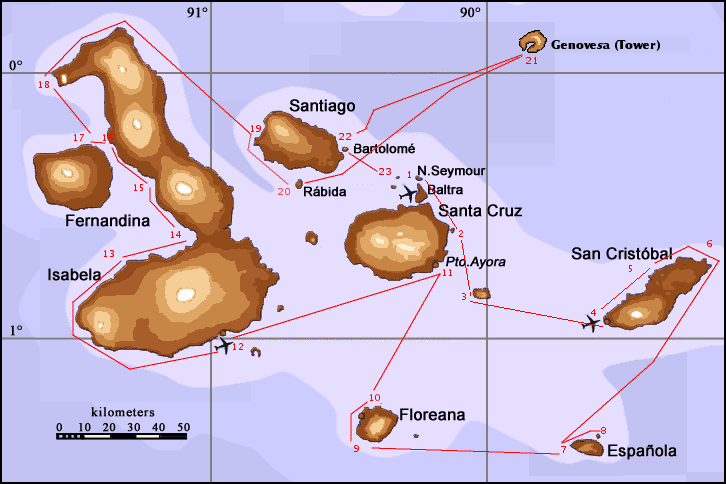
[Graphic: Daphne is the tiny island nearest the "23" on this map of the Galapagos Islands (click to enlarge).

Continued from part #1.]

In 1982 the large ground finch [Geospiza magnirostris] arrived on the tiny Galápagos island of Daphne [As the article says further on, the ancestor of these finches arrives on the Galapagos Islands "about two to three million years ago," so clearly this is not the first time that the large ground finch has arrived on Daphne! Indeed, the same cycle of events has presumably re-occurred at least every ~100 years, in which case it has happened ~200-300 thousand times! In which case, this is not evidence of "evolution" but of stasis, the absence of evolution!], just east of the island of San Salvador (map of the Galápagos).

Since then the medium ground finch [Geospiza fortis], a long-time Daphne resident, has evolved to have a smaller beak - apparently as a result of direct competition with the larger bird for food. [Continuing with the routine Darwinists Fallacy of Equivocation on the word "evolution" (and its cognates). Here again "evolution" (i.e. "evolved") merely means: 2) a minor change in a single characteristic (i.e. beak size) in a species of finch. Note that "evolved" can be both a smaller and a larger average size beak in a particular population. When (not if) the average size of the beaks of the G. fortis population on Daphne island increases again, no doubt there will be triumphant articles announcing that "Finch Beaks Say Darwin Was Right"! Since "evolution" can go in any and all directions, and Darwinism `predicts' all of them, up, Darwin is always `right'!]

Evolutionary theory had previously suggested that competition between two similar species can drive the animals to evolve in different directions. [See previous. And if they did not "evolve in different directions," then no doubt "Evolutionary theory" would have suggested that too!]

But until now the effect had never been observed in action in the wild. [Presumably they mean only for Galapagos finches? But if they are saying that this "character displacement" had "never been observed in action in the wild" in any animal species, then it would show how little Darwinism is supported by empirical evidence.]

In the new study Princeton's Peter and Rosemary Grant closely tracked the two related species for decades. [This also shows how, if a scientific experiment is not supposed to be fully accepted until it has been independently duplicated by other researchers, who are trying to falsify the original experiment, Darwinism falls short. Who is going to track these "two related species for decades" on the Galapagos to see if the Grants were right? Who would even dare to try to falsify research that supported Darwinism? And even if there was someone who was willing to do it and they could obtain funding, if their results contradicted that of the Grants, then it would no doubt be dismissed as "different conditions," etc, etc. Note that this is not saying that the Grants are dishonest, but it is a fundamental principle of science that scientists who want something to be true, unconsciously will notice evidence for it and not notice evidence against it. That is precisely why randomised `blind' experiments that are repeated many times and able to be repeated by others has the highest credibility in science.

As it happens, this very month, Scientific American's resident `skeptic', avowed atheist Darwinist Michael Shermer, has pontificated on about "confirmation bias, whereby we seek and find confirmatory evidence in support of already existing beliefs and ignore or reinterpret disconfirmatory evidence" and bragged about "In science we have built-in self-correcting machinery. Strict double-blind controls are required in experiments, in which neither the subjects nor the experimenters know the experimental conditions during the data-collection phase":

"This surety is called the confirmation bias, whereby we seek and find confirmatory evidence in support of already existing beliefs and ignore or reinterpret disconfirmatory evidence. ... The implications of the findings reach far beyond politics. A jury assessing evidence against a defendant, a CEO evaluating information about a company or a scientist weighing data in favor of a theory will undergo the same cognitive process. What can we do about it? In science we have built-in self-correcting machinery. Strict double-blind controls are required in experiments, in which neither the subjects nor the experimenters know the experimental conditions during the data-collection phase. Results are vetted at professional conferences and in peer-reviewed journals. Research must be replicated in other laboratories unaffiliated with the original researcher. Disconfirmatory evidence, as well as contradictory interpretations of the data, must be included in the paper. Colleagues are rewarded for being skeptical. Extraordinary claims require extraordinary evidence. We need similar controls for the confirmation bias in the arenas of law, business and politics. Judges and lawyers should call one another on the practice of mining data selectively to bolster an argument and warn juries about the confirmation bias. CEOs should assess critically the enthusiastic recommendations of their VPs and demand to see contradictory evidence and alternative evaluations of the same plan. Politicians need a stronger peer-review system that goes beyond the churlish opprobrium of the campaign trail, and I would love to see a political debate in which the candidates were required to make the opposite case. Skepticism is the antidote for the confirmation bias." (Shermer, M., "The Political Brain," Scientific American, July 2006)

So presumably Shermer would agree that Darwinists like the Grants who are sufficiently motivated to spend decades living on and travelling to a tiny island in the middle of the Pacific to measure the beaks of finches, would qualify for a "confirmation bias, whereby" they "seek and find confirmatory evidence in support of already existing beliefs and ignore or reinterpret disconfirmatory evidence"?

If so, then where are the "Strict double-blind controls are required in experiments, in which neither the subjects nor the experimenters know the experimental conditions during the data-collection phase"? Where is the "Research [that] must be replicated in other laboratories unaffiliated with the original researcher"? Where is the "Disconfirmatory evidence, as well as contradictory interpretations of the data, [that] must be included in the paper?

If they are not there, and their being there is a defining quality of "science", then presumably Shermer would agree (if he was consistent) that these experiments, and almost all experiments in evolutionary biology, where "unlike `harder' scientists" evolutionary biologists "usually cannot resolve issues with a simple experiment, such as adding tube A to tube B and noting the color of the mixture":

"In science's pecking order, evolutionary biology lurks somewhere near the bottom, far closer to phrenology than to physics. For evolutionary biology is a historical science, laden with history's inevitable imponderables. We evolutionary biologists cannot generate a Cretaceous Park to observe exactly what killed the dinosaurs; and, unlike `harder' scientists, we usually cannot resolve issues with a simple experiment, such as adding tube A to tube B and noting the color of the mixture." (Coyne, J.A., "The fairy tales of evolutionary psychology." Review of "A Natural History of Rape: Biological Bases of Sexual Coercion," by Randy Thornhill & Craig T. Palmer, MIT Press, 2000. The New Republic, March 4, 2000)

would not qualify as "science"?!

And also, if "Extraordinary claims require extraordinary evidence," then Shermer should agree (but his ultimate "confirmation bias"as an atheist would prevent him from doing so) that Darwinism, "the standard scientific theory" which makes the most "extraordinary claims," including that: 1) "human beings have developed over millions of years from less advanced forms of life," (which I accept); and 2) "but God had no part in this process" (my emphasis):

"In one of the most existentially penetrating statements ever made by a scientist, Richard Dawkins concluded that `the universe we observe has precisely the properties we should expect if there is, at bottom, no design, no purpose, no evil and no good, nothing but blind, pitiless indifference.' Facing such a reality, perhaps we should not be surprised at the results of a 2001 Gallup poll confirming that 45 percent of Americans believe `God created human beings pretty much in their present form at one time within the last 10,000 years or so'; 37 percent prefer a blended belief that `human beings have developed over millions of years from less advanced forms of life, but God guided this process'; and a paltry 12 percent accept the standard scientific theory that `human beings have developed over millions of years from less advanced forms of life, but God had no part in this process.'" (Shermer M.B., "The Gradual Illumination of the Mind," Scientific American, February 2002. My emphasis)

that we are going to need much better evidence than the cyclical variations in the size of finch beaks on the Galapagos, which have presumably been fluctuating back and forth for the last "two to three million years" and going nowhere!]

Continued in part #3.

Stephen E. Jones, BSc (Biol).
`Evolution Quotes Book'

Tuesday, July 18, 2006

"Instant" Evolution Seen in Darwin's Finches, Study Says #1

"Instant" Evolution Seen in Darwin's Finches, Study Says, National Geographic, Mason Inman, July 14, 2006 ... [Graphic: A large ground finch (Geospiza magnirostis) and in inset a medium ground finch (G. Fortis) on Daphne Major island, Galapagos: National Geographic.

Also in ABC/Discovery News, Boston Globe, Chicago Tribune, CNN, LA Times, Livescience & Nature News, as well as the abstract of the original paper in Science . I may comment on those other articles in further post(s), after I finish working through this National Geographic article, if they add something extra of interest.]

Evolution may sometimes happen so fast that it's hard to catch in action, a new study of Galápagos finches suggests. [In both the title and here "evolution" evidently means: 1) the entire process that brought about the origin of finches; birds and all of life. As we shall see, this is another example of how Darwinists employ their fundamental Fallacy of Equivocation on the word "evolution" (and its cognates), i.e. "the deliberate" (or deluded) "confusing of two senses of a term", "in order to maintain [their] political, cultural and intellectual authority":

"Now it is the design theorists' contention that the Darwinian establishment, in order to maintain its political, cultural and intellectual authority, consistently engages in a fallacy of equivocation when it uses the terms creation and evolution. The fallacy of equivocation is the fallacy of speaking out of both sides of your mouth. It is the deliberate confusing of two senses of a term, using the sense that's convenient to promote one's agenda. For instance, when Michael Ruse in one of his defenses of Darwinism writes, `Evolution is a fact, fact, FACT!' [Ruse, M., "Darwinism Defended," Addison-Wesley: Reading MA, 1982, p.58] how is he using the term evolution? Is it a fact that organisms have changed over time? There is plenty of evidence to confirm that organisms have experienced limited change over time. Is it a fact that the full panoply of life has evolved through purposeless naturalistic processes? This might be a fact, but whether it is a fact is very much open to debate.' (Dembski, W.A., "Intelligent Design: The Bridge Between Science and Theology," InterVarsity Press: Downers Grove IL, 1999, p.115. Emphasis original)

As Phillip E. Johnson pointed out, "a single term - `evolution' - is used to designate processes" from "A shift in the relative numbers of dark and light moths in a population" to "the creative process that produced the cell, the multicellular organism, the eye, and the human mind":

"Much confusion results from the fact that a single term- `evolution'-is used to designate processes that may have little or nothing in common. A shift in the relative numbers of dark and light moths in a population is called evolution, and so is the creative process that produced the cell, the multicellular organism, the eye, and the human mind. The semantic implication is that evolution is fundamentally a single process, and Darwinists enthusiastically exploit that implication as a substitute for scientific evidence. Even the separation of evolution into its `micro' and `macro' varieties- which Darwinists generally resist-implies that all the creative processes involved in life comprise a single, two-part phenomenon that will be adequately understood when we discover a process that makes new species from existing ones. Possibly this is the case, but more probably it is not. The vocabulary of Darwinism inherently limits our comprehension of the difficulties by misleadingly covering them with the blanket term `evolution.'" (Johnson, P.E., "Darwin on Trial," [1991], InterVarsity Press: Downers Grove IL, Second edition, 1993, pp.69-70)

Researchers from New Jersey's Princeton University have observed a species of finch in Ecuador's Galápagos Islands that evolved to have a smaller beak within a mere two decades. [And here "evolution" (i.e. "evolved") means 2) a minor change in a single characteristic ( i.e. beak size) in a species of finch.]

... Surprisingly, most of the shift happened within just one generation, the scientists say. [Therefore it cannot be the Darwinian process of favourable allele(s)in a given environment replacing unfavourable allele(s), i.e. for small beak size, in a population. That, by definition requires the finches bearing the unfavourable allele(s) to die without offspring and then the finches bearing the favourable allele(s), i.e. for large beak size to breed up.

In fact, Neo-Darwinist mathematician and geneticist J.B.S. Haldane, in a discovery named "Haldane's Dilemma", found that for "the typical higher vertebrate ... over the long term, the average rate of gene substitution is no better than one gene" i.e. at each locus "every 300 generations" (my emphasis):

"In the 1950s the evolutionary geneticist, J.B.S. Haldane, calculated the maximum rate of genetic change due to differential survival. He reluctantly concluded there is a serious problem here, now known as Haldane's Dilemma. [Haldane, J.B.S., "The Cost of Natural Selection," Journal of Genetics, Vol. 55, pp.511-524] His calculations show that many species of higher vertebrate could not plausibly evolve in the available time. ... Differential survival is required for selective gene substitution, and this causes genetic death. There is no way around it. Some individuals must live, and others must die without heirs. The substitution of a gene incurs some number of deaths. We divide this by the number of survivors who reproductively 'pay' for the genetic deaths, and the ratio is called the cost of substitution. ... Haldane found the cost of gene substitution is reduced if the replacement is slower, over more generations. Thus, the cost is lower if the selection coefficients are smaller. He found the cost is minimized and becomes nearly constant for all selection coefficients less than ten percent (s < 0.1), which is said to cover most evolution. The selection coefficients need not remain constant during gene substitution, but may vary. As long as s is less than 0.1 then the cost is kept constant and at a minimum. ... Haldane estimated that over a variety of circumstances the substitution of a gene incurs an average cost of thirty (Cs = 30). ... Haldane then surveyed the capacity of higher vertebrate species to pay the various costs. He estimated that averaged over the long term these species have a reproductive excess of one tenth (Ps = 0.1). This means the typical higher vertebrate can reproduce an additional one tenth its population size each generation and devote this excess specifically (and with perfect efficiency) to paying the cost of substitution. In summary, the cost of substitution Cs is 30 and it is paid off in installments (Ps) of 0.1 each generation. At that rate it takes (Cs + Ps) 300 generations to pay the cost of substituting one gene. Haldane's conclusion was clear: over the long term, the average rate of gene substitution is no better than one gene every 300 generations. This does not mean these substitutions occur sequentially, one by one. Several genes can undergo substitution simultaneously at various speeds. If you average all these speeds, then the total rate can be one per 300 generations. Over the long term, a faster rate than this is not plausible- the species cannot plausibly pay the cost." (ReMine, W.J., "The Biotic Message: Evolution Versus Message Theory," St. Paul Science: Saint Paul MN, 1993, pp.208, 215-216)

Oxford evolutionary biologist Mark Ridley confirmed that for "the theory of evolution by natural selection ... A mutant that produces on average 1 per cent more offspring than its alternative allele ... would take 4,266 generations to increase in frequency from 0.1 per cent to 99.9 per cent of the population":

"The rate of evolution is easily defined. It is simply the amount of change in a trait divided by the time the change took. ...Rates of evolution could also be used to test the theory of evolution by natural selection. Natural selection takes time. For a mutant to increase in frequency from its initial rare state to become the normal gene in the whole population may take a few thousand generations. The exact amount of time can be calculated from equations first derived by J.B.S. Haldane in 1924; it depends on the gene's initial frequency and its selective advantage. A mutant that produces on average 1 per cent more offspring than its alternative allele, for instance, would take 4,266 generations to increase in frequency from 0.1 per cent to 99.9 per cent of the population. If the selective advantage of a particular change in a particular trait were known, Haldane's equation would predict how fast it should evolve under natural selection. The prediction could in principle be tested. In practice, no strong test of this kind has ever been possible. The evidence is not good enough. Our knowledge of genetics and selective advantages is too weak, let alone the quality of fossil evidence. The selective advantages of most evolutionary changes are probably not much more than a few per cent (and probably much less). We can predict that evolution should never go faster than such a selective advantage would allow. In fact the rates of evolution observed in the fossil record are well below that limit. This provides a test of Darwinism, for evolution could possibly go faster than Darwinism allows, and if it did we should need another theory: the fact that the rates are not too fast is evidence for the Darwinian theory. But the test is imprecise; the range of facts allowed by the theory is very wide. (Ridley, M., "The Problems of Evolution," Oxford University Press: Oxford UK, 1985, pp.121-122)

Darwin himself emphasised that "natural selection is a slow process":

"Lastly, natural selection is a slow process, and the same favourable conditions must long endure in order that any marked effect should thus be produced." (Darwin, C.R., "The Origin of Species By Means of Natural Selection," 1872, Sixth Edition, Senate: London, 1994, p.180)

"Why should not Nature take a sudden leap from structure to structure? On the theory of natural selection, we can clearly understand why she should not; for natural selection acts only by taking advantage of slight successive variations; she can never take a great and sudden leap, but must advance by short and sure, though slow steps." (Darwin, 1872, p.156)

Therefore, I assume that this change is not even Darwinian natural selection of random micromuations, but is in fact an example of "phenotypic plasticity", i.e. "The ability of an organism with a given genotype to change its phenotype in response to changes in the environment":

"Phenotypic plasticity ... The ability of an organism with a given genotype to change its phenotype in response to changes in the environment is called phenotypic plasticity. Such plasticity in some cases expresses as several highly morphologically distinct results; in other cases, a continuous norm of reaction describes the functional interrelationship of a range of environments to a range of phenotypes. Organisms of fixed genotype may differ in the amount of phenotypic plasticity they display when exposed to the same environmental change. Hence phenotypic plasticity can evolve and be adaptive if fitness is increased by changing phenotype. Immobile organisms such as plants have well developed phenotypic plasicity giving a clue to the adaptive significance of phenotypic plasticity. A highly illustrative example of phenotypic plasticity is found in the social insects, colonies of which depend on the division of their members into distinct castes, such as workers and guards. Individuals in separate castes differ dramatically from one another, both physically and behaviorally. However, the differences are not genetic; they arise during development and depend on the manner of treatment of the eggs by the queen and the workers, who manipulate such factors as embryonic diet and incubation temperature. The genome of each individual contains all the instructions needed to develop into any one of several 'morphs', but only the genes that form part of one developmental program are activated." ("Phenotypic plasticity," Wikipedia, 26 May 2006).

But then as Keith Stewart Thomson explained, "not all change is evolution" (despite mere words like "the potential `macroevolutionary significance' of `phenotypic plasticity'"):

"Leaping Lizards? All of this makes one sympathetic with Nicholas Wade of The New York Times, who recently wrote an article entitled `Leapin' Evolution Is Found in Lizards.' This was a report on an experiment in which lizards of the species Anolis sagrei from an island in the Bahamas were released onto an island lacking lizards and with a different vegetation pattern (Losos, Warheit and Schoener 1997) [Losos, J.B., Warheit, K.I. & Schoener, T.W.. Adaptive differentiation following experimental island colonization in Anolis lizards. Nature, Vol. 387, 1997, pp.70-73]. After 10 years, the limb proportions of the experimental population had shifted significantly in the direction predicted on the basis of the new host ecology. Whether the results document a case of evolution depends, of course, on definitions. Certainly it is a form of change over time, and such demonstrations are a necessary requirement for documenting a case of Darwinian evolution caught in flagrante delicto. But it is not sufficient to the case. All evolution is change, but not all change is evolution. Rates of change can be measured, as they were in this experiment; to call them `rates of evolution' as do Losos, Warheit and Schoener begs the most interesting question. I would argue that in order to constitute evidence of true evolution a phenomenon must meet three simple criteria: It must be shown to be genetically based, it must be irreversible, and it should result in reproductive isolation of populations. In other words, the smoking gun of evolution is speciation, not local adaptation and differentiation of populations. ... This exciting new study, rather like the superb observational work of Peter and Rosemary Grant on Galapagos finches and a number of other recent studies, at last gives some thorough quantification in a field in which it has been notably lacking. Whether or not they provide the long-sought smoking gun of evolution, the experiments of Losos, Warheit and Schoener have the potential to explore the mechanism(s) underlying the processes of adaptation. Darwin's use of `natural selection' is normally considered to mean the sorting of genetic- based variation within a particular environmental context. The authors of the paper do not use the term. Nor do they consider the short-term directional change observed in these lizards to be evidence for founder effect or genetic drift. Instead, the authors of this exciting Anolis study present it as a possible demonstration of the potential `macroevolutionary significance' of `phenotypic plasticity.' They argue for the `adaptive importance of nongenetic environmental effects on morphological size and shape of animals.' By this they appear to mean that if Anolis can adapt rapidly to new environments without the introduction of new genetic variation, perhaps the mode of rapid evolution required for punctuated equilibrium is a possibility. This less-than-traditional interpretation owes more to the ideas of Waddington (for example, genetic assimilation) or Schmalhausen than to the classical population genetics of Dobzhansky. The million- dollar question is: What mechanisms lie between the short-term, low-scale and wholly reversible results so far obtained and the origin of a new species? What conditions and mechanisms are required to feed back from a given level of phenotypic plasticity to a new genetic or phenotypic constitution? Stay tuned." (Thomson, K.S., "Natural Selection and Evolution's Smoking Gun," American Scientist, Vol. 85, No. 6, November-December 1997, pp.516-518, p.518)

and if these Darwin's finches, like the Bahamas Anolis lizards, are merely another example of phenotypic plasticity, then it would be: 1) mere "change" but not "evolution;" and 2) yet another best example of Darwinian evolution in action (like the Peppered Moth) that would have to be quietly removed from the textbooks.

But in that case it would be even more embarassing for Darwinists because of the link of these finches (i.e. Darwin's finches!) with Darwin and his theory!]

Continued in part #2.

Stephen E. Jones, BSc (Biol).
`Evolution Quotes Book'

Sunday, July 16, 2006

How man's best friend overcame laws of natural evolution

How man's best friend overcame laws of natural evolution, The Sunday Times - Ireland, July 16, 2006, Jan Battles ...

[Graphic: Only some of the ~350 dog breeds, The Blueberry Basket at Brock Farm, Maine]

A geneticist says he may have solved the mystery of how 350 breeds of dog evolved from a single ancestor, the grey wolf. Matthew Webster of the Smurfit Institute of Genetics at Trinity College, Dublin, and colleagues at Uppsala University, Sweden, say the domestication of dogs may be allowing them to override the natural laws governing evolution. They suggest natural selection, which ensures the survival of the fittest and weeds out genetic mutations that don't provide a survival advantage, was relaxed when dogs became domesticated. Living with people allowed harmful genetic variations to flourish that would never have survived in the wild. This interference with nature could also explain why domestic dogs developed an array of diseases such as cancer, heart disease and epilepsy. "Dogs exhibit more variation in size, appearance and behaviour than any other mammal, but the source of this huge diversity is something of a mystery," said Webster. "Dogs were domesticated from wolves very recently, on an evolutionary timescale, so all the variability seen in different dog breeds today has been generated in a relatively short time." Scientists are still puzzled as to how such a scale of development could have taken place in a relatively short evolutionary timescale of 15,000 years. ... "Living with humans means harmful mutations can still survive in dogs that wouldn't have been able to breed in the wild. Wolves ... would be less likely to survive if they had these mutations," he said. "It is possible that changes in lifestyle caused by dog domestication have allowed mutations to accumulate across the entire dog genome, contributing to the huge differences in appearance in today's dogs. This could also explain why so many diseases affect modern breeds, a consequence of the weaker natural selection. A lot of dog breeds now wouldn't survive if they weren't living with humans." His findings are published in Genome Research. ... [Darwin appealed to "man's power of accumulative selection", mentioning especially "the many breeds of dogs" as evidence that "the principle of selection, which we have seen is so potent in the hands of man, appl[ies] under nature":

"Let us now briefly consider the steps by which domestic races have been produced, either from one or from several allied species. Some effect may be attributed to the direct and definite action of the external conditions of life, and some to habit; but he would be a bold man who would account by such agencies for the differences between a dray- and race-horse, a greyhound and bloodhound, a carrier and tumbler pigeon. One of the most remarkable features in our domesticated races is that we see in them adaptation, not indeed to the animal's or plant's own good, but to man's use or fancy. ... when we compare the dray horse and race horse, the dromedary and camel, the various breeds of sheep fitted either for cultivated land or mountain pasture, with the wool of one breed good for one purpose, and that of another breed for another purpose; when we compare the many breeds of dogs, each good for man in different ways ... we must, I think, look further than to mere variability. We cannot suppose that all the breeds were suddenly produced as perfect and as useful as we now see them; indeed, in many cases, we know that this has not been their history. The key is man's power of accumulative selection: nature gives successive variations; man adds them up in certain directions useful to him. In this sense he may be said to have made for himself useful breeds. ... Can the principle of selection, which we have seen is so potent in the hands of man, apply under nature? I think we shall see that it can act most efficiently." (Darwin, C.R., "The Origin of Species By Means of Natural Selection," Sixth Edition, 1872, Senate: London, 1994, pp.22, 62)

Dawkins likewise cited "the change that man has wrought in a much shorter time by genetic selection of dogs," in "a few hundreds, or at most thousands, of years" as the same process of "real natural evolution" extrapolated over "several hundred million years" in order to explain "how ... our type of eye ... evolve[d] its present complexity and perfection from nothing":

"Eyes don't fossilize, so we don't know how long our type of eye took to evolve its present complexity and perfection from nothing, but the time available is several hundred million years. Think, by way of comparison, of the change that man has wrought in a much shorter time by genetic selection of dogs. In a few hundreds, or at most thousands, of years we have gone from wolf to Pekinese, Bulldog, Chihuahua and Saint Bernard. Ah, but they are still dogs aren't they? They haven't turned into a different 'kind' of animal? Yes, if it comforts you to play with words like that, you can call them all dogs. But just think about the time involved. Let's represent the total time it took to evolve all these breeds of dog from a wolf, by one ordinary walking pace. Then, on the same scale, how far would you have to walk, in order to get back to Lucy and her kind, the earliest human fossils that unequivocally walked upright? The answer is about 2 miles. And how far would you have to walk, in order to get back to the start of evolution on Earth? The answer is that you would have to slog it out all the way from London to Baghdad. Think of the total quantity of change involved in going from wolf to Chihuahua, and then multiply it up by the number of walking paces between London and Baghdad. This will give some intuitive idea of the amount of change that we can expect in real natural evolution." (Dawkins R., "The Blind Watchmaker," W.W Norton & Co: New York NY, 1986, p.40. Emphasis original)

But this article is saying that it was the absence of natural selection, i.e. "natural selection, which ensures the survival of the fittest and weeds out genetic mutations that don't provide a survival advantage, was relaxed when dogs became domesticated" (my emphasis) that has been the true cause of the variability in dogs. That is, all that the breeders did was, as Crick noted (like Darwin and Dawkins without realising its significance), was to preserve "the freaks of nature" thrown up when natural selection was relaxed:"

"If you doubt the power of natural selection I urge you, to save your soul, to read Dawkins's book. I think you will find it a revelation. Dawkins gives a nice argument to show how far the process of evolution can go in the time available to it. He points out that man, by selection, has produced an enormous variety of types of dog, such as Pekinese, bulldogs, and so on, in the space of only a few thousand years. Here `man' is the important factor in the environment, and it is his peculiar tastes that have produced (by selective breeding, not by `design') the freaks of nature we see preserved all around us as domestic dogs, yet the time required to do this, on the evolutionary scale of hundreds of millions of years, is extraordinarily short. So we should not be surprised at the ever greater variety of creatures that natural-selection has produced on this much larger time scale." (Crick, F.H.C., "What Mad Pursuit: A Personal View of Scientific Discovery," [1988], Penguin: London, 1990, reprint, p.29)

That is, the evidence of selective breeding is, that "natural selection" merely has a conservative role! It is mutations in the absence of natural selection that allowed the various breeds of dogs and other domestic animals and plants to appear and survive.

The analogy from selective breeding therefore is that it was not natural selection that created the eye (or indeed any of life's complex designs): it was mutations in the absence of natural selection that created them. And if undirected mutations could not plausibly create life's complex designs (I agree with Darwinists on that point), then that leaves directed mutations as the sole remaining cause!

As Sherlock Holmes observed, "when you have eliminated the impossible, whatever remains, however improbable, must be the truth":

"`How came he, then?' I reiterated. `The door is locked, the window is inaccessible. Was it through the chimney?' The grate is much too small,' he answered. `I had already considered that possibility.' `How then?' I persisted. `You will not apply my precept,' he said, shaking his head. `How often have I said to you that when you have eliminated the impossible, whatever remains, however improbable, must be the truth? We know that he did not come through the door, the window, or the chimney. We also know that he could not have been concealed in the room, as there is no concealment possible. Whence, then, did he come?' `He came through the hole in the roof,' I cried. `Of course he did. He must have done so. If you will have the kindness to hold the lamp for me, we shall now extend our researches to the room above, - the secret room in which the treasure was found.'" (Doyle, A.C., "The Sign of Four," Penguin: London, 2001, pp.42-43. Emphasis original).

Stephen E. Jones, BSc (Biol).
`Evolution Quotes Book'

Saturday, July 15, 2006

Cook, P., "Evolution versus Intelligent Design" (New Holland, 2006) #1

I recently bought a new book by a Peter Cook, "Evolution versus Intelligent Design: Why all the Fuss?" (New Holland Publishers: Sydney NSW, Australia, 2006). I have only been able to find the book online at New Holland Publishers.

The author (who I had not heard of and cannot find on the Web) is described on the back cover as having "a BA in Religious Studies and a PhD in Philosophy from the University of Sydney" and "has taught logic and argument as well as publishing articles on contemporary European philosophy and philosophy of language." I have skimmed through the book (it is only ~128 half-sized pages) and I can see there are many things that I disagree with (including much that is simply irrelevant to ID)!

However, an advantage in working through the book is that eventually I would then have covered many of the issues for and against ID and evolution (or rather Darwinism).

Which is my first point that the title already sets up a Fallacy of False Dilemma. ID is not necessarily opposed to "evolution." In fact Mike Behe, a leader of the ID movement has described his position as "evolution occurred, but was guided by God":

"[Eugenie] Scott refers to me as an intelligent design `creationist,' even though I clearly write in my book `Darwin's Black Box' (which Scott cites) that I am not a creationist and have no reason to doubt common descent. In fact, my own views fit quite comfortably with the 40% of scientists that Scott acknowledges think `evolution occurred, but was guided by God.' Where I and others run afoul of Scott and the National Center for Science Education (NCSE) is simply in arguing that intelligent design in biology is not invisible, it is empirically detectable. The biological literature is replete with statements like David DeRosier's in the journal `Cell': `More so than other motors, the flagellum resembles a machine designed by a human' [DeRosier, D.J., "The Turn of the Screw: The Bacterial Flagellar Motor," Cell, Vol. 93, 1998, p.17]. Exactly why is it a thought-crime to make the case that such observations may be on to something objectively correct?" (Behe M.J., "Intelligent Design Is Not Creationism," Science, dEbate, 7 July 2000)

And Bill Demsbki another ID leader has stated that "intelligent design is compatible with ... the most far-ranging evolution":

"Where does intelligent design fit within the creation-evolution debate? Logically, intelligent design is compatible with everything from utterly discontinuous creation (e.g., God intervening at every conceivable point to create new species) to the most far-ranging evolution (e.g., God seamlessly melding all organisms together into one great tree of life). For intelligent design the primary question is not how organisms came to be (though, as we've just seen, this is a vital question for intelligent design) but whether organisms demonstrate clear, empirically detectable marks of being intelligently caused. In principle an evolutionary process can exhibit such `marks of intelligence' as much as any act of special creation." (Dembski W.A., "Intelligent Design: The Bridge Between Science and Theology," InterVarsity Press: Downers Grove IL, 1999, pp.109-110)

What ID is opposed to is any "evolution" that denies design (e.g. Darwinian evolution, or Darwinism). So the book should have been titled, "Darwinian Evolution [or Darwinism] versus Intelligent Design."

Now to the book itself. Its Introduction (p.7) says:

"If you ... are ... interested in the debate about the teaching of evolution and intelligent design ... the internet can provide you with a seemingly limitless supply of reading materials on the topic. All of this literature, however, is written by someone who wants to convince you of their point of view. Be they a clergyman or a biologist, the author will set out arguments in favour of their own view, and present their opponents' arguments in ways often intended to make them look foolish. That is not the approach taken here. "

This is the second thing I disagree with, after the title. I have no brief to defend the "evolution" side, but it is simply not true for Cook to claim, or imply, that IDists "present their opponents' arguments in ways often intended to make them look foolish" (my emphasis). And then to claim, or imply, that he is the exception. In fact, as we shall see, Cook (either though ignorance or deliberately) does not present IDist arguments fairly, although to his credit he is fairer than the average ID critic.

Cook continues:

"This book aims to present both sides of the argument about evolution and intelligent design without bias, in order that you, the reader, can formulate your own view. " (p.7)

I remember when I was doing a philosophy of science unit for my biology degree and our lecturer (a former nuclear physicist) wisely observed that everyone is biased on issues that are important to them, and the best that can be done is to be aware of, and declare upfront, our respective biases, so that our listeners or readers can take those biases into account when evaluating our arguments.

She was not specifically talking about evolution or intelligent design, but I am sure that she would agree that no one is "without bias" on those topics. It is a defect that Cook he does not declare upfront what his position is on "evolution" and "intelligent design."

"Both theories are explained in detail, the arguments for each viewpoint are presented as strongly as they can be, and where possible these arguments are put side by side for easy comparison." (p.7)

This is a commendable aim, but it is unrealistic. Cook does not present ID's "arguments ... as strongly as they can be" (to put it mildly!), although he might sincerely think he is. It is evident (as we shall see) that he is not neutral with respect to ID (although he may be trying to be). It would have been better if Cook had invited a Darwinist and an IDist to present their positions on either side of each issue, rather than one person (like Cook) thinking he can present both positions neutrally and fairly.

"The final chapter is titled `Where to stand?' but it does not advocate a particular position on the debate. Rather, it simply explores the positions available for you, the reader, to take." (p.7)

If I do eventually work my way through the book, as one who has been a member of the ID movement since 1994, the "reader" of the book who finds my webbed comments, will have a true ID position to chose between.

[To be continued in part #2]

Stephen E. Jones, BSc (Biol).
`Evolution Quotes Book'

Monday, July 10, 2006

Behe's "Darwin's Black Box, 10th Anniversary Edition" #2

Continued from part #1 with my comments on Mike Behe's new Afterword chapter in his Darwin's Black Box 10th Anniversary Edition (2006).

[Graphic: Professor Michael J. Behe, Lehigh University]

A major part of Behe's Afterword deals - not surprisingly, since it is his major contribution to the General Theory of Intelligent Design - with a defence of his Theory of Irreducible Complexity (IC):

"Ten years ago I used the phrase `irreducible complexity' (IC) to shine a spotlight on a large and then-substantially-unappreciated problem for Darwinian evolution-like a mousetrap, almost all of the elegant molecular machinery of the cell needs multiple parts to work. Because of the need for many parts, it is extraordinarily difficult to rigorously envision how systems such as the cilium, [bacterial] flagellum, or blood clotting cascade could have arisen from simpler systems by the `numerous, successive, slight modifications' imagined by Charles Darwin. I define irreducible complexity on page 39-'a single system which is composed of several well-matched, interacting parts that contribute to the basic function, and where the removal of any one of the parts causes the system to effectively cease functioning.' Now, I am a scientist-I'm no philosopher. The purpose of the definition was to highlight the empirical difficulty for Darwinian gradualism posed by complex interactive systems in a real biological context, not to play word games. Nonetheless, some rejoinders to Darwin's Black Box have sought to sweep the evolutionary problem for natural selection under the rug by picking at the phrase `irreducible complexity,' or by subtly altering its definition." (Behe, M.J., "Darwin's Black Box: The Biochemical Challenge to Evolution," [1996], Free Press: New York NY, 10th Anniversary Edition, 2006, p.257).

Nothing demonstrates the intellectual bankruptcy of Darwinism better (or worse) than their routine defence of their theory by substituting a straw man, i.e. "a rhetorical technique based on misrepresentation of an opponent's position":

"A straw man argument is a rhetorical technique based on misrepresentation of an opponent's position. To `set up a straw man' or `set up a straw-man argument' is to create a position that is easy to refute, then attribute that position to the opponent. A straw-man argument can be a successful rhetorical technique (that is, it may succeed in persuading people) but it is in fact misleading, since the argument actually presented by the opponent has not been refuted." ("Straw man," Wikipedia, 2006).

Rather than refute Behe's actual Irreducible Complexity argument, as Behe shows, the Darwinists set up their own caricature of IC and then refute that! Of course, in doing so they: 1) delude themselves (because they have only refuted their own "misrepresentation of an opponent's position"); and 2) show that they cannot refute Behe's actual Irreducible Complexity evidence and argument (because if they could, they would have - after ten years)!

Behe's first case in point is Darwinist philosopher Robert T. Pennock:

"In 1999 the philosopher of science Robert Pennock argued in Tower of Babel that irreducible complexity was no problem for Darwinism. As philosophers will do, he focused not on the science, but on the definition, or at least what he construed as the definition:
`[E]ven if a system is irreducibly complex with respect to one defined basic function, this in no way implies that nearby variations might not serve other nearby functions. Behe claims that there could never be any functional intermediates that natural selection could have selected for on the way to any irreducibly complex system, but he can't get the empirical conclusion from his "by definition" conceptual argument. The strong empirical premise he needs is false' [Pennock, R., "Tower of Babel: The Evidence Against the New Creationism," MIT Press, Cambridge, Massachusetts, 1999, pp.267-268.]
Pennock, however, simply substituted his own concept of irreducible complexity for mine. (my emphasis) I never wrote that `there could never be any functional intermediates that natural selection could have selected for on the way to any irreducibly complex system.' Those are Pennock's words. On the contrary, on page 40, I point out that, although irreducible complexity does rule out direct routes, it does not automatically rule out indirect ones. I did go on to argue that indirect routes seem very unlikely, and that the more complex the system the more unlikely indirect routes become. But I did not assert that indirect routes were logically impossible, as he implies. That would be silly. No scientific evidence can show that something is logically impossible, since logical impossibility is concerned. only with self-contradictory statements (like `he's a married bachelor') rather than with nature (like `DNA is usually a double helix'). For example, geocentrism isn't logically impossible-it's just wrong. No scientific theory has ever had to, or ever could, rule out rival explanations by showing them to be logically impossible, and neither must intelligent design. Scientific theories succeed simply by explaining the data better than rival theories." (Behe, 2006, pp.257-258. Emphasis original).

Pennock here tries a common Darwinist tactic (pioneered by Darwin himself) of reversing the burden of proof on to the opponent by making out that Behe is claiming that there are no "functional intermediates." Then all the Darwinist needs to do is point to some example (including imaginary) of same and he has won the argument under those terms.

But what Darwinists need to do is demonstrate that the claimed irreducibly complex system was in fact "formed by numerous, successive, slight modifications" (my emphasis) which is what their theory is:

"If it could be demonstrated that any complex organ existed, which could not possibly have been formed by numerous, successive, slight modifications, my theory would absolutely break down." (Darwin, C.R., "The Origin of Species," 1872, Sixth Edition, Senate: London, 1994, p.146)

Or as Darwin put it even more clearly in his posthumously published "big species book" Natural Selection (from which he abstracted his Origin of Species), "could have been formed by the accumulation, through natural selection, of infinitesimally slight variations, each useful to its possessor" (my emphasis):

"What shall we say of the eye? Is it conceivable that this transcendant organ with its power of adjusting its focus to different distances & of letting in more or less light, - with its nearly perfect correction for chromatic & spherical aberration, could have been formed by the accumulation, through natural selection, of infinitesimally slight variations, each useful to its possessor. I confess that no language at first seems too strong to condemn the absurdity of such a notion." (Darwin, C.R., in Stauffer, R.C., ed., "Charles Darwin's Natural Selection: Being the Second Part of His Big Species Book Written From 1856 to 1858," [1975], Cambridge University Press: Cambridge UK, 1987, reprint, p.359).

As Bill Dembski responded to Theistic Evolutionist Howard Van Till's citing the Darwinist claim that the type III secretory system as a precursor to the bacterial flagellum, "What's needed is a complete evolutionary path" (my emphasis), i.e. a series of "infinitesimally slight variations, each useful to its possessor," "and not merely a possible oasis along the way," otherwise that would be "like saying we can travel by foot from Los Angeles to Tokyo because we've discovered the Hawaiian Islands":

"In line with the previous concern, Van Till offers the type III secretory system as a possible precursor to the bacterial flagellum. This ignores that the current evidence points to the type III system as evolving from the flagellum and not vice versa (cf. Milt Saier's recent work at UCSD). But beyond that, finding a component of a functional system that performs some other function is hardly an argument for the original system evolving from that other system. One might just as well say that because the motor in a motorcycle can be used as a blender, therefore the motor evolved into the motorcycle. Perhaps, but not without intelligent design. Even if it could be shown that the type III system predated the flagellum (contrary to Milt Saier's work), it could at best represent one possible step in the indirect Darwinian evolution of the bacterial flagellum. But that still wouldn't constitute a solution to the evolution of the bacterial flagellum. What's needed is a complete evolutionary path and not merely a possible oasis along the way. To claim otherwise is like saying we can travel by foot from Los Angeles to Tokyo because we've discovered the Hawaiian Islands. Evolutionary biology needs to do better than that." (Dembski, W.A., "Naturalism's Argument from Invincible Ignorance: A Response to Howard Van Till," Design Inference Website, September 2002).

[To be continued in part #3]

Stephen E. Jones, BSc (Biol).
`Evolution Quotes Book'
Sunday, July 09, 2006

Pulled down by gravity: Fine acting fails to liberate The Life of Galileo

Pulled down by gravity: Fine acting fails to liberate The Life of Galileo, The Sunday Times, July 09, 2006, Christopher Hart ... But the play is riven with weaknesses. This version is by David Hare, who claims The Life of Galileo isn't "a simple-minded attack on the Catholic church". Unfortunately, however, that is exactly how it comes across: an oppressively schematic depiction of the reactionary, medieval Catholic church, BAD, against the noble, heroic individual scientist, GOOD, with a lack of subtlety or shading that would embarrass Richard Dawkins. [While I doubt that Richard Dawkins would be embarrassed by any excuse to attack Christianity, irrespective whether it was true or not, it is good to see that the media is getting beyond what Phil Johnson calls their "`Bash Creationism' macro" where "They start with Galileo, move on to the Scopes trial, and go through the whole religion-versus-science routine":

"Early press reports tended to say that Kansas had banned evolution from the classroom, had stripped all references to evolution from its curriculum guidelines, and so on. Some reporters thought the school board was bringing creation science and the Bible into the science curriculum. This was all a misunderstanding, which stemmed, in part, from two things. One is that the earliest reports came before the decision was actually announced, and they were clearly from news sources on the science educators' drafting committee. That committee had given the board a strongly pro-evolution draft. Members of the committee were vociferously angry about the action the board had decided on, and they exaggerated the story of the atrocity that was about to be committed. The second source of misunderstanding, I think, is that this was the kind of story that reporters generally treat with a template. They start with Galileo, move on to the Scopes trial, and go through the whole religion-versus-science routine. I think some of them hit the `Bash Creationism' macro on the word processor. Many of the news reports and editorials could almost have been written by the same person. The Kansas school board did not eliminate all references to evolution. In the revised guidelines it accepted there were almost four hundred words on the subject, compared to fewer than a hundred in the previous guidelines ...." (Johnson P.E., "Evolution and the Curriculum: A Conversation with Phillip Johnson and Gregg Easterbrook," Ethics and Public Policy Center, February 2000, No. 4)

As a Protestant, I have no brief for the Roman Catholic church, but as Christian scholar, the late Charles E. Hummel, pointed out, "Galileo's condemnation by-the Catholic church" was not an example of "Christianity's hostility to free inquiry and to scientific progress". In fact, "The real authoritarianism that engineered Galileo's downfall was that of the Aristotelian scientific outlook in the universities" (my emphasis):

"Over the centuries Galileo's condemnation by-the Catholic church has loomed large in controversies between science and religion. His trial has been held up as the prime example of Christianity's hostility to free inquiry and to scientific progress. For example, one biography of Galileo concludes with this assessment:
Galileo does stand as a classic example of the evils of a totalitarian regime. He was persecuted and prosecuted by men who ... were afraid of the power of independent thought. Galileo queried the Scriptures, he made his own interpretation, and so cut right across the religious authority of the Church.... All they could see was a man who could disrupt their system, and they took the one course they could: they stifled the dissension at its source.' [Ronan, C.A., "Galileo," G. P. Putnam's Sons: New York, 1974, p.253]
But was the conflict so clear-cut? Whose system did Galileo set out to disrupt, the religious authority of Rome or the scientific authority of Aristotle? How did an academic conflict originating within the university become a theological issue for the church? And what forces of power politics-ambition, envy, prejudice, rancor, special interests - propelled the conflict to its disturbing conclusion? ... Galileo's trial of 1633 was not the simple conflict between science and religion so commonly pictured. It was a complex power struggle of personal and professional pride, envy and ambition, affected by pressures of bureaucratic politics. The deliberations seemed to take on a life of their own, moving toward an inevitable conclusion with elements of a Greek tragedy. ... one should be wary of accepting the traditional interpretation of the trial, exemplified by Colin Ronan's conclusion:
Galileo does stand as a classic example of the evils of a totalitarian regime.... [He] cut right across the religious authority of the Church.... It was essentially Galileo's danger to an authoritarian outlook that caused his downfall ." [Ronan, 1974, p.213]
... Ronan's conclusion is a curious mixture of truth and error. He is close to the truth when he calls Galileo the victim of an authoritarian outlook. The problem is that he points the guilty finger in the wrong direction. To call the Catholic Church in the Italy of that time (a collection of independent states) a totalitarian regime is an anachronism. The Pope hardly had the power of a modern dictator. For example, if Galileo had stayed in the Republic of Venice, which had recently expelled the Jesuits for political intrigue, he would have been safe. The real authoritarianism that engineered Galileo's downfall was that of the Aristotelian scientific outlook in the universities. Only after Galileo had attacked that establishment for decades did his enemies turn their controversy into a theological issue. Even then it was the natural philosophers who worked behind the scenes with pliable church authorities to foment Galileo's trial, and finally to rob him of the reasonable solution worked out by the Inquisition. ... A more accurate assessment is given by Santillana: `In reality it was a confused free-for-all in which prejudice, inveterate rancor, and all sorts of special and corporate interests were prime movers.... It has been known for a long time that a major part of the church intellectuals were on the side of Galileo, while the clearest opposition to him came from secular ideas.... The tragedy was the result of a plot of which the hierarchies themselves turned out to be the victims no less than Galileo-an intrigue engineered by a group of obscure and disparate characters in strange collusion. [de Santillana, G., "The Crime of Galileo," University of Chicago Press: Chicago IL, 1955, pp.xii-xiii]" (Hummel, C.E., "The Galileo Connection: Resolving Conflicts between Science & the Bible," Intervarsity Press: Downers Grove IL, 1986, pp.13, 116, 122-123)

Moreover, as this London Sunday Times article notes, "there's a huge, clanging irony at the heart of" this play and that is, the "Inquisition is reckoned to have executed about 3,000 people in three-and-a-half centuries" (which "is 3,000 too many"), but it is "hardly a death toll to match that of some 20th century communist" i.e. atheist "regimes":

And there's a huge, clanging irony at the heart of it that Hare rather curiously avoids. The wicked Inquisition is reckoned to have executed about 3,000 people in three-and-a-half centuries. This is 3,000 too many, but hardly a death toll to match that of some 20th century communist regimes that Brecht himself so admired. Brecht's Inquisition, banning books, enforcing a rigid ideology, persecuting and sometimes executing dissidents, reminds you precisely of the eastern bloc, 1945-89, which Brecht insisted he found so congenial, living in Soviet-occupied East Berlin for the last decade of his life. But no such teasing connections are made. When Brecht/Hare have Galileo sneering at the free market, you know this is no longer a properly imagined character you're listening to. ...

That is, over 90 million of its own citizens killed by atheist governments in Russia, China, Cambodia, Africa, Eastern Europe, and Latin America, in the `enlightened' 20th century:

"Communism did kill, Courtois and his fellow historians demonstrate, with ruthless efficiency: 25 million in Russia during the Bolshevik and Stalinist eras, perhaps 65 million in China under the eyes of Mao Zedong, 2 million in Cambodia, millions more Africa, Eastern Europe, and Latin America--an astonishingly high toll of victims. This freely expressed penchant for homicide, Courtois maintains, was no accident, but an integral trait of a philosophy, and a practical politics, that promised to erase class distinctions by erasing classes and the living humans that populated them. Courtois and his contributors document Communism's crimes in numbing detail, moving from country to country, revolution to revolution. The figures they offer will likely provoke argument, if not among cliometricians then among the ideologically inclined. So, too, will Courtois's suggestion that those who hold Lenin, Trotsky, and Ho Chi Minh in anything other than contempt are dupes, witting or not, of a murderous school of thought--one that, while in retreat around the world, still has many adherents. A thought-provoking work of history and social criticism, The Black Book of Communism fully merits the broadest possible readership and discussion." (McNamee, G., Editorial review of "The Black Book of Communism: Crimes, Terror, Repression," by Stephane Courtois, Harvard University Press, 1999. Amazon.com)

The Roman Catholic Church has apologised for "the trial of Galileo" and the "Inquisition" (amongst other things), but I have yet to hear an atheist apologise for the far, far greater sins of atheism!

Stephen E. Jones, BSc (Biol).
`Evolution Quotes Book'

Wednesday, July 05, 2006

V4 also debuts Automated Intelligent Design Technology ...

ID knows it has made it when it appears in sophisticated software (albeit for sewer design!) product descriptions [Graphic: MWH Soft Infosewer]:

MWH Soft releases new version of InfoSewer

MWH Soft announced the worldwide availability of the V4 Generation of InfoSewer for power ArcGIS users. This latest version introduces valuable user-driven enhancements and functionalities, along with architectural and database improvements that make sophisticated sewer systems analysis and design applications fast and easy to use.

V4 also debuts Automated Intelligent Design Technology, which for the first time puts expert-level, high performance techniques in the hands of every user that enable automation of the most challenging wastewater collection systems design, expansion and rehabilitation activities. These enhancements equip wastewater utilities with unprecedented power to improve system management, operation and regulatory compliance. ... (my emphasis)

Seriously, the absorption of "intelligent design" into mainstream terminology (especially design and engineering) is very important (although they could hardly describe such products as only "apparently designed by `blind watchmaker' evolution"!).

Which reminds me of this variation of the three stages of acceptance of a new scientific idea, reputedly by Agassiz, and cited approvingly by Von Baer and Gould (although in ID's case the second stage is "that it is ... religion!):

"In another article written in 1866 to criticize a brave new world that often forgot, and more frequently disparaged, the discoveries of previous generations, von Baer made a rueful comment that deserves enshrinement as one of the great aphorisms in the history of science. Invoking Agassiz, his younger friend and boon companion in rejecting the new theory of mechanistic evolution, von Baer wrote:`Agassiz says that when a new doctrine is presented, it must go through three stages. First, people say that it isn't true, then that it is against religion, and in the third stage, that it has long been known.' (Author's translation)." (Gould, S.J., "Abscheulich! - Atrocious! - the precursor to the theory of natural selection," Natural History, Vol. 109, No. 2, March 2000, pp.42-49)

It sounds like ID is now entering into the third stage of "it has long been known"!

Stephen E. Jones, BSc (Biol).
`Evolution Quotes Book'

Tuesday, July 04, 2006

Behe's "Darwin's Black Box, 10th Anniversary Edition" #1

I bought Mike Behe's "Darwin's Black Box, 10th Anniversary Edition" the other day, just for the new 18-page Afterword chapter (I already have the original 1996 edition). I wasn't disappointed! Here are some key quotes from the Afterword with my comments.

[Graphic: "Darwin's Black Box, 10th Anniversary Edition," Stephen E. Jones]

Behe begins by considering that while "it might seem a trifle premature to declare victory (my emphasis)," the fact is that despite "denunciations issuing almost weekly," from the science-media establishment "a decade after the publication of Darwin's Black Box the scientific argument for design is stronger than ever ... the book's argument for design stands":

"Today, with fresh denunciations issuing almost weekly from scientific societies and newspaper editorial boardrooms alike, it might seem a trifle premature to declare victory. Yet, although the cultural dynamic is still playing itself out, a decade after the publication of Darwin's Black Box the scientific argument for design is stronger than ever. Despite the enormous progress of biochemistry in the intervening years, despite hundreds of probing commentaries in periodicals as diverse as The New York Times, Nature, Christianity Today, Philosophy of Science, and Chronicle of Higher Education, despite implacable opposition from some scientists at the highest levels, the book's argument for design stands. Other than updating the list of my children in the Acknowledgements (append Dominic, Helen, and Gerard), there is very little of the original text I would change if I wrote it today." (Behe, M.J., "Darwin's Black Box: The Biochemical Challenge to Evolution," [1996], Free Press: New York NY, 10th Anniversary Edition, 2006, p.255)

This is all the more astonishing when it is considered that, as Behe points out, "For modern science, ten years is an eon" (my emphasis) and the decade from the mid-1990s was no exception, with rapid "progress in understanding how the machinery of life works" including "the cilia and flagella" (which Behe gave as examples of irreducible complexity), and "The mechanisms cells use to construct" these are now "known to be stunningly sophisticated molecular systems themselves, like automated factories that make outboard motors," with the result that "the case for the intelligent design of life becomes exponentially stronger":

"For modern science, ten years is an eon. As an analogy, think of how the Internet has developed. In the mid 1990s e-mail was clumsy and the Web was a shadow of what it has become. In the same time interval, by some measures biochemistry has advanced as much as the Internet. A little over a decade ago the very first genome sequence of a free living organism-a tiny bacterium named Haemophilus influenzae-had just been published. ... Now hundreds of genomes have been sequenced ... Progress in elucidating genomes has been matched by progress in understanding how the machinery of life works. ... The mechanisms cells use to construct the cilia and flagella described in Chapter 4 were almost totally obscure when this book was first written. Today they're known to be stunningly sophisticated molecular systems themselves, like automated factories that make outboard motors. In short, as science advances relentlessly, the molecular foundation of life is not getting any less complex than it seemed a decade ago; it is getting exponentially more complex. As it does, the case for the intelligent design of life becomes exponentially stronger." (Behe, 2006, p.256).

Only the other day it occurred to me that the often quoted phrase "from so simple a beginning" (indeed the title of a box of Darwin's books) at the conclusion of Darwin's Origin of Species:

"There is grandeur in this view of life, with its several powers, having been originally breathed into a few forms or into one; and that, whilst this planet has gone cycling on according to the fixed law of gravity, from so simple a beginning endless forms most beautiful and most wonderful have been, and are being, evolved." (Darwin, C.R., "The Origin of Species by Means of Natural Selection," [1859], Penguin: London, First Edition, 1985, reprint, pp.459-460)

is what Darwinism expected (and indeed is based on) that life at the basic molecular level was "simple" and so was its "beginning."

But as Behe notes at near the end of his Afterword chapter, "In Darwin's day, the cell was thought to be so simple that first-rate scientists ... could seriously think that it might arise spontaneously from sea mud" (and even gave it a name, Bathybius haeckeli), which Behe adds, "would be quite congenial to Darwinism." But in fact it is "the astonishing complexity of the cell" that the advance of science (my emphasis) has revealed that has made "the idea of intelligent design ... more and more compelling"!:

"The future prospects for design are excellent, because they rest not on any person's or group's preferences, but on the data. The rise of the intelligent design hypothesis is not due to anything I or any other individual has written or said, but to the great advance of science in understanding life. In Darwin's day, the cell was thought to be so simple that first-rate scientists such as Thomas Huxley and Ernst Haeckel could seriously think that it might arise spontaneously from sea mud, which would be quite congenial to Darwinism. Even just fifty years ago it was a lot easier to believe that Darwinian evolution might explain the foundation of life, because so much less was known. But as science quickly advanced and the astonishing complexity of the cell became clear, the idea of intelligent design has become more and more compelling. The conclusion of intelligent design is strengthened by each new example of elegant, complex molecular machinery or system that science discovers at the foundation of life. In 1996 that elegance already could be clearly seen, and in the past ten years it has greatly increased. There is no reason to expect it to level off any time soon." (Behe, 2006, p.270).

Indeed, it is that "beginning" of life which, as journalist Pamela R. Winnick notes, is now "because not in spite of science" (her emphasis) "cracking the very foundations of atheism" and has begun its "collapse"!:

"FOR THE CELEBRITY scientists who relied on their science to promote their often astonishing views of life, there was an elephant in the living room. It was right there in front of them for all to see. It was menacing, allpowerful, able to pounce at any moment and trample on the carefully constructed nihilism of the scientificphilosophers. `If I were a creationist,' wrote John Horgan of Scientific American, `I would cease attacking the theory of evolution ... and focus instead on the origin of life.' [Horgan, J., "The End of Science," [1996], Little, Brown & Co: London, 1997, reprint, p.138] Life's origins, how it all came into being, was central to both religion and science. Religion took it on faith that God created life, while science took it on faith that life came into being through a purely materialistic process in which inorganic molecules somehow evolved into life. Often scientists would ignore or trivialize the enigma of life's origins, claiming that answer would be `simple' once it was found. Many, however, tried to hide the fact that science couldn't figure out life's beginnings; they couldn't just wave the white flag and admit like fumbling fools on the witness stand that the answer was beyond the grasp of science. ... Scientists had a reason to be defensive. Anyone who looked at them closely could see that when it came to the metaphysics of existence, they were sinking fast in the quicksand. In laboratories all over the country, they had tried again and again to solve the mystery of life, to discover a process that turns non-life into life. The distance between the two is not a simple step like water to ice; it is a distance beyond human comprehension. `Between a living cell and the most highly ordered non-biological system, there is a chasm as vast and absolute as it is possible to conceive,' [Denton, M.J., "Evolution: A Theory in Crisis," Burnett Books: London, 1985, pp.249-250] Australian biochemist Michael Denton wrote in Evolution: A Theory in Crisis, a seminal work, highly criticized, that in the 1990s would inspire a group of other scientists to reexamine the premises of Darwinism. Even bacteria, among the most simple forms of life, wrote Denton, `are exceedingly complex objects.' [Denton, 1985, p.250] `The simplest bacterium is so damn complicated from the point of view of a chemist that it is almost impossible to imagine how it happened,' said Harold P. Klein, chairman of a committee formed by the National Academy of Sciences to investigate origin-of-life research [Horgan, J., "In The Beginning...," Scientific American, Vol. 264, No. 2, February 1991, pp.100-109, p.104]. ... To British astronomer Fred Hoyle, the origin of life was about as probable as a tornado creating a 747 as it whirled through a junkyard-in other words, so unlikely as to be impossible. [Hoyle, F., "The Intelligent Universe," Michael Joseph: London, 1983, pp.18-19] But the ultra-reductionists had an answer in the ready, the same answer they gave to every other troublesome issue raised by evolution: given enough time, they argued, `anything is possible:' But that was it. The sum and substance of their science was itself based on religious faith.And so the answer proved so elusive, the scientific guesses so unsatisfactory, that the great pillars of atheism began to collapse. One wonders exactly what Richard Dawkins must have thought when a compatriot and one-time Oxford colleague made his public turnabout, cracking the very foundations of atheism. In 2004, philosopher Antony Flew-one of the world's most committed atheists-captured the international limelight with an astonishing announcement: that because not in spite of science, he was no longer an atheist. In his video `Has Science Discovered God?' Flew said that the investigation of DNA `has shown, by the almost unbelievable complexity of the arrangements which are needed to produce life, that intelligence must have been involved' [Ostling, R.N., "Atheist Philosopher, 81, Now Believes in God," LiveScience/Associated Press, 10 December 2004] Quite a betrayal from a man who for more than fifty years had taught at universities around the world and in lectures, books, and articles that atheism was the only explanation for life." (Winnick, P.R., "A Jealous God: Science's Crusade Against Religion," Nelson Current: Nashville TN, 2005, pp.168-170, 172. Emphasis original)

[Continued in part #2]

Stephen E. Jones, BSc (Biol).
`Evolution Quotes Book'

Sunday, July 02, 2006

Where does Cyrenius fit into your harmonization of the Matthew & Luke nativity stories? #4


AN

----- Original Message -----
From: AN
To: Stephen E. Jones
Sent: Tuesday, June 27, 2006 7:25 PM
Subject: Cyrenius

>Dear Mr Jones,
>
>Where does he [Cyrenius] fit into your harmonization of the Matthew & Luke nativity stories?
>
>AN

[Continued from part #3]

Finally, to now answer the original question, "Where does he [Cyrenius] fit into your harmonization of the Matthew & Luke nativity stories?"

The only points that I can see where there could have been a problem in relation to "Cyrenius" (i.e. Quirinius) is to do with Jesus being born in the reign of "King Herod", i.e. Herod the Great (73-4BC), i.e. before Herod died in 4BC:

"Herod ... known as Herod the Great born 73 BC died March/April, 4 BC, Jericho, Judaea Roman-appointed king of Judaea (37–4 BC). A practicing Jew, he was of Arab origin. He was critical to imperial control of Judaea, despite his earlier support of Mark Antony, and the Roman emperor increased his territory. Judaea prospered under his early reign, during which he increased trade and built fortresses, aqueducts, and theatres, but he could not give full rein to his desire to build and thrive because he feared the Pharisees, Judaism's controlling faction, who viewed him as a foreigner. He lost favour through increasing cruelty, manifest in the murder of his wife, her sons, and other relatives. His grip on his kingdom weakened as he became increasingly mentally unstable and physically debilitated. He killed his eldest son, and he slew the infants of Bethlehem (see Jesus). He died shortly after a bungled suicide attempt. " ("Herod," Encyclopædia Britannica Online)

That is, in points 1, 2 and 28 of my "A Harmony of the Nativity Accounts in the Gospels of Matthew & Luke":

"1. Joseph and his pregnant wife Mary (Lk 2:5), went from Nazareth to Bethlehem (Lk 2:4), his ancestral town (Lk 2:3-4), in order to register for a Roman census (Lk 2:1-3). ...

2. A son, later named Jesus (Lk 2:21; Mt 1:25), was born to Mary in Bethlehem (Lk 2:4-7; Mt 2:1), in a stable: "she... placed him in a manger, because there was no room for them in the inn" (Lk 2:7). ...

"28. After Joseph and family had been living in Egypt for only short time, Herod having died (in 4BC), an angel again appeared in a dream to Joseph (Mt 2:19), telling him to "take the child and his mother and go to the land of Israel, for those who were trying to take the child's life are dead." (Mt 2:20). ..."

But as I said in part #1, "... he [Cyrenius] fits in just fine!" That is because (as I said in part #3) Jesus was born between 7 and 4 BC:

"The data summarized in the preceding paragraphs (¶¶463-467) are capable of being incorporated in three different chronological schemes of the life of Jesus (Tables 142-144). Of the three the first makes it possible to take Lk 3:23 in the most exact sense of the words `about thirty' (¶419) , and to take Jn 2:20 in what may be the most natural sense of these words as counting forty-six years from the time when Herod began the rebuilding of the Temple in 19/18 B.C. (¶434). The second scheme fits the Synoptic requirement of one year and some months for the duration of the ministry (¶¶437-438) , but is insufficient for the requirements of the Fourth Gospel which, unless its materials are critically rearranged (¶440) , supposes a longer ministry (¶441) . The third scheme, again, allows for the longer ministry but makes it necessary to take `about thirty' (Lk 3:23) with considerable latitude (¶425), and to take Jn 2:20 as counting forty-six years after the priests completed the temple edifice proper (¶435), an interpretation which is possible but perhaps not quite as natural as that which counts from Herod's inauguration of the entire project in the nineteenth year of his reign (¶434) . All together it appears that some preference may be given to the first chronological scheme of the life of Jesus. If the birth of Jesus should be placed earlier, say in 7/6 B.C. (¶¶388, 389), rather than in 5/4 B.C. (¶463), the foregoing schemes (Tables 142, 143, 144) could still hold as far as the public ministry is concerned, only the phrase "about thirty" would have to be taken with more latitude (¶427) " (Finegan, J., "Handbook of Biblical Chronology," Princeton University Press: Princeton NJ, 1964, p.468)

with 5-4 BC being considered the most likely by chronologists Finegan (Ibid., p.248) and Hoehner:

"Conclusion. Having considered some of these chronological notes, it seems the evidence would lead one to conclude that Christ's birth occurred sometime in late 5 B.C. or early 4 B.C. ... Finegan (p. 248) comes to the same date though he uses some different data." (Hoehner, H.W., "Chronological Aspects of the Life of Christ," [1975], Zondervan: Grand Rapids MI, 1981, Fifth Printing, p.25. Emphasis original)

which I agree with.

As already posted in part #1, #2 and #3 there were two censuses, which Luke in fact indicates (Luke 2:2 & Acts 5:37) the first between 7-4 BC and the second between 6-7 AD, and Cyrenius (i.e. Quirinius) apparently oversaw both.

In concluding, I point out that if Luke was a fraud or myth-maker, there was no reason for him to mention all this checkable detail, unless it was true! If Luke was a fraud, he could just have said that Mary and Joseph went to Bethlehem to fulfill the prophecy in Micah 5:2:

"But you, Bethlehem Ephrathah, though you are small among the clans of Judah, out of you will come for me one who will be ruler over Israel, whose origins are from of old, from ancient times. "

that the Messiah was to be born there, as Matthew in fact does in in his account (Mat 2:1-6):

"1After Jesus was born in Bethlehem in Judea, during the time of King Herod, Magi from the east came to Jerusalem 2and asked, `Where is the one who has been born king of the Jews? We saw his star in the east and have come to worship him.' 3When King Herod heard this he was disturbed, and all Jerusalem with him. 4When he had called together all the people's chief priests and teachers of the law, he asked them where the Christ [Messiah] was to be born. 5'In Bethlehem in Judea,' they replied, `for this is what the prophet has written: 6' 'But you, Bethlehem, in the land of Judah, are by no means least among the rulers of Judah; for out of you will come a ruler who will be the shepherd of my people Israel.'[Micah 5:2]"

As I pointed out in my Harmony: "This harmony of the nativity accounts in the gospels of Matthew and Luke has that `truth is stranger than fiction' complex quality of real life that would be unlikely to have been concocted" and "far from being a problem, the two nativity accounts of Matthew 2 and Luke 2 present a composite picture that has a `three-dimensional' quality of real, historical truth"!

Stephen E. Jones, BSc (Biol).
`Evolution Quotes Book