Saturday, September 09, 2006

Dobzhansky was a religious man, although he ... rejected ... the existence of a personal God

Every now and then a Darwinist will trot out the geneticist Theodosius Dobzhansky (1900-1975) , co-founder of the Neo-Darwinian modern synthesis, as an example of how `religion' (or `faith') and evolution are not incompatible.

[Graphic: Theodosius Dobzhansky, Wikipedia]

The latest (thanks to Denyse O'Leary for alerting me of this) is a letter in Nature ("Dogma, not faith, is the barrier to scientific enquiry," Nature, Vol. 443, 7 September 2006, p.26) by a German evolutionary biologist, Prof. Dr. Ulrich Kutschera, who claims that: 1) "famous evolutionists such as Dobzhansky were firm believers in a personal God"; and therefore 2) "Christians and atheists can cooperate to develop scientific theories, as long as religious dogma is not mixed up with facts and experimental data"; which the latter 3. "Unfortunately ... is exactly what young-Earth creationists and intelligent-design theorists are doing":

"In his book The Language of God (Free Press, 2006), [Francis] Collins discusses the ideas of Theodosius Dobzhansky, a darwinist and the main architect of the modern synthetic theory of biological evolution. In a famous article, "Nothing in biology makes sense except in the light of evolution" (Am. Biol. Teach. 35, 125-129; 1973), Dobzhansky described his religious beliefs: "It is wrong to hold creation and evolution as mutually exclusive alternatives. I am a creationist and an evolutionist. Evolution is God's, or Nature's, method of Creation." In contrast to modern creationists, Dobzhansky accepted macroevolution and the documented age of Earth. He argued that "the Creator has created the living world not by caprice (supernatural fiat) but by evolution propelled by natural selection". He collaborated for many years with Ernst Mayr, who, when asked about his religious views, replied: "I am an atheist. There is nothing that supports the idea of a personal God. On the other hand, famous evolutionists such as Dobzhansky were firm believers in a personal God. He would work as a scientist all week and then on Sunday get down on his knees and pray to God" (Skeptic 8, 76-82; 2000). In about 1950, Dobzhansky and Mayr founded our modern 'atheistic' evolutionary theory. Their work showed that Christians and atheists can cooperate to develop scientific theories, as long as religious dogma is not mixed up with facts and experimental data. Unfortunately, this is exactly what young-Earth creationists and intelligent-design theorists are doing. They should read the 1973 essay in which Dobzhansky - an open-minded, non-dogmatic theist - thoroughly refuted their irrational claims. "

1) Note that Prof. Kutschera says "famous evolutionists" (plural) and then cites only one who has been dead for over a quarter-century! Where are the current "famous evolutionists" who are "firm believers in a personal God"? The fact is that Larson and Witham surveyed members of the USA National Academy of Sciences and found that over 90 percent were atheist/agnostics, with biologists being "the most skeptical, with 95 percent ... evincing atheism and agnosticism":

"Disbelief [in a personal God] among NAS members responding to our survey exceeded 90 percent. The increase may simply reflect that they are more elite than Leuba's `greater' scientists, but this interpretation would also please Leuba. NAS biologists are the most skeptical, with 95 percent of our respondents evincing atheism and agnosticism." (Larson, E.J. & Witham, L., "Scientists and Religion in America," Scientific American, Vol. 281, No. 3, September 1999, pp.78-83, p.80)

I don't know where Mayr got his idea that "Dobzhansky" was a "firm believer... in a personal God" and that "He would work as a scientist all week and then on Sunday get down on his knees and pray to God." According to Dobzhansky's former student, fellow geneticist (and former Jesuit priest) Francisco Ayala, in what was originally a eulogy following Dobzhansky death, "Dobzhansky was a religious man" as long as one does not count his rejection of "fundamental beliefs of traditional religion, such as the existence of a personal God and of life beyond physical death":

"Dobzhansky was a religious man, although he apparently rejected fundamental beliefs of traditional religion, such as the existence of a personal God and of life beyond physical death. His religiosity was grounded on the conviction that there is meaning in the universe. He saw that meaning in the fact that evolution has produced the stupendous diversity of the living world and has progressed from primitive forms of life to mankind. Dobzhansky held that, in man, biological evolution has transcended itself into the realm of self-awareness and culture. He believed that somehow mankind would eventually evolve into higher levels of harmony and creativity. He was a metaphysical optimist." (Ayala, F.J. & Fitch, W.M., "Genetics and the origin of species: An introduction," Proceedings of the National Academy of Sciences USA, Vol. 94, July 1997, pp.7691-7697, p.7693).

As Phillip E. Johnson, responding to one of Stephen Jay Gould's "skilful manipulation of definitions" in his claim that "Dobzhansky" was "the greatest evolutionist of our century and a lifelong Russian Orthodox," pointed out, "Dobzhansky made a religion out of evolution," he "was what we would today call a New Age pantheist" and "Of course evolution is not incompatible with religion when the religion is evolution" (my emphasis):

"The organizations that speak officially for science continue to deny that there is a conflict between Darwinism and `religion.' This denial is another example of the skilful manipulation of definitions, because there are evolution-based religions that embrace naturalism with enthusiasm. Stephen Jay Gould holds up the geneticist Theodosius Dobzhansky, `the greatest evolutionist of our century and a lifelong Russian Orthodox,' [Gould, S.J., "Darwinism Defined: The Difference Between Fact and Theory," Discover, January 1987, pp.64-70, p.65] as proof that evolution and religion are compatible. The example is instructive, because Dobzhansky made a religion out of evolution. According to a eulogy by Francisco Ayala, 'Dobzhansky was a religious man, although he apparently rejected fundamental beliefs of traditional religion, such as the existence of God and of life beyond physical death. His religiosity was grounded on the conviction that there is meaning in the universe. He saw that meaning in the fact that evolution has produced the stupendous diversity of the living world and has progressed from primitive forms of life to mankind ... He believed that somehow mankind would eventually evolve into higher levels of harmony and creativity.' [Ayala, F.J., "Nothing in biology makes sense except the light of evolution," The Journal of Heredity, Vol. 68, January-February 1977, pp.3, 9] In short, Dobzhansky was what we would today call a New Age pantheist. Of course evolution is not incompatible with religion when the religion is evolution." (Johnson, P.E. "Evolution as Dogma: The Establishment of Naturalism,," [First Things, October 1990], Foundation for Thought and Ethics: Richardson TX, 1990, p.11)

Johnson repeated the above on at least two other occasions (Johnson, P.E., "Response to Gould," Origins Research, Access Research Network, Vol. 15, No. 1, Spring/Summer 1993, pp.10-11; and Johnson, P.E., "Darwinism and Theism", in Buell J. & Hearn V., eds., "Darwinism: Science or Philosophy?," Foundation for Thought and Ethics: Richardson TX, 1994, pp.43-44) and I know for a fact that he was never contradicted by anyone (including Mayr) with the claim that "Dobzhansky" was a "firm believer... in a personal God" and that "He would ... on Sunday get down on his knees and pray to God."

Indeed, it is evident in some of the very words of Dobzhansky that Prof. Kutschera quotes, "Evolution is God's, or Nature's, method of Creation," that for Dobzhansky, "Nature" was "God," which is pantheism. But pantheism is a just another form of atheism in that it denies the existence of a personal God.

2) Prof. Kutschera says that "Christians and atheists can cooperate to develop scientific theories, as long as religious dogma is not mixed up with facts and experimental data (my emphasis)." But if Christianity is true (which it is), then apart from atheism being false, so would the twin philosophical foundations of evolution, Materialism (matter is all there is) and Naturalism (nature is all there is) be false. Then it would be clear that it was science and evolution which were based on "religious dogma," namely that "God had no part in this process":

"Facing such a reality, perhaps we should not be surprised at the results of a 2001 Gallup poll confirming that 45 percent of Americans believe `God created human beings pretty much in their present form at one time within the last 10,000 years or so'; 37 percent prefer a blended belief that `human beings have developed over millions of years from less advanced forms of life, but God guided this process'; and a paltry 12 percent accept the standard scientific theory that `human beings have developed over millions of years from less advanced forms of life, but God had no part in this process.'" (Shermer, M.B., "The Gradual Illumination of the Mind," Scientific American, February 2002. My emphasis)

Now it is actually possible that both Christianity could be true (which it is) and "human beings have developed over millions of years from less advanced forms of life, but God had no part in this process," if God had pre-programmed ("front-loaded") humans into the Big Bang and left the rest to natural processes. But then that would be something that would have to be established on the basis of the evidence, not just assumed to be so in order to be compatible with then false materialistic-naturalistic philosophy.

3. Prof. Kutschera's "Unfortunately, this is exactly what young-Earth creationists and intelligent-design theorists are doing" assumes that the "facts and experimental data" would never point to God having supernaturally intervened in life's history (otherwise he would be proposing that science should always prefer a materialistic-naturalistic falsehood, to a creationist truth).

But in fact leading former atheist philosopher Antony Flew came to precisely that view (that God had supernaturally intervened in the origin of life), based on the scientific evidence alone (Ostling, R.N., "Atheist Philosopher, 81, Now Believes in God," Livescience, 10 December 2004).

Stephen E. Jones, BSc (Biol)
Genesis 1:9. And God said, "Let the water under the sky be gathered to one place, and let dry ground appear." And it was so.

Friday, September 08, 2006

Benedict's evolving thought on evolution #1

Benedict's evolving thought on evolution, The National Catholic Reporter, September 8, 2006, John L. Allen Jr.

[Graphic: Profile: Pope Benedict XVI: "Cardinal Ratzinger is known for his uncompromising stance," BBC]

Presumably, Pope Benedict XVI asked his Schülerkreis, the circle of his former doctoral students, to discuss "Creation and Evolution" during the group's annual meeting this month at Castel Gandolfo, Italy, because he wants to consult theologians, philosophers and natural scientists before addressing the subject -- if, indeed, he feels the need to say anything, a point which remains to be seen. [This interesting article is, however, based on a false premise: that Pope Benedict has the realistic option of doing nothing (or even little) about the tide (or tsunami) of scientific materialism- naturalism engulfing his church.

But Benedict is no fool and surely realises that his predecessor Pope John Paul II's 1996 statement that "new knowledge has led to the recognition of the theory of evolution as more than a hypothesis" (Pope John Paul II, "Truth Cannot Contradict Truth," Address to the Pontifical Academy of Sciences, October 22, 1996) has been taken by the scientific materialists (like the late Stephen Jay Gould) to be a capitulation by the Roman Catholic Church to "evolution" as "not merely ... a plausible possibility, but also as an effectively proven fact":

"In the context of this `standard' position, I was enormously puzzled by a statement issued by Pope John Paul II on October 22, 1996, to the Pontifical Academy of Sciences ... In this document, titled `Truth Cannot Contradict Truth,' the Pope defended both the evidence for evolution and the consistency of the theory with Catholic religious doctrine. ... I knew that Pope Plus XII ... had made the primary statement in a 1950 encyclical entitled Humani Generis. I knew the main thrust of his message: Catholics could believe whatever science determined about the evolution of the human body, so long as they accepted that, at some time of his choosing, God had infused the soul into such a creature. ... John Paul begins by summarizing Pius's older encyclical of 1950 ... The novelty and news value of John Paul's statement lies, rather, in his profound revision of Pius's second and rarely quoted claim that evolution, while conceivable in principle and reconcilable with religion, can cite little persuasive evidence in support, and may well be false. John Paul states ... that evolution can no longer be doubted by people of goodwill and keen intellect ... `Today, almost half a century after the publication of the encyclical, new knowledge has led to the recognition of the theory of evolution as more than a hypothesis.' ... In conclusion, Pius had grudgingly admitted evolution as a legitimate hypothesis that he regarded as only tentatively supported and potentially (as he clearly hoped) untrue. John Paul, nearly fifty years later, reaffirms the legitimacy of evolution under the NOMA principle-no news here-but then adds that additional data and theory have placed the factuality of evolution beyond reasonable doubt. Sincere Christians must now accept evolution not merely as a plausible possibility, but also as an effectively proven fact. In other words, official Catholic opinion on evolution has moved from `say it ain't so, but we can deal with it if we have to' (Pius's grudging view of 1950) to John Paul's entirely welcoming `it has been proven true; we always celebrate nature's factuality, and we look forward to interesting discussions of theological implications.' [Gould's words not the Popes']" (Gould, S.J., "Non-Overlapping Magisteria," in "Leonardo's Mountain of Clams and the Diet of Worms: Essays on Natural History", [1998], Vintage: London, 1999, reprint, pp.271-273, 278-280)

But then "evolution" to scientific materialists like Gould means fully naturalistic "evolution," that is "... the standard scientific theory that `human beings have developed over millions of years from less advanced forms of life, but God had no part in this process.'" (Shermer, M.B., "The Gradual Illumination of the Mind," Scientific American, February 2002. My emphasis).

Therefore Phillip E. Johnson (and I) regards Gould's focusing on Pope John Paul II's "recognition of the theory of evolution as more than a hypothesis," while ignoring "the Pope's crucial qualification that `theories of evolution which, in accordance with the philosophies inspiring them, consider the spirit as emerging from the forces of living matter or as a mere epiphenomenon of this matter, are incompatible with the truth about man,'" as an example of Gould's "unscrupulousness" and his "essay is a tissue of half-truths aimed at putting the religious people to sleep, or luring them into a `dialogue' on terms set by the materialists":

"Gould displays both his talent and his unscrupulousness in an essay in the March 1997 issue of Natural History, entitled `Nonoverlapping Magisteria' and subtitled `Science and religion are not in conflict, for their teachings occupy distinctly different domains.' With a subtitle like that, you can be sure that Gould is out to reassure the public that evolution leads to no alarming conclusions. True to form, Gould insists that the only dissenters from evolution are `Protestant fundamentalists who believe that every word of the Bible must be literally true.' Gould also insists that evolution (he never defines the word) is `both true and entirely compatible with Christian belief.' ... The centerpiece of Gould's essay is an analysis of the complete text of Pope John Paul's statement of October 22, 1996 to the Pontifical Academy of Sciences endorsing evolution as `more than a hypothesis.' He fails to quote the Pope's crucial qualification that `theories of evolution which, in accordance with the philosophies inspiring them, consider the spirit as emerging from the forces of living matter or as a mere epiphenomenon of this matter, are incompatible with the truth about man.' Of course, a theory based on materialism assumes by definition that there is no `spirit' active in this world that is independent of matter. ... Gould's essay is a tissue of half-truths aimed at putting the religious people to sleep, or luring them into a `dialogue' on terms set by the materialists. ... Gould insists, however, that all such discussion must cede to science the power to determine the facts, and one of the facts is an evolutionary process that is every bit as materialistic and purposeless for Gould as it is for Lewontin or Dawkins. If religion wants to accept a dialogue on those terms, that's fine with Gould-but don't let those religious people think they get to make an independent judgment about the evidence that supposedly supports the `facts.' And if the religious people are gullible enough to accept materialism as one of the facts, they won't be capable of causing much trouble." (Johnson P.E., "The Unraveling of Scientific Materialism," First Things, No. 77, November 1997, pp.22-25)

But the point is, unless Pope Benedict more forcefully emphasises that materialistic-naturalistic evolution is (including theistic naturalistic evolution) which denies apriori design and God's supernatural intervention in life's history, is incompatible with Roman Catholicism, the atheistic Darwinists outside the church (and the theistic Darwinists within) it will just keep ignoring John Paul II's qualifications and keep claiming that he declared that "evolution" was "a fact."

Johnson (referring to Jesus' saying in Mat. 6:24 that, "No one can serve two masters. Either he will hate the one and love the other, or he will be devoted to the one and despise the other"), points out that when the mind tries to serve the two masters of naturalism and theism, "naturalism in the end will be the true master and theism will have to abide by its dictates":

"Scientific naturalism, on the other hand, does leave a place for `religious belief,' provided that the religious believers do not challenge the authority of naturalistic science to say what is real and what is not. ... blurring the issues a little to save a place for theistic religion in a naturalistic intellectual culture may seem like a sound strategy. Of course, I do not agree with that strategy. I do not think that the mind can serve two masters, and I am confident that whenever the attempt is made, naturalism in the end will be the true master and theism will have to abide by its dictates." (Johnson, P.E., "Darwin on Trial," InterVarsity Press: Downers Grove IL, Second Edition, 1993, p.169)

I am sure that Pope Benedict is well aware of this too, and that unless he deals decisively and soon with the the cancer of naturalism within his church, there may not be a Roman Catholic church in the not-too-distant future.

If that sounds too far-fetched, consider that the "Anglican Church of Canada, one of the country's largest and oldest denominations" (and I expect other Protestant denominations which have been taken over secular ideologies and ideologists) is "facing extinction by the middle of this century":

"The Anglican Church of Canada, one of the country's largest and oldest denominations, is in precipitous decline losing 13,000 members each year and facing extinction by the middle of this century, says a new report prepared for prepared for the church's bishops."(Foot, R., "Anglican ranks on road to extinction, grim report finds," CanWest News Service, December 01, 2005)

To be continued in part #2.

Stephen E. Jones, BSc (Biol)
Genesis 1:8. God called the expanse "sky." And there was evening, and there was morning-the second day.

Tuesday, September 05, 2006

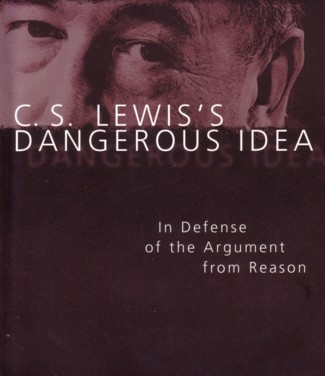
C.S. Lewis' argument from reason

Today I found two other variations of C.S. Lewis' "argument from reason", the term used for (given by?) Christian philosopher Victor Reppert for:

"C.S. Lewis's argument, found in his book Miracles that naturalism is self-refuting because it is inconsistent with the validity of reasoning." (Reppert, V.E., "C.S. Lewis's Dangerous Idea: A Philosophical Defense of Lewis's Argument from Reason," InterVarsity Press: Downers Grove IL, 2003, p.11)

First, here is a quote of Lewis' main argument (which I already knew about)

[Graphic: Amazon.com]

that not only does "materialism" (i.e. matter is all there is) "refute... itself" but so does "Naturalism" (i.e. nature is all there is) because "It discredits our processes of reasoning or at least reduces their credit to such a humble level that it can no longer support Naturalism itself":

"A theory which explained everything else in the whole universe but which made it impossible to believe that our thinking was valid, would be utterly out of court. For that theory would itself have been reached by thinking, and if thinking is not valid that theory would, of course, be itself demolished. It would have destroyed its own credentials. It would be an argument which proved that no argument was sound-a proof that there are no such things as proofs-which is nonsense. Thus a strict materialism refutes itself for the reason given long ago by Professor Haldane: `If my mental processes are determined wholly by the motions of atoms in my brain, I have no reason to suppose that my beliefs are true ... and hence I have no reason for supposing my brain to be composed of atoms.'" [Haldane, J.B.S., "Possible Worlds," Chatto & Windus: London, 1927, p.209] But Naturalism, even if it is not purely materialistic, seems to me to involve the same difficulty, though in a somewhat less obvious form. It discredits our processes of reasoning or at least reduces their credit to such a humble level that it can no longer support Naturalism itself." (Lewis, C.S., "Miracles: A Preliminary Study," [1947], Fontana: London, Second edition, 1963, reprint, pp.18-19. Ellipses Lewis')

Here are the two other variations of Lewis' argument from reason that I discovered (or rediscovered?) today.

If the mind is in the final analysis nothing but the brain (as both Materialism and Naturalism claim), then "to talk of one bit of matter as being true about another bit of matter" is "nonsense":

"It therefore follows that all knowledge whatever depends on the validity of inference. If, in principle, the feeling of certainty we have when we say `Because A is B therefore C must be D' is an illusion, if it reveals only how our cortex has to work and not how realities external to us must really be, then we can know nothing whatever. ... This admission seems to me completely unavoidable and it has very momentous consequences. In the first place it rules out any materialistic account of thinking. We are compelled to admit between the thoughts of a terrestrial astronomer and the behaviour of matter' several light-years away that particular relation which we call truth. But this relation has no meaning at all if we try to make it exist between the matter of the star and the astronomer's brain, considered as a lump of matter. The brain may be in all sorts of relations to the star no doubt: it is in a spatial relation, and a time relation, and a quantitative relation. But to talk of one bit of matter as being true about another bit of matter seems to me to be nonsense." (Lewis, C.S., "De Futilitate," in "Christian Reflections," [1967], Hooper, W., ed., Fount: Glasgow UK, Fourth Impression, 1988, pp.86-88)

And if the "mind is a product of the irrational" (which materialistic-naturalistic evolution claims it is) then "how shall I trust my mind when it tells me about Evolution?":

"What makes it impossible that it should be true is not so much the lack of evidence for this or that scene in the drama as the fatal self-contradiction which runs right through it. The Myth [of Evolution] cannot even get going without accepting a good deal from the real sciences. And the real sciences cannot be accepted for a moment unless rational inferences are valid: for every science claims to be a series of inferences from observed facts. It is only by such inferences that you can reach your nebulae and protoplasm and dinosaurs and sub-men and cave-men at all. Unless you start by believing that reality in the remotest space and the remotest time rigidly obeys the laws of logic, you can have no ground for believing in any astronomy, any biology, any palaeontology, any archaeology. To reach the positions held by the real scientists- which are then taken over by the Myth-you must, in fact, treat reason as an absolute. But at the same time the Myth asks me to believe that reason is simply the unforeseen and unintended by-product of a mindless process at one stage of its endless and aimless becoming. The content of the Myth thus knocks from under me the only ground on which I could possibly believe the Myth to be true. If my own mind is a product of the irrational - if what seem my clearest reasonings are only the way in which a creature conditioned as I am is bound to feel- how shall I trust my mind when it tells me about Evolution? They say in effect: 'I will prove that what you call a proof is only the result of mental habits which result from heredity which results from bio-chemistry which results from physics.' But this is the same as saying: 'I will prove that proofs are irrational': more succinctly, 'I will prove that there are no proofs': The fact that some people of scientific education cannot by any effort be taught to see the difficulty, confirms one's suspicion that we here touch a radical disease in their whole style of thought. But the man who does see it, is compelled to reject as mythical the cosmology in which most of us were brought up. That it has embedded in it many true particulars I do not doubt: but in its entirety, it simply will not do. Whatever the real universe may turn out to be like, it can't be like that." (Lewis, C.S., "The Funeral of a Great Myth," in "Christian Reflections," [1967], Hooper, W., ed., Fount: Glasgow UK, Fourth Impression, 1988, pp.117-118)

In other words (and here is another quote, this one by another Christian philosopher James. W. Sire), the only way for evolution to be true (i.e. free of Darwin's "horrid doubt") is that our minds had been put together under the direction of an Intelligent Designer!:

"Charles Darwin himself once said, `The horrid doubt always arises whether the convictions of man's mind, which has developed from the mind of the lower animals, are of any value or at all trustworthy. Would anyone trust the conviction of a monkey's mind, if there are any convictions in such a mind?' [Darwin, C.R., Letter to W. Graham, July 3rd, 1881, in Darwin, F., ed., "The Life and Letters of Charles Darwin," [1898], Basic Books: New York NY, Vol. I., 1959, reprint, p.285] In other words, if my brain is no more than that of a superior monkey, I cannot even be sure that my own theory of my origin is to be trusted. Here is a curious case: If Darwin's naturalism is true, there is no way of even establishing its credibility let alone proving it. Confidence in logic is ruled out. Darwin's own theory of human origins must therefore be accepted by an act of faith. One must hold that a brain, a device that came to be through natural selection and chance-sponsored mutations, can actually know a proposition or set of propositions to be true. C.S. Lewis puts the case this way: `If all that exists is Nature, the great mindless interlocking event, if our own deepest convictions are merely the by-products of an irrational process, then clearly there is not the slightest ground for supposing that our sense of fitness and our consequent faith in uniformity tell us anything about a reality external to ourselves.Our convictions are simply a fact about us-like the colour of our hair. If Naturalism is true we have no reason to trust our conviction that Nature is uniform. [Lewis, C.S., "Miracles: A Preliminary Study," [1947], Fontana: London, 1960, Revised Edition, 1963, reprint, p.109] What we need for such certainty is the existence of some `Rational Spirit' outside both ourselves and nature from which our own rationality could derive. Theism assumes such a ground; naturalism does not." (Sire, J.W., "The Universe Next Door: A Basic World View Catalog," [1976], InterVarsity Press: Downers Grove IL, Second Edition, 1988, pp.94-95. Emphasis original)

As Lewis says above, "The fact that some people of scientific education cannot by any effort be taught to see the difficulty, confirms one's suspicion that we here touch a radical disease in their whole style of thought"!

Stephen E. Jones, BSc (Biol).
Genesis 1:7. So God made the expanse and separated the water under the expanse from the water above it. And it was so.

Monday, September 04, 2006

Pope, former students ponder evolution

Pope, former students ponder evolution, The Australian, Tom Heneghan in Paris, September 04, 2006.

[Graphic: Father Joseph Fessio SJ, PBS]

POPE Benedict and his former doctoral students spent a weekend pondering evolution without discussing controversies over intelligent design and creationism raging in the United States, a participant said. [I would have been surprised if they did, "discuss... controversies over intelligent design and creationism raging in the United States." Why would they? But three days of Pope Benedict and his 39 (see below) former doctoral students "pondering evolution" is itself highly significant.]

The three-day closed-door meeting at the papal summer residence of Castel Gandolfo outside Rome ended as planned without drawing any conclusions but the group plans to publish its discussion papers, said Father Joseph Fessio. These will be very interesting. But I would not be surprised if Pope Benedict, or more likely Cardinal Christoph Schönborn, make interim public statements which sum up the consensus of the discussions.

This American Father Joseph Fessio, the founder of Ignatius Press (which has published at least one ID work, "Science and Evidence For Design in the Universe," by ID theorists Michael Behe, William Dembski and Stephen Meyer), is probably someone to watch for the future on this issue.]

Media speculation had said the debate might shift Vatican policy to embrace "intelligent design," which claims to prove scientifically that life could not have simply evolved, or even the "creationist" view that God created the world in six days. "It wasn't that at all," Fr Fessio, who is provost of Ave Maria University in Florida, said. As I indicated in my previous post on this, I personally don't expect the Pope to come out in support of ID directly. Rather I expect he will move Roman Catholic policy further away from materialistic theories of evolution like Darwinism and nearer towards theories of evolution that are compatible with design, such as Michael Behe's, "evolution occurred, but was guided by God":

"[Eugenie] Scott refers to me as an intelligent design `creationist,' even though I clearly write in my book `Darwin's Black Box' (which Scott cites) that I am not a creationist and have no reason to doubt common descent. In fact, my own views fit quite comfortably with the 40% of scientists that Scott acknowledges think `evolution occurred, but was guided by God.' Where I and others run afoul of Scott and the National Center for Science Education (NCSE) is simply in arguing that intelligent design in biology is not invisible, it is empirically detectable. The biological literature is replete with statements like David DeRosier's in the journal `Cell': `More so than other motors, the flagellum resembles a machine designed by a human' [DeRosier, D.J., "The Turn of the Screw: The
Bacterial Flagellar Motor
," Cell, Vol. 93, 1998, p.17]. Exactly why is it a thought-crime to make the case that such observations may be on to something objectively correct?" (Behe, M.J., "Intelligent Design Is Not Creationism," Science, dEbate, 7 July 2000)

which will be indirectly supportive of ID. ]

The Pope's session with 39 former students was "a meeting of friends with some scholars to discuss an interesting theme". [This is an interesting downplaying of the event. I am sure that a meeting between the Pope and "39 former students" of his on the topic of evolution was not just idle chit-chat! I expect that they went a long way to setting the policy direction of the Benedict XVI papacy in respect of evolution, and it will be along the lines of the distinction between "evolution" as science and "evolutionism" as ideology, as foreshadowed by Cardinal Schönborn (see also another of my previous posts):

Cardinal Schönborn Proposes Evolution Debate: Calls for More Science, Less Ideology, ZENIT, AUG. 25, 2006 ... Cardinal Christoph Schönborn is proposing an ideology-free debate on the theory of evolution, and wants to clarify the Church's position on the topic. ... At a press conference ... the cardinal, explained that ... there is "no conflict between science and religion," but, rather, a debate "between a materialist interpretation of the results of science and a metaphysical philosophical interpretation." Cardinal Schönborn ... called for clarification of the difference between the "theory of evolution" and "evolutionism," the latter understood as an ideology, based on scientific theory. ... This is evolutionism, not theory of evolution." ... "What I desire intensely is that, also in school programs, questions be explained, at the scientific level, opened by the theory of evolution, such as the famous question of the missing rings," [links] Cardinal Schönborn said. The cardinal said that 150 years after Darwin's theory, "there is no evidence in the geological strata of intermediate species that should exist, according to Darwin's theory." He continued: "He himself said in his book that this is a hole in his theory and asked that they be found. "This should be discussed in a serene manner. If a theory is scientific and not ideological, then it can be discussed freely." ...

This citing of scientific problems with Darwin's theory, such as "the famous question of the missing ...[links]"; "there is no evidence in the geological strata of intermediate species that should exist, according to Darwin's theory" and even paraphrasing Darwin that "He himself said in his book that this is a hole in his theory and asked that they be found" is (I would have thought as admittedly a non-Catholic) highly significant coming from a Cardinal and one so highly placed at that!

If I were a Darwinist I would be worried that the Roman Catholic Church, having for decades been in defensive mode over evolution, such that Darwinists have cited that as its acceptance of the theory, is now showing signs of going on the offensive in calling for a "scientific" (as opposed to "ideological") discussion about "Darwin's theory"!]

"We did not really speak much about intelligent design," said Fr Fessio, whose Ignatius Press publishes the Pope's books in English. "In fact, that particular controversy did not arise." ... [This particular wording is interesting: 1) "We did not really speak much about intelligent design" (which means that they did speak "about intelligent design"); and 2) "In fact, that particular controversy did not arise" (presumably the "controversy" over teaching ID in schools, which is an issue that one would expect could not be discussed meaningfully until Pope Benedict had first clarified the Roman Catholic Church's position in respect of evolution.]

Stephen E. Jones, BSc (Biol)
Genesis 1:6. And God said, "Let there be an expanse between the waters to separate water from water."

U.S. Courts have ruled atheism is a religion for the purposes of the First Amendment

Randel

Thanks for your message and apologies for the delay in replying. As usual when I receive a message on a creation/ evolution/ design topic, I am replying cc. my blog CreationEvolutionDesign (with a change to the subject line).

[Graphic: Logo of Origin of Life Fairness in Public Schools, Inc.]

I also usually remove the sender's personal identifying information, but in this case I assume you would want me to leave it in.

----- Original Message -----
From: ceo@originoflifefairness.org
To: Stephen E. Jones
Sent: Friday, September 01, 2006 12:42 AM
Subject: A news story suggestion for content in your website and any publication of yours

>To: Stephen E. Jones,
>
>I wish to submit for consideration a story about a new 501(c)(3) non-profit corporation that approaches the issue of teaching origin of life theories in public schools from a new angle that I believe you may approve of. [I approve of school students being given all the relevant information, for and against, on a topic to enable them to make a personal, informed decision about it.

On the "origin of life," I approve of students being informed of its main problems and the main alternatives both naturalistic and supernaturalistic.

I agree with the editor of The Dallas Morning News that it is absurd that an atheist like Antony Flew can,from the evidence of nature alone, conclude that there must be a God who created the first living cell, yet the US Courts have ruled that school students are not allowed to be told that evidence. As the editor put it, "If the scientific data are compelling enough to cause an atheist academic of Antony Flew's reputation to recant much of his life's work, why shouldn't Texas [and indeed all] schoolchildren be taught the controversy?":

"An intellectual bombshell dropped last week when British professor Antony Flew, for decades one of the world's leading philosophers of atheism, publicly announced that he now affirms the existence of a deity. To be sure, Mr. Flew has not become an adherent of any creed. He simply believes that science points to the existence of some sort of intelligent designer of the universe. He says evidence from DNA research convinces him that the genetic structure of biological life is too complex to have evolved entirely on its own. Though the 81-year-old philosopher believes Darwinian theory explains a lot, he contends that it cannot account for how life initially began. We found this conversion interesting in light of last year's controversy regarding proposed revisions to the state's high school biology textbooks. Our view then was that while religion must be kept out of science classes, intellectual honesty demands that when science produces reliable data challenging the prevailing orthodoxies, students should be taught them. We were bothered by Harvard geneticist Richard Lewontin's statement that for scientists, materialism must be `absolute, for we cannot allow a Divine Foot in the door.' That's called stacking the deck. Mr. Flew may be dead wrong, but it's refreshing to see that an academic of his stature is unafraid to let new facts change his mind. The philosopher told The Associated Press that if admirers are upset with his about-face, then `that's too bad. My whole life has been guided by the principle of Plato's Socrates: Follow the evidence, wherever it leads.' If the scientific data are compelling enough to cause an atheist academic of Antony Flew's reputation to recant much of his life's work, why shouldn't Texas schoolchildren be taught the controversy?" (Editorial, "An Atheist's Apostasy," The Dallas Morning News, December 15, 2004)]

> I see you are in Austrailia but thought you might be interested to know anyhow. Your website became one to be contacted when it appeared on an index listing of creationist organizations.

You may be interested in an Australian perspective that, as I have pointed out in a previous blog post, it is not the First Amendment of the US Constitution which mandates the separation of church and state but the US Supreme Courts' interpretation of it, the proof being that Australia has an almost identical establishment clause (S.116) in its Constitution, but the Australian High Court has interpreted that fairly literally, i.e. "The Commonwealth [i.e. Federal Government ] shall not make any law for establishing any religion":


Dover ruling could be its own genesis #1 ... It is not the "1st Amendment, which mandates the separation of church and state" but the USA Supreme Courts' interpretation of it. Proof of that is that the Australian Constitution which drew heavily on the United States model, has an establishment clause, Section 116:
116. The Commonwealth shall not make any law for establishing any religion, or for imposing any religious observance, or for prohibiting the free exercise of any religion, and no religious test shall be required as a qualification for any office or public trust under the Commonwealth.
which is almost identical to the USA's First Amendment:
Congress shall make no law respecting an establishment of religion, or prohibiting the free exercise thereof; or abridging the freedom of speech, or of the press; or the right of the people peaceably to assemble, and to petition the Government for a redress of grievances.
Yet the Australian High Court has tended to interpret the Australian Constitution fairly literally, i.e. "shall not make any law for establishing any religion" means just that. For example, the Australian Parliament starts each sitting day with a prayer, government schools allow religious instruction classes as part of the curriculum, employ Christian (and maybe other religions) paid chaplains and the Federal government provides financial grants to private religious schools. In fact, between 2001-2003 an Anglican Archbishop was Australia's Governor-General (which is effectively Australia's President, albeit largely ceremonial).


and therefore there is no legal impediment in Australia to teaching creation or intelligent design in schools, although there are political and practical constraints in a largely secular society.

>Few are aware that the U.S. Courts have ruled atheism is a religion for the purposes of the First Amendment in 2005 and thought about it's implications on the teaching of origin of life theories in public schools. In brief, evolution becomes both religious and scientifc theory (using the court's definition of scientific theory), and abiogenesis becomes purely religious theory. That being the case, these atheist origin of life theories should be treated the same as any other origin of life theory. Anything less is unconstitutional. Visit the website at http://originoflifefairness.org/ for much more information and the links/facts to back it up.

Thanks for this information, which I was not aware of. Here is a news item I found about it, which appears to be based on this American Family Association press release (see also here and here):

Court rules atheism a religion: Decides 1st Amendment protects prison inmate's right to start study group, WorldNetDaily, August 20, 2005 ...A federal court of appeals ruled yesterday Wisconsin prison officials violated an inmate's rights because they did not treat atheism as a religion. "Atheism is [the inmate's] religion, and the group that he wanted to start was religious in nature even though it expressly rejects a belief in a supreme being," the 7th Circuit Court of Appeals said. The court decided the inmate's First Amendment rights were violated because the prison refused to allow him to create a study group for atheists. Brian Fahling, senior trial attorney for the American Family Association Center for Law & Policy, called the court's ruling "a sort of Alice in Wonderland jurisprudence." "Up is down, and atheism, the antithesis of religion, is religion," said Fahling. The Supreme Court has said a religion need not be based on a belief in the existence of a supreme being. In the 1961 case of Torcaso v. Watkins, the court described "secular humanism" as a religion. Fahling said today's ruling was "further evidence of the incoherence of Establishment Clause jurisprudence." "It is difficult not to be somewhat jaundiced about our courts when they take clauses especially designed to protect religion from the state and turn them on their head by giving protective cover to a belief system, that, by every known definition other than the courts' is not a religion, while simultaneously declaring public expressions of true religious faith to be prohibited," Fahling said. ...

Here also is an excerpt from that Appeals Court finding that, "Atheism is, among other things, a school of thought that takes a position on religion, the existence and importance of a supreme being, and a code of ethics. As such, we are satisfied that it qualifies as Kaufman's religion for purposes of the First Amendment claims he is attempting to raise":

"Kaufman argues that the defendants' refusal to allow him to create the study group violated his rights under both the Free Exercise Clause and the Establishment Clause of the First Amendment. ... We address his claim under the Free Exercise Clause first. An inmate retains the right to exercise his religious beliefs in prison. ... The problem here was that the prison officials did not treat atheism as a `religion,' perhaps in keeping with Kaufman's own insistence that it is the antithesis of religion. But whether atheism is a `religion' for First Amendment purposes is a somewhat different question than whether its adherents believe in a supreme being, or attend regular devotional services, or have a sacred Scripture. The Supreme Court has said that a religion, for purposes of the First Amendment, is distinct from a `way of life,' even if that way of life is inspired by philosophical beliefs or other secular concerns. ... A religion need not be based on a belief in the existence of a supreme being (or beings, for polytheistic faiths), ...nor must it be a mainstream faith .... Without venturing too far into the realm of the philosophical, we have suggested in the past that when a person sincerely holds beliefs dealing with issues of `ultimate concern' that for her occupy a `place parallel to that filled by ... God in traditionally religious persons,' those beliefs represent her religion. .... We have already indicated that atheism may be considered, in this specialized sense, a religion. ... ('If we think of religion as taking a position on divinity, then atheism is indeed a form of religion.'). Kaufman claims that his atheist beliefs play a central role in his life, and the defendants do not dispute that his beliefs are deeply and sincerely held. The Supreme Court has recognized atheism as equivalent to a `religion' for purposes of the First Amendment on numerous occasions ... The Establishment Clause itself says only that `Congress shall make no law respecting an establishment of religion,' but the Court understands the reference to religion to include what it often calls `nonreligion.' In McCreary County, it described the touchstone of Establishment Clause analysis as `the principle that the First Amendment mandates government neutrality between religion and religion, and between religion and nonreligion.' ... As the Court put it in Wallace v. Jaffree, 472 U.S. 38 (1985): At one time it was thought that this right [referring to the right to choose one's own creed] merely proscribed the preference of one Christian sect over another, but would not require equal respect for the conscience of the infidel, the atheist, or the adherent of a non- Christian faith such as Islam or Judaism. But when the underlying principle has been examined in the crucible of litigation, the Court has unambiguously concluded that the individual freedom of conscience protected by the First Amendment embraces the right to select any religious faith or none at all. .... In keeping with this idea, the Court has adopted a broad definition of `religion' that includes nontheistic and atheistic beliefs, as well as theistic ones. Thus, in Torcaso v. Watkins, 367 U.S. 488, it said that a state cannot `pass laws or impose requirements which aid all religions as against non-believers, and neither can [it] aid those religions based on a belief in the existence of God as against those religions founded on different beliefs.' ... Indeed, Torcaso specifically included `Secular Humanism' as an example of a religion. ... It is also noteworthy that the administrative code governing Wisconsin prisons states that one factor the warden is prohibited from considering in deciding whether an inmate's request to form a new religious group should be granted is `the absence from the beliefs of a concepts of a supreme being.' ... Atheism is, among other things, a school of thought that takes a position on religion, the existence and importance of a supreme being, and a code of ethics. As such, we are satisfied that it qualifies as Kaufman's religion for purposes of the First Amendment claims he is attempting to raise." (Kaufman v. McCaughtry, 419 F.3d 867 (8th Cir. 2005), 2005 US App, pp.3-6. References omitted)

>The mainstream media wants to keep this knowledge quiet. If you agree the public needs to know about this issue, your help would be greatly appreciated telling the public about this website. It is indeed significant that it appears not to have been mentioned in any major secular news article, despite its obvious relevance to the issue of atheists using the Establishment Clause to prevent theistic religion being taught in schools where it bears on the issue of origins.

If "for purposes of the First Amendment," "`religion' ... includes ... atheistic beliefs, and "Atheism" is deemed to be a religion because it is "a school of thought that takes a position on religion, the existence and importance of a supreme being" and "a state cannot ... aid those religions based on a belief in the existence of God as against those religions founded on different beliefs" then it follows that equally "a state cannot ... aid those religions based on a belief in the" non-"existence of God as against those religions founded on different beliefs."

Quite clearly the State us aiding (to put it mildly!) atheistic religion when it rules out even reading a 1-minute statement before a science class letting students know there are problems with Darwin's atheistic theory of evolution and there is materials on an alternative position, ID, in the school library (as happened at Dover High School).

Indeed, some Darwinists, like Michael Ruse, have admitted that "If Darwinism equals atheism" (which it does because it denies design, being based on the philosophies of Materialism = matter is all there is = there is no God, and Naturalism = nature is all there is = there is no supernatural = there is no God) then it can't be taught in US schools because of the constitutional separation of church and state":

"The curious thing is that among those celebrating the prominence of these two Darwinians [Richard Dawkins and Daniel Dennett] on both sides of the Atlantic is an unexpected constituency - the American creationist/intelligent- design lobby. Huh? Dawkins, in particular, has become their top pin-up. How so? William Dembski (one of the leading lights of the US intelligent-design lobby) put it like this in an email to Dawkins: `I know that you personally don't believe in God, but I want to thank you for being such a wonderful foil for theism and for intelligent design more generally. In fact, I regularly tell my colleagues that you and your work are one of God's greatest gifts to the intelligent-design movement. So please, keep at it!' [Dembski, W.A., "Richard Dawkins - God’s Best Gift to ID," Uncommon Descent, May 1, 2005] But while Dembski, Dawkins and Dennett are sipping the champagne for their very different reasons, there is a party pooper. Michael Ruse, a prominent Darwinian philosopher (and an agnostic) based in the US, with a string of books on the subject, is exasperated: `Dawkins and Dennett are really dangerous, both at a moral and a legal level.' The nub of Ruse's argument is that Darwinism does not lead ineluctably to atheism, and to claim that it does (as Dawkins does) provides the intelligent-design lobby with a legal loophole: `If Darwinism equals atheism then it can't be taught in US schools because of the constitutional separation of church and state. It gives the creationists a legal case. Dawkins and Dennett are handing these people a major tool.'" (Bunting, M., "Why the intelligent design lobby thanks God for Richard Dawkins," The Guardian, March 27, 2006)

>We do reciprocal links on our "Supporters" page for those interested to linking to our website. Be sure to let us know by email if you decide to place a link on your website (not just a temporary news story).

I had already added your site Origin of Life Fairness in Public Schools, Inc to my Creation Links page, before I got down to this "reciprocal links" offer.

>Please contact me via email if you have any questions the website cannot answer.
>

>Sincerely,
>Randel Huey
>CEO/Founder "Origin of Life Fairness in Public Schools, Inc."
>Jacksonville, Florida

I wish you well in your efforts to use this ruling that "for purposes of the First Amendment" atheism is a religion, so the US courts cannot constitutionally make rulings that favour atheistic religions (e.g. Darwinism) over theistic religion (e.g. Creationism, and ID - if it be granted for the sale of argument only that ID is a form of theistic religion).

I also think the origin of life is the best place to start, since as science writer John Horgan admits, "the origin of life ... is by far the weakest strut of the chassis of modern biology":

"If I were a creationist, I would cease attacking the theory of evolution- which is so well supported by the fossil record-and focus instead on the origin of life. This is by far the weakest strut of the chassis of modern biology. The origin of life is a science writer's dream. It abounds with exotic scientists and exotic theories, which are never entirely abandoned or accepted, but merely go in and out of fashion." (Horgan, J., "The End of Science: Facing the Limits of Knowledge in the Twilight of the Scientific Age," [1996], Little, Brown & Co: London, 1997, reprint, p.138)

Stephen E. Jones, BSc (Biol)
Genesis 1:5. God called the light "day," and the darkness he called "night." And there was evening, and there was morning-the first day.

Sunday, September 03, 2006

The Pope and Darwin: Why Benedict XVI wants to talk about evolution

The Pope and Darwin: Why Benedict XVI wants to talk about evolution, but won't tread into the U.S. battle over intelligent design,

[Graphic: Castel Gandolfo]

TIME, Jeff Israely/Rome, Aug. 31, 2006 .... [See also ABC News & New York Times] Headline writers (even TIME's) might be tempted to advertise a grudge match between the Holy Father and the high priest of natural selection. [There always has been a "grudge match" between Darwin's theory of "natural selection" and Christianity. That is because Darwin's theory of the natural selection of random (in the sense of undirected) variations was based on the premise that either: 1) God did not exist (Materialism); or 2) if God did exist, He never intervened supernaturally in life's history (Naturalism). Darwin himself said that he "would give absolutely nothing for the theory of Natural Selection, if it requires miraculous additions at any one stage of descent" (my emphasis):

"If I were convinced that I required such additions to the theory of natural selection, I would reject it as rubbish ... I would give absolutely nothing for the theory of Natural Selection, if it requires miraculous additions at any one stage of descent." (Darwin, C.R., Letter to C. Lyell, October 11, 1859, in Darwin F., ed., "The Life and Letters of Charles Darwin," [1898], Basic Books: New York NY, Vol. II., 1959, reprint, pp.6-7)

But look again. Our title promises the Pope AND Darwin, not the Pope VS. Darwin. Benedict XVI will indeed be hosting a scholarly powwow this weekend at his summer residence at Castel Gandolfo, south of Rome, to debate evolution and creation. [This is highly significant that: 1) a Pope is even going to "debate evolution and creation" (my emphasis); and 2) that the story was evidently leaked to the media.]

But don't expect the Catholic Church to start disputing Darwin's basic findings, [It never was "Darwin's" actual "basic findings" that were a problem for Christianity, but the materialistic spin that Darwin (and Darwinists after him) put on those findings.] which Pope John Paul II in 1996 called "more than a hypothesis." [This is misleading. First, Pope John Paul II did not even mention "Darwin" or "natural selection" in his 1996 message to the to the Pontifical Academy of Sciences on evolution:

"Taking into account the scientific research of the era, and also the proper requirements of theology, the encyclical Humani Generis treated the doctrine of `evolutionism' as a serious hypothesis, worthy of investigation and serious study, alongside the opposite hypothesis. Pius XII added two methodological conditions for this study: one could not adopt this opinion as if it were a certain and demonstrable doctrine, and one could not totally set aside the teaching Revelation on the relevant questions. He also set out the conditions on which this opinion would be compatible with the Christian faith-a point to which I shall return. Today, more than a half-century after the appearance of that encyclical, some new findings lead us toward the recognition of evolution as more than an hypothesis. .... The theory ... is constantly being tested against the facts; when it can no longer explain these facts, it shows its limits and its lack of usefulness, and it must be revised. ... And to tell the truth, rather than speaking about the theory of evolution, it is more accurate to speak of the theories of evolution. The use of the plural is required here-in part because of the diversity of explanations regarding the mechanism of evolution, and in part because of the diversity of philosophies involved. There are materialist and reductionist theories, as well as spiritualist theories. .... Pius XII underlined the essential point: if the origin of the human body comes through living matter which existed previously, the spiritual soul is created directly by God ... (Humani Generis) As a result, the theories of evolution which, because of the philosophies which inspire them, regard the spirit either as emerging from the forces of living matter, or as a simple epiphenomenon of that matter, are incompatible with the truth about man. They are therefore unable to serve as the basis for the dignity of the human person." (Pope John Paul II, "Message to the Pontifical Academy of Sciences:on Evolution," The Vatican, October 22, 1996)

As can be seen above, Pope John Paul II said that "evolution" (not Darwinism) was "more than an hypothesis." And he then qualified that by saying "it is more accurate to speak of the theories of evolution"(my emphasis), and mentioning "materialist and reductionist theories, as well as spiritualist theories," so he was not just referring to Darwin's theory.

And the then Pope specifically rejected "the theories of evolution which ... regard the spirit either as emerging from the forces of living matter, or as a simple epiphenomenon of that matter" as "incompatible with" the Roman Catholic view of "the truth about man." Since Darwinism, being a materialist theory of evolution, denies that there is a non-material spirit in man, and regards the mind as both "emerging from the forces of living matter" and as "a simple epiphenomenon of that matter":

"The notebooks prove that Darwin was interested in philosophy and aware of its implications. He knew that the primary feature distinguishing his theory from all other evolutionary doctrines was its uncompromising philosophical materialism. Other evolutionists spoke of vital forces, directed history, organic striving, and the essential irreducibilty of mind-a panoply of concepts that traditional Christianity could accept in compromise, for they permitted a Christian God to work by evolution instead of creation. Darwin spoke only of random variation and natural selection. In the notebooks Darwin resolutely applied his materialistic theory of evolution to all phenomena of life, including what he termed `the citadel itself' - the human mind. And if mind has no real existence beyond the brain, can God be anything more than an illusion invented by an illusion? In one of his transmutation notebooks, he wrote: `Love of the deity effect of organization, oh you materialist!...' [Darwin, C.R., "C Notebook," February 1838, p.166] " (Gould, S.J., "Darwin's Delay," in "Ever Since Darwin: Reflections in Natural History," [1978], Penguin: London, 1991, reprint, pp.24-25.

it follows that Pope John Paul II rejected Darwin's theory of evolution.

So it is either ignorance, self-delusion or dishonesty for evolutionists to quote in isolation Pope John Paul II's statement that "evolution" was "more than an hypothesis," without also quoting his rejection of "theories of evolution which, because of the philosophies which inspire them, regard the spirit either as emerging from the forces of living matter, or as a simple epiphenomenon of that matter" which includes Darwinian evolution!

Moreover, advocates of the teaching in U.S. schools of intelligent design - which holds that nature is so complex that it must be God's doing - should not count on any imminent Holy See document or papal pronouncement to help boost their cause. [Here are two falsehoods in support of evolution. First, the ID movement does not "advocate... of the teaching in U.S. schools of intelligent design" but rather that "teachers teach the scientific controversy about Darwinian evolution":

"When two groups of experts disagree about a controversial subject that intersects the public school curriculum students should learn about both perspectives. In such cases teachers should not teach as true only one competing view, just the Republican or Democratic view of the New Deal in a history class, for example. Instead, teachers should describe competing views to students and explain the arguments for and against these views as made by their chief proponents. Educators call this `teaching the controversy.' Recently, while speaking to the Ohio State Board of Education, I suggested this approach as a way forward for Ohio in its increasingly contentious dispute about how to teach theories of biological origin, and about whether or not to introduce the theory of intelligent design alongside Darwinism in the Ohio biology curriculum. I also proposed a compromise involving three main provisions: (1) First, I suggested-- speaking as an advocate of the theory of intelligent design--that Ohio not require students to know the scientific evidence and arguments for the theory of intelligent design, at least not yet. (2) Instead, I proposed that Ohio teachers teach the scientific controversy about Darwinian evolution. Teachers should teach students about the main scientific arguments for and against Darwinian theory. And Ohio should test students for their understanding of those arguments, not for their assent to a point of view. (3) Finally, I argued that the state board should permit, but not require, teachers to tell students about the arguments of scientists, like Lehigh University biochemist Michael Behe, who advocate the competing theory of intelligent design." (Meyer, S.C., "Teach the Controversy," Cincinnati Enquirer, March 30, 2002. Discovery Institute - Center for Science and Culture: Seattle WA)

Second, "intelligent design" does not hold "that nature is so complex that it must be God's doing" (my emphasis). Unlike Natural Theology, ID makes no claim that the designer must be God. All ID claims is that there is empirically detectable evidence for design in nature:

"Design theory-also called design or the design argument-is the view that nature shows tangible signs of having been designed by a preexisting intelligence. It has been around, in one form or another, since the time of ancient Greece. ... Following the triumph of Darwin's theory, design theory was all but banished from biology. Since the 1980s, however, advances in biology have convinced a new generation of scholars that Darwin's theory was inadequate to account for the sheer complexity of living things. These scholars-chemists, biologists, mathematicians and philosophers of science-began to reconsider design theory. They formulated a new view of design that avoids the pitfalls of previous versions. Called intelligent design (ID), to distinguish it from earlier versions of design theory (as well as from the naturalistic use of the term design), this new approach is more modest than its predecessors. Rather than trying to infer God's existence or character from the natural world, it simply claims `that intelligent causes are necessary to explain the complex, information-rich structures of biology and that these causes are empirically detectable' [Dembski W.A., "Intelligent Design," InterVarsity: Downer's Grove IL, 1999, p.106]." (Hartwig M., "What is Intelligent Design? ," Frequently Asked Questions about Intelligent Design, Access Research Network, 2003)

This weekend's private retreat is an annual gathering of the Pope's former theology students to freely discuss one topic of interest, without the aim of reaching any set conclusion. Evolution appears to be very much on the pontiff's mind. Indeed, as per my previous post, Pope takes a close look at intelligent design, as Cardinal Ratzinger, Pope Benedict even wrote a book that critiqued evolution and supported intelligent design Here is a quote by ID theorist Michael Behe which cites the same quotes from then Cardinal Ratzinger's book that "the great projects of the living creation are not the products of chance and error" but "point to a creating Reason and show us a creating Intelligence" and "the human being is indeed a divine project" (my emphasis). That is, "unlike" Darwinism represented by "Professor Dawkins, Ratzinger says that nature does appear to exhibit purpose and design" (my emphasis) :

"What has the progress of science told us about the ultimate nature of the universe and life? Well, of course, there are a lot of opinions on the subject, but I think we can break them down into two opposite sides. The first side can perhaps be represented by Richard Dawkins, professor of the public understanding of science at Oxford University. Professor Dawkins has stated that: `The universe we observe has precisely the properties we should expect if there is at bottom no design, no purpose, no evil and no good, nothing but pointless indifference.' [Dawkins, R., "River out of Eden: A Darwinian View of Life," Phoenix: London, 1996, p.155] Certainly a dreary view, but a seriously proposed one. The second point of view can be represented by Joseph Cardinal Ratzinger, an advisor to Pope John Paul II. About ten years ago Cardinal Ratzinger wrote a little book entitled In the Beginning: A Catholic Understanding of the Story of Creation and the Fall. In the book Cardinal Ratzinger wrote: `Let us go directly to the question of evolution and its mechanisms. Microbiology and biochemistry have brought revolutionary insights here.... It is the affair of the natural sciences to explain how the tree of life in particular continues to grow and how new branches shoot out from it. This is not a matter for faith. But we must have the audacity to say that the great projects of the living creation are not the products of chance and error.... [They] point to a creating Reason and show us a creating Intelligence, and they do so more luminously and radiantly today than ever before. Thus we can say today with a new certitude and joyousness that the human being is indeed a divine project, which only the creating Intelligence was strong and great and audacious enough to conceive of. Human beings are not a mistake but something willed.' [Ratzinger J., "In the Beginning: A Catholic Understanding of the Story of Creation and the Fall," Eerdmans: Grand Rapids MI, 1986, pp.54-56] I would like to make three points about the Cardinal's argument. First, unlike Professor Dawkins, Ratzinger says that nature does appear to exhibit purpose and design. Secondly, to support the argument he points to physical evidence- the `great products of the living creation', which `point to a creating Reason'. Not to philosophical, or theological, or scriptural arguments, but to tangible structures. Thirdly, Ratzinger cites the science of biochemistry-the study of the molecular foundation of life-as having particular relevance to his conclusion." (Behe, M.J., "Evidence for Design at the Foundation of Life," in Behe, M.J., Dembski, W.A. & Meyer, S.C., "Science and Evidence for Design in the Universe: Papers Presented at a Conference Sponsored by the Wethersfield Institute New York City, September 25, 1999," Ignatius Press: San Francisco CA, 2000, pp.113-115)

It is a "natural selection" of its own that this was the singular subject chosen by the Pope and his disciples for three days of lectures and discussion. Some conservative Catholics do indeed have growing doubts about the teaching of Darwin, which they say is now used to explain the very meaning of human existence. The issue of evolution has been on this pope's agenda from Day One, as Benedict proclaimed at his installation mass: "We are not some casual and meaningless product of evolution. Each of us is the result of a thought of God." [Agreed. These last comments are so opposite to the previous ones that they seem to have been written by a different person. Perhaps an editor?]

These concerns echo those expressed by backers of intelligent design, who include a mix of mostly Protestants and Roman Catholics. The ID advocates take pains to distinguish themselves from old-school "creationists," arguing instead that evolution has simply elbowed out any other explanation for how we or the world was created. Darwin, they worry, has become "Darwinism" - natural science transformed into dogmatic philosophy. [Again agreed. I expect that Pope Benedict will build on and strengthen his predecessor's and his own distinction between "evolution" - the empirical scientific theory and "evolutionism" (including Darwinism) - the materialist-naturalist philosophy.

I also expect he will make a strong affirmation of design, which is not to say that he will explicitly endorse ID (Catholicism has its own rich tradition of design arguments going back to Aquinas). However, any Roman Catholic theologian/philosopher who then attacked design might find himself asked to please explain why he is going against official Church policy!]

Still, the heart of the battle in the U.S. is not about theology or philosophy. It's about location. Proponents say ID should be taught in biology class at public schools, and this is a debate that Benedict will almost certainly avoid. [Again, this is simply false that "Proponents say ID should be taught in biology class at public schools." ID is opposed to mandating the teaching of ID in schools. See the Discovery Institute's criticism of the Dover Board and again on "Teach the Controversy."]

The ID proponents have found intellectual allies in the highest reaches of the Catholic hiearchy. Christoph Cardinal Schönborn, the influential Archbishop of Vienna, wrote an opinion piece last year in the New York Times that was favorable to the theory of intelligent design. Three months later, the pope entered the fray personally, when he used the words "intelligent project" to describe the universe's creation. Not surprisingly Schönborn, who was a star student in the early 1970s of then professor of theology Father Joseph Ratzinger, will give the equivalent of the keynote address this weekend at the Castel Gandolfo get-together. ...[This is also very significant! As I said in my previous post on this, if Pope Benedict did come out in favour of design in nature (it would not have to be specifically in support of ID) and ruled that anti-design theories of evolution like Darwinism were incompatible with the Roman Catholic Church's position, it would give an enormous boost to ID and cut the ground right out from under the anti-IDists who presume to speak for Roman Catholicism, like Ken Miller, John Haught, and George Coyne (although the latter has already had a foretaste of the new Pope's policy)!]

Stephen E. Jones, BSc (Biol).
Genesis 1:4. God saw that the light was good, and He separated the light from the darkness.

Saturday, September 02, 2006

Why the mind is life's greatest mystery

Why the mind is life's greatest mystery, The Independent, 7 June 2006 ... Another older item from my backlog. I am posting more of it because it is no longer webbed.

[Graphic: Logo of Toward a Science of Consciousness 2007 Conference, Budapest, Hungary, July 23-26, 2007]

Why do we dream? Do we all see a blue sky, or is your blue someone else's orange? Despite extensive research, we can't understand consciousness. Here expert Susan Blackmore explains why what goes on in our heads is a continuing puzzle ... Consciousness is said to be "one of the last great mysteries for science". It is at once the most familiar thing in the world and the most difficult to explain. Oddly enough the great successes of modern neuroscience only seem to make consciousness harder to understand. ... This "what it's like for me", is what philosophers call "qualia"; the intrinsic properties of the experiences themselves. So the mystery is this - how can a few pounds of living neurons inside a skull create qualia? No one knows. ... Perhaps the key thinker in this debate is the young Australian philosopher David Chalmers. ... He said that scientists researching vision, memory, thinking or emotions were just tackling "easy problems". Even if they solved all those there would still be something else left to explain - consciousness itself - and this he called the "hard problem". ... Scientists and philosophers are falling over themselves to become the one who solves the hard problem. The trouble is, no one knows how to set about solving it. At one extreme are those who think a revolution in physics is the answer. The Tucson anaesthetist Stuart Hameroff is one such theorist. "Every day," he told me, "I put patients to sleep and wake them up and it's still incredible. You wonder - where do they go?" He has teamed up with the British mathematician, Sir Roger Penrose, to argue that the brain is a quantum computer and the conscious self depends on quantum effects in the microtubules - tiny tubular structures inside every cell of the body. ... Far more common are the neuroscientists who think that if we just get on with the "easy problems" we will eventually solve the hard one. Pre-eminent among these is the late Francis Crick, who won the 1962 Nobel prize for discovering the structure of DNA. Aged 60 and after nearly half a century of work in biology, he changed tack totally - turning his attention from the mystery of heredity to that of consciousness. ... Crick had no time for the speculations of psychologists or philosophers ... He was convinced that what we need to do is put the hard problem aside and get on with studying the neural correlates of consciousness; that is, measure what is going on inside the brain when a person has a conscious experience.... He likens the hard problem to an ancient conundrum - the nature of life itself. Back in the 19th century, biologists were convinced that they would find a special "life force" that breathed life into plants and animals and departed at their death. Of course, no such force was ever found, Crick himself contributing to its demise. The answer turned out to be that when you understand how living things work, you realise they don't need any special force at all. Could the same be true for consciousness? Pat and Paul Churchland certainly think so, and the pair, who are both professors of philosophy at the University of California, San Diego, take a strong line on Chalmers and his hard problem. "I don't see how you can tell, by looking at a problem, how difficult it is," says Pat. "There are many examples where people thought a problem was unsolvable, and turned out to be wrong." For the Churchlands, there is no "mystery of consciousness". For them, when we grasp how the brain's visual system processes colour information, the problem of qualia will be solved. The most extreme view, however, is posited by Tufts University professor, Daniel Dennett.In his book Consciousness Explained, he denies the existence of qualia and says that there is no such thing as "consciousness itself". Dennett believes that if we start from our intuitions about consciousness then we are doomed to failure. For example, he argues, some people may feel as though they have a little conscious self somewhere inside their head, which is the subject of the stream of experiences. He believes that the brain possesses no central controller; no inner screen where the images could appear; and no one inside to experience them. There is no magic process that somehow turns ordinary nerve activity into conscious experiences. We must, he told me, throw out all of these perfectly natural, but misguided ways of thinking about consciousness. But how? Turning your intuitions inside out is terribly hard, but if Dennett is right then most of the others I spoke to are completely wrong. Quantum physics will not help one jot, and no one will ever find Crick's "consciousness neurons". I would love to pop into the Tardis, jump forward a few years, and see who turns out to be right. For now at least, consciousness looks set to remain one of our greatest mysteries. Materialists like Crick (and indeed as they all are) have not noticed that a "vital force" would be perfectly compatible with materialism (i.e. matter is all there is). But what Crick himself found in DNA, but never seems to have realised it, is information which: 1) is not reducible to matter (and therefore that alone renders materialism false); and 2) ultimately requires an intelligent source to generate it.

Then there is this "hard problem" of consciousness which materialism has not yet (and I predict never will) explain, despite the misleading title of Dennett's book, which should have been, "Consciousness Explained Away"!

Here are some quotes on the "hard problem" of consciousness that I have never posted before:

"The Hard Problem Researchers use the word `consciousness' in many different ways. To clarify the issues, we first have to separate the problems that are often clustered together under the name. For this purpose, I find it useful to distinguish between the `easy problems' and the `hard problem' of consciousness. The easy problems are by no means trivial-they are actually as challenging as most in psychology and biology-but it is with the hard problem that the central mystery lies. The easy problems of consciousness include the following: How can a human subject discriminate sensory stimuli and react to them appropriately? How does the brain integrate information from many different sources and use this information to control behavior? How is it that subjects can verbalize their internal states? Although all these questions are associated with consciousness, they all concern the objective mechanisms of the cognitive system. Consequently, we have every reason to expect that continued work in cognitive psychology and neuroscience will answer them. The hard problem, in contrast, is the question of how physical processes in the brain give rise to subjective experience. This puzzle involves the inner aspect of thought and perception: the way things feel for the subject. When we see, for example, we experience visual sensations, such as that of vivid blue. Or think of the ineffable sound of a distant oboe, the agony of an intense pain, the sparkle of happiness or the meditative quality of a moment lost in thought. All are part of what I am calling consciousness. It is these phenomena that pose the real mystery of the mind. ... Given the flurry of recent work on consciousness in neuroscience and psychology, one might think this mystery is starting to be cleared up. On closer examination, however, it turns out that almost all the current work addresses only the easy problems of consciousness. The confidence of the reductionist view comes from the progress on the easy problems, but none of this makes any difference where the hard problem is concerned. ... The hard problem of consciousness, in contrast, goes beyond problems about how functions are performed. Even if every behavioral and cognitive function related to consciousness were explained, there would still remain a further mystery: Why is the performance of these functions accompanied by conscious experience? It is this additional conundrum that makes the hard problem hard." (Chalmers, D.J., "The Puzzle of Conscious Experience," Scientific American, Vol. 273, No. 6, December 1995, pp.62-64)

"Is consciousness the hardest of hard problems? Is it all down to bits of wiring in the brain or quantum mechanics? ... Whoever is right, one thing is certain-consciousness remains the first and last of the great human mysteries. So what kind of problem is it? The philosophers of the hard school think that consciousness is in a league of its own. Consciousness, they argue, has absolutely unique properties: it is private, subjective, peculiar to the individual, and cannot be directly observed by a third person. As David Chalmers of the University of California, Santa Cruz, and the hardest of the hard school of philosophers, summed it up after the last Tucson conference: "When we see, we experience visual sensations-the felt quality of redness, the experience of dark and light, the quality of depth in a visual field. Other experiences go along with perception in different modalities-the sound of a clarinet, the smell of mothballs...Then there are bodily sensations from pains to orgasms-mental images that are conjured up internally, the felt quality of emotion, and the experience of a stream of conscious thought. What unites all of these states is that there is something it is to be to be in them. All of them are states of experience." The hard school believes that understanding how the brain works does not automatically mean we will understand consciousness. They accept that we will be able, for example, to trace the visual processes that help us to discriminate colour, starting with cells in the retina that respond to different wavelengths of light. But really explaining consciousness, explaining why these neural processes should be accompanied by a feeling of "what it is like to be me", is a completely different kind of problem, says Chalmers. Indeed, he has suggested that consciousness might turn out to be an irreducible property, in the same category as time and space, and understanding it may force us to rewrite everything we know abut the Universe." ("Zombies, dolphins and blindsight," New Scientist, Vol 150, 4 May 1996, p.20)

"WHAT science is good at is easy questions, says philosopher and cognitive scientist David Chalmers. Consciousness, however, raises a hard question. Science explains how physical systems behave in certain ways, or carry out certain functions. What science is not (currently) good at, according to Chalmers, is explaining subjective feels and experiences: the redness of an apple, the stinging sensation of a pain, or (as Chalmers puts it) the `ineffable sound of the distant oboe'. So questions about consciousness fall into two categories, according to Chalmers. There are (relatively) easy, function-related questions such as `How can a physical device discriminate Marmite from marmalade?', or even `How can such a device access Marmite- related memories when it spots a jar?' And then there are hard questions, relating not to function but to feel: questions such as `Why does the experience of tasting Marmite feel like anything at all?' and `Why does it feel like this rather than like something else?' Of such stuff is the so-called `hard problem' of consciousness made. The answers to these questions, Chalmers believes, must lie beyond the reach of standard, function- oriented scientific explanation. Chalmers's distinction, and his bold assertion that a resolution of the hard problem may require a radical revision in our notions of the physical world, set the agenda for this fine volume of papers culled from the pages of the highly successful Journal of Consciousness Studies." (Clark, A., "So how does it feel?" Review of "Explaining Consciousness: The Hard Problem," J. Shear, ed., MIT Press: Cambridge MA, 1997. New Scientist, Vol. 155, 23 August 1997, p.40)

"Both quantum-consciousness theories and neural ones were rejected in Tucson by David Chalmers, a young Australian philosopher and mathematician. In his lecture, Chalmers declared that physical theories can account only for the various functions of the brain, such as perception, memory, and decision-making. But no physical theory can explain why these cognitive functions are accompanied by conscious sensations, which some philosophers call qualia. Chalmers called consciousness `the hard problem.'' (Horgan, J., "The Undiscovered Mind: How the Brain Defies Explanation," [1999], Phoenix: London, 2000, reprint, p.242)

"`Almost everyone agrees that there will be very strong correlations between what's in the brain and consciousness,' says David Chalmers, a philosophy professor and Director of the Center for Consciousness at the Australian National University. `The question is what kind of explanation that will give you. We want more than correlation, we want explanation -- how and why do brain process give rise to consciousness? That's the big mystery.' ... Chalmers is best known for distinguishing between the 'easy' problems of consciousness and the 'hard' problem. The easy problems are those that deal with functions and behaviors associated with consciousness and include questions such as these: How does perception occur? How does the brain bind different kinds of sensory information together to produce the illusion of a seamless experience? `Those are what I call the easy problems, not because they're trivial, but because they fall within the standard methods of the cognitive sciences,' Chalmers says. The hard problem for Chalmers is that of subjective experience. `You have a different kind of experience -- a different quality of experience -- when you see red, when you see green, when you hear middle C, when you taste chocolate ...Whenever you're conscious, whenever you have a subjective experience, it feels like something.' According to Chalmers, the subjective nature of consciousness prevents it from being explained in terms of simpler components, a method used to great success in other areas of science. He believes that unlike most of the physical world, which can be broken down into individual atoms, or organisms, which can be understood in terms of cells, consciousness is an irreducible aspect of the universe, like space and time and mass. `Those things in a way didn't need to evolve,' said Chalmers. `They were part of the fundamental furniture of the world all along.' Instead of trying to reduce consciousness to something else, Chalmers believes consciousness should simply be taken for granted, the way that space and time and mass are in physics. According to this view, a theory of consciousness would not explain what consciousness is or how it arose; instead, it would try to explain the relationship between consciousness and everything else in the world.'" (Than, K., "Why Great Minds Can't Grasp Consciousness," Livescience, 8 August 2005)

Stephen E. Jones, BSc (Biol).
Genesis 1:4: God saw that the light was good, and He separated the light from the darkness.

Closing the book on the lousiest story ever sold

Now it is September, I realise that I have a backlog of what I consider to be blogworthy items going back to May(!) that I intended to post but never got the time to comment on.

[Graphic: Dan Brown, Wikipedia]

So I am going to post them in rapid succession with minimum comments.

Here is the oldest, a speculation of the logical progression to the final end of Dan Brown and his anti-Christian book The Da Vinci Code (and its ilk):

Closing the book on the lousiest story ever sold, Mail & Guardian Online, Tom Eaton, 27 May 2006 ... The past 10 years of his life had savaged the dilapidated novelist. His cheeks, once chubby and flushed, were flaking onion-skin drawn tight over a mangrove swamp of burst blood vessels; and his eyes -- little round beads that had blinked quizzically from the back covers of 500-million paperbacks -- were useless egg-whites swimming in two oily pans. He sank deeper into his chair, and listened to the indistinct shrieks coming from outside, where his great-grandchildren -- Mary Magdalene, John-Judas Junior, Phil the Baptist and little Gomorrah-Sue -- were sticking knitting needles into a wax effigy of Dostoyevsky. ... There was a curious whooshing, strumming sound, and a shadow crossed his blind old eyes. The grand piano, dropped by God from 80 000 feet, obliterated him in an atonal shower of splinters. It was very dark and cold. The old man groped in front of him, his footsteps echoing. "Jesus?" he stammered. A silvery voice replied. "Nobody of that name here" "Is this ...?" "Even in death he cannot resist litotes," said the voice, and there was faint rustling laughter all around him. "When shall we make him start?" asked a silky voice somewhere below him. "Now," said the silver voice. "Bring the Pen and the Eternal Ream. And when he weeps, you may scourge him" ... When thinking of what comment to make on this, Obadiah 1:15, which I recently looked at in my study of Messianic prophecies of the Old Testament, came to mind:

"The day of the LORD is near for all nations. As you have done, it will be done to you; your deeds will return upon your own head."

Stephen E. Jones, BSc (Biol).
Genesis 1:3. And God said, "Let there be light," and there was light.