Tuesday, June 13, 2006

The War of the World: History's Age of Hatred

The War of the World: History's Age of Hatred, The Guardian ... Tristram Hunt discusses The War of the World: History's Age of Hatred by Niall Ferguson, Saturday June 3, 2006 ...

[Graphic: Penguin Books. See also: "A century of slaughter," The Times, May 27, 2006. In my comments below I do not claim to reflect Ferguson's views.]

At a time when more and more history is focused on less and less, one has to admire any totalising attempt at the 20th century. Tying in with a new Channel 4 series, Harvard professor and Sunday Telegraph columnist Niall Ferguson has delivered just that: a deftly paced, continent-crossing account of the last century's "age of hatred". But how much of it is new? His thesis is clear: what makes the 20th century remarkable is its exceptional violence. "The hundred years after 1900 were without question the bloodiest century in history, far more violent in relative as well as absolute terms than any previous era." ... [It must be close to the supreme irony when atheists blame "religion" (whatever that is) in general, and Christianity in particular, for the evils of the world, and in the words of John Lennon's "Imagine," fantasise that if "there's no heaven .... And no religion too" then there would be "Nothing to kill or die for" and "all the people" would be "Living life in peace"!

Well, the world has now had the 20th century when the modern, secular, atheistic state emerged and, as a result, as Christian evangelists D. James Kennedy and Jerry Newcombe point out in their book, "What If Jesus Had Never Been Born?," more than 170 million people were killed," and of these "About 130 million ... died because of atheistic ideology" (the other ~40 million were killed by the secular State's wars-see below):

"No era has been like the twentieth century in terms of man killing his fellow man. Easily more than 170 million people were killed by other human beings in this century. And that is a `conservative estimate.' About 130 million of these died because of atheistic ideology-whether it was Hitler's racism that viewed Jews as human bacteria or Mao's attempt to liquidate Christianity in the Great Proletarian Cultural Revolution (1966-1976). While modern technology helped make all these deaths possible, for the most part the atrocities of the twentieth century happened because modern man rejected God. As one wag put it: `In the 18th century, the Bible was killed; in the 19th century, God was killed; in the 20th century, man was killed.' Faith in the Bible began to be undermined in the so-called Enlightenment three centuries ago. Then, one century later, faith in God was undermined; for example, Nietzsche was the first to say `God is dead.' In the twentieth century, this wrong thinking came to full fruition, and the bitter harvest saw more people killed than ever before. Interestingly, someone spotted graffiti that declared: `God is dead' and was signed `Nietzsche.' Under it were the words `Nietzsche is dead' and was signed `God'! The frightening thing about a humanist and atheistic state is that there is nothing beyond man to which one can make an appeal. The founders of this country said that men have been created equal and have been endowed by their Creator with certain inalienable rights. Therefore, our rights are not given to us by the State, which can extend or withhold them as it pleases, but rather they have been inalienably given to us by God. We have an appeal beyond man, beyond the State, to God Himself, whereas in the humanist state there is nothing but man. The humanist state inevitably leads to tyranny and despotism. As Dostoevsky said, `If God is dead, then all things are permissible.'" (Kennedy, D.J. & Newcombe, J., "What If Jesus Had Never Been Born?: The Positive Impact of Christianity in History," [1994], Thomas Nelson Publishers: Nashville TN, Revised edition, 2001, p.225)

And that is not counting "Worldwide, the present number of abortions ... estimated to be a staggering 65 million per year."

Now, "Using the most exaggerated criteria and numbers, one could come up with no more than 17 million people killed by professing Christians" (my emphasis) "`in the name of Christ' in twenty centuries of Christian history":

"Now let's add up these figures: Mao killed about 72 million human beings from 1948 to 1976. When we add the 40 million Stalin is responsible for, we come to a number of 112 million. Throw in Hitler's 15 million (not counting the devastating war he started) and we come to about 127 million. Add other killings by other atheistic and totalitarian states-as a result of their atheistic ideology-you come up with a number of more than 130 million. If we were to add those dead from the wars of the twentieth century, the number would easily jump to 170 million; but in order to compare apples with apples, we'll stick with the 130 million figure. Using the most exaggerated criteria and numbers, one could come up with no more than 17 million people killed by professing Christians "in the name of Christ" in twenty centuries of Christian history. So when compared with the top estimate of 17 million allegedly killed in the name of Christ, we see a huge difference with the estimated 130 million killed by atheists. Thus, the number of those killed in the name of the secular state in the twentieth century alone is about eight times more than our estimate of the number of those killed in the name of Christ in all centuries of the Christian era. An interesting point about our comparison is that we're only talking about those born. The unborn are not even taken into consideration. It's no secret the Church has always been opposed to abortion. There are millions alive today who would have been aborted were it not for the Christian stance on this issue. Worldwide, the present number of abortions is estimated to be a staggering 65 million per year. This means that approximately one billion people have been killed by abortion alone just within the last twenty years. Thus, if we added up the aborted unborn to the total picture the number of those killed by professing Christian perpetrators `in the name of Christ' would appear microscopic compared to those killed by the ideas and practices of atheism. The next time someone tries to say that old lie that more people have been killed in the name of Christ, correct them with the facts. As Paul Johnson- the great historian-says, the twentieth-century State has "proved itself the great killer of all time. Columnist Joseph Sobran writes about the secularist who repeatedly looks to the crimes of the past committed in the name of religion, ignoring the crimes committed in the last century in the name of `irreligion': `They will keep their eyes fixed in horror on wrongs committed centuries ago, because, as a friend of mine puts it, they haven't noticed the twentieth century. But that century [was] one of mass murder, genocide, and institutionalized terrorism, the fruits of that phantom faith in the secular state that persists in promising `liberation' even as it attacks the most fundamental human attachments. '" (Kennedy & Newcombe, 2001, pp.236-237. Emphasis in original)
As former atheist and molecular biologist turned theologian Alister McGrath in his book "Dawkins' God: Genes, Memes, and the Meaning of Life," Soviet atheistic communism alone killed "between 85 million and 100 million" (an average of well over a million a year for Soviet Union's ~70 year existence from 1922 to 1991). McGrath notes that "Even his most uncritical readers should be left wondering why Dawkins has curiously failed to mention, let alone engage with, the blood-spattered trail of atheism in the twentieth century":

"Everyone would agree that some religious people do some very disturbing things. But the introduction of that little word `some' to Dawkins' argument immediately dilutes its impact. For it forces a series of critical questions. How many? Under what circumstances? How often? It also forces a comparative question: how many people with antireligious views also do some very disturbing things? And once we start to ask that question, we move away from cheap and easy sniping at our intellectual opponents, and have to confront some dark and troubling aspects of human nature. Let's explore this one. I used to be anti-religious. In my teens, I was quite convinced that religion was the enemy of humanity, for reasons very similar to those that Dawkins sets out in his popular writings. But not now. And one of the reasons is my dreadful discovery of the dark side of atheism. Let me explain. In my innocence, I assumed that atheism would spread through the sheer genius of its ideas, the compelling nature of its arguments, its liberation from the oppression of religion, and the dazzling brilliance of the world it commended. Who needed to be coerced into such beliefs, when they were so obviously right? Now, things seem very different. Atheism is not `proved' in any sense by any science, evolutionary biology included. Dawkins thinks it is, but offers arguments which are far from compelling. And yes, atheism liberated people from religious oppression, especially in France in the 1780s. But when atheism ceased to be a private matter and became a state ideology, things suddenly became rather different. The liberator turned oppressor. To the surprise of some, religion became the new liberator from atheist oppression. Unsurprisingly, these developments tend to be airbrushed out of Dawkins' rather selective reading of history. But they need to be taken with immense seriousness if the full story is to be told. The final opening of the Soviet archives in the 1990s led to revelations that ended any notion that atheism was quite as gracious, gentle, and generous a worldview as some of its more idealistic supporters believed. The Black Book of Communism, based on those archives, created a sensation when first published in France in 1997, not least because it implied that French communism - still a potent force in national life-was irreducibly tainted with the crimes and excesses of Lenin and Stalin. Where, many of its irate readers asked, were the `Nuremberg Trials of Communism'? Communism was a `tragedy of planetary dimensions' with a grand total of victims variously estimated by contributors to the volume at between 85 million and 100 million - far in excess of the excesses committed under Nazism. Now, one must be cautious about such statistics, and equally cautious about rushing to quick and easy conclusions on their basis. Yet the basic point cannot really be overlooked. One of the greatest ironies of the twentieth century is that many of the most deplorable acts of murder, intolerance, and repression were carried out by those who thought that religion was murderous, intolerant, and repressive - and thus sought to remove it from the face of the planet as a humanitarian act. Even his most uncritical readers should be left wondering why Dawkins has curiously failed to mention, let alone engage with, the blood-spattered trail of atheism in the twentieth century - one of the reasons, incidentally, that I eventually concluded that I could -no longer be an atheist." (McGrath, A.E., "Dawkins' God: Genes, Memes, and the Meaning of Life," Blackwell: Malden MA, 2005, pp.112-114. Emphasis original)

Quite clearly Dawkins' (and his ilk's) attacking of Christianity as "The Root of All Evil" is not rational. He (and they) should consider (but probably won't) that, "One of the greatest ironies of the twentieth century is that many of the most deplorable acts of murder, intolerance, and repression were carried out by those who thought that religion was murderous, intolerant, and repressive - and thus sought to remove it from the face of the planet as a humanitarian act"!

Stephen E. Jones, BSc (Biol).
`Evolution Quotes Book

Sunday, June 11, 2006

Re: Would Jesus stoop to quotemining? #4

AN (cc. CED with further changes)

----- Original Message -----
From: AN
To: Stephen E. Jones
Sent: Saturday, June 10, 2006 12:30 AM
Subject: Would Jesus stoop to quotemining?

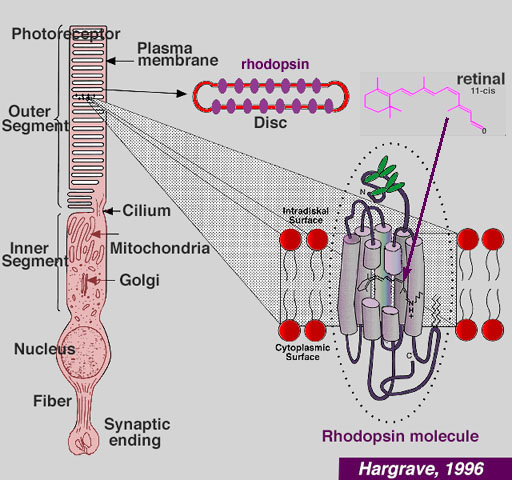
[Graphic: Photoreceptor, Department of Physics, University of Florida]

>The incomprehensible creationist - the Darwin "eye" quote revisited
John Stear, 7 March 2004
[Updated 16 May 2005]

Continued from part #3.

>Young Earth creationists (YECs) and at least one OEC invariably use only the first few lines and omit the part beginning "Yet reason tells me,". Obviously, using the full quote destroys the creationists' argument. Even Answers in Genesis, the most influential YEC web site, has advised their followers not to use the Darwin eye quote because "Citing his [Darwin's] statement at face value is subtly out of context". See Arguments we think creationists should NOT use.

That depends on what the creationist's argument is. As I explained to Stear in my response of 7 Mar 2004, my argument was only that "Darwin admitted it seemed `absurd in the highest degree' that the eye could have been formed by natural selection":

"I cannot answer for other creationists, but all I say in my quote of Darwin is the truth that, "Darwin admitted it seemed `absurd in the highest degree' that the eye could have been formed by natural selection":
--------------------------------------------------------------------------
Darwinism (including Neo-Darwinism) #4 - Difficulties:
Organs of extreme perfection [...] Eye
Darwin admitted it seemed "absurd in the highest degree" that the eye could have been formed by natural selection:
"To suppose that the eye with all its inimitable contrivances for adjusting the focus to different distances, for admitting different amounts of light, and for the correction of spherical and chromatic aberration, could have been formed by natural selection, seems, I freely confess, absurd in the highest degree." (Darwin, Charles R. [English naturalist and founder of the modern theory of evolution], "The Origin of Species by Means of Natural Selection," [1872], Everyman's Library, J.M. Dent & Sons: London, 6th Edition, 1928, reprint, p.167). [....]
------------------------------------------------------------------------"

As my response says, "all I say in my quote of Darwin is the truth that, "Darwin admitted it seemed `absurd in the highest degree' that the eye could have been formed by natural selection."

Nevertheless, to be consistent with my other instances of the same quote, I have now replaced the above with the following:

"To suppose that the eye with all its inimitable contrivances for adjusting the focus to different distances, for admitting different amounts of light, and for the correction of spherical and chromatic aberration, could have been formed by natural selection, seems, I freely confess, absurd in the highest degree. When it was first said that the sun stood still and the world turned round, the common sense of mankind declared the doctrine false; but the old saying of Vox populi, vox Dei, as every philosopher knows, cannot be trusted in science. Reason tells me, that if numerous gradations from a simple and imperfect eye to one complex and perfect can be shown to exist, each grade being useful to its possessor, as is certainly the case; if further, the eye ever varies and the variations be inherited, as is likewise certainly the case; and if such variations should be useful to any animal under changing conditions of life, then the difficulty of believing that a perfect and complex eye could be formed by natural selection, though insuperable by our imagination, should not be considered as subversive of the theory." (Darwin, C.R., "The Origin of Species By Means of Natural Selection," 1872, Sixth Edition, Senate: London, 1994, pp.143-144)

However, I stand by the heading, that "Darwin admitted it seemed `absurd in the highest degree' that the eye could have been formed by natural selection," because it is the truth, being: 1) what Darwin wrote and left unchanged in all six editions of his Origin of Species (1859-1872); and 2) what he confided to his friends in his private correspondence (see part #2).

I will leave it up to you whether you inform Stear of this change, although I expect you (or someone) would have let him know and he is monitoring these posts.

>I emailed Mr Jones and took him to task for deliberately misleading visitors to his site by selectively quoting Charles Darwin. Mr Jones responded this morning in an email to a group (copying his response to me rather than directly replying). Bearing in mind that he had the full text of Darwin's statement in front of him, his response was nothing short of staggering. He said:

Even back then it was my normal practice to copy private messages I received on creation/evolution/ design topics to my then functioning Yahoo list, CreationEvolutionDesign. However (from memory) unless the email was replied directly to the list (i.e. not cc'd), it would not always be accepted by Yahoo's membership verification system. Here on my Google blog that is not a problem, so I send responses direct to the person and cc. to my blog (as with these posts).

>Thanks. But the above makes *no* difference to the point that I was making, namely that "Darwin admitted it seemed 'absurd in the highest degree' that the eye could have been formed by natural selection." [Mr Jones' emphasis]

No doubt as a true-believing Darwinist, Stear finds this "staggering". Nevertheless, it is the plain truth: Darwin did "admit... it seemed 'absurd in the highest degree' that the eye could have been formed by natural selection. To the Darwinist mind, Darwin's adding of his error-ridden (see part #3), question-begging, last part:

"Reason tells me, that if numerous gradations from a simple and imperfect eye to one complex and perfect can be shown to exist, each grade being useful to its possessor, as is certainly the case; if further, the eye ever varies and the variations be inherited, as is likewise certainly the case; and if such variations should be useful to any animal under changing conditions of life, then the difficulty of believing that a perfect and complex eye could be formed by natural selection, though insuperable by our imagination, should not be considered as subversive of the theory."

it is as though Darwin never wrote his first part, "To suppose that the eye ... could have been formed by natural selection, seems, I freely confess, absurd in the highest degree" (emphasis mine)!

>Surely it would be clear to a reasonably literate person that Darwin was pointing out that it only seems to be a difficulty and then goes on to demonstrate that in fact it isn't a difficulty at all.

The above sentence was not in Stear's post to me.

And I disagree with Stear that "Darwin ... goes on to demonstrate that in fact it isn't a difficulty at all." As I have pointed out in part #2, Darwin did not convince his contemporaries nor even himself that the eye could have been formed by the natural selection of "slight, successive, favourable variations" (or random micromutations in Neo-Darwinism).

As I mentioned in another previous post where Dawkins makes the same claim as Stear that after "Darwin's famous phrase, to suppose that `the eye, with all its inimitable contrivances ... could have been formed by natural selection, seems, I freely confess, absurd in the highest degree.' He then goes on to explain it":

The Problem with God: Interview with Richard Dawkins
Beliefnet, October 2005, Interview by Laura Sheahen ... Are there one or two phrases you've heard repeatedly quoted out of context that you'd like to set the record straight about?

Well, that's one of them, about the Cambrian Explosion. Another one is Darwin's famous phrase, to suppose that "the eye, with all its inimitable contrivances"-he goes on about the complications of the eye-"could have been formed by natural selection, seems, I freely confess, absurd in the highest degree." He then goes on to explain it, and they never quote that. They just stop there. Dishonest. [...]

Darwin did not go on to explain how the eye could have been formed by the natural selection of "slight, successive, favourable variations."As I mentioned in that other previous post, "I had also critiqued Darwin's entire argument on the eye, first on an evolution-run list Jan 8, 2001 #1 and #2 and then on my list CED, Mar 27, 2001 #1/2 and #2/2 offering to debate it but there were no takers! Evidence that Darwin's explanation of the origin of the eye is inadequate is that (to my knowledge), no Darwinist (including Dawkins) has ever used it!

>Mr Jones continued:
In fact in the extended quote above Darwin says that "the difficulty of believing that a perfect and complex eye could be formed by natural selection" was "insuperable by our imagination"!

The interesting thing is what "would be clear to a reasonably literate person" is that something which was "insuperable by our imagination" is a real problem, whereas to true believing Darwinists like Stear (and Dawkins) it "isn't a difficulty at all"!

>I repeat, Darwin clearly said, "the difficulty of believing that a perfect and complex eye could be formed by natural selection, though insuperable by our imagination, can hardly be considered real." That is, the "difficulty" cannot be considered real.

This was not in Stear's post to me either, but he makes it sound like it was.

Also, for someone who professes to be concerned about accuracy in quotes, Stear (either ignorantly or knowingly), is here basing his argument on the 1859 First Edition of the Origin, where Darwin has "... then the difficulty of believing that a perfect and complex eye could be formed by natural selection, though insuperable by our imagination, can hardly be considered real" (my emphasis).

I was going to give Stear the benefit of the doubt that he was merely ignorant (inexcusably so for one who claims to be enough of an authority on Darwin to go around correcting others) that by his final 1872 Sixth Edition of the Origin, Darwin had watered that down to the rather lame, "... then the difficulty of believing that a perfect and complex eye could be formed by natural selection, though insuperable by our imagination, should not be considered as subversive of the theory" (my emphasis).

But then I realised that Stear must know the difference, because my quote that he is criticising is from Darwin's Sixth Edition (see it as it originally was in my Yahoo list post of 7 March 2004). Why would one use a quote from a First Edition to counter use of the same quote in a work's Sixth Edition? It cannot be because the First Edition is online and the Sixth Edition wasn't, because the same site, Literature.org, whose online First Edition Stear used, also has an online Sixth Edition, which I know for a fact has been in existence since at least 2003. So it seems inescapable that Stear deliberately chose to use Darwin's First Edition, so that he could base an argument on its stronger wording "can hardly be considered real," which Darwin himself had later abandoned!

If this is so, then Stear is a hypocrite! Bearing in mind Stear's one and only post to me where, without even waiting to find out my side of the story, but as the usual (in my experience) Darwinist judge, jury and executioner, he accused me of lying and misleading to get my point across and being "prepared to deliberately omit a part of a quote to further your own ... ends, an act that you should surely consider a sin":

--Original Message Text---
From: John Stear
Date: Sun, 7 Mar 2004 11:38:50 +1000
I must say that the most surprising thing about creationists is their ability to lie and mislead in a vain attempt to get their point across. And as you are a committed Christian I find it extraordinary that you are prepared to deliberately omit a part of a quote to further your own (and creationism's) ends, an act that you should surely consider a sin.

However, I don't claim that Stear is a hypocrite, as he could merely be incompetent (although I doubt that he could be that incompetent), or there could be some other explanation that I haven't thought of. I will leave it up to him to decide which cap fits.

>If it weren't for the fact that Mr Jones must be aware that he is misrepresenting science in order to further his cause, one might be forgiven for wondering where he was on the day his high school class studied English comprehension.

It is a standard tactic of Darwinists to identify Darwin with "science" itself, so that anyone who they claim is misrepresenting Darwin, is thereby "misrepresenting science"! For the record, I have no problem with Darwin's (or Darwinists') actual science (I accept universal common ancestry, for example). My problem is with Darwin's (and Darwinists') materialist philosophy masquerading as science.

And see above for who is having problems with "English comprehension"!

>Note: It's now over twelve months since I pointed out to Mr Jones his use of at least one "out of context" quote. Today, 28 September 2005, the quote, still "out of context", remains on Mr Jones' web site.

Well, I have now added more of the "context" (see above) but I would be surprised if that will satisfy Stear (or you).

Thanks again for your message which gave me the opportunity to publicly respond to Stear's criticism. As I said at the start in part #1, as it is my long-standing policy not to get involved in private discussions on creation/ evolution/design issues, this four-part response is almost certainly my first and last to you.

Because this response blew out to four parts, which may be resented, in future where I respond publicly on CED to a private creation/evolution/design message, and a longer than one post response is likely, I am going to post only a brief acknowledgment to the sender, telling him/her that my response will be posted only to my blog.

Stephen E. Jones, BSc (Biol).
`Evolution Quotes Book'

Re: Would Jesus stoop to quotemining? #3

AN (cc. CreationEvolutionDesign)

----- Original Message -----
From: AN
To: Stephen E. Jones
Sent: Saturday, June 10, 2006 12:30 AM
Subject: Would Jesus stoop to quotemining?

>The incomprehensible creationist - the Darwin "eye" quote revisited
John Stear, 7 March 2004
[Updated 16 May 2005]

Continued from part #2.

>The quote, in its entirety, is taken from The Origin of Species, Chapter 6, "Organs of extreme perfection and complication".

To suppose that the eye with all its inimitable contrivances for adjusting the focus to different distances, for admitting different amounts of light, and for the correction of spherical and chromatic aberration, could have been formed by natural selection, seems, I freely confess, absurd in the highest degree. Yet reason tells me, that if numerous gradations from a perfect and complex eye to one very imperfect and simple, each grade being useful to its possessor, can be shown to exist; if further, the eye does vary ever so slightly, and the variations be inherited, which is certainly the case; and if any variation or modification in the organ be ever useful to an animal under changing conditions of life, then the difficulty of believing that a perfect and complex eye could be formed by natural selection, though insuperable by our imagination, can hardly be considered real. How a nerve comes to be sensitive to light, hardly concerns us more than how life itself first originated; but I may remark that several facts make me suspect that any sensitive nerve may be rendered sensitive to light, and likewise to those coarser vibrations of the air which produce sound.

Darwin was just bluffing. There was no way that in the 19th century, he could have known that "gradations from a perfect and complex eye to one very imperfect and simple, each grade being useful to its possessor, can be shown to exist."

And in fact "gradations from a perfect and complex eye to one very imperfect and simple"can not "be shown to exist." Even between two types of shrimps (i.e. Euphausiid shrimps" i.e. krill "classified as close 'cousins' to true shrimps), one of the world's foremost authorities on the eye, Prof. Michael Land, wrote that "a refracting optical system, with refractive index crystalline cones, could not evolve into a reflecting system with squared multilayer-coated surfaces, nor vice versa" and "Both are successful and very sophisticated image-forming devices, but I cannot imagine an intermediate form that would work at all" (my emphasis):

"Darwinism does not look you squarely in the eye. It insists on faith in the unseen conversion of one type of eye into another. Upon this faith a humble shrimp imposes considerable strain. Moths, fireflies and Euphausiid shrimps, creatures all active in the dark, have special compound eyes which include a retina on which the multiple lenses focus at a common point to form an upright image. These shrimps, which seem to be, and are, classified as close 'cousins' to true shrimps, employ lens cylinders which smoothly bend the incoming light so that it all focuses at a common point, rather than forming multiple images as most compound eyes do. This feat of optical engineering has only been duplicated by humans in the last decade. If this were not enough, Michael Land, a biologist from Sussex University, has observed that other shrimps have eyes which employ a different principle of physics, reflection from mirrors. The eyes have squared facets employed as radially arranged mirrors. It requires precise geometry to align such mirrors so that incoming rays are all reflected to focus at a common point, forming an image there. In an article entitled 'Nature as an Optical Engineer' Dr Land wrote: `I would guess that a refracting optical system, with refractive index crystalline cones, could not evolve into a reflecting system with squared multilayer-coated surfaces, nor vice versa. Both are successful and very sophisticated image-forming devices, but I cannot imagine an intermediate form that would work at all.' [Land, M., "Nature as an Optical Engineer," New Scientist, Vol. 84, October 1979, p.13] No common ancestors or series, leading up to these two very different sorts of eyes in the same shrimp-like body, are known. Confronted with the evidence, I believe a reasonable Mr. Darwin would have opted for a theory of design. Over one hundred years ago he wrote: `To suppose that the eye ... could have been formed by natural selection, seems, I freely confess, absurd in the highest degree.'" (Pitman, M., "Adam and Evolution," Rider & Co: London, 1984, pp.217-218)

And Darwin, by his admission that he was not explaining, "How a nerve comes to be sensitive to light," thereby evaded the main issue, in that he is not then explaining how the eye arose, because he is starting with an already fully-functioning eye! Just as in "how life itself first originated", the real challenge for Darwin's theory, is to get from nothing (i.e. no life, no eye) to something (life, an eye).

And there are in fact, no "very imperfect and simple" eyes. All eyes are very complex, just that some are more very complex than others! As an irreducible minimum an eye has to: 1) capture individual photons of light; 2) transduce each photon into a chemical signal; 3) pass it along an optical nerve to a brain; 4) the brain has to interpret those signals; and 5) tell the animal what they mean; so that 6) it can take the appropriate action.

As I mentioned not long ago, Richard L. Gregory, Emeritus Professor of Neuropsychology at the Department of Experimental Psychology, Bristol University, another expert on the eye, even though he is an evolutionist who accepts that "the human eye and brain have come about through slow painful trial and error," regards "The problem of how eyes have developed" as "a major challenge to the Darwinian theory of evolution by Natural Selection" because then "each step must confer some advantage upon its owner, to be selected and transmitted through the generations." But then "what use is a half-made lens?" and "What use is a lens giving an image, if there is no nervous system to interpret the information?" and "How could a visual nervous system come about before there was an eye to give it information?":

"The problem of how eyes have developed has presented a major challenge to the Darwinian theory of evolution by Natural Selection. We can make many entirely useless experimental models when designing a new instrument, but this was impossible for Natural Selection, for each step must confer some advantage upon its owner, to be selected and transmitted through the generations. But what use is a half-made lens? What use is a lens giving an image, if there is no nervous system to interpret the information? How could a visual nervous system come about before there was an eye to give it information? In evolution there can be no master plan, no looking ahead to form structures which, though useless now, will come to have importance when other structures are sufficiently developed. And yet the human eye and brain have come about through slow painful trial and error." (Gregory, R.L., "Eye and Brain: The Psychology of Seeing," [1966], Weidenfeld & Nicolson: London, Second edition, 1972, p.25)

And Darwin was also wrong in his assumption that "any sensitive nerve may be rendered sensitive to light". As leading geneticist and Dawkins opponent, Gabriel Dover, pointed out, the fact is that all true eyes are based on the Pax-6 master gene:

"The Pax-6 gene of mammals is interchangeable with the equivalent Pax-6 gene of Drosophila. The experiment of getting Pax-6 switched on in tissues not normally expressing Pax-6 can be done using either the fly's own Pax-6 gene or one taken from a mouse. Either way, the results are quite startling - eyes are produced on several unusual parts of the fly's body, such as legs and wings. Insect eyes and mammalian eyes are constructed in different ways. The insect eye is a many-sided compound eye in which each 'eyelet' and its lens can be said to be equivalent to the single mammalian eye. So what should we be expecting from our gene-swopping experiments? We might guess that the Pax-6 of Drosophila produces patches of compound eye wherever Pax-6 is operating. But what of the Pax master gene from a mouse? Will it produce an insect or mouse eye when turned 'on' in different Drosophila tissues? The answer is that it produces a Drosophila compound eye on legs, wings, halteres and antennae. Moreover the antenna eyes generate the same electric impulses as the normal eyes showing that they are functional. Eyes cannot be induced in any tissue; the foreign eye master gene has to be active at the appropriate stage of insect development. Nevertheless, the mouse Pax-6 can successfully interact with the estimated 2,500 target genes lying dormant in many different Drosophila organs. Pax-6 genes exist in such diverse species as amphibians, squid worms and planariums, as well as mammals and insects. Some of these have also been shown capable of inducing extra eyes in Drosophila. What these experiments tell us is that Pax-6 really can be considered a master control gene that has been conserved over a huge distance of evolutionary time, probably predating the Cambrian epoch of 550 million years ago. " (Dover, G.A., "Dear Mr Darwin: Letters on the Evolution of Life and Human Nature," [1999], University of California Press: Berkeley CA, 2000, reprint, pp.170-171)

[Graphic: New Scientist] which only arose once and codes for all "the widely different structures and operations of eyes (eye cup, pinhole, camera-type with single lens, mirror and compound)" which "goes against a hundred years of insistence" by Darwinists falsely that the these "different ... eyes ... arose independently, at least forty and maybe up to sixty-five times" to emphasize "the repetitive ease with which natural selection could" allegedly "produce an eye":

"The Pax-6 story tells us that there has been just one origin and one evolutionary line of progression, from the earliest patches of light-sensitive cells to the variety of advanced eye-forms around us. This unavoidable conclusion, Charles [Darwin], goes against a hundred years of insistence that the widely different structures and operations of eyes (eye cup, pinhole, camera-type with single lens, mirror and compound) arose independently, at least forty and maybe up to sixty-five times. Our old friend Richard Dawkins devoted a chapter in one of his books to 'the forty-fold path to enlightenment', emphasizing the repetitive ease with which natural selection could produce an eye, and so relieving you of the 'cold shudder' you experienced whenever you grappled with this problem." (Dover, 1999, p.172) .

Note Dover's subtle irony. Darwin can now, posthumously, be relieved "of the 'cold shudder'" he "experienced whenever" he "grappled with this problem" of how "natural selection could produce an eye," because it didn't!

Concluded in part #4.

Stephen E. Jones, BSc (Biol).
`Evolution Quotes Book'

Saturday, June 10, 2006

Re: Would Jesus stoop to quotemining? #2

AN

----- Original Message -----
From: AN
To: Stephen E. Jones

Sent: Saturday, June 10, 2006 12:30 AM
Subject: Would Jesus stoop to quotemining?

[Graphic: Dr George Matsumoto, BioForum, California Academy of Sciences.]

Continued from part #1. As before, this is being copied to my blog, CreationEvolutionDesign, minus your personal identifying information and some further changes. In fact it is really intended for my blog's readers, not to you (since all you did was send me John Stear's web page criticism of me with no comment from you, except the subject line). For added clarity, my words are in bold, to distinguish them from Stear's.

>The incomprehensible creationist - the Darwin "eye" quote revisited
John Stear, 7 March 2004
[Updated 16 May 2005]

John Stear is the owner of the "No Answers in Genesis" website. Wikipedia describes him as an "Australian atheist and skeptic ... a retired civil servant." There is no mention that Stear has any science or other relevant qualifications.

Being an atheist, Stear has no option but to believe in some form of fully naturalistic evolution, irrespective of the evidence. As Christian geneticist David Wilcox observed, "One can be a theistic `Darwinian,' but no one can be an atheistic `Creationist'":

"I conclude that the easy acceptance of neo-Darwinism as a complete and adequate explanation for all biological reality has indeed been based in the metaphysical needs of a dominant materialistic consensus. One can be a theistic `Darwinian,' but no one can be an atheistic `Creationist.'" (Wilcox, D.L., "Tamed Tornadoes," in Buell, J. & Hearn, V., eds., "Darwinism: Science or Philosophy? ," Foundation for Thought and Ethics: Richardson TX, 1994, p.215)

>I've had an interesting albeit frustrating exchange with West Australian old Earth creationist (OEC), Steve Jones. Mr Jones hosts a web site that includes a collection of quotes, one of which is the infamous Charles Darwin quote concerning the evolution of the eye. The quote is often used by YECs in an effort to convince their credulous followers that Darwin had doubts about some aspects of evolution. [...]

As far as I can recall, Stear sent me one message on 7 March 2004, to which I responded (copy to my discussion group) the same day. And by "frustrating," presumably Stear means that I did not roll over and admit he was right, including his claim that I "lie" and am "disingenuous":

"I must say that the most surprising thing about creationists is their ability to lie and mislead in a vain attempt to get their point across ... It's unlikely I'll investigate your site further as I'm sure it's contents will be, in the main, as disingenuous as your selective use of quotes."

As I responded to Stear, "Nothing like an open-minded evolutionist!" At least Stear notes that I am an "old Earth creationist."

As for Stear's "effort to convince their credulous followers that Darwin had doubts about some aspects of evolution," either Stear is ignorant of Darwin's writings (which is not unusual for evolutionists-my namesake British geneticist Steve Jones wrote that he has "never met a biology undergraduate who has read The Origin of Species"):

"I have never met a biology undergraduate who has read The Origin of Species. Even scientists, familiar as they are with its contents (or what they believe them to be), honour it in the breach rather than the observance." (Jones, J.S., "Almost Like a Whale: The Origin of Species Updated," Doubleday: London, 1999, p.xxvii)

or he must think that Darwin was being disingenuous or lying when he wrote of his doubts about some aspects of evolution, e.g. 1) in his Origin of Species that "the eye with all its inimitable contrivances ... could have been formed by natural selection" :

"To suppose that the eye with all its inimitable contrivances for adjusting the focus to different distances, for admitting different amounts of light, and for the correction of spherical and chromatic aberration, could have been formed by natural selection, seems, I freely confess, absurd in the highest degree." (Darwin, C.R., "The Origin of Species By Means of Natural Selection," 1872, Sixth Edition, Senate: London, 1994, pp.142-143. My emphasis)

2) in his private correspondence, which was only published after Darwin's death, Darwin admitted to his American confidant, Harvard botanist Asa Gray, a few months after the publication of his Origin of Species, that he agreed that his "attempt to account for the formation of ... eyes ... by natural selection" was one of the "weak points" in his book and confided that "The eye to this day gives me a cold shudder" (my emphasis):

"Well, what seems to me the weakest point in the book is the attempt to account for the formation of organs, the making of eyes, &c., by natural selection." [Gray A., letter to Darwin C.R., January 23rd, 1860] "...About the weak points I agree. The eye to this day gives me a cold shudder, but when I think of the fine known gradations, my reason tells me I ought to conquer the cold shudder." (Darwin C.R., Letter to Asa Gray, February, 1860, in Darwin, F., ed., "The Life and Letters of Charles Darwin," [1898], Basic Books: New York NY, Vol. II., 1959, reprint, pp.66-67)

3) in another private letter about the same time, Darwin wrote to another of his confidants, geologist Charles Lyell, that Cambridge botany professor John Henslow, "also shudders at the eye":

"Henslow is staying here; I have had some talk with him; he is in much the same state as Bunbury, I and will go a very little way with us, but brings up no real argument against going further. He also shudders at the eye! " (Darwin, C.R., Letter to Charles Lyell, February, 15th, 1860, in ibid., p.79)

4) in 1844, in a sketch of his theory discovered after his death, Darwin wrote (presumably in the margin because I cannot see it in the webbed copy) that the origin of "the eye ... was `the greatest difficulty to the whole theory":

"In July 1844, when Annie was three, Charles wrote a note for Emma: `I have just finished my sketch of my species theory. If, as I believe ... my theory is true, and if it be accepted even by one competent judge, it will be a considerable step in science. I therefore write this, in case of my sudden death, as my most solemn and last request, which I am sure that you will consider the same as if legally entered in my will, that you will devote £400 to its publication: He showed the essay to Emma and she found time to read it carefully, noting a few places where she did not understand his train of thought. She also questioned one important point in his argument. Paley in his Natural Theology and generations of naturalists before him had found the structure and functioning of the eye the most persuasive of all the proofs of the existence of God `from design: It was clearly the contrivance of a Creative mind, and Paley claimed it was impossible to imagine how such a complex mechanism could have developed by a chance succession of small steps from an organ with another function. Charles recognised that if he was to persuade others to accept his theory, he must be able to show that the structure could have evolved in this way by a purely natural process. He wrote in the essay that this was `the greatest difficulty to the whole theory' and offered an ingenious suggestion as to how the development might have occurred. But Emma was not persuaded by his argument, and wrote in the margin 'A great assumption - E.D.' Charles's suggestion was, indeed, a `great assumption', and Emma knew that it was a key part of the argument for the theory which he hoped would be a major contribution to science. It was only ever a conjecture; the evidence for it was widely scattered, indirect and fragmentary. For Emma to question the point in the direct way that she did was to strike at the heart of the theory." (Keynes, R., "Annie's Box: Charles Darwin, His Daughter and Human Evolution," Fourth Estate: London, 2001, p.79-80. Ellipses Keynes')

It is by the way not only creationists who take Darwin at his word that he had doubts about some aspects of evolution. Evolutionist anthropologist Barbara Noske wrote that "Even Darwin himself was occasionally seized by doubt while contemplating organs of extreme perfection" and citing Darwin's admission that "The eye gives me a cold shudder":

"Bypassing the recent wave of Creationism in the US and its criticism of Darwin's theory, a number of objections can be made against the notion of natural selection, some of which I will mention here. Such intricate changes have arisen in nature, involving such immensely complex series of mutations that mathematicians find it almost impossible to attribute these to blind chance. Rattray Taylor mentions several instances of features which evolved long before they were of any advantage so that they hardly can have been caused by natural selection. Even Darwin himself was occasionally seized by doubt while contemplating organs of extreme perfection. `The eye gives me a cold shudder,' he wrote." (Noske, B., "Humans and Other Animals: Beyond the Boundaries of Anthropology," Pluto Press: London, 1989, p.65)

This part #2 has become too long for my blog, so I will continue it in part #3.

Stephen E. Jones, BSc (Biol).
`Evolution Quotes Book'

Re: Would Jesus stoop to quotemining? #1

AN

----- Original Message -----
From: AN
To: Stephen E. Jones
Sent: Saturday, June 10, 2006 12:30 AM
Subject: Would Jesus stoop to quotemining?

[Graphic: Dr George Matsumoto, BioForum, California Academy of Sciences.]

Thank you very much for your message - or rather, just sending me John Stear's "The incomprehensible creationist - the Darwin "eye" quote revisited" criticism of me for the following quote of Darwin on the eye one of my web pages:

Darwinism (including Neo-Darwinism) #4 - Difficulties: [...]
* Eye
o Darwin admitted it seemed "absurd in the highest degree" that the eye could have been formed by natural selection

"To suppose that the eye with all its inimitable contrivances for adjusting the focus to different distances, for admitting different amounts of light, and for the correction of spherical and chromatic aberration, could have been formed by natural selection, seems, I freely confess, absurd in the highest degree." (Darwin, Charles R. [English naturalist and founder of the modern theory of evolution], "The Origin of Species by Means of Natural Selection," [1872], Everyman's Library, J.M. Dent & Sons: London, 6th Edition, 1928, reprint, p.167)

As is my normal practice when I receive a private message on a creation/evolution/design topic, I have copied my response to my blog CreationEvolutionDesign, after removing your personal identifying information (and making some further changes by way of clarification).

Please don't interpret this as an invitation to debate this issue-it isn't. As I have explained many times before: 1) it is my long-standing policy not to get involved in private discussions on creation/evolution/design issues; and 2) after more than a decade (1994-2005) of publicly debating evolutionists on Internet discussion groups, I closed down my own Internet discussion group in order to post to my blog and write my book "Problems of Evolution" (and more recently to take a ~1-year detour classify my ~10,000 online quotes into an `Evolution Quotes Book'). So this is almost certainly my first and last response to you.

The reason why I thank you very much for your message, is that while Googling I had noticed Stear's criticism of me and I had thought of posting a response to my blog, and now you have given me the opportunity to do so.

Because of its length, I will divide this post into four parts, this part #1 dealing with your allegation of "quotemining" and whether Jesus would "stoop" (using your word) to it; and parts #2, #3 & #4, responding to Stear's page about Darwin's `explanation' of the eye.

So, first, a comment on your subject line question: "Would Jesus stoop to quotemining?" If by "quotemining" you mean "quote ... to speak or write (a passage) from another usually with credit acknowledgment" + "mining ... to extract from a source " (Merriam-Webster Online Dictionary), then I enthusiastically plead guilty! Especially since I presume evolutionists real concern is one of Webster's alternative definition of "mining ... to dig under to ... cause the collapse of (an enemy position)"!

There is nothing wrong with selecting out from a larger body of writing, a quote to make a specific point. In fact both Jesus and the Apostles did it. For example, in Acts 17:22-33, the Apostle Paul addressed the Athenian philosophers and in v.28 quoted from their own pagan philosopher-poets, as my NIV Study Bible comments:

"ACTS ... 17:28, some of your own poets. There are two quotations here: (1) `In him we live and move and have our being,' from the Cretan poet Epimenides (c. 600 B.C.) in his Cretica, and (2) `We are his offspring,' from the Cilician poet Aratus (c. 315-240) in his Phaenomena, as well as from Cleanthes (331-233) in his Hymn to Zeus. Paul quotes Greek poets elsewhere as well (see 1Co 15:33; Tit 1:12 and notes)." (Barker, K., et al., eds., "The NIV Study Bible," Zondervan: Grand Rapids MI, 1985, p.1680).

And, as it happens, in my morning devotions about a week ago, in which I am going through the Messianic prophecies of Old Testament, I came to Isaiah 61:1-2:

"1 The Spirit of the Sovereign LORD is on me, because the LORD has anointed me to preach good news to the poor. He has sent me to bind up the brokenhearted, to proclaim freedom for the captives and release from darkness for the prisoners, 2 to proclaim the year of the LORD's favor and the day of vengeance of our God, to comfort all who mourn,"

which Jesus part-quotes from in Luke 4:18-19, stopping mid-sentence to make His specific point:

18"The Spirit of the Lord is on me, because he has anointed me to preach good news to the poor. He has sent me to proclaim freedom for the prisoners and recovery of sight for the blind, to release the oppressed, 19to proclaim the year of the Lord's favor."

My NIV Study Bible comments:

"ISAIAH ... 61:2 year of the LORD'S favor. Corresponds to the `day of salvation' in 49:8 (see note there) and the `year of my redemption' in 63:4. Christ ended his quotation at this point (Lk 4:19-20), probably because the `day of vengeance' will not occur until his second coming. day of vengeance. See 34:2,8 and notes." (Barker, 1985, p.1106) .

Now, no doubt Paul's and Jesus' opponents of that day (and indeed their modern equivalents) could, to avoid having to deal with the substance of their arguments, claim that Paul and Jesus "selectively," quote-mined," "out-of-context"!

Fearnside and Holther in their book "Fallacy: The Counterfeit of Argument," identify two criteria for determining whether a quote is "out of context": 1) "to make out through a suitable manipulation of the text that an authority is on his side" and 2) "omitting distinctions, exceptions or qualifying remarks, or by otherwise distorting the text":

"There is a special misuse of authority which is notorious under the name of quoting out of context. This may be done in either of two ways that seem especially attractive to the unscrupulous. The first is for one to make out through a suitable manipulation of the text that an authority is on his side. This is done by omitting distinctions, exceptions or qualifying remarks, or by otherwise distorting the text. The second is to treat the opponent as a sort of authority of his own position and to pounce upon something he has said that can be used against him-if the rest is ignored." (Fearnside, W.W. & Holther, W.B., "Fallacy: The Counterfeit of Argument," Prentice-Hall: Englewood Cliffs NJ, 1959, Twenty-fifth printing, pp.88-89)

Neither applies in this instance: 1) It should go without saying that I do not make out that Darwin is on my side (indeed an important point in quoting evolutionists with problems over aspects of evolution is that they are evolutionists):

"One more thing needs to be said. Evolutionists have often protested unfair to quoting an evolutionist as if he were against evolution itself. So let it be said from the outset that the vast majority of authorities quoted are themselves ardent believers in evolution. But that is precisely the point, and the value of The Revised QUOTE BOOK. The foundations of the evolutionary edifice are hardly likely to be shaken by a collection of quotes from the many scientists who are biblical creationists. In a court of law, an admission from a hostile witness is the most valuable. Quoting the evolutionary palaeontologist who admits the absence of in-between forms, or the evolutionary biologist who admits the hopelessness of the mutation/selection mechanism, is perfectly legitimate if the admission is accurately represented in its own right, regardless of whether the rest of the article is full of hymns of praise to all the other aspects of evolution." (Snelling, A., "The Revised Quote Book," [1984], Creation Science Foundation: Brisbane QLD, 1990, inside cover. Emphasis original)

And I do not manipulate the text, "omitting distinctions, exceptions or qualifying remarks, or by otherwise distorting the text." As always, I quote directly, with references, from Darwin's (and other evolutionists') own writings to show that Darwin really did have an ongoing problem in believing that the eye could have been formed solely by the natural selection of "slight, successive, favourable variations" (or random micromutations in Neo-Darwinism):

"As natural selection acts solely by accumulating slight, successive, favourable variations, it can produce no great or sudden modifications; it can act only by short and slow steps. Hence the canon of `Natura non facit saltum,' [nature does not make leaps] which every fresh addition to our knowledge tends to confirm, is on this theory intelligible." (Darwin, C.R., "The Origin of Species By Means of Natural Selection," 1872, Sixth Edition, Senate: London, 1994, pp.413-414. Parenthesis mine).

2) As for treating Darwin as an "authority of his own position," clearly he is in this context of his own explanation of the origin of the eye solely by the natural selection of random micromutations in his Origin of Species. If evolutionists want to concede that Darwin's explanation of the eye was inadequate, then they have conceded my point. But their problem then is that after ~150 years, there is nothing better, and indeed the problem (as with other long-standing problems of evolution) has only become worse (since if it really happened fully naturalistically, then science should have by now discovered it). Then there would be no need for claims of "quotemining." All evolutionists would need to do is produce the fully naturalistic explanation. Indeed, the more evolutionists employ such "shoot the messenger" defences, the more they show that the critics are right!

In respect of "to pounce upon something he has said that can be used against him-if the rest is ignored," in this context I am only dealing with Darwin's explanation of the eye in his Origin of Species, and I have not ignored anything in respect of that. As will be seen in part #4, on at least two different Internet discussion groups when this issue came up, I quoted Darwin's entire explanation in his Origin of Species of the origin of the eye, interspersed with my critical comments, and invited my evolutionist opponent(s) to debate it with me in detail but there were no takers!

Of course, I do not expect committed evolutionists to concede that I am not "quote-mining," i.e. "dishonestly," "selectively," "quoting out of context" Darwin (or any other leading evolutionists with probems of aspects of evolution). In my experience most (not all) evolutionists work on the principle that: 1) It just simply cannot be that Darwin did not explain the eye (or any other major evolutionist claim); and therefore 2) the critic who presents evidence to that effect by quoting from the original source(s), must be guilty of (deliberately) misquoting Darwin (or other leading evolutionists). QED! It is always easier to "shoot the messenger" than to accept the bad news he brings (but unfortunately that does not change matters if the bad news is real)!

I will now begin to deal with the substance of Stear's argument in part #2.

Stephen E. Jones, BSc (Biol).
`Evolution Quotes Book'

Friday, June 09, 2006

Big bang in Antarctica - killer crater found under ice #4

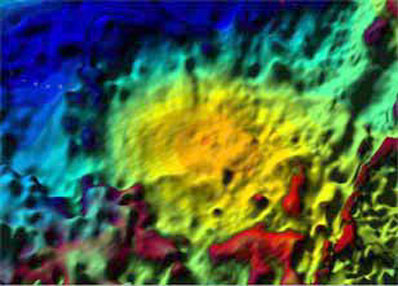
Big bang in Antarctica - killer crater found under ice, EurekAlert!, 1-Jun-2006, Pam Frost Gorder, Ohio State University ... [Graphic: Gravity fluctuations and radar images in the Wilkes Land region of East Antarctica, Spaceflight Now]

[Continued from part #3 ... But as anthropologist Matt Cartmill pointed out, in what I consider to be the most amazingly perceptive article I have ever seen by an evolutionist, that when "Stephen Jay Gould argue[d] that the evolution of human beings was fantastically improbable and that a host of unlikely events had to fall out in just the right way for intelligent life to emerge on this planet," then "One might well take this as a sign of God's hand at work in the evolutionary process":

"Evolutionists seem to be especially prone to this mistake. The claim that evolution is purposeless and undirected has become almost an article of faith among evolutionary biologists. For example, the official `Statement on Teaching Evolution' from the National Association of Biology Teachers describes evolution as `an unsupervised, impersonal, unpredictable, and natural process.' That pretty much rules God out of the picture. One popular book on evolution, Richard Dawkins's Blind Watchmaker, is subtitled Why the Evidence of Evolution Reveals a Universe Without Design. In his book Wonderful Life, Stephen Jay Gould argues that the evolution of human beings was fantastically improbable and that a host of unlikely events had to fall out in just the right way for intelligent life to emerge on this planet. One might well take this as a sign of God's hand at work in the evolutionary process. Gould, however, bends his argument to the opposite conclusion that the universe is indifferent to our existence and that humans would never evolve a second time if we rewound time's videotape and started over. But to reach this conclusion, you have to assume the very thing that you are trying to prove: namely, that history isn't directed by God. If there is a God, whatever he wills happens by necessity. Because we can't really replay the same stretch of time to see if it always comes out the same way, science has no tests for the presence of God's will in history. Gould's conclusion is a profession of his religious beliefs, not a finding of science. The broad outlines of the story of human evolution are known beyond a reasonable doubt. However, science hasn't yet found satisfying, law-based natural explanations for most of the details of that story. All that we scientists can do is admit to our ignorance and keep looking. Our ignorance doesn't prove anything one way or the other about divine plans or purposes behind the flow of history. Anybody who says it does is pushing a religious doctrine." (Cartmill, M., "Oppressed by Evolution," Discover, Vol. 19, No. 3, March 1998)

As a tournament chess player in my misspent youth, I was impressed at the time by 1996 this perceptive article on Deep Blue - Kasparov, 1996, Game 1, the first serious chess game won by a computer against a reigning world chess champion. In particular, the observation that, "The omniscient have no fear," referring to Deep Blue taking what seemed to human grandmasters, "crazy chances," indeed "insane" moves:

"What is Deep Blue's secret? Grand master Yasser Seirawan put it most succinctly: `The machine has no fear.' He did not just mean the obvious, that silicon cannot quake. He meant something deeper: because of its fantastic capacity to see all possible combinations some distance into the future, the machine, once it determines that its own position is safe, can take the kind of attacking chances no human would. The omniscient have no fear. In Game 1, Blue took what grand master Robert Byrne called `crazy chances.' On-site expert commentators labeled one move `insane.' It wasn't. It was exactly right. Here's what happened. Late in the game, Blue's king was under savage attack by Kasparov. Any human player under such assault by a world champion would be staring at his own king trying to figure out how to get away. Instead, Blue ignored the threat and quite nonchalantly went hunting for lowly pawns at the other end of the board. In fact, at the point of maximum peril, Blue expended two moves-many have died giving Kasparov even one-to snap one pawn. It was as if, at Gettysburg, General Meade had sent his soldiers out for a bit of apple picking moments before Pickett's charge because he had calculated that they could get back to their positions with a half-second to spare. In humans, that is called sangfroid. And if you don't have any sang, you can be very froid. But then again if Meade had known absolutely-by calculating the precise trajectories of all the bullets and all the bayonets and all the cannons in Pickett's division-the time of arrival of the enemy, he could indeed, without fear, have ordered his men to pick apples. Which is exactly what Deep Blue did. It had calculated every possible combination of Kasparov's available moves and determined with absolute certainty that it could return from its pawn-picking expedition and destroy Kasparov exactly one move before Kasparov could destroy it. Which it did. It takes more than nerves of steel to do that. It takes a silicon brain. No human can achieve absolute certainty because no human can be sure to have seen everything. Deep Blue can. Now, it cannot see everything forever-just everything within its horizon, which for Deep Blue means everything that can happen within the next 10 or 15 moves or so." (Krauthammer, C., "Deep Blue Funk," Time, South Pacific edition, February 26, 1996, pp.70-71)

Humans chessplayers, even the best, have to have informal rules of thumb, based on centuries of accumulated experience, e.g. taking pawns with your queen far over on the opponent's queenside, while your king is under attack on your kingside, is suicidal. This is because, as the article says, "No human can achieve absolute certainty because no human can be sure to have seen everything." But, as the article continues, "Deep Blue can ... see everything within its horizon" with absolute infallibility.

Now this is (to me at least) a good analogy of how the omniscient God can, and does, do things that may seem to limited humans as "crazy" and even "insane." God, the Bible tell us, has "the plan determined for the whole world" that encompasses "all nations" (Isa 14:26). In this plan God "works out everything in conformity with the purpose of his will,"(Eph 1:11). Therefore God could (and I firmly believe did) create humans "from the dust of the ground" (Gen 2:7) by using as his `potter's clay' (Isa 29:16; 45:9; 64:8; Jer 18:4,6; Rom 9:21) any of the resource of His universe. Being truly omniscient God does not need rules, and so His plan looks to the unbeliever like:

" there was nothing preordained about the emergence of Homo sapiens on the plains of Africa ... The sobering conclusion is that even when everything else in the environment was perfect, blind chance still ruled the development of intelligent life" (Taylor, S.R., "Destiny or Chance: Our Solar System and its Place in the Cosmos," [1998], Cambridge University Press: Cambridge UK, 2000, reprint, pp.191-192)

This plan includes (if in fact it is what happened) a giant meteor impact ~250 mya in East Gondwana, which in turn was a causal factor in: 1) Australia beginning its separation from Antarctica ~100 mya as the final stage of breakup of Gondwana; 2) creating the Antarctic Circumpolar Current; 3) causing global temperatures to cool; 4) including Africa; which, together with other tectonic movements including the opening of the Great Rift Valley in Africa, 5) "led to a diversification of local climates that encouraged adaptation and speciation among the higher apes," including "more open, savanna vegetation" which was a factor in the emergence of "bipedalism and other human adaptive traits":

"These shifts were the result of longer-term changes than those produced by astronomical fluctuations, and were almost certainly related to plate tectonics. The build-up of ice in the Northern Hemisphere may have resulted from the uplift of the Tibetan and Colorado plateaus disturbing global atmospheric circulation (Tibet has risen by some two vertical kilometres during the Plio-Pleistocene). Glaciation in Antarctica was probably initiated by the final breakup of the great southern continent, Gondwanaland. So long as Antarctica was joined to Australia and South America, cold polar ocean currents were deflected northwards towards the Equator and returned as warmer tropical waters. Once the link was broken, however, a circum-Antarctic current developed around the South Pole, isolating it thermally. The opening of Drake Passage between Tierra del Fuego and the Antarctic peninsula from about 22 million years ago may have been critical. Tectonic changes were also important in determining regional environmental histories. The compression of the zone between the European and African tectonic plates, for example, led to the temporary closure of the Straits of Gibraltar during the Miocene. As a result, Atlantic waters no longer flowed into the Mediterranean Sea, which progressively dried up to become a series of giant salt lakes - the so-called Messinian salinity crisis. Another region where tectonic and climatic histories were intertwined was East Africa. Here the opening of the Rift System during the later Cenozoic led to a diversification of local climates that encouraged adaptation and speciation among the higher apes. West of the rifts, rainfall was high enough to support tropical moist forest, but to the east, and in the rifts themselves, the climate became drier and more open, savanna vegetation came to dominate. Whether a move down from the trees encouraged bipedalism and other human adaptive traits is hard to know. However, it may be significant that Plio-Pleistocene hominids and modern chimpanzees and gorillas have disjunct distributions in tropical Africa; the apes are found only in moist forests and adjacent wood lands whereas the hominids lived in the savanna lands within and to the east of the rift system." (Roberts, N., "Human evolution in a geological context," in Jones, J.S., Martin, R. & Pilbeam, D., eds., "The Cambridge Encyclopedia of Human Evolution," Cambridge University Press: Cambridge UK, 1992, p.178)!]

Stephen E. Jones, BSc (Biol).
`Evolution Quotes Book'

Thursday, June 08, 2006

Big bang in Antarctica - killer crater found under ice #3

Big bang in Antarctica - killer crater found under ice, EurekAlert!, 1-Jun-2006, Pam Frost Gorder, Ohio State University ... [Continued from part #2

Graphic: "Gravity fluctuations beneath East Antarctica measured by GRACE satellite," SPACE.com

Which gets me, eventually to the connection between this claimed giant meteor impact ~250 mya that it is claimed eventually helped cause Australian to split off from Antarctica ~150 million years later ~100 mya!

Australian planetary scientist, Professor Emeritus Stuart Ross Taylor (who I had quoted from in this previous post), has some other great quotes in his book, "Destiny or Chance: Our Solar System and its Place in the Cosmos" (1998) about how rare Earth is, and therefore "the odds of finding 'little green men' elsewhere in the universe decline to zero." But as a (presumed from the tone of the book) atheist/agnostic, he comforts himself that "even on this well-endowed planet, there was nothing preordained about the emergence of Homo sapiens on the plains of Africa," and "even when everything else in the environment was perfect, blind chance still ruled the development of intelligent life":

"However, despite this great flowering of life, intelligence seems to have developed only among the vertebrates, and there, rarely. Among the 24 orders of mammals, high intelligence seems to have arisen in only one, in primates. Why is this so? Clearly high intelligence has little evolutionary advantage, for it has appeared once in tens of billion attempts. As Ernst Mayr ... the biologist, has pointed out, [Mayr, E.W., "Does It Pay To Acquire High Intelligence?," Perspectives in Biology and Medicine, Vol. 37; No. 3, 1994, pp.150-154] even the development of high intelligence may not lead to the ability to communicate with distant planets. Only one of the 20 or so civilisations that have arisen on Earth in the past 5000 years has developed the technology to communicate with other possible life forms elsewhere. But even on this well-endowed planet, there was nothing preordained about the emergence of Homo sapiens on the plains of Africa. Three separate continents were available on the Earth on which the later stages of the evolution of land animals could evolve. [Pollard, W.G., "The prevalence of Earthlike planets," American Scientist , Vol. 67, November-December, 1979, pp.653-659, p.654] All these vast areas shared the benign conditions on this planet that make it such a comfortable environment for life. When life first invaded the land in the late Silurian and Devonian Periods about 400 million years ago, the scattered continents were slowly uniting into a single land mass, which we call Pangaea. During the next few hundred million years, as plants and animals evolved and the dinosaurs became dominant, this great mass began to split up. A large southern continent, called Gondwana (after an historic region of central India), sailed away. This in turn slowly fragmented into familiar pieces that now appear on our maps of the world. Australia, Antarctica and South America, carrying their cargo of animals and plants, broke away leaving Africa in isolation. Australia separated from the frozen southern continent and departed northward. Africa and India also travelled north at a rate of a few centimetres a year, finally ramming into Europe and Asia and creating from this titanic collision the mighty mountain chains of the Alps and Himalayas. So were formed the three continental masses on which the later evolution of land animals proceeded independently. Australia, isolated from the rest of the world, produced the weird marsupial animals that puzzled early explorers. In South America, the land animals and their fossil ancestors intrigued Charles Darwin by their differences from his familiar European species, but the South American monkeys, primates like us, never left the trees. Africa, in addition to the splendid array of lions, antelopes, zebras, giraffes and the rest that we all admire, managed to produce another unique species, Homo sapiens. On the other continents no species remotely resembling us arose. The sobering conclusion is that even when everything else in the environment was perfect, blind chance still ruled the development of intelligent life. When the remote possibilities of developing a habitable planet are added to the chances of developing both high intelligence and a technically advanced civilisation, the odds of finding 'little green men' elsewhere in the universe decline to zero." (Taylor, S.R., "Destiny or Chance: Our Solar System and its Place in the Cosmos," [1998], Cambridge University Press: Cambridge UK, 2000, reprint, pp.191-192)

Taylor (evidently not realising the contradiction), had earlier cited Laplace's famous reply to Napoleon who asked where God fitted into Laplace's mathematical model of the origin of the Solar System, that he had "no need for that hypothesis":

"The orbits of the planets, although elliptical as every schoolchild now is told, are in fact nearly circular. This regular arrangement led Laplace to the concept that the system had arisen far in the past from a primitive rotating cloud, the `solar nebula'. This idea has survived. This was in contrast to the ideas of Newton, who had believed that the Solar System had been created in its present form only a few thousand years earlier. Laplace however was an inhabitant of the Age of Enlightenment. Born into what we would now call a middle-class farming family, he had survived the French Revolution and was a distinguished member of the French scientific establishment at the beginning of the nineteenth century. He was able to show that the apparent variations in the orbits of the planets were self-correcting and so God was not needed to adjust the system. Laplace gave a copy of his famous book to Napoleon, to whom he had taught mathematics when the Emperor had been an artillery cadet. Bonaparte, seeing no mention of God, presumably the designer of the system, asked Laplace about this omission. Laplace, having solved the problem that had bothered Newton, made his famous reply that he had `no need for that hypothesis' [Brush, S.G., "A History of Modern Planetary Physics," Vol 1. Cambridge University Press, 1996, p.20] A watershed had been crossed. Now the solar system could be considered as having arisen by the operation of natural processes from a primitive beginning, rather than being created perfect in the instant. This marks the beginning of modern attempts to understand how the Sun and the planets came into being." (Taylor, 1998, p.15)

But as Taylor had written in the article I had cited in that previous post, Laplace was wrong as "attempts to find some general formulae for recreating the detail of the Solar System are likely to be on the wrong track" since "Local accidents have predominated over general theories":

"These new discoveries reinforce the message from our own system. Nothing resembling our Solar System has been discovered. The conditions that existed to make our set of planets are not easily reproduced elsewhere. Indeed, no two planets in the Solar System are alike. Likewise, the 80-odd moons are also odd characters that defy efforts to put them into pigeonholes. So it should have come as no surprise that when nature tried elsewhere to build planets the end result was different. We are left with the conclusion that attempts to find some general formulae for recreating the detail of the Solar System are likely to be on the wrong track. Local accidents have predominated over general theories, just as some overlooked detail of the landscape may ruin the course of a battle that was planned according to the best principles of military strategy." (Taylor, S.R., "The Solar System: An Environment For Life?," in Walter, M., ed., et al., "To Mars and Beyond: Search for the Origins of Life," Art Exhibitions Australia: Sydney & National Museum of Australia: Canberra, Australia, 2001, p.67)

Earlier in the same article he noted that "Many unique and unrepeatable events occurred as the planets were put together. So the formation of planets like the Earth is not an inevitable result that could be repeated like a gigantic computer program":

"HOW ARE PLANETS MADE? The most popular current theory is that planets are built up `brick by brick' from smaller bodies called planetesimals. This is usually referred to as the planetesimal hypothesis. There is a lot of evidence for the former existence of planetesimals during the formation of the Solar System. For example, the large tilts of many planets (the Earth's is 23.5 degrees) have been caused by collision with very large bodies well over 1000 kilometres in diameter. The rapid 24-hour spin of the Earth is probably due to a giant impact that probably formed the Moon as a by-product. Venus, in contrast, has almost zero tilt and is rotating very slowly backwards, taking 243 Earth days for one rotation. Perhaps Venus never experienced a giant impact. The large icy giant, Uranus, 14 times more massive than the Earth, is lying on its side. A body the size of the Earth would be needed to tip Uranus over, while collisions with a body between three and 10 Earth masses would be needed to produce the 27-degree tilt of Saturn. All the planets spin. All the planets spin at different rates. These observations all point to the growth of planets in our system from a series of large bodies rather than from dust or small - less than 10 kilometre diameter - bodies. The ultimate significance is that many chance collisions occur randomly while planets are growing. Many unique and unrepeatable events occurred as the planets were put together. So the formation of planets like the Earth is not an inevitable result that could be repeated like a gigantic computer program, but partly depends on random events during the early history of the nebula. Venus, Earth and Mars (we have no data for Mercury at present) all appear to have lost volatile elements such as lead, sodium, potassium as well as water. This appears to be typical of the entire inner Solar System. The most plausible model is that early violent solar activity swept away not only the gaseous elements, but also ices and volatile elements that had not condensed." (Taylor, 2001, p.59. Emphasis original)

This is a good (or bad!) example of atheist/agnostics' `heads-atheism-wins-and-tails-God-loses' thinking. If the Solar System arose as the result of simple natural laws, then science has "no need for that [God] hypothesis." But if the Solar System arose as the result not of simple natural laws, but by a series of unique events, then again, science has "no need for that [God] hypothesis"!

[Concluded in part #4]

Stephen E. Jones, BSc (Biol).
`Evolution Quotes Book'

Tuesday, June 06, 2006

Big bang in Antarctica - killer crater found under ice #2

Big bang in Antarctica - killer crater found under ice, EurekAlert!, 1-Jun-2006, Pam Frost Gorder, Ohio State University ...

[Graphic: ScienceDaily

Whatever caused the Permian extinction - not to mention the other four of the `Big Five' mass extinctions - the bottom line is that without it (and indeed all of them) we would not be here! ... Continued from part #1

I was reading a 1982 essay by the late Ernst Mayr on the unlikelihood that there is extraterrestrial intelligent life and therefore that SETI was a waste of time. I knew that Mayr had in 1988 pointed out that because "each step leading to the evolution of intelligent life on earth was highly improbable and that the evolution of the human species was the result of a sequence of thousands of these highly improbable steps", therefore "It is a miracle that man ever happened, and it would be an even greater miracle if such a sequence of improbabilities had been repeated anywhere else" (my emphasis):

"Looking at the SETI project from a biologist's point of view ... I demonstrate that each step leading to the evolution of intelligent life on earth was highly improbable and that the evolution of the human species was the result of a sequence of thousands of these highly improbable steps. It is a miracle that man ever happened, and it would be an even greater miracle if such a sequence of improbabilities had been repeated anywhere else." (Mayr, E.W., "Toward a New Philosophy of Biology: Observations of an Evolutionist," Harvard University Press: Cambridge MA, 1988, p.5)

Here are just three in that "sequence of thousands of highly improbable steps," which if they had not happened, we would not be here:

1) "an astonishing, unique event 1800 million years ago the first eukaryote originated, a creature with a well-organized nucleus and the other characteristics of `higher' organisms":

"After the origin of life, i.e. 3.8 billion years ago, life on Earth consisted for 2 billion years only of simple prokaryotes, cells without an organized nucleus. These bacteria and their relatives developed surely 50-100 different (some perhaps very different) lineages, but none of them led to intelligence in this enormously long time. Owing to an astonishing, unique event that is even today only partially explained, 1800 million years ago the first eukaryote originated, a creature with a well-organized nucleus and the other characteristics of `higher' organisms. From the rich world of the protists (consisting of only a single cell) there eventually originated three groups of multicellular organisms: the fungi, the plants and the animals. But none of the millions of species of fungi and plants was able to produce intelligence." (Mayr, E.W., "The Search for Extraterrestrial Intelligence," in Zuckerman, B. & Hart, M.H., "Extraterrestrials: Where Are They?," [1982], Cambridge University Press: New York, Second edition, 1995, pp.153-154)

2) the origin of higher intelligence in only one phylum "the chordates," in only one lineage of chordates' "the vertebrates," in only one lineage of vertebrates, "the mammals," in only one order of mammals, the primates (not mentioned by Mayr):

"The animals (Metazoa) branched out in the Precambrian and Cambrian to about 60-80 lineages (phyla). Only a single one of them, that of the chordates, led eventually to genuine intelligence. The chordates are an old and well-diversified group, but only one of its numerous lineages, that of the vertebrates, eventually produced intelligence. Among the vertebrates a whole series of groups evolved, types of fishes, amphibians, reptiles, birds, and mammals. Again it was only a single lineage, that of the mammals, that led to high intelligence. The mammals had a long evolutionary history which began in the Triassic, more than 200 million years ago, but only in the latter part of the Tertiary, i.e. some 15-20 million years ago, did higher intelligence originate in one of the c. 24 orders of mammals." (Mayr, 1995, p.154)

and 3) from that one order of primates, only one species, "Homo sapiens " out of a total of "perhaps as many as 50 billion species, since the origin of life," "achieved the kind of intelligence needed for the establishment of a civilization":

"The elaboration of the brain of the hominids began only about 3 million years ago, and that of the cortex of Homo sapiens only about 300 000 years ago. Nothing demonstrates the improbability of the origin of high intelligence better than the millions of phyletic lineages that failed to achieve it. How many species have existed since the origin of life? This figure is as much a matter of speculation as the number of planets in our Galaxy. But if there are 30 million living species, and if the life expectancy of a species is about 100 000 years, then one can postulate that there have been billions, perhaps as many as 50 billion species, since the origin of life. Only one of these achieved the kind of intelligence needed for the establishment of a civilization." (Mayr, 1995, p.154)

Which reminds me, that Julian Huxley, co-founder of the Neo-Darwinian Modern Synthesis, also pointed out in 1941 that "not merely has conceptual thought been evolved only in man: it could not have been evolved except in man," there being "but one path of unlimited progress through the evolutionary maze" and so "The course of human evolution is as unique in the profounder sense of being the only path that could have achieved the essential characters of man":

"We are now in a position to define the uniqueness of human evolution. The essential character of man as a dominant organism is conceptual thought. And conceptual thought could have arisen only in a multicellular animal, an animal with bilateral symmetry, head and blood system, a vertebrate as against a mollusc or an arthropod, land vertebrate among vertebrates, a mammal among land vertebrates. Finally, it could have arisen only in a mammalian line which was gregarious, which produced one young at a birth instead of several, and which had recently, become terrestrial after a long period of arboreal life. There is only one group of animals which fulfils these conditions-a terrestrial offshoot of the higher Primates. Thus not merely has conceptual thought been evolved only in man: it could not have been evolved except in man. There is but one path of unlimited progress through the evolutionary maze. The course of human evolution is as unique as its result. It is unique not in the trivial sense of being a different course from that of any other organism, but in the profounder sense of being the only path that could have achieved the essential characters of man." (Huxley, J.S., "The Uniqueness of Man," in "The Uniqueness of Man," Chatto & Windus: London, 1941, Third impression, pp.15-16)]
[Concluded in part #3]

Stephen E. Jones, BSc (Biol).
`Evolution Quotes Book'