Thursday, March 16, 2006

New fossil complicates picture of feather evolution

New fossil complicates picture of feather evolution, San Diego Union-Tribune/AP, March 15, 2006 NEW YORK - A 150 million-year-old fossil from southern Germany has paleontologists ruffled over how feathers arose in the line of dinosaurs that eventually produced birds. The fossil is a juvenile carnivorous dinosaur about 2 1/2 feet long that paleontologists have named Juravenator for the Jura mountains in southern Germany where it was found. ... The fossil's exceptionally well-preserved bone structure clearly puts it among feathered kin on the dinosaur family tree. Because all of its close relatives are feathered, paleontologists would expect Juravenator to follow suit. But a small patch of skin on Juravenator's tail shows no sign of feathers. And the skin also doesn't have the follicles that are typical of feathered dinosaurs, said Luis Chiappe, director of the Dinosaur Institute at the Natural History Museum of Los Angeles County. He and Ursula B. Gohlich of the University of Munich describe the fossil in Thursday's issue of the journal Nature. "It has a typical scaly dinosaurian skin," Chiappe said. The paleontologists believe Juravenator's closest known relative may have been a fully feathered dinosaur from China, Sinosauropterix [sic]. There are a number of possible explanations for Juravenator's nakedness. Feathers could have been lost on the evolutionary line leading to Juravenator after arising in an ancestor to both it and its feathered relatives. Or feathers could have evolved more than once in dinosaurs, cropping up in sister species at different times and places. It is also possible that this particular fossil of Juravenator, which appears to be a juvenile, only grew feathers as an adult or lost its feathers for part of the year. But there is another possibility as well, said Mark Norell, curator of paleontology at the American Museum of Natural History: It is entirely possible that Juravenator did have feathers, but they simply failed to fossilize. "Feathers are really just difficult things to preserve," Norell said. To support his hypothesis he pointed out that several fossils of the oldest known bird, archaeopteryx [sic], lack feathers. [See also: "German dino find clouds picture of feather evolution," CBC; "Dinosaur Find Raises Questions about the Origin of Feathers," Livescience; Fossil prompts rethink on dinosaur feathers," MSNBC; "Scaly New Dinosaur Creates Flap Over Feathers' Evolution," National Geographic, etc.

Here we have "a small patch of skin" where feathers would be if this dinosaur had feathers, on a close relative of the claimed `feathered dinosaur' Sinosauropteryx which is claimed to have feathers on its tail, yet "Juravenator's tail shows no sign of feathers"! This is further support for ornithologist Alan Feduccia's theory that "these structures are not down or feathers but collagen fibers that support a frill or skin flap running along the back." Norell (since he is a - if not the - major proponent of the `feathered dinosaur' theory) does not mention yet another possibility, that no dinosaur has feathers, they being the paleontology equivalent of the canals on Mars that eminent 19th/early 20th century astronomers could see with their own eyes (because that is what they wanted to be there)!]

Whether or not the new specimen raises interesting questions about how feathers - and thus birds - evolved, most experts do not see it as a challenge to the widely accepted view that modern birds are descended from dinosaurs. ... [Since I accept universal common ancestry I would have no problem if birds did descent from dinosaurs (although I regard it as more likely that birds shared an earlier reptile common ancestor with dinosaurs). But that is not the issue here, which is whether dinosaurs had true feathers. And this featherless patch of skin on a dinosaur where feathers should be if the `feathered dinosaur' theory was true, is strong (if not conclusive) evidence against that theory.]

Stephen E. Jones, BSc (Biol).
"Problems of Evolution"


"The inconclusiveness of Darwin's argument escaped neither his friends nor his critics. Huxley summed up the matter precisely. `What,' he asked, `does an impartial survey of the positively ascertained truths of paleontology testify in relation to the common doctrines of progressive modification?' To which he frankly replied: `It negatives these doctrines; for it either shows us no evidence of such modification, or demonstrates such modification as has occurred to have been very slight; and, as to the nature of that modification, it yields no evidence whatsoever that the earlier members of any long-continued group were more generalized in structure than the later ones.' [Huxley T.H., "Paleontology and the Doctrine of Evolution," [1870], "Critiques and Addresses," Macmillan: London, 1883, pp.182-83.]" (Himmelfarb G., "Darwin and the Darwinian Revolution," [1959], Elephant Paperbacks: Chicago IL, 1996, reprint, p.332)

Wednesday, March 15, 2006

The life of pi

The life of pi, [See "Later note" below] The Independent, 13 March 2006, Steve Connor ... The United States accords pi the ultimate accolade tomorrow, its own national day, charts its history and celebrates a number that is irrational, transcendental ... and unique. In case it has escaped your attention, tomorrow is 14 March which, in American notation, is written 3/14. If you have a certain type of mind you will immediately notice that these digits bear a close approximation to one of the most important numbers in mathematics - pi. Tomorrow has therefore been declared World Pi Day in honour of the mathematical constant that has beguiled and bewildered successive generations of numerate scholars since the days of ancient Babylon. Every schoolchild is told pi is the ratio of the circumference of a circle to its diameter. In other words, divide the distance around the edge of a circle by its diameter and you always get the same or "constant" number - pi. It's a nice bit of trigonometry that we learn by gradual osmosis and forget by rapid diffusion. Yet its simple truth has provided mathematicians - ancient and modern - with a cornucopia of conundrums. The first and most interesting is working out the precise value of pi. That has proved something of a challenge since the decimal places of pi can theoretically run on for ever. .. A supercomputer in Tokyo once calculated pi to more than 2 billion digits. It could not, however, reach the final decimal place because as every mathematician knows, that lies somewhere beyond infinity, a place they go only in their dreams. ... A less exact value was given by another early reference to pi, this time in the Bible (Kings 7:23), which described a round basin with the dimensions: 10 cubits in diameter and 30 cubits in circumference. Scholars point out that, although this gives us a neat and tidy value to pi of exactly three, it is unfortunately quite inaccurate ... It was however Archimedes who is credited as being the first to elevate the calculation of pi to a more theoretical discipline. It is for that reason the number is sometimes known as Archimedes' constant. . If William Jones, a Welsh mathematician, is remembered for one thing it is his suggestion to call Archimedes's constant "pi" after the Greek letter. ... In 1761, Johann Lambert demonstrated the irrational nature of pi. In its simplest terms, that meant you could not describe the number as a simple ratio of two whole numbers. ... The second major discovery came in 1882 when Ferdinand von Lindemann proved that pi had another unusual feature: it was transcendental. In mathematical terms, it means pi is not the root of any algebraic equation with rational coefficients. ... A life-long obsessive called William Shanks spent 20 years calculating pi to 707 decimal places. Unfortunately, his achievement was discredited when the first digital computers found that he had made a mistake at the 528th decimal place - rendering all subsequent digits meaningless. . ... [There is a lesson in poor Shanks' making a mistake, not realising it was a mistake, and thereafter unwittingly wasting his life working out the consequences of that mistake.

It is simply false the oft-repeated claim by so-called `sceptics', that the Bible in 1 Kings 7:23 (and in the parallel passage 2 Chronicles 4:2):

"He [Huram ... a man of Tyre and a craftsman in bronze] made the Sea of cast metal, circular in shape, measuring ten cubits from rim to rim and five cubits high. It took a line of thirty cubits to measure around it."

claims that the value of "PI is exactly 3":

"In I Kings 7:23, an altar font in Solomon's Temple was ten cubits across and thirty cubits around. This means that the mathematical constant PI (pi) is exactly 3. All school children know that PI is not 3 but 3.14159 and there is nothing to suggest that the Hebrew author was approximating. If PI is equal to exactly 3, then no machine, aeroplane, ship, motor vehicle etc. could be designed or would operate. The Bible's mathematics is consistent and in II Chronicles 4:2, we also read that PI is exactly 3. There are only two possible alternatives. Either the Bible is wrong and that PI is equal to 3.14159 or that the biblical PI is only approximate. Accordingly the Bible must be in error. Little wonder that many theologians argue that creationists who attempt to literally interpret the Bible mock the Bible, and by so mocking the Bible, they are anti-Christian. The creationist solution to the biblical approximation to the value of PI is to interpret only parts of the Bible as literal. A selective literal interpretation of the Bible is a common creationist contradiction." (Plimer I.R., "Telling lies for God," Random House: Sydney NSW, Australia, 1994, pp.17-18)

But the Bible makes no claim about the value of pi. It simply records that the circular basin built for Solomon's temple in fact measured "ten cubits from rim to rim and thirty cubits around it," a cubit being about 17.5 inches (or ~44.45 cm):

"The cubit was the distance from elbow to finger tip. ... This standard Hebrew cubit was 17.5 inches (44.45 cm), slightly shorter than the common Egyp. cubit of 17.6 inches (44.7 cm). This generally accepted figure compares closely with the length given for the Siloam tunnel as `1,200 cubits', equivalent to a measured 1,749 feet (533.1 m), giving a cubit of 17.49 inches or 44.42 cm. Excavated buildings at Megiddo, Lachish, Gezer and Hazor reveal a plan based on multiples of this measure. Also Solomon's bronze laver of 1,000 bath capacity (i.e. 22,000 litres; 1 Ki. 7:23-26; 2 Ch. 4:2, 5), when calculated for the capacity of a sphere, gives a cubit of 17.51 inches or 44.48 cm ." (Wiseman D.J., "Weights and Measures," in Douglas J.D., et al., eds., "New Bible Dictionary," [1962], Inter-Varsity Press, Leicester UK, Second edition, 1982, Reprinted, 1988, p.1247)

Now these were whole numbers, rounded to the nearest ten. So if the basin was a simple cylinder with actual dimensions of (say) diameter 9.7 and circumference 30.4 cubits, then the nearest whole numbers are 10 and 30, yet that is a ratio to the third decimal place (which neither the Hebrews then in ~970 BC, or anyone, had) of ~3.134, which is 0.008 (i.e. 8 thousandths) different from pi (3.142). Also, pi itself is an approximation - it is not as though there was an exact number of pi that the Bible got wrong. So there is no need to go any further. To the nearest whole number pi is in fact 3 and the Bible account is only concerned here with measurements to the nearest whole number (indeed, to the nearest multiple of ten).

But in fact, by considering what else the passage says about this basin in 1 Kings 7:24-26:

23He made the Sea of cast metal, circular in shape, measuring ten cubits from rim to rim and five cubits high. It took a line of thirty cubits to measure around it. 24Below the rim, gourds encircled it-ten to a cubit. The gourds were cast in two rows in one piece with the Sea. 25The Sea stood on twelve bulls, three facing north, three facing west, three facing south and three facing east. The Sea rested on top of them, and their hindquarters were toward the center. 26It was a handbreadth in thickness, and its rim was like the rim of a cup, like a lily blossom. It held two thousand baths.

it "was a handbreadth in thickness" and it had a "rim" that turned out "like the rim of a cup, like a lily blossom." A "handbreadth" (or palm) was one-sixth of a cubit:

"The long or `royal' cubit was a handbreadth (`palm') longer than the standard cubit of 6 palms (Ezk. 40:5), i.e. 20.4 inches or 51.81 cm. With this compare the Babylonian cubit of 50.3 cm (of 30 fingers length marked on a statue of Gudea) which was `3 fingers' shorter than the Egyp. cubit of 52.45 cm (Herodotus, Hist. 1. 178). ... The palm (tepah; topah) or `handbreadth' was the width of the hand at the base of the 4 fingers (hence Vulg. quattuor digitis), i.e. 7.37 cm. Thus was measured the thickness of the bronze laver (I Ki. 7:26 = 2 Ch. 4:5), the edge of the tabernacle table (Ex. 25:25; 37:12), and of that in Ezekiel's Temple (40:5; 43:13). A man's life is but (a few) handbreadths in length (Ps. 39:5)." (Wiseman, Ibid., p.1247).

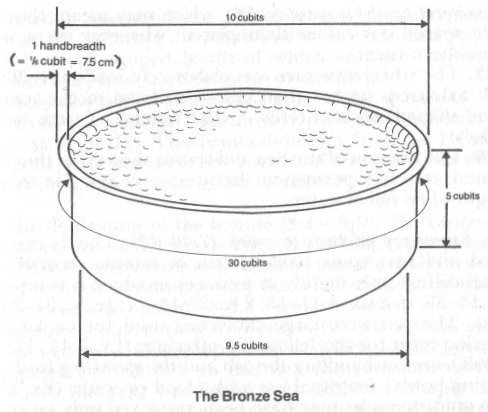
Now if: 1) the width of the cup-like rim was a "handbreadth", i.e. the same as the thickness of the wall of the basin; 2) the diameter "measuring ten cubits from rim to rim" was taken from the outer edge of the cup-like rim; and 3) the circumference measurement of "a line of thirty cubits around it") was taken was around the main body of the basin; all of which is entirely reasonable, then the actual dimensions (using cubits because there is no need to convert it into modern units-the result is the same) of the main cylindrical body of the basin would be: a) diameter 10 cubits, less two handbreadths of 1/6th each, i.e. 10 - 1/3 = 9 2/3 = 9.67 cubits; and b) circumference of 30 cubits. That yields a ratio of 30/9.67 = 3.102, which is only 0.04 (i.e. four hundredths) less than pi (3.142), again to the third decimal place.

There are in fact other ways to reconcile the measurements of this basin with pi (and I have posted some of them on various Internet forums, e.g. June 4, 2000 & May 3, 2005), but they usually rely on the inside circumference of the basin being measured, which on reconsideration I find less plausible. I regard this solution (which is my own-as far as I am aware) to be more plausible.

Later note: Yesterday (17 March 2006), I was in a Christian bookstore and I saw a commentary on 1 and 2 Kings, which I had never read before. I opened it at 1 Kings 7:23 to see what it said about the dimensions of the basin and about pi. It said nothing about pi, but it did have a drawing of the basin, which agrees with my proposal, except it makes a small mistake in giving the diameter of its cylinder body as 9.5 cubits, when 10 - (2 x 1/6) = 9 2/3 or 9.67 cubits. Indeed, that it did not even mention pi is evidence that that really is the best dimensions and measurements of the basin, independent of any question about pi. I also had since realised that being a casting, the width of the cup-like rim would almost certainly be a flared-out continuation of the thickness of the main body wall, which was 1/6th of a cubit (see above). Here is what the commentary said about this passage:

"1 KINGS 7:19-26 ... `The Bronze Sea' (7:23-26). This huge basin or reservoir was one of the great Hebrew technical works, corresponding in modern metallurgy to the casting of the largest church bell. It was viewed as a large expanse and volume of water (Heb. yam, `sea' is only used figuratively here, v. 23) and corresponded with the bronze basin in the tabernacle (Ex. 30:17-21). It was used by priests for cleansing their hands and feet and perhaps also to supply water to the standing basins for the rinsing of offerings (2 Ch. 4:10).
23. The size is given as five metres in diameter and two and a half metres in height and a handbreadth (v. 26, a sixth of a cubit = 7.5 cm.) thick. The capacity was about ten thousand gallons (two thousand baths is a measure, cf. the post-exilic `three thousand', 2 Ch. 4:5). [The bath is attested archaeologically as varying locally between 18 and 45 litres.] Its form has been reconstructed with the circumference given generally as thirty cubits." (Wiseman D.J., "1 and 2 Kings: An Introduction and Commentary," Tyndale Old Testament Commentaries," [1993], InterVarsity Press: Leicester UK, Reprinted, 2003, p.115)]

Stephen E. Jones, BSc. (Biol).
"Problems of Evolution"


"The difficulties which appear to oppose themselves to the reception of `Natural Selection' or `the survival of the fittest,' as the one explanation of the origin of species, have no doubt been already considered by Mr. Darwin. Nevertheless, it may be worth while to enumerate them, and to state the considerations which appear to give them weight; and there is no doubt but that a naturalist so candid and careful as the author of the theory in question, will feel obliged, rather than the reverse, by the suggestion of al the difficulties which can be brought against it. What is to be brought forward may be summed up as follows: That `Natural Selection' is incompetent to account for the incipient stages of useful structures. That it does not harmonize with the co-existence of closely similar structures of diverse origin. That there are grounds for thinking that specific differences may be developed suddenly instead of gradually. That the opinion that species have definite though very different limits to their variability is still tenable. That certain fossil transitional forms are absent, which might have been expected to be present. That some facts of geographical distribution intensify other difficulties. That the objection drawn from the physiological difference between `species' and `races' still exists unrefuted. That there are many remarkable phenomena in organic forms upon which `Natural Selection' throws no light whatever, but the explanations of which, if they could be attained, might throw light upon specific origination." (Mivart S.J., "On the Genesis of Species," Macmillan & Co: London & New York, Second edition, 1871, pp.24-25)

Gallup: More Than Half of Americans Reject Evolution, Back Bible

Gallup: More Than Half of Americans Reject Evolution, Back Bible, Editor & Publisher, March 08, 2006 ... NEW YORK A Gallup report released today reveals that more than half of all Americans, rejecting evolution theory and scientific evidence, agree with the statement, "God created man exactly how Bible describes it." Another 31% says that man did evolve, but "God guided." Only 12% back evolution and say "God had no part." Gallup summarized it this way: "Surveys repeatedly show that a substantial portion of Americans do not believe that the theory of evolution best explains where life came from." They are "not so quick to agree with the preponderance of scientific evidence." The report was written by the director of The Gallup Poll, Frank Newport. ... Newport wraps it up: "Several characteristics correlate with belief in the biblical explanation for the origin of humans. Those with lower levels of education, those who attend church regularly, those who are 65 and older, and those who identify with the Republican Party are more likely to believe that God created humans 'as is,' than are those who do not share these characteristics." Gallup has asked this question, in different forms, going back to 1982, but has consistently shown support at 45% or higher for the notion that "God created man in present form." The most recent poll, last September, posed the question this way: "Which of the following statements comes closest to your views on the origin and development of human beings." This produced the 53% who chose "God created man exactly how Bible describes it," the 31% who said man did evolve but "God guided," and the 12% who backed evolution with God playing "no part." ... [The first alternative, "God created man exactly how Bible describes it" is ambiguous, and the 53% would include Old Earth/Progressive Creationists who don't like the other two alternatives. Newport is correct that "Only 12% back evolution," since "God guided" evolution is "not evolution at all", as Darwin, Dawkins and the scientific community understand "evolution" to mean, "God had no part":

"Darwin wrote in a letter to Sir Charles Lyell, the leading geologist of his day: `If I were convinced that I required such additions to the theory of natural selection, I would reject it as rubbish...I would give nothing for the theory of Natural selection, if it requires miraculous additions at any one stage of descent.' This is no petty matter. In Darwin's view, the whole point of the theory of evolution by natural selection was that it provided a non-miraculous account of the existence of complex adaptations. For what it is worth, it is also the whole point of this book. For Darwin, any evolution that had to be helped over the jumps by God was not evolution at all." (Dawkins R., "The Blind Watchmaker," W.W. Norton: New York NY, 1986, pp.248-249. Emphasis Dawkins')

Therefore, those who reject evolution (in that all-important "standard scientific theory" sense):

"In one of the most existentially penetrating statements ever made by a scientist, Richard Dawkins concluded that `the universe we observe has precisely the properties we should expect if there is, at bottom, no design, no purpose, no evil and no good, nothing but blind, pitiless indifference.' Facing such a reality, perhaps we should not be surprised at the results of a 2001 Gallup poll confirming that 45 percent of Americans believe `God created human beings pretty much in their present form at one time within the last 10,000 years or so'; 37 percent prefer a blended belief that `human beings have developed over millions of years from less advanced forms of life, but God guided this process'; and a paltry 12 percent accept the standard scientific theory that `human beings have developed over millions of years from less advanced forms of life, but God had no part in this process.'" (Shermer M.B., "The Gradual Illumination of the Mind," Scientific American, February 2002. My emphasis)

are the vast majority totalling 84%!]

Stephen E. Jones, BSc. (Biol).
"Problems of Evolution"


"Admitting, then, organic and other evolution, and that new forms of animals and plants (new species, genera, etc.) have from time to time been evolved from preceding animals and plants, it follows, if the views here advocated are true, that this evolution has not taken place by the action of `Natural Selection' alone, but through it (amongst other influences) aided by the concurrent action of some other natural law or laws, at present undiscovered. It is probable also that the genesis of species takes place partly, perhaps mainly, through laws which may be most conveniently spoken of as special powers and tendencies existing in each organism; and partly through influences exerted on each such organism by surrounding conditions and agencies organic and inorganic, terrestrial and cosmical, among which the `survival of the fittest' plays a certain but subordinate part." (Mivart S.J., "On the Genesis of Species," Macmillan & Co: London & New York , Second edition, 1871, p.23. Emphasis original)

Tuesday, March 14, 2006

Study Explores Why Some Individuals Sacrifice To Help Others Reproduce, etc

Study Explores Why Some Individuals Sacrifice To Help Others Reproduce, ScienceDaily, March 9, 2006. In a new study forthcoming in the April 2006 issue of The American Naturalist, Peter Nonacs [et al.] explore a theory of social behavior that seeks to explain why some individuals willingly sacrifice their own reproduction to help raise others' offspring. "Transactional Skew" (TS) theory proposes that such cooperation is possible through "shared reproduction," making it worthwhile to help close relatives because some of the same genes are getting passed along. Thus, the degree of shared reproduction should vary across groups by the degree to which they are related. However, in a study across four species of paper wasps -- long considered one of the best examples supporting this theory -- the researchers found that not only was there cooperation and shared reproduction between sisters but also between distantly related or unrelated wasps. "This result strongly rejects the unique TS prediction that the level of cooperation should vary across groups according to the attributes of individual group members," says Nonacs. "[We] propose an alternative explanation in which wasps seek to cooperate with close kin, but less related groups sometimes form due to recognition errors." ... [So even in "one of the best examples supporting this theory," the Darwinist `selfish genes' explanation fails. If "wasps seek to cooperate with ...less related groups ...due to recognition errors" then those so-called "recognition errors" are the norm and that undermines the entire Darwinist `selfish genes' theory explanation of "why some individuals willingly sacrifice their own reproduction to help raise others' offspring"!]

Destroying Astrobiology Would be a `Disaster', SPACE.com, Rocco Mancinelli, SETI Institute, 4 March 2006 ...Astrobiology is the study of the origin, evolution, distribution, and future of life in the universe. As part of that, it seeks to understand the origin of the building blocks of life, how these building blocks combine to create life, how life affects and is affected by the environment from which it arose, and finally, whether and how life expands beyond its planet of origin. It requires studying fundamental concepts of life and habitable environments that will help us to recognize biospheres that might be quite different from our own. This includes studying the limits of life, life's phylogeny and effects of the space environment on living systems. Such fundamental questions require long term stable funding for the science community. This means keeping the NASA Astrobiology Institute (NAI) and the grants programs funded at healthy levels. The search for potentially inhabited planets beyond our solar system includes laboratory and field investigations of the origins and early evolution of life, and studies of the potential of life to adapt to future challenges, both on earth and in space. As such, astrobiology has never been, nor should it ever be, uniquely tied to a Mars Sample return mission, or human exploration of Mars. The broad interdisciplinary character of astrobiology compels us to strive for the most comprehensive and inclusive understanding of biological, planetary, and cosmic phenomena. NASA essentially developed astrobiology as a whole new interdisciplinary scientific field from scratch. It now has thousands of researchers, many international affiliates, multiple peer reviewed journals and is growing. Even NSF has been amazed by what NASA's astrobiology program has accomplished. Abandoning this field now would undermine some of the most exciting science NASA has going. ... [The fact is that astrobiology (i.e. exobiology renamed to make it sound like a new science), despite the billions spent on it, still "has yet to demonstrate that its subject matter exists", as Simpson pointed out over 40 years ago in 1964. The "thousands of researchers, many international affiliates, multiple peer reviewed journals and ... growing" is a byproduct of what origin of life researcher Jeffrey Bada noted of astrobiology that "one of the field's attractions was money--and lots of it." Indeed, such a large group of researchers dependent on ever-increasing amounts of taxpayer funding with no hard evidence "its subject matter exists," is a recipe to generate hyped claims about the existence of extraterrestrial life on various planets and moons (e.g. Saturn Moon Has Geysers, Hinting Life Is a Possibility, New York Times, March 10, 2006) both within and outside our Solar System. But personally I hope astrobiology does continue because its continual failure is evidence that life is unique to Earth!]

The Growing Habitable Zone: Locations for Life Abound, SPACE.com, Ker Than, 7 February 2006 ... In a galaxy filled with billions of stars, scientists searching for alien life need some way to pick out those which are most likely to harbor habitable planets and moons. For more than 150 years, an important tool in this screening process has been the concept of a "circumstellar habitable zone." Traditionally, this zone has been defined as a narrow disk around a star where temperatures are moderate enough that water on the surface of a planet can exist in a liquid form. The idea is that where liquid water exists, life might arise. Beginning in the latter half of the 20th century, new information began to emerge that challenged the traditional view. Scientists on Earth began finding rugged organisms thriving in harsh conditions that were off-limits to most other creatures. Meanwhile, images beamed back by robotic probes in space revealed that other moons within our solar system were much more interesting geologically-and perhaps biologically-than our own. However, beginning a decade ago, planets discovered around other stars began to reveal a diversity of planetary systems that was beyond expectations. More recently, scientists have gone back and reexamined their ideas about the possibility of habitable planet forming around red dwarf stars. Despite being the most abundant stars in the galaxy, red dwarfs have traditionally been shunned by scientists as being too small and too dim to support life. Those prejudices are beginning to fade and the recent discovery of a small, rocky world in orbit around a red dwarf 28,000 light-years from our corner of the solar system has refueled speculations that these stars might harbor planets with life ... [This older item from my backlog is a good (bad?) example of how astrobiology hypes up the case for extraterrestrial life. As pointed out in my post of 22-Feb-06, this "small, rocky world in orbit around a red dwarf" was "Just over five times heavier than Earth" and even "planets only a few times heavier than Earth ... the extra gravity ... would crush these minerals into ... semi-conductors or metals" resulting in "enhanced heat flow from the planet's core to the surface, which means more volcanoes and more `planetquakes':

"Astronomers have detected more than 150 planets orbiting nearby stars, raising hopes of finding another Earth ... But there may be more to finding that `goldilocks' planet, just the right size and distance from its star to match Earth, warns one research team. Last month, an international team reported in Nature that it had detected the smallest extrasolar planet orbiting a normal star yet. Just over five times heavier than Earth, OGLE- 2005-BLG-390Lb, is 28,000 light years away. It orbits two-and-a-half times further away from its star than Earth does the sun, and enjoys chilly temperatures of -364 degrees because of the dimness of its star. A few earlier discoveries of similarly-sized `extra solar' planets had also occurred, but all those orbit very close to their stars. But the discoveries show that astronomers are closing in on a planet in the `habitable zone' where temperatures are neither too cold or too hot for life ... But it may not be so easy, suggests University of Minnesota physicist Renata Wentzcovitch and colleagues in the current Science magazine. For `Super Earth' planets only a few times heavier than Earth, the interior chemistry of the planet's core may have a big effect on whether future space tourists will ever want to vacation there. In the study, the team looked at the `Super Earth' orbiting the star Gliese 876, 15 light years away. The researchers analyzed the chemistry of perovskite, an electronically inert mineral made of oxygen, silicon and magnesium, found in the mantle covering the iron cores of planets. On Earth, there is a thin layer of the stuff in the mantle. Through computer simulations, the study team found the extra gravity of a `Super Earth' (twice as strong on its surface as Earth's) would crush these minerals into new forms, ones that would take on the properties of semi-conductors or metals ...The result there would be enhanced heat flow from the planet's core to the surface, which means more volcanoes and more `planetquakes.' The effects on the planet's magnetic field, which on Earth shields the surface from solar radiation, of increased electrical activity in the mantle are more difficult to figure out, she says. The larger point is there is more to finding another Earth than detecting a planet the same size and same distance from its star, she says. Venus and Earth are very similar, she notes, but have significant differences in their interior chemistry. Venus has a more viscous interior that lead to a planet-sized earthquake hundreds of millions of years ago, she says, and that likely also explains the hellish conditions there, where 800-degree winds are lashed by sulfuric acid rain." (Vergano D., "Finding 'Super Earth' is a 'Goldilocks' errand," USA Today, February 19, 2006)

So from the failure to find truly Earth-like planets in a "circumstellar habitable zone," i.e. "a narrow disk around a star where temperatures are moderate enough that water on the surface of a planet can exist in a liquid form," astrobiology is now trying to make a virtue out of necessity by appealing to "a diversity of planetary systems that was beyond expectations" and ... rugged organisms thriving in harsh conditions that were off-limits to most other creatures". But these "harsh conditions" on Earth are still moderate compared with those on other planets and exoplanets. And that some organisms can adapt to extreme conditions (by Earth's standards) does not mean they could originate in such conditions. Such extremophiles have very complex genetic repair systems:

"How do they do it? What defenses do these frequently diminutive creatures (many are microbial, although not all - think penguins) mount against environmental conditions that would either pickle or pyrolize you and me? There are two fundamental strategies: erect a barrier against the elements, or change your metabolism. For example, some halophiles protect themselves from a saline environment by increasing the concentration of salts in their innards. With salinity about the same both within and without the cell, the halophile needn't fear that runaway osmosis will drain it of its precious water. If you can't defend against a brutal habitat, you can learn to love it. For example, psychrophiles come equipped with special proteins to adapt their lifestyle to the cold. Some of these proteins act as antifreeze to lower the freezing point of water, to prevent its congealing, expanding, and sundering the cell. Other proteins (enzymes) are specially formulated to ensure that chemistry continues even when the temperature dips to the single digits or lower. Many researchers are looking for ways to exploit the Darwinian inventiveness that has produced these extremophile defense mechanisms. For example, Deinococcus radiodurans, which boasts a highly sophisticated DNA repair shop within its tiny cell walls, is able to recover from exposure to massive doses of molecule-busting, high energy radiation by simply fixing the damage. It's hoped that this talent will prove useful in engineering microbes that can clean up radioactive spills, or possibly even protect us from skin cancer." (Shostak S., "Extremophiles: Not So Extreme?," SPACE.com/SETI Institute, 4 August 2005)

which would be an even greater problem for evolution if the original living organism "boasts a highly sophisticated DNA repair shop within its tiny cell walls"! Mind you, as it is, even simplest living organism has "a highly sophisticated DNA repair shop within its tiny cell walls"! In fact this very morning in my first draft of my book, "Problems of Evolution," I added to chapter 11 Major Transitions, 11.1 "Non-living to prokaryote," sections 11.1.6 "Error-checking" and 11.1.7 "Self-repair" to the necessary capabilties that the earliest living organisms would need to have.]

Stephen E. Jones, BSc (Biol).
"Problems of Evolution"


"Now we will revert simply to the consideration of the theory of `Natural Selection' itself. ... If the theory of Natural Selection can be shown to be quite insufficient to explain any considerable number of important phenomena connected with the origin of species, that theory, as the explanation, must be considered as so far discredited. If other causes than Natural (including sexual) Selection can be proved to have acted-if variation can in any cases be proved to be subject to certain determinations in special directions by different means than Natural Selection, it then becomes antecedently probable that it is so in other cases, and that Natural Selection depends upon, and only supplements, such means; which conception is opposed to the pure Darwinian position." (Mivart S.J., "On the Genesis of Species," Macmillan & Co: London & New York , Second edition, 1871, pp.21-22. Emphasis original)

Sunday, March 12, 2006

Mirecki: Beating up intelligent design

Beating up intelligent design, The Scientist, March 2006, Ishani Ganguli ... Late last year, following the Kansas State Board of Education's decision to treat evolution as a disputed theory in elementary and middle school classrooms, Paul Mirecki, a professor of religious studies at the University of Kansas, announced plans to teach a counter-course: Special Topics in Religion: "Intelligent Design, Creationism, and other Religious Mythologies." Soon after that, the trouble started. After comments Mirecki made about the course on a private listserv were made public in late November, the university reevaluated the class. "The fundies," Mirecki wrote of religious conservatives on Nov. 19, 2005, to a university group he advises, the Society of Open-Minded Atheists and Agnostics, "want it all taught in a science class, but this will be a nice slap in their big fat face by teaching it as a religious studies class under the category [of] mythology." Mirecki apologized for the comments and withdrew the course on Dec. 1, 2005, after additional controversial comments he made on the listserv, apparently disparaging a variety of groups and individuals, were published, says Lynn Bretz, University of Kansas spokesperson. Bretz says Mirecki had been making such comments for three years. About 30 students had already enrolled in the class. Early on the morning of December 5, Mirecki showed up at the emergency room of Lawrence Memorial Hospital with bruises. He told police he had been beaten on a rural road by two men who had referred to the course. The police investigation is still open, according to Lieutenant Kari Wempe of the Douglas County Sheriff's Office. Mirecki stepped down as chair of the department of religious studies two days after the alleged beating. He and the university administration said the resignation was voluntary, though his peers recommended the move. Mirecki later released a statement repudiating this. "I've become radioactive and the university's administrators won't support me," he wrote, and is considering suing the university. Though "a lot of people feel that it's really unfortunate what happened," says Jennifer Gleason, assistant professor in the University's department of ecology and evolutionary biology, "the [biology] department doesn't seem to be really doing anything about it or taking a stand or anything. Obviously we need to do a better job of educating the public about what evolution is about." Mirecki, who remains a tenured professor, is currently teaching "Understanding the Bible." He did not return calls for comment. As to whether an "intelligent design as mythology course" has a future at the University of Kansas, with or without Mirecki, the administration said in a December statement that it "continues to believe the course has merit and should be taught in the future." The university has "been very clear that neither [intelligent design] nor creationism should be taught as science," Bretz writes in an E-mail. ... [A fair summary which, by just telling the story, presents Mirecki in a poor light. Indeed, the headline, "Beating up intelligent design" makes it clear that it was Mirecki who did the beating up of ID, not the other way around.

I had expected that the police would by now have charged Mirecki with a hate-crime hoax, since his minor injuries did not match his claim of having been beaten "with their fists and a metal object for about a minute" and by Mirecki's own admission that the police treated him "more like a criminal than a victim." However, it seems they are just going to leave it open.

The atheist (and what's more anti-Christian) Mirecki teaching "Understanding the Bible" is another example of what Jesus observed:

"If a blind man leads a blind man, both will fall into a pit" (Mat 15:14).

That is because, as the Bible itself teaches, it can only be truly understood with the illumination of the indwelling Holy Spirit:

"The man without the Spirit does not accept the things that come from the Spirit of God, for they are foolishness to him, and he cannot understand them, because they are spiritually discerned." (1 Cor 2:14. My emphasis)

That is why Mirecki (and his ilk) cannot see the difference between the gnostic gospels (like his so-called "Gospel of the Savior") and the New Testament gospels. To him (and them) all religious writings (the Bible included) are just the fully naturalistic products of human beings, and so are all equally false.

If the University does teach an "intelligent design as mythology course" they would have to fully justify their claim from the ID movement's own writings (which is why they will never do it).

Gleason does not draw the obvious conclusion why "the [biology] department doesn't seem to be really doing anything about it" is that they, like Mirecki's own colleagues in the Religious Studies Department, don't believe Mirecki's version. And as for doing "a better job of educating the public about what evolution is about", Mirecki has in fact done that-evolution in the sense that the University of Kansas and other universities understand it, is atheistic (and therefore anti-Christian), i.e.:

"the standard scientific theory that `human beings have developed over millions of years from less advanced forms of life, but God had no part in this process.'" (Shermer M.B., "The Gradual Illumination of the Mind," Scientific American, February 2002. My emphasis)]

PS: I have added the following Mivart quote to my "Problems of Evolution" book outline, PE 2.8.6. "Fallacies used to support evolution ... Straw man". However, unlike Mivart (or maybe Mivart was just being polite?), I do regard Darwin's erecting of a straw man of his opponents' position as "intentional misrepresentation." I agree with the Darwinist Gillespie in the quote immediately above where I have put Mivart's, that "Darwin [in] setting up a straw man in order to improve the appearance of his own case ... had selected his target well and knew exactly what he was doing" !

Stephen E. Jones, BSc (Biol).
"Problems of Evolution"


"Nothing could be further from Mr. Darwin's mind than any, however small, intentional misrepresentation; and it is therefore the more unfortunate that he should not have shown any appreciation of a position opposed to his own other than that gross and crude one which he combats so superfluously-that he should appear, even for a moment, to be one of those, of whom there are far too many, who first misrepresent their adversary's view, and then elaborately refute it; who, in fact, erect a doll utterly incapable of self-defence, and then, with a flourish of trumpets and many vigorous strokes, overthrow the helpless dummy they have previously raised. This is what many do who more or less distinctly oppose theism in the interests, as they believe, of physical science; and they often represent, amongst other things, a gross and narrow anthropomorphism as the necessary consequence of views opposed to those which they themselves advocate." (Mivart S.J., "On the Genesis of Species," Macmillan & Co: London & New York, Second edition, 1871, p.19)

Darwin smacked in new U.S. poll, etc

Darwin smacked in new U.S. poll: Whopping 69 percent of Americans want alternate theories in classroom, WorldNetDaily, March 7, 2006 ... A new poll shows 69 percent of Americans believe public school teachers should present both the evidence for and against Darwinian evolution. The Zogby International survey indicated only 21 percent think biology teachers should teach only Darwin's theory of evolution and the scientific evidence that supports it. A majority of Americans from every sub-group were at least twice as likely to prefer this approach to science education, the Zogby study showed. About 88 percent of Americans 18-29 years old were in support, along with 73 percent of Republicans and 74 percent of independent voters. Others who strongly support teaching the strengths and weaknesses of evolutionary theory include African-Americans (69 percent), 35-54 year-olds (70 percent) and Democrats (60 percent). ... [It is noteworthy that the USA secular media seem to have ignored this completely, a Google search on "Zogby" + "evolution" returning only hits in India and at Christian and ID sites. This 69% of all Americans who want "the evidence for and against Darwinian evolution" to be taught in schools is a marked increase on the Zogby poll's ~64% in 2000. Even Democrats (60%) were strongly in favour, so it can hardly be claimed that only the so-called "religious right" want students to be taught the problems of evolution and its main alternatives. But it is the overwhelming (88%) support among 18-29 year olds that must really be a worry for the Darwinists and provide encouragement for the ID movement that inevitably the courts are going to start reflecting the majority view of the USA public on this issue. See also next item.]

Creationism to be taught on GCSE science syllabus: Exam board is accused of confusing pupils by including religion, The Times, March 10, 2006, Tony Halpin, AN EXAMINATIONS board is including references to ...creationism... in a new GCSE science course for schools. The OCR board admitted that a biology course due to be introduced in September encourages schools to consider alternative views to Charles Darwin's theory of evolution. Its new "Gateway to Science" curriculum asks pupils to examine how organisms become fossilised. It then asks teachers to ...explain that the fossil record has been interpreted differently over time (eg creationist interpretation).... OCR, one of the three main exam boards in England, said that the syllabus was intended to make students aware of scientific controversy. But critics accused the board of blurring the line between science and religious education by putting creationism into lessons alongside evolution. A spokeswoman for OCR said: ...Candidates need to understand the social and historical context to scientific ideas both pre and post Darwin. Candidates are asked to discuss why the opponents of Darwinism thought the way they did and how scientific controversies can arise from different ways of interpreting empirical evidence.... John Noel, OCR's science qualifications manager [said] ... "It is simply looking at one particular example of how scientific interpretation changes over time. The history of scientific ideas not only has a legitimate place in science lessons, it is a requirement of the new programme of study." But James Williams, science course leader at Sussex University's school of education, said: "This opens a legitimate gate for the inclusion of creationism or intelligent design in science classes as if they were legitimate theories on a par with evolution fact and theory. I'm happy for religious theories to be considered in religious education, but not in science where consideration could lead to a false verification of their status as being equal to scientific theories." ... [See also BBC, The Guardian and the OCR. If the goal of education is to help students understand issues they will encounter as citizens in the adult world, then this is a step in the right direction. It will also highlight the incongruity of the situation in the USA, supposedly the world's exemplar of free speech, where a series of bizarre interpretations of the US Constitution's First Amendment prohibiting the Federal legislature establishing a State religion, means that USA students are not allowed to find out officially in school what they can find out on the Internet or in the newspapers, that there are in fact "alternative views to Charles Darwin's theory of evolution"!]

Stephen E. Jones, BSc (Biol).
"Problems of Evolution"


"Still, in so important a matter, it is to be regretted that he [Darwin] did not take the trouble to distinguish between such merely popular notions [of creation] and those which repose upon some more venerable authority. ... Instead of so doing, he seems to adopt the narrowest notions of his opponents, and, far from endeavouring to expand them, appears to wish to endorse them and to lend to them the weight of his authority. It is thus that Mr. Darwin seems to admit and assume, that the idea of `creation' necessitates a belief in an interference with or dispensation of, natural laws, and that `creation' must be accompanied by arbitrary and unorderly phenomena. None but the crudest conceptions are placed by him to the credit of supporters of the dogma of creation, and is constantly asserted that they, to be consistent, must offer `creative fiats' as explanations of physical phenomena, and be guilty of numerous other such absurdities. It is impossible, therefore, to acquit Mr. Darwin of at least a certain carelessness in this matter; and the result is, he has the appearance of opposing ideas which he gives no clear evidence of having ever fully appreciated. He is far from being alone in this, and perhaps merely takes up and reiterates, without much consideration, assertions previously put, forth by others." (Mivart S.J., "On the Genesis of Species," Macmillan & Co: London & New York, Second edition, 1871, p.18)

Saturday, March 11, 2006

Re: If our ancestors where some ape-like creatures why we still don't see any of them around today?

AN

I am copying my reply to my blog CED (minus your personal details). Please do not interpret this as an invitation to have an extended debate, as it isn't. As I have said before, I started this blog and closed down my Yahoo list CED, so that after 10+ years of debates on C/E lists, I would have more time to write my book, "Problems of evolution". My words are bold to more easily distinguish them from yours.

----- Original Message -----
From: AN
To: Stephen E. Jones
Sent: Saturday, March 11, 2006 5:36 PM
Subject: Family may provide evolution clue, etc
AN>Hello Stephen,
>
>I follow your Blog in a daily basis and I find it very informative indeed. Since your Blog doesn't allow anonymous comments I send my comments regarding your last two posts via email.

Thanks. I decided to allow comments only by registered users to cut down the number of comments.

AN>-Family may provide evolution clue, etc.
>-Gene regulation separates humans from apes: study, etc
>Your posts arised those questions that have been left unanswered in my mind once again.
>
>1)If our ancestors where some ape-like creatures why we still don't see any of them around today?

The Theory of Universal Common Ancestry does not claim that the actual ancestral species must continue to exist forever (since no species does). Its claim is that existing species share a common ancestor. In the case of humans, hominids and apes, it would have been "some ape-like creatures" which were members of a species that has since gone extinct.

AN>This question is a vital one which if left unanswered alone is enough to ruin all of those -already too fragile- bases of the Evolution Theory.

It has not been "left unanswered" and I have now answered it. And I am not arguing for "the Evolution Theory" but rather the Universal Common Ancestry Theory. They are not the same thing (see my Common ancestry is not necessarily evolution). To put it simply:

"the standard scientific theory [of evolution is] that `human beings have developed over millions of years from less advanced forms of life, but God had no part in this process.'" (Shermer M.B., "The Gradual Illumination of the Mind," Scientific American, February 2002. My emphasis).

It is not sufficient for the standard scientific theory of evolution that "human beings have developed over millions of years from less advanced forms of life," since "God [may have] guided this process," which the standard scientific theory evolution rejects and labels those who believe that, like ID theorist Mike Behe, creationists:

"Intelligent-design theorist Michael Behe has said that he has no reason to doubt the truth of common descent, but he does doubt the power of natural selection to shape the full range of biological complexities. In Darwin's Black Box he claims to have found a number of such "complex organs" to prove his case. This is clearly an important claim. ... So what does Behe have to say? We already have a fairly clear idea given our earlier discussions of critical passages from Darwin's Black Box Behe hopes to show the impotence of Darwinism by pointing out purportedly profound explanatory gaps. Trying to do this is nothing new. ICR's Duane Gish has tried to do this by pointing out gaps in the fossil record. ... Indeed, as we saw, almost every creationist attack proceeds in the same way, by citing something that Darwinism supposedly cannot explain." (Pennock, R.T., "Tower of Babel: The Evidence Against the New Creationism," The MIT Press: Cambridge MA, 1999, Fourth printing, p.264. My emphasis).

AN>The main idea here is that if at some point in the past some line of apes separated, evolved and became human, why we still can't see some of those ancestors around?

See above. Since the ape-human common ancestor split was about ~6 million years ago and species tend to last an average of 1-3 million years, it would be unlikely (but not impossible) that the ancestral species from which humans and apes diverged existed today. However, what would probably be impossible is proving that it was the ancestral species, since both genomes would have changed in the intervening (combined ~12 million-year) period.

AN>As we can see today there is a big diversity among human races and their living conditions. From primitive tribes in Africa and Australia to Advanced urban areas in every places around the world. We can find isolated areas where primitive human races still exists but we are unable to find any places where pre-human races also exists. Why?

See above. Actually, there is not "a big diversity among human races". Humans across the world are genetically more similar than the two species of African chimpanzees, Pan troglodytes (common chimpanzee) and Pan paniscus (bonobo), (but unfortunately I cannot find on my system a quote to support that in the short time I have allocated to this post).

AN>There must be some places where some of those ancestors of homo-sapiens could successfuly be preserved and survive till 20th century. Am I missing something here?

Yes you are indeed "missing something here" (see above). The propositions that: 1) humans and apes share a common ancestor; but 2) that ancestral species has become extinct; are perfectly logical and reasonable, given the time the split occurred (~6 mya) exceeds by many times the average duration of species (~1-3 myrs).

AN>According to Darwinism the fittest will survive better but it doesn't necessariliy means that the less fit will not survive at all.

I am not arguing for "Darwinism". Common ancestry is not "Darwinism." Common ancestry is a relationship whereas Darwinism is a mechanism, the natural selection of random mutations.

As long as those less fit homo-sapiens could produce offsprings and find an isolated area to live and reproduce, then we must be able to find a few of them somewhere in someplaces in Africa where believed our ancestors were coming from.

The above is a truism. But the fact that we don't "find a few of them somewhere in someplaces in Africa" (i.e. members of the common ancestral species of apes and humans) means they are extinct.

AN>But not even one single species of our claimed transional races could ever been found. Am I right? Why all we have in present world is only apes and humans but not something inbetween?

The "transitional races" between the ape-human ancestral split are the extinct hominids, e.g. Australopithecines, Homo erectus, Homo neanderthalensis (Neanderthal man), etc.

AN>2) The Intelligence/IQ factor.
Now assume you go to a deep jungle, find a totally isolated primitive tribe which never ever heard of a bit of modern world technology and science. Now take one of their offsprings and bring him to modern world and raise him in a school teaching him modern sciences. It is very likely for him to to become an astrophysicist. Isn't it? His family has no inherited knowledge or ability beyond making primitive tools, but that guy could go much beyond his inherited abilities. Why? According to Darwinism a life form must only have the least set of abilieties required for it to fit in its particular environment. Like any other human properties if IQ is also a product of RM/NS and environmental adaptation/changes then how our imaginary guy with parents raised in a very primitive environment can have an IQ equal or even more compared to human species living in the urban areas? How such high level of IQ could pre-exist or develop in a primitive environment where there is actually no need for it?
Isn't it evidence for the fact that source of human Intelligence has nothing to do with those so-called evolutionary RM/NS processes.

This is confusing "Darwinism" (a mechanism) with common ancestry (a relationship). See above.

AN>3)Mutations, genes, IQ Factor and Information Technology.
Compare an ape's intelligence with IQ of human. First one is not even able to count from 1 to 3 on the other hand the other is able to understand Theory of relativity. Now roughly consider how much changes are required for one to transform into the another. Also from an Information Technology point of view try to imagine the software/hardware complexity difference between these two type of intelligent machines. If you ask an IT professional a question such as "hey I have a software that can only count from 1 to 10 but I also have a piece of genius artificialy intelligent software that can be taught to understand the Theory of relativity and also bring new insights to it, tell me how much more lines of codes are required for the second one?"
He would probably answer even millions of lines of code could not just be enough. Also he would notice that the algorithms required for second software would be far too complex than our current understanding of artificial intelligence which can't even mimic 1/1000 of it.
if only less than 4 per cent of the chimpanzee's genetic code is different from humans, how this amount of complexity difference required for these two types of "intelligent machines" can exist at first place? I also don't take this into account that much of those %4 also code for appearance differences between man and ape.

It is actually less than 2% "of the chimpanzee's genetic code [that] is different from humans". But that is ~2% of a genome of ~25,000-30,000 genes, i.e. ~500-600 genes, and even one gene can make a big difference (e.g. sickle cell anaemia). But there are also important cell, chromosome and gene regulation (see "Most Human-chimp Differences Due To Gene Regulation -- Not Genes," Science Daily, March 10, 2006) differences between humans and chimps.

Also back to the above section "2) The Intelligence/IQ factor" I need to ask once again; why this amount of intelligence complexity pre-exists in human machines who live in primitive conditions that actually have no enviromental or selective pressure to force them to raise their IQ to such higher levels?

This may well be an argument against Darwinism, but it is irrelevant to the question of whether apes and humans share a common ancestor.

AN>Well the Intelligent Design theory can have very good answers to above questions but Darwinisms can't even come close to a satisfactory or rational explanation for them.

Again you are confusing "Darwinism" with common ancestry. "Intelligent Design theory" per se has no position for or against common ancestry. Proof of that is that Mike Behe is a leader of the Intelligent Design movement and he accepts common ancestry (see Behe M.J., "Darwin Under the Microscope," New York Times, October 29, 1996).

AN>Best regards
>AN

Stephen E. Jones, BSc (Biol).
"Problems of Evolution"

Friday, March 10, 2006

Family may provide evolution clue, etc

Family may provide evolution clue, BBC, 7 March 2006 ... Five siblings from Turkey who walk on all fours could provide science with an insight into human evolution, researchers have said. The four sisters and one brother could yield clues to why our ancestors made the transition from four-legged to two-legged animals, says a UK expert. But Professor Nicholas Humphrey rejects the idea that there is a "gene" for bipedalism, or upright walking. .... Professor Humphrey ... says that our own species' transition to walking on two feet must have been a more complex process that involved many changes to the skeleton and to the human genetic make-up. However, a German group says a genetic abnormality does seem to be involved in the siblings' gait. ... Three of the sisters and one brother have only ever walked on two hands and two feet, but another sister alternates between a bipedal and quadrupedal gait. Another brother walks on two feet all the time, but only with difficulty. ... The siblings ... were born with what looks like a form of brain damage. MRI scans seem to show that they have a form of cerebellar ataxia, which affects balance and coordination. However, scientists are divided on what caused them to revert to quadrupedalism (walking on all fours). The method of locomotion used by the Turkish children and by our closest relatives chimpanzees and gorillas, differs in a crucial way, said Professor Humphrey. While gorillas and chimpanzees walk on their knuckles, the Turkish siblings put their weight on the wrists, lifting their fingers off the ground. ... "What's significant about that is that chimpanzees ruin their fingers walking like that," ... "These kids have kept their fingers very agile, for example, the girls in the family can do crochet and embroidery." He added that calluses pictured on the hands of one family member demonstrated that the behaviour was not a hoax. Professor Humphrey said this could be the way that humankind's direct ancestors walked. Hands which have kept the fingers dextrous would also have been able to manipulate tools, a key development which influenced the evolution of the human body and intelligence. "I think it's possible that what we are seeing in this family is something that does correspond to a time when we didn't walk like chimpanzees but was an important step between coming down from the trees and becoming fully bipedal," the LSE researcher said. 'Infant walking' Professor Humphrey thinks that the brain abnormality simply caused the siblings to rediscover a form of locomotion used by our ancestors. "Because of the peculiar circumstances they were in, they kept walking as infants," he said. But a team led by Stefan Mundlos of the Max Planck Institute in Berlin, Germany, thinks that the genetic abnormality which causes the children's unusual gait may have played a more fundamental role in evolution. Professor Mundlos has located the gene on chromosome 17 and speculates that a gene important in the transition to bipedalism may have been knocked out in the children. ... [I doubt that this has anything to do with the human transition from quadrupedalims to bipedalism, for the simple reason that chimps, other apes and even monkeys can walk bipedally (although they cannot adopt a striding gait-which is the unique feature of human bipedalism), whereas some members of this unfortunate family cannot walk bipedally at all. That they save their fingers from being ruined by using their wrists (indeed the photo shows one of them at least using shoes on her hands) hardly needs a fancy `evolutionary' explanation!]

Liquid water on Saturn moon could support life: Cassini spacecraft sees signs of geysers on icy Enceladus, MSNBC, Alan Boyle, March 9, 2006 ... Scientists have found evidence that cold, Yellowstone-like geysers of water are issuing from a moon of Saturn called Enceladus, apparently fueled by liquid reservoirs that may lie just tens of yards beneath the moon's icy surface. The surprising discovery, detailed in Friday's issue of the journal Science, could shoot Enceladus to the top of the list in the search for life elsewhere in our solar system. Scientists described it as the most important discovery in planetary science in a quarter-century. "I think this is important enough that we will see a redirection in the planetary exploration program," Carolyn Porco, head of the imaging team for the Cassini mission to Saturn, told MSNBC.com. "We've just brought Enceladus up to the forefront as a major target of astrobiological interest." The readings from Enceladus' geyser plumes indicate that all the prerequisites for life as we know it could exist beneath Enceladus' surface, Porco said. "Living organisms require liquid water and organic materials, and we know we have both on Enceladus now," she said. "The plumes through which Cassini flew last July contain methane, contain CO2, propane - they contain several organic materials." The third necessary ingredient - energy for fueling life's processes - could exist around hydrothermal vents around the bottom of Enceladus' water reservoirs, just as it does around Earth's deep-ocean hydrothermal vents. ... [This continues the delusion (or the wilful misleading of the taxpayer) that if "all the prerequisites for life as we know it ... exist" then life will exist. But a half-century plus of assembling "all the prerequisites for life as we know it" in laboratory experiments has not produced life, or anything even close to it. As the biophysicist Blum pointed out in 1951 (before the 1953 Miller-Urey experiment), that it "no more follows" that "once the proper molecular compounds were there, life would appear" than "that an automobile ... might spring spontaneously from a mixture of all the chemical species from which it is composed":

"The living machine is clearly not just a mixture of chemicals, yet there seems to be widespread belief that, once the proper molecular compounds were there, life would appear, whether on the earth, on Mars, or elsewhere in the universe. This no more follows, I may point out at the risk of being thought overly facetious, than that an automobile, 1962 model, might spring spontaneously from a mixture of all the chemical species from which it is composed. " (Blum H.F., "Time's Arrow and Evolution," [1951], Harper Torchbooks: New York NY, Second Edition, 1955, Revised, 1962, p.178G)

As with an "automobile" what is needed to turn parts into a functioning machine (in this case a "living machine", i.e. a self-replicating Von Neumann machine), is intelligent design! I wonder if astrobiologists despatch a probe to Enceladus specifically to look for signs of life, such that if there was life there it would find it, and there wasn't, would that falsify the `life is just physics and chemistry' scientific materialist paradigm? If not, then in what sense is it falsifiable and therefore science (according to their own demarcation criteria by which they dismiss ID)?]

Stephen E. Jones, BSc (Biol).
"Problems of Evolution"


"Moreover, in estimating the vehemence of the opposition which has been offered, it should be borne in mind that the views defended by religious writers are, or should be, all-important in their eyes. They could not be expected to view with equanimity the destruction in many minds of `theology, natural and revealed, psychology, and metaphysics;' nor to weigh with calm and frigid impartiality arguments which seemed to them to be fraught with results of the highest moment to mankind, and, therefore, imposing on their consciences strenuous opposition as a first duty. Cool judicial impartiality in them would have been a sign perhaps of intellectual power, but also of a grievous deficiency of generous emotion. It is easy to complain of onesidedness in the views of many who oppose Darwinism in the interest of orthodoxy; but not at all less patent is the intolerance and narrow-mindedness of some of those who advocate it, avowedly or covertly, in the interest of heterodoxy." (Mivart S.J., "On the Genesis of Species," Macmillan & Co: London & New York, Second edition, 1871, p.16)

Thursday, March 09, 2006

Gene regulation separates humans from apes: study, etc

Gene regulation separates humans from apes: study, ABC March 9, 2006. ? Why are humans and apes so different if their genomes are so similar? Less than 4 per cent of the chimpanzee's genetic code is different from humans - a tally so tiny that some speculate the distinction between primates may lie in just a handful of key genes - perhaps as few as 50 out of 20,000 or so in the human genome. But a study published on Thursday in Nature, the British science weekly, suggests the truth lies elsewhere. Put simply, the researchers say it is not the number of genes that counts but the way they operate. ... Genes are the codes for making proteins, the molecules that make up cells and direct their operations. The molecular ballet of proteins is extraordinarily complex and even slight changes in gene regulation can have enormous repercussions on anatomy and behaviour. Researchers led by Yoav Gilad, an assistant professor of genetics at the University of Chicago, looked at the expression of 1,056 genes in ? man, the orangutan, chimpanzee and rhesus macaque monkey ... Sixty per cent of these genes - mainly involved in basic cellular processes - are pretty much unchanged in their expression patterns. The big difference was in a group of genes for transcription factors - important genes that control the expression of other genes. Hominids split with chimps, the last break in the common primate lineage, around 5 million years ago. Since then, transcription factor genes among humans are four times more likely to have changed expression patterns as the genes they regulate. But there was no such change among the other primates. "The big question is why are humans so different?" associate professor Gilad said. "What sort of changes in the environment or lifestyle would drive such a rapid shift in the expression of genes - in this case the liver - in humans and no other primate?" Associate professor Gilad speculates that the answer could lie in the acquisition of fire, one of the fundamental differences between humans and animals. "No other animal relies on cooked food," associate professor Gilad said. "Perhaps something in the cooking process altered the biochemical requirements for maximal access to nutrients as well as the need to process the natural toxins found in plant and animal foods." The idea that gene expression, rather than the raw number of genes, could explain the differences between primates was first aired in 1975. But until now, lack of technology prevented the theory from being taken further. ... [This shows how misleading is the claim that based on their genes, humans are just another form of chimps, and the latter should have human rights. Also, Darwinists usually assume that form follows function (i.e. "changes in the environment or lifestyle" leads to changes in genes) and rarely (if ever) that function follows form (i.e. changes in genes leads to changes in lifestyle). It seems to me that the latter is much more likely. After all, humans have now been living in every continent for tens of thousands of years, under every different environments, and their genes have changed only superficially. This is a point made by Pierre Grasse:

"Man is one of the most cosmopolitan terrestrial animals; he lives in all kinds of climates. He underwent several thousand types of mutations, judging from the number of alleles reported in the various human populations presently comprising three billion individuals, all showing different genotypes .... The potential supply of mutants for selection is thus very abundant. What has happened, then? Nothing important or even noticeable. ... Mutations do differentiate individuals, but the human species, despite the magnitude of its population and the diversity of its habitats, both of which are conditions favorable for the evolution of the human species, exhibits anatomical and physiological stability. In wealthy western societies natural selection is thwarted by medical care, good hygiene, and abundant food, but it was not always so. Today in underdeveloped countries, where birth and death rates are equally high (tropical Africa, Amazonia, Pakistan, India, Patagonia, some Polynesian islands), natural selection can exert its pressure freely; yet the human type hardly changes. ... Within each population, men differ by their genotype, and yet the species Homo sapiens has not modified its plan or structure of functions. To the common base are added a variety of diversifying and personifying ornaments, totally lacking evolutionary value." (Grasse P.-P., "Evolution of Living Organisms: Evidence for a New Theory of Transformation," [1973], Academic Press: New York NY, 1977, pp.85-86)]

S.C. Schools Won't 'Analyze' Evolution: S.C. Board of Education Rejects Call to 'Critically Analyze' Evolution, ABC News ? COLUMBIA, S.C. Mar 8, 2006 (AP) - The state Board of Education on Wednesday rejected a state panel's proposal to change high school standards on evolution by calling on students to "critically analyze" the theory. Science teachers had complained that although critical analysis is part of all science, the wording was really a backdoor attempt to force educators to teach religious-based alternatives. In a 10-6 vote, board members agreed. The Education Oversight Committee, a school reform panel made up of lawmakers, teachers, parents and other community members, recommended the change last month. Panel member Sen. Mike Fair, R-Greenville, has said it was intended to introduce students to challenges to evolutionary theory. Education Superintendent Inez Tenenbaum, a Democrat, has called the effort "a ploy to confuse the issue of evolution so that ultimately evolution won't be taught." ... [The more the Darwinists seek to protect their sacred cow from criticism, the more students will (at least subconsciously) consider that evolution is a weak theory that cannot withstand criticism!]

Santorum writes foreword for book on intelligent design, Wilkes Barre Times-Leader/AP, Mar. 08, 2006, Kimberly Hefling ?WASHINGTON - Pennsylvania Sen. Rick Santorum wrote the foreword for a new book praising a retired law professor sometimes called the father of the intelligent-design movement. The book, "Darwin's Nemesis: Phillip Johnson and the Intelligent Design Movement," consists of 18 essays honoring Johnson's work, according to the publisher, InterVarsity Press. It was edited by William A. Dembski, and is available in April. .... Johnson's 1991 book "Darwin on Trial" has been credited with helping to facilitate the intelligent design movement into the classroom. Santorum, the No. 3 Senate Republican, praises Johnson in the foreword as someone who has helped promote a group of leaders in the cause of "scientific renewal," .... Santorum also credits Johnson with assisting him in his efforts to "inject a renewed and unbiased understanding of science and its practice into the curricula of our public schools." "The importance of the cause is clear: what could be more important than showing that only a shallow, partisan understanding of science supports the false philosophy of materialist reductionism with its thoroughly unscientific denial of formal and final causes in nature and its repudiation of the first cause of all being?" Santorum said as the decline "of true science has been a major factor in the decline of Western culture, so too the renewal of science will play a big part in cultural renewal." ... [For those who can't wait to read this (like me!), there is an online Preface by William A. Dembski and Chapter 1. Your Witness, Mr. Johnson: A Retrospective Review of Darwin on Trial by Stephen Meyer.]

Stephen E. Jones, BSc (Biol).
"Problems of Evolution"

I ... favor ... "alien" colonization for the original ... organisms on this planet

Joe

I am also responding here by a blog post to your follow-up comment because it raised the issue of Panspermia. Again my words are in bold to distinguish them from yours. I am still working on part #2 of my response to your first comment.

Joe G said...

JG>You are on no schedule to respond to my rants. That you responded at all is good enough. Thank you.

If it was just a "rant" I would not have responded.

JG>Common ancestry- I have read most of what you posted in your essay. Obviously I missed (didn't read) some of your other work or I would have (and should have) realized you already discussed the "Essential genome of minmal bacterium". My apologies for that.

Thanks, but there was no need to apologise.

JG>My point is what can be modified in a population of "bone-less" inverts that would give rise to "boned" vertebrates?

Bone is a soft tissue that hardens, being derived from mesoderm tissue. After all, boneless (e.g. human) vertebrate embryo becomes a boned vertebrate adult. There is also an intermediate between bone and boneless, namely cartilage, not to mention the calcium exoskeleton secreted by molluscs and indeed the calcium endoskeleton in echinoderms (starfish).

JG>The only answer I ever get is "DNA!", which I say is a bogus "answer".

It is not only "DNA" but new specialised bone-forming cells including osteocytes.

JG>But hey I am the lunatic who favors "alien" colonization for the original populations of organisms on this planet. And even though that just "pushes things back" I say that science has to go with what we have and keep searching for more. IOW solve OUR reality then figure out the next step.

As your critics say, it just "pushes things back". The same problems of life originating and developing (including boneless becoming bone) had to be solved somewhere.

A major problem with interstellar panspermia (apart from cosmic radiation which would sterilise any life enroute to Earth across interstellar distances) is the time frame. The Universe is ~14 billion years old and life on Earth began ~4 bya. That was when the Universe was ~10 billion years old and a very different place. The volume of space was much smaller (since volume increases by the cube of distance) and radiation much greater because radiation falls off with the square of distance. So the combined effect of both was that radiation was very much greater. For life to arise somewhere else, develop, then cross interstellar space and arrive here, means it had to originate well before ~4 bya (say ~5 bya) when the Universe was an even more hostile place.

There is also the `needle in a haystack problem' that one of my (atheist) biology lecturers pointed out. The Earth from the perspective of another interstellar exoplanet is an invisible point (even with a telescope). Unless one is arguing for Directed Panspermia (in which case one has to factor in the extra time frame for intelligent technological beings to arise- on Earth it took ~4 billion years), it is effectively impossible for a bacterium to be wafted undirected by its star's solar wind (which raises another problem in that our star's (the Sun) solar wind would blow it away from our Solar System), and find Earth (and then survive the entry on an Earth that was undergoing the Late Heavy Bombardment ~3.9 bya with lethal UV rays on its surface since there was no ozone layer).

I have added the above (in a clearer 6-point format) to my "Problems of Evolution" book outline, PE 7.6.4. "Problems of origin of life locations ... Panspermia".

JG>Off topic:

But here is a serious question- DNA replication and transcription-

It's not "off topic".

JG>When the DNA is "unzipped" an existing "stock-pile" of nucleotides is used to make the necessary copy (either of the entire sequence or the "gene").
>
>Where does that "stock-pile" come from? I can't find it in any biology literature.

The "stockpile" is comprised of "deoxynucleoside triphosphates" "(dATP, dTTP, dGTP, and dCTP)" which are in the cell nucleus' cytoplasm and are added by DNA polymerase (an RNA/protein molecular machine) according to Watson-Crick complementary base-pairing rules, to a single strand of DNA (exposed by DNA polymerase):

"When the semiconservative model of DNA replication was first proposed in the early 1950s, biologists thought that DNA replication was so complex it could be carried out only by intact cells. A few years later, however, Arthur Kornberg found that an enzyme he had isolated from bacterial cells could copy DNA molecules in a test tube. This enzyme, which he named DNA polymerase, required that a small amount of DNA be initially present to act as a template. In the presence of such a template, DNA polymerase catalyzes the elongation of DNA chains using as substrates the triphosphate deoxynucleoside derivatives of the four bases found in DNA (dATP, dTTP, dGTP, and dCTP). As each of these substrates is incorporated into a newly forming DNA chain, its two terminal phosphate groups are released. Since deoxynucleoside triphosphates are high-energy compounds whose free energy of hydrolysis is comparable to that of ATP, the energy released as these phosphate bonds are broken drives what would otherwise be a thermodynamically unfavorable polymerization reaction. In the DNA polymerase reaction, incoming nucleotides are covalently bonded to the 3' hydroxyl end of the growing DNA chain. Each successive nucleotide is linked to the growing chain by a phosphoester bond between the phosphate group on its 5' carbon and the hydroxyl group on the 3' carbon of the nucleotide added in the previous step .... In other words, chain elongation occurs at the 3' end of a DNA strand and the strand is therefore said to grow in the 5' -> 3' direction." (Becker W.M., Kleinsmith L.J. & Hardin J., "The World of the Cell," [1986], Benjamin/Cummings: San Francisco CA, Fourth edition, 2000, p.540)

By the way, DNA polymerase seems to be yet another rotary molecular machine!

I assume the deoxynucleoside triphosphates in turn are formed by other cellular machinery from the nucleotide bases and phosphates in food. Although photosynthetic bacteria (cyanobacteria again) and plants don't ingest food with A,T,G & C in them (they make their food from the carbon and oxygen in the air and water, and take in soluble phosphorous in water) so maybe animals synthesise the deoxynucleoside triphosphate DNA precursors (dATP, dTTP, dGTP, and dCTP) from scratch? The four DNA nucleotide bases, Adenosine (A), Thymine (T), Guanine (G) and Cytosine (C) are comprised only of N, H and O molecules.

It was, by the way, "biologists' investigation of DNA" which was specifically cited by fomer leading atheist Antony Flew (author of a book "Darwinian Evolution"), as among "the almost unbelievable complexity of the arrangements which are needed to produce (life)" that convinced him "intelligence must have been involved":

"A British philosophy professor who has been a leading champion of atheism for more than a half-century has changed his mind. He now believes in God -- more or less -- based on scientific evidence, and says so on a video released Thursday. At age 81, after decades of insisting belief is a mistake, Antony Flew has concluded that some sort of intelligence or first cause must have created the universe. A super-intelligence is the only good explanation for the origin of life and the complexity of nature, Flew said in a telephone interview from England. Over the years, Flew proclaimed the lack of evidence for God while teaching at Oxford, Aberdeen, Keele, and Reading universities in Britain, in visits to numerous U.S. and Canadian campuses and in books, articles, lectures and debates. There was no one moment of change but a gradual conclusion over recent months for Flew, a spry man who still does not believe in an afterlife. Yet biologists' investigation of DNA "has shown, by the almost unbelievable complexity of the arrangements which are needed to produce (life), that intelligence must have been involved," Flew says in the new video, "Has Science Discovered God?" … The first hint of Flew's turn was a letter to the August-September issue of Britain's Philosophy Now magazine. "It has become inordinately difficult even to begin to think about constructing a naturalistic theory of the evolution of that first reproducing organism," he wrote. … Flew told The Associated Press his current ideas have some similarity with American "intelligent design" theorists, who see evidence for a guiding force in the construction of the universe." (Ostling R.N.,"One of the world's leading atheists now believes in God, more or less,"San Francisco Chronicle/Associated Press, December 9, 2004. My emphasis).

Stephen E. Jones, BSc (Biol).
"Problems of Evolution"