Saturday, April 21, 2007

Re: Thoughts on your web page - Jesus' return #1

AN

Thanks for your message. As is my usual policy when I receive a private message on a creation (including Christianity), evolution or intelligent design topic, I am replying to my blog CreationEvolutionDesign, after removing your personal identifying information.
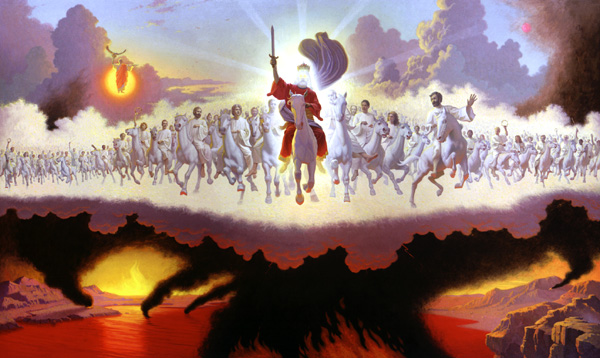
[Above: Maranatha! (The Return of Jesus Christ), 1987, Stephen Gjertson]

----- Original Message -----
From: AN
To: Stephen E. Jones
Sent: Sunday, April 15, 2007 6:47 AM
Subject: Thoughts on your web page - Jesus' return

>Hi Steve,
>
>A friend just introduced me to your web page. I've had a quick poke around but have not studied it in detail . . . yet.
>
>I went straight to your thoughts on Jesus' return.

I assume you are referring to my work-in-progress web page, "The Second Coming of the Lord Jesus Christ."At present it consists only of Bible verses on that topic which I have been studying in my morning devotions this year. I may later flesh it out into with my added comments.

My approach in this study to focus primarily on the New Testament references to the Second Coming of Christ. I generally consider it to be the correct approach to start with the New Testament's interpretation of the Old Testament. However, I do have a section , "Predicted in the Old Testament" which has verses that I (and the commentaries I consulted) consider to predict Jesus' Second Coming.

>Some of the verses you quote show that events surrounding Israel and her neighbours are integral to this great event (Zech 14 for example).
>
>You're no doubt aware of Ezekiel 38. Verse 8 of this chapter is yet another remarkable (partially fulfilled) Bible prophecy. The rebirth of the nation of Israel in 1948 would have aroused many Christians who understood this prophecy. Ezekiel 38 appears to predict the removal of Israel's walls designed to keep out terrorists.

The problem with equating Ezekiel 38:8 literally with "the nation of Israel":

Eze 38:1-9. "[1]The word of the LORD came to me: [2]`Son of man, set your face against Gog, of the land of Magog, the chief prince of Meshech and Tubal; prophesy against him [3]and say: "This is what the Sovereign LORD says: I am against you, O Gog, chief prince of Meshech and Tubal. [4]I will turn you around, put hooks in your jaws and bring you out with your whole army-your horses, your horsemen fully armed, and a great horde with large and small shields, all of them brandishing their swords. [5]Persia, Cush and Put will be with them, all with shields and helmets, [6]also Gomer with all its troops, and Beth Togarmah from the far north with all its troops-the many nations with you. [7]" "Get ready; be prepared, you and all the hordes gathered about you, and take command of them. [8]After many days you will be called to arms. In future years you will invade a land that has recovered from war, whose people were gathered from many nations to the mountains of Israel, which had long been desolate. They had been brought out from the nations, and now all of them live in safety. [9]You and all your troops and the many nations with you will go up, advancing like a storm; you will be like a cloud covering the land."'"

is that in the preceding chapter, Ezekiel 37:24, Ezekiel had prophesied that, "My servant David will be king over them, and they will all have one shepherd" (my emphasis):

Eze 37:24-28. "[24]My servant David will be king over them, and they will all have one shepherd. They will follow my laws and be careful to keep my decrees. [25]They will live in the land I gave to my servant Jacob, the land where your fathers lived. They and their children and their children's children will live there forever, and David my servant will be their prince forever. [26]I will make a covenant of peace with them; it will be an everlasting covenant. I will establish them and increase their numbers, and I will put my sanctuary among them forever. [27]My dwelling place will be with them; I will be their God, and they will be my people. [28]Then the nations will know that I the LORD make Israel holy, when my sanctuary is among them forever."

and also, earlier in chapter 34, the LORD had spoken through Ezekiel, "I will place over them one shepherd, my servant David ... and my servant David will be prince among them"(my emphasis):

Eze 34:23-24"[23]I will place over them one shepherd, my servant David, and he will tend them; he will tend them and be their shepherd. [24]I the LORD will be their God, and my servant David will be prince among them. I the LORD have spoken."

But since David (10th century BC) had been dead ~400 years in Ezekiel's (6th century BC) day, I agree with my commentary on Ezekiel that, "David is described as my servant, a clear Messianic title" and "The quality of permanence attaching to this future reign and expressed in the repeated phrase for ever, for evermore ... is a strong indication that Ezekiel is here thinking not so much of a line of Davidic kings, as he had known them in the past, but of a supernatural kingly being" (i.e. the Messiah):

"[Ezekiel 37:]24. David is described as my servant, a clear Messianic title, as well as king and prince for ever (25). We have already noted ` that Ezekiel avoided describing any of his Hebrew contemporaries as king (melek), but reserved this title for the Davidic leader of the future (cf. on 7:27; 12:10). The quality of permanence attaching to this future reign and expressed in the repeated phrase for ever, for evermore (25, 26, 28), is a strong indication that Ezekiel is here thinking not so much of a line of Davidic kings, as he had known them in the past, but of a supernatural kingly being in whom would be concentrated all the qualities of wisdom, enduement with the Spirit, righteousness and peace that were expected of God's anointed ruler." (Taylor, J.B., "Ezekiel: An Introduction and Commentary," Tyndale Press: London, 1969, pp.240-241. Emphasis original)

So I take it that Ezekiel 38-39 is not literally about "the nation of Israel" but is about David's descendant Jesus (Mt 1:1; Lk 1:27,32; 3:23,31; Rom 1:3; 2 Tim 2:8; Rev 3:7; 5:5; 22:16) and His Messianic Kingdom, as also predicted in the following other prophecies:

2 Sam 7:8,12-13,16 [8]"Now then, tell my servant David, 'This is what the LORD Almighty says: ... [12]When your days are over and you rest with your fathers, I will raise up your offspring to succeed you, who will come from your own body, and I will establish his kingdom. [13]He is the one who will build a house for my Name, and I will establish the throne of his kingdom forever. ... [16]Your house and your kingdom will endure forever before me; your throne will be established forever.' "

Ps 89:3-4,27-29, 35-37 "[3]You said, `I have made a covenant with my chosen one, I have sworn to David my servant,' [4]'I will establish your line forever and make your throne firm through all generations.' Selah [27]`I will also appoint him my firstborn, the most exalted of the kings of the earth. [28]I will maintain my love to him forever, and my covenant with him will never fail. [29]I will establish his line forever, his throne as long as the heavens endure. [35]Once for all, I have sworn by my holiness-and I will not lie to David- [36]that his line will continue forever and his throne endure before me like the sun; [37]it will be established forever like the moon, the faithful witness in the sky.' Selah"

Ps 132:11,17"[11]The LORD swore an oath to David, a sure oath that he will not revoke: `One of your own descendants I will place on your throne- ...' [17]`Here I will make a horn grow for David and set up a lamp for my anointed one'"

Hos 3:5 Afterward the Israelites will return and seek the LORD their God and David their king. They will come trembling to the LORD and to his blessings in the last days.

Isa 9:7"Of the increase of his government and peace there will be no end. He will reign on David's throne and over his kingdom, establishing and upholding it with justice and righteousness from that time on and forever. The zeal of the LORD Almighty will accomplish this."

Jer 23:5-6 [5]"`The days are coming,' declares the LORD, `when I will raise up to David a righteous Branch, a King who will reign wisely and do what is just and right in the land. [6]In his days Judah will be saved and Israel will live in safety. This is the name by which he will be called: The LORD Our Righteousness.'"

Jer 30:8-9 [8]"'In that day,' declares the LORD Almighty, 'I will break the yoke off their necks and will tear off their bonds; no longer will foreigners enslave them. [9]Instead, they will serve the LORD their God and David their king, whom I will raise up for them'"

Jer 33:15-16 [15]"In those days and at that time I will make a righteous Branch sprout from David's line; he will do what is just and right in the land. [16]In those days Judah will be saved and Jerusalem will live in safety. This is the name by which it will be called: The LORD Our Righteousness."

Continued in part #2.

Stephen E. Jones, BSc. (Biology).


Exodus 16:1-8. 1The whole Israelite community set out from Elim and came to the Desert of Sin, which is between Elim and Sinai, on the fifteenth day of the second month after they had come out of Egypt. 2In the desert the whole community grumbled against Moses and Aaron. 3The Israelites said to them, "If only we had died by the LORD's hand in Egypt! There we sat around pots of meat and ate all the food we wanted, but you have brought us out into this desert to starve this entire assembly to death." 4Then the LORD said to Moses, "I will rain down bread from heaven for you. The people are to go out each day and gather enough for that day. In this way I will test them and see whether they will follow my instructions. 5On the sixth day they are to prepare what they bring in, and that is to be twice as much as they gather on the other days." 6So Moses and Aaron said to all the Israelites, "In the evening you will know that it was the LORD who brought you out of Egypt, 7and in the morning you will see the glory of the LORD, because he has heard your grumbling against him. Who are we, that you should grumble against us?" 8Moses also said, "You will know that it was the LORD when he gives you meat to eat in the evening and all the bread you want in the morning, because he has heard your grumbling against him. Who are we? You are not grumbling against us, but against the LORD."

Monday, April 09, 2007

`The building of carbon depends on a moustache ... of oxygen on a mole, and ... of ... dysprosium... on a slight scar over the right eye' (Hoyle) #3

Continuing from part #2 with the 1957 address of late cosmologist Sir Fred Hoyle (1915-2001)

[Above: Stellar nucleosynthesis: the synthesis of elements from hydrogen to iron in red giant star immediately prior to its explosion as a supernova]

at University Church, Cambridge, on the topic of "Religion and the Scientists."

Hoyle, had concluded from the "apparently random quirks" of resonance energies necessary for the stellar nucleosynthesis of carbon-12 from helium-4 via beryllium-8, without which neither we, nor any carbon-based life in the entire Universe, could exist, was "part of a deep laid scheme":

"Yet this is just the case for the building of many complex atoms inside stars. The building of carbon depends on a moustache, the building of oxygen on a mole, and if you prefer a less well known case, the building of the atom dysprosium depends on a slight scar over the right eye. If this were a purely scientific question and not one that touched on the religious problem, I do not believe that any scientist who examined the evidence would fail to draw the inference that the laws of nuclear physics have been deliberately designed with regard to the consequences they produce inside the stars. If this is so, then my apparently random quirks become part of a deep laid scheme. If not, then we are back again to a monstrous sequence of accidents." (Hoyle, F., in Stockwood, M., ed., "Religion and the Scientists: Addresses Delivered in the University Church, Cambridge," Lent Term, 1957, SCM Press: London, 1959, p.64).

Hoyle observes that "it may well emerge, as more becomes known, that the laws seem" of physics and chemistry "have also been deliberately designed to promote the origin of life" (my emphasis):

"There is an interesting similarity between this whole inorganic problem of the origin of the complex atoms and the problem of the origin of life. In my last few moments I would like to give a little consideration to this similarity. In both cases we have matter evolving from simpler to more complex forms in accordance with the laws of physics and chemistry. ... The similarity between the origin of life and of complex atoms has other extensions. Just as it is now emerging that the laws of nuclear physics are designed to promote the origin of the complex atoms, so it may well emerge, as more becomes known, that the laws seem as if they have also been deliberately designed to promote the origin of life." (Hoyle, Ibid., pp.64-65).

As can be seen above, the problem is not lack of scientific evidence for design, since as Hoyle observed, "If this were a purely scientific question and not one that touched on the religious problem" no "scientist who examined the evidence would fail to draw the inference that the laws of nuclear physics have been deliberately designed with regard to the consequences they produce inside the stars" (my emphasis)!

The "religious problem" being that scientists, like all human beings, know that there is a Creator from the evidence of nature, but again, like all human beings, scientists are guilty sinners who try to suppress that truth:

"When people see evidence of design, they automatically think of a designer. ... By the way, the atheist knows this too. Richard Dawkins says that biology is the study of complex things that look as if they were designed for a purpose. He sees it. Francis Crick, another arch-materialist, says that biologists have to remind themselves constantly that what they study was not created; it evolved. You see, if they didn't remind themselves constantly that there is no Designer, then the facts that stare them in the face might get their attention. This is exactly what Paul says in Romans 1:18. He tells us that God's eternal, invisible attributes, namely His eternal power and majesty, have always been visible in the things that are made. I think this is just plain common-sense that everybody recognises. That's why Paul goes on to say we are without excuse. [Rom 1:19-20] The fact is that people know that God is there; they just don't want to honour Him as such. And so their foolish minds are darkened. [Rom 1:21] And that's exactly what happens when you refuse to acknowledge design in the creation. So what the scientific naturalists have to do is keep design, or intelligent design, off the table; Because, once it is on the table, it will inevitably triumph. And the more you look at the Darwinian mechanism that's supposed to fill the role of a Creator, the more obvious it is that it doesn't have what it takes." (Johnson, P.E., "Designer genes," Australian Presbyterian, October 2001, pp.4-8, p.8. Emphasis in original).

The late atheist Bertrand Russell (1872 -1970) claimed that the reason he did not believe in God was (apart from the fact that he was "a geriatric employer who regularly sexually preyed upon his young female employees") that there was "Not enough evidence":

"Bertrand Russell, philosopher, mathematician and author of, among other works, Why I Am Not a Christian, was once asked how he would respond if upon dying he found himself in the presence of God and was asked why he hadn't believed in God's existence during his stay on earth. Russell's response was summed up in three words: Not enough evidence! Now I submit that most persons on hearing of this response would conclude that in Russell we have a careful thinker who won't let himself be swayed by bogus or equivocal evidence. In other words, most people nowadays would regard Russell's skepticism as sober and measured. Atheism is regarded as a reasonable position these days because God, if he exists, has been too lazy or secretive to furnish us with convincing proofs of his existence. It's worth noting that this attitude is of recent vintage. In other epochs atheism has been considered perverse and unreasonable. Thus the apostle Paul could write, `What can be known about God is plain to them, because God has shown it to them. Ever since the creation of the world his eternal power and divine nature, invisible though they are, have been understood and seen through the things he has made. So they are without excuse' (Romans 1:19-20 NRSV)." (Dembski, W.A., "On the Very Possibility of Intelligent Design,," in Moreland, J.P., ed., "The Creation Hypothesis: Scientific Evidence for an Intelligent Designer," InterVarsity Press: Downers Grove IL, 1994, p.130. Emphasis original).

but as William Dembski noted, "this attitude is of recent vintage" and in "other epochs atheism has been considered perverse and unreasonable."

Christian apologist William Lane Craig points out that even if "the evidence is equally balanced" for and against the existence of God, "The rational man ought to believe in God ... rather than the reverse":

"Most people would say that it's impossible to `prove' the existence of God and that therefore, if one is going to believe in God, he must `take it by faith' that God exists. I've heard many students say this as an excuse for not believing in God. `Nobody can prove that God exists and nobody can prove that he doesn't,' they say with a smile, `so I just don't believe in him.' I've already argued that such a blithe attitude fails to appreciate the depth of man's existential predicament in a universe without God. The rational man ought to believe in God even when the evidence is equally balanced, rather than the reverse. But is it in fact the case that there is no probatory evidence that a Supreme Being exists? This was not the opinion of the biblical writers. The Psalmist said, `The heavens are telling of the glory of God; and their expanse is declaring the work of his hands' (Ps 19:1), and the apostle Paul declared, `Since the creation of the world His invisible attributes, His eternal power and divine nature, have been clearly seen, being understood through what has been made, so that they [men] are without excuse' (Rom 1:20). Nor can it be said that this evidence is so ambiguous as to admit of equally plausible counter-explanations-for then people would not be `without excuse.' Thus, people are without excuse for not believing in God's existence, not only because of the internal testimony of the Holy Spirit, but also because of the external witness of nature." (Craig, W.L., "Reasonable Faith: Christian Truth and Apologetics," [1984], Crossway Books: Wheaton IL, Revised Edition, 1994, p.77)

But in fact the view of "the biblical writers" was that "because of the external witness of nature" to there being a Creator-God, "people are without excuse for not believing in God's existence" (my emphasis).

Of course an atheist can (like Bertrand Russell) just keep raising the bar of what evidence would be necessary for him to believe in God, so that he never has to believe it. But what counts is not whether the unbeliever considers the evidence for God's existence to be sufficient (by definition it never will be or they would not be an unbeliever), but whether God considers the evidence for His existence in nature to be sufficient. And the Bible says that "God himself regards the evidence" for His own existence as not merely sufficient but "conclusive" (my emphasis):

"To anyone who gives thoughtful consideration to the proofs for God's existence already advanced, the evidence appears conclusive. He can only exclaim, `Surely, there is a God!' God himself regards the evidence as conclusive. If he did not so regard it, he would have given us more evidence, but the evidence is sufficient (Acts 14:17; 17:23-29; Rom. 1:8-20). The Bible simply assumes the existence of God. To believe in the existence of God is, therefore, the normal and natural thing to do, and agnosticism and atheism are the abnormal and unnatural positions. Indeed, the latter are tantamount to saying that God has not furnished us with sufficient evidence of his existence. Such attitudes are a reflection on a benevolent and holy God and are sinful. Nevertheless, men as a whole have refused to have God in their knowledge (Rom. 1:28). Sin has so distorted their vision and corrupted their hearts as to make them reject the evidence and go on without a God or set up gods of their own creation." (Thiessen, H.C. & Doerksen, V.D., "Lectures in Systematic Theology," [1949], Eerdmans: Grand Rapids MI, Revised, 1977, p.32). Emphasis original).

So how much more will the judgment of God be on the wilful unbelief of those who have the evidence that modern science has revealed, of this "fine-tuning" of the Universe "for our existence" (including "the step-by-step build-up of heavy elements inside stars" that "depends on a series of spectacular coincidences") which has only "two possible explanations. Either the Universe was designed specifically for us by a creator or there is a multitude of universes" (my emphasis):

"But the main reason for believing in an ensemble of universes is that it could explain why the laws governing our Universe appear to be so finely tuned for our existence. In the 1950s, for instance, Fred Hoyle discovered that the step-by-step build-up of heavy elements inside stars depends on a series of spectacular coincidences. Only if the nuclei of beryllium-8, carbon-12 and oxygen-16 exist in particular energy states can hydrogen be built up into the elements of life such as calcium, magnesium and iron. This fine-tuning has two possible explanations. Either the Universe was designed specifically for us by a creator or there is a multitude of universes--a `multiverse'. Only in those universes in which the properties of beryllium-8, carbon-12 and oxygen-16 are right for life would any life arise to notice any fine-tuning." (Chown, M., "Anything Goes," New Scientist, 6 June 1998, Vol. 158, pp.26-30)

and yet they do "not think it worthwhile to retain the knowledge of God" (Rom 1:28) and would rather "exchange... the truth of God for a lie, and worship.. and served created things" (i.e. "a multitude of universes--a `multiverse'") "rather than the Creator" (Rom 1:25)?!

Stephen E. Jones, BSc. (Biology).


Exodus15:22-27. 22Then Moses led Israel from the Red Sea and they went into the Desert of Shur. For three days they traveled in the desert without finding water. 23When they came to Marah, they could not drink its water because it was bitter. (That is why the place is called Marah.) 24So the people grumbled against Moses, saying, "What are we to drink?" 25Then Moses cried out to the LORD, and the LORD showed him a piece of wood. He threw it into the water, and the water became sweet. There the LORD made a decree and a law for them, and there he tested them. 26He said, "If you listen carefully to the voice of the LORD your God and do what is right in his eyes, if you pay attention to his commands and keep all his decrees, I will not bring on you any of the diseases I brought on the Egyptians, for I am the LORD, who heals you." 27Then they came to Elim, where there were twelve springs and seventy palm trees, and they camped there near the water.

MORE religion, including the intelligent design theory ... should be taught in public and private schools, church leaders say

Continuing from the previous post, here is the unwebbed article calling for ID to be taught in Western Australian schools, which appeared in yesterday's (Easter Sunday's), Perth Sunday Times newspaper.

[Left: Antony Flew, on the cover of his 1996 book "Atheistic Humanism" (which position he has now abandoned on the basis of the scientific evidence for intelligent design-see below), Amazon.com]

New role call for religion in schools, The Sunday Times, April 8, 2007, page 12, Paul Lampathakis ... MORE religion, including the intelligent design theory, should be taught in public and private schools, church leaders say.

While "intelligent design theory" is not "religion" but scientific in that it is based solely on the evidence of nature, not the Bible, the main point is that Western Australian's major Sunday newspaper, is echoing the call by the Roman Catholic Archbishop of Perth, Barry Hickey, that "intelligent design theory, should be taught in public and private schools" (my emphasis)!

Perth's Catholic and Anglican archbishops said during Easter, that children needed more focus on things like the meaning of life in school subjects as well as religion. Otherwise schools risked producing children who were "robots" suffering from a "deep emptiness". Catholic Archbishop Barry Hickey said intelligent design theory would give students a chance to question the mysteries of life that science couldn't explain.

While ID theorists may not normally put it that way, Archbishop Hickey's argument that "intelligent design theory would give students a chance to question the mysteries of life that science couldn't explain" does make the points: 1) that there are "mysteries of life that" materialistic-naturalistic "science" seems unable to plausibly "explain." For example the origin of life, which led leading atheist philosopher Antony Flew , on the basis of the scientific evidence for intelligent design, to abandon atheism in favour of a deistic God creating the first living organism:

"A British philosophy professor who has been a leading champion of atheism for more than a half-century has changed his mind. He now believes in God -- more or less -- based on scientific evidence, and says so on a video released Thursday. At age 81, after decades of insisting belief is a mistake, Antony Flew has concluded that some sort of intelligence or first cause must have created the universe. A super-intelligence is the only good explanation for the origin of life and the complexity of nature, Flew said in a telephone interview from England. Flew said he's best labeled a deist like Thomas Jefferson, whose God was not actively involved in people's lives. ...,' he said. `It could be a person in the sense of a being that has intelligence and a purpose, I suppose.' ... Over the years, Flew proclaimed the lack of evidence for God while teaching at Oxford, Aberdeen, Keele, and Reading universities in Britain, in visits to numerous U.S. and Canadian campuses and in books, articles, lectures and debates. There was no one moment of change but a gradual conclusion over recent months for Flew, a spry man who still does not believe in an afterlife. Yet biologists' investigation of DNA `has shown, by the almost unbelievable complexity of the arrangements which are needed to produce (life), that intelligence must have been involved,' Flew says in the new video, `Has Science Discovered God?' .... The first hint of Flew's turn was a letter to the August-September issue of Britain's Philosophy Now magazine. `It has become inordinately difficult even to begin to think about constructing a naturalistic theory of the evolution of that first reproducing organism,' he wrote. .. if his belief upsets people, well `that's too bad,' Flew said. `My whole life has been guided by the principle of Plato's Socrates: Follow the evidence, wherever it leads.' ... Flew told The Associated Press his current ideas have some similarity with American `intelligent design' theorists, who see evidence for a guiding force in the construction of the universe. He accepts Darwinian evolution but doubts it can explain the ultimate origins of life." (Ostling, R.N., "Atheist Philosopher, 81, Now Believes in God," Livescience, 10 December 2004).

And 2) "students" don't have the "chance to question" or hear about questions of same. Yet as this editorial in The Dallas Morning News put it, "If the scientific data are compelling enough to cause an atheist academic of Antony Flew's reputation to recant much of his life's work, why shouldn't Texas" and all "schoolchildren be taught the controversy?" (my emphasis):

"An intellectual bombshell dropped last week when British professor Antony Flew, for decades one of the world's leading philosophers of atheism, publicly announced that he now affirms the existence of a deity. To be sure, Mr. Flew has not become an adherent of any creed. He simply believes that science points to the existence of some sort of intelligent designer of the universe. He says evidence from DNA research convinces him that the genetic structure of biological life is too complex to have evolved entirely on its own. Though the 81-year-old philosopher believes Darwinian theory explains a lot, he contends that it cannot account for how life initially began. We found this conversion interesting in light of last year's controversy regarding proposed revisions to the state's high school biology textbooks. Our view then was that while religion must be kept out of science classes, intellectual honesty demands that when science produces reliable data challenging the prevailing orthodoxies, students should be taught them. We were bothered by Harvard geneticist Richard Lewontin's statement that for scientists, materialism must be `absolute, for we cannot allow a Divine Foot in the door.' That's called stacking the deck. Mr. Flew may be dead wrong, but it's refreshing to see that an academic of his stature is unafraid to let new facts change his mind. The philosopher told The Associated Press that if admirers are upset with his about-face, then `that's too bad. My whole life has been guided by the principle of Plato's Socrates: Follow the evidence, wherever it leads.' If the scientific data are compelling enough to cause an atheist academic of Antony Flew's reputation to recant much of his life's work, why shouldn't Texas schoolchildren be taught the controversy?" (Editorial, "An Atheist's Apostasy," The Dallas Morning News, December 15, 2004)

The theory, which suggests some parts of the universe and nature are so complex they must have been designed by a higher intelligence, has sparked debate and court battles in the US. "I would like the notion of intelligent design to be examined, also in government schools, without necessarily becoming a proof of the existence of God," Archbishop Hickey said.

Hickey hits the nail on the head. The issue of whether there is scientific evidence that "some parts of the universe and nature are so complex they must have been designed by a higher intelligence" is logically separate from the issue of whether that is "proof of the existence of God."

At the very least, "the notion of intelligent design" should "be examined ... in government schools" because:

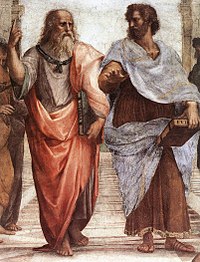
[Right: "Plato and Aristotle, depicted here in The School of Athens, both developed philosophical arguments based on the universe's apparent design," Wikipedia]

1) students should be prepared in schools for major intellectual issues that they will confront as adult citizens; and 2) the Argument from Design to a Designer is part of our Western intellectual heritage going back at least to the Greek philosophers Plato (c.427-347 BC) and Aristotle (c.384-322 BC).

"Because I think that if it is not (examined), then science is not being entirely honest. I think science has to show us what is there. And if it comes up with a very intricate marvellous design, let's call it intelligent design." Under such teaching, children with faith would say, "yes that's the result of the creator", and those without would say, "it's there by chance and we have no explanation", Archbishop Hickey said. "(those) with faith will make the next step to God," he said. "The school can't do that. But it can say, `yes, look at the human eye, look at all the things we find in nature. There seems to be an ... intelligent design in what we discover'."

This is an important point. A science that, rather than simply present the evidence for and against its theory of evolution, but instead "employ[s] propaganda and legal barriers to prevent relevant questions from being asked" and "rel[ies] on enforcing rules of reasoning that allow no alternative to the official story":

"In the final analysis, it is not any specific scientific evidence that convinces me that Darwinism is a pseudoscience that will collapse once it becomes possible for critics to get a fair hearing. It is the way the Darwinists argue their case that makes it apparent that they are afraid to encounter the best arguments against their theory. A real science does not employ propaganda and legal barriers to prevent relevant questions from being asked, nor does it rely on enforcing rules of reasoning that allow no alternative to the official story. If the Darwinists had a good case to make, they would welcome the critics to an academic forum for open debate, and they would want to confront the best critical arguments rather than to caricature them as straw men. Instead they have chosen to rely on the dishonorable methods of power politics." (Johnson, P.E., "The Wedge of Truth: Splitting the Foundations of Naturalism," Intervarsity Press: Downers Grove IL, 2000, p.141)

is not being "entirely honest."

Such a science has forfeited its right to that title and has in fact become a "a pseudoscience", i.e. a "body of knowledge, methodology, belief, or practice that claims to be scientific but does not follow the scientific method," "a pretended or spurious science; a collection of related beliefs about the world mistakenly regarded as being based on scientific method or as having the status that scientific truths now have" (my emphasis), that in particular, does not "Follow the evidence, wherever it leads."

Anglican Archbishop Roger Herft said children did think about "deeper questions". "If our classrooms do not allow for the exploration of the spirit, the exploration of the questions of meaning, then we're going to produce, ultimately, human beings who have deep emptiness in them," he said. "They will seek to fill that emptiness in a number of ways, whether it's drugs, or violence, or gang life or other groups that ultimately tend to be antisocial."

As mentioned in my previous post, there is however no evidence that I am aware of that Anglican Archbishop Roger Herft is in favour of ID, and nor does it seem likely given that he is described as "a leading liberal" in Australia's Anglican Church.

WA Education Minister Mark McGowan said he would not introduce intelligent design into the school curriculum and it was not part of school science programs because it was not evidence-based. He said questions like "where do we come from?" and "who made us?" were often discussed in class and children were able to make their own decisions. Editorial: Page 71 ...

If McGowan really said that "intelligent design ... was not evidence-based," then he presumably has not personally studied ID primary literature first-hand, but is merely parroting secondhand Darwinist propaganda.

But as I have mentioned in previous posts on this, e.g. "Creation theory wins support" (13-Aug-05)", "Teachers reject creation theory" (14-Aug-05), "Kosky rules intelligent design a faith, etc" (01-Nov-05), "In a class of their own, etc" (17-Nov-05) & "Pope takes a close look at intelligent design" (29-Aug-06); there is mounting competitive pressure on Australian State schools as parents are increasingly sending their children to private schools, and as more private schools include ID in their curriculum, sooner or later public schools will have to follow suit, or be left behind in a second-rate educational ghetto.

Stephen E. Jones, BSc. (Biology).


Exodus 14:21-31. 21Then Moses stretched out his hand over the sea, and all that night the LORD drove the sea back with a strong east wind and turned it into dry land. The waters were divided, 22and the Israelites went through the sea on dry ground, with a wall of water on their right and on their left. 23The Egyptians pursued them, and all Pharaoh's horses and chariots and horsemen followed them into the sea. 24During the last watch of the night the LORD looked down from the pillar of fire and cloud at the Egyptian army and threw it into confusion. 25He made the wheels of their chariots come off so that they had difficulty driving. And the Egyptians said, "Let's get away from the Israelites! The LORD is fighting for them against Egypt." 26Then the LORD said to Moses, "Stretch out your hand over the sea so that the waters may flow back over the Egyptians and their chariots and horsemen." 27Moses stretched out his hand over the sea, and at daybreak the sea went back to its place. The Egyptians were fleeing toward it, and the LORD swept them into the sea. 28The water flowed back and covered the chariots and horsemen-the entire army of Pharaoh that had followed the Israelites into the sea. Not one of them survived. 29But the Israelites went through the sea on dry ground, with a wall of water on their right and on their left. 30That day the LORD saved Israel from the hands of the Egyptians, and Israel saw the Egyptians lying dead on the shore. 31And when the Israelites saw the great power the LORD displayed against the Egyptians, the people feared the LORD and put their trust in him and in Moses his servant.

PERTH's Catholic and Anglican archbishops ... want to break new ground by having ... intelligent design taught in WA public schools

This webbed editorial and the unwebbed article in my next post, both calling for ID to be taught in Western Australian schools, appeared in Perth's yesterday's (Easter Sunday) Sunday Times newspaper.

[Left: Roman Catholic Archbishop of Perth, Barry Hickey, Australian Catholic Bishops Conference]

Here is an excerpt from the webbed editorial with my comments (in bold):

Fresh look at clearing up life's mysteries, The Sunday Times, Editorial, April 07, 2007 ... PERTH's Catholic and Anglican archbishops have taken a fresh and welcome approach to an old debate this Easter. As reported in The Sunday Times today, they want to break new ground by having a religious genre of intelligent design taught in WA public schools. Even though it doesn't find favour with Education Minister Mark McGowan, it is an interesting and provocative thought.

I would be surprised if the Anglican Archbishop of Perth, Roger Herft,

[Right: Anglican Archbishop of Perth, Roger Herft, St George's Cathedral, Perth Western Australia]

was in favour of ID, since from comments in the media he seems to be a religious liberal (indeed he is described in the media as "a leading liberal"), and there is nothing in his latest reported comments specifically about ID.

But the Roman Catholic Archbishop of Perth, Barry Hickey, has made positive comments about ID before, e.g. "Intelligent design is a far more elegant description of historical changes than an entirely evolutionary approach, and it therefore should not be ignored in the classroom" and "Intelligent design, while it does not demand belief in a creator, sits very comfortably with Catholics who believe ... God ... has a clear design for the universe and for each human being in it":

Archbishop Hickey on Intelligent Design theory, The Church Around the World, "The theory of evolution is an inadequate way to describe the universe and life because it ignores too much and makes great presumptive leaps without evidence," said Archbishop Barry Hickey of Perth in August. He was commenting on the debate over whether Intelligent Design theory should be taught in schools. "The problem in our society is that the theory of evolution has been installed in our education system and is defended by too many educators as the sole scientific approach to the existence of the universe and the appearance of the many forms of life. "One result is that too many students are unable to protect themselves from the conscious or sub-conscious assumption that human life has no purpose or meaning. "They are asked to accept that all the marvels of nature and the complexity of living organisms, even intelligent human life, are the products of two laws, natural selection and the survival of the fittest, that is, the result of chance. "Intelligent design is a far more elegant description of historical changes than an entirely evolutionary approach, and it therefore should not be ignored in the classroom. "Intelligent design, while it does not demand belief in a creator, sits very comfortably with Catholics who believe that whatever came first came from God who has a clear design for the universe and for each human being in it." ... 'The Record' (Perth) ...

As for ID "doesn't find favour with Education Minister Mark McGowan," this is no surprise, since Western Australia has an Australian Labor Party State government, so its Education Minister (whatever his private views) is beholden to the support of the (presumably predominantly atheistic) WA State Teacher's Union. As evidence of this, when the issue of teaching ID in State schools, McGowan's predecessor was initially in favour of it ("Creation theory wins support," 13-Aug-05) but then `backflipped' ("Teachers reject creation theory," 13-Aug-05) the next day when she found out that the Teacher's Union was against it!

Catholic Archbishop Barry Hickey says that intelligent design would give students an opportunity to question the mysteries of life that science can't explain. And Anglican Archbishop Roger Herft said: "I think if our classrooms do not allow for the exploration of the spirit, the exploration of the questions of meaning, then we're going to produce ultimately, human beings who have deep emptiness in them"

As mentioned previously, only Roman Catholic Archbishop Barry Hickey mentioned "intelligent design." From Hickey's comments above evolution making "great presumptive leaps without evidence" and "mysteries of life that science can't explain," it sounds like he is well aware of evolution's scientific and philosophical problems and presumably he is also aware of the evidence and arguments for ID.

ID is the term for the controversial theory that, because of the complexities of certain features found in nature, an "intelligent designer" exists as a biblical God or some other superior being. ID supporters point to various questions that science can't answer to back their claims.

The media just cannot seem to get it into their heads that ID is not a theory about a "designer" - it is a theory about design! Nevertheless, progress has been made in that most journalists these days understand that ID does not claim that the design was necessarily caused by the "biblical God" (although those IDists who are Christians, like me, assume that it was).

In opposition, are atheists, including many scientists, who believe in the theory of evolution which they say shows that all living things developed naturally from simple organisms over the course of millions of years. Nearly all scientists consider evolution to be a scientific fact. ...

This makes a good point that those opposed to ID are mostly "atheists" (who therefore have no option but to rule out intelligent design irrespective of the evidence). The claim that "Nearly all scientists consider evolution to be a scientific fact" is often asserted but it has never been demonstrated scientifically to be true, since there would have to be a worldwide scientific survey of all scientists and "evolution" would have to be clearly defined as, "the standard scientific theory that `human beings have developed over millions of years from less advanced forms of life, but God had no part in this process'":

"Facing such a reality, perhaps we should not be surprised at the results of a 2001 Gallup poll confirming that 45 percent of Americans believe `God created human beings pretty much in their present form at one time within the last 10,000 years or so'; 37 percent prefer a blended belief that `human beings have developed over millions of years from less advanced forms of life, but God guided this process'; and a paltry 12 percent accept the standard scientific theory that `human beings have developed over millions of years from less advanced forms of life, but God had no part in this process.'" (Shermer, M.B., "The Gradual Illumination of the Mind," Scientific American, February 2002. My emphasis).

It would be very interesting to see the results of such a worldwide survey of all scientists. It might well turn out that most scientists do not "consider evolution to be a scientific fact," in the sense that "God" (or an Intelligent Designer) "had no part in this process."

Some argue that ID and traditional creationism go hand-in-hand; others claim that there are fine differences but important ones. ...

It is good to see that this editor is aware that the claim that "ID and traditional creationism go hand-in-hand" is false, because "there are fine differences but important ones" (my emphasis). Those "differences" include:

  1. "traditional creationism" is based on the Bible, whereas ID is based solely on the evidence of nature;
  2. creationism claims the Designer is the Biblical God, but ID does not (because it cannot from the evidence of nature alone, identify the designer);
  3. not all IDists are "traditional creationists" (and indeed some, like Michael Denton and David Berlinski are agnostics); and
  4. not all "traditional creationists" are IDists and indeed probably most are not and some leading creationists, both Young-Earth (e.g. the late Henry Morris) and Old-Earth (e.g. Hugh Ross), are actually opposed to ID.

See "Intelligent Design and Creationism Just Aren't the Same" and "Intelligent design is not creationism."

What logically follows is that religious teaching at all levels and at all ages, but particularly among the young, should be questioned to reach a considered judgment between ID/creationism and evolutionism. After all, there are those who form beliefs somewhere between these extremes. .... And if the teaching of intelligent design was introduced in schools and it resulted in more young people questioning the basis for traditional religious beliefs so that they can make informed judgments, then it would be an effective innovation. ...

This seems confused and sounds like the "camel is a horse designed by a committee" insertion of a different editor. It is not only "religious teaching" that "should be questioned to reach a considered judgment between ID/creationism and evolutionism" but also the scientific teaching, i.e. the actual evidence for and against evolution, and also the materialist-naturalist = atheistic philosophical assumptions supporting evolution (what Archbishop Hickey above called "The ... great presumptive leaps without evidence" of the "theory of evolution") that should be questioned.

If "the teaching of intelligent design was introduced in schools" it would not so much "result... in more young people questioning the basis for traditional religious beliefs" but more likely result in them "questioning the basis for traditional" scientific materialist "beliefs" (which is why evolutionists are so much against ID being taught in schools)!

Continued next post with the unwebbed article.

Stephen E. Jones, BSc. (Biology).


Exodus 14:1-4,8,15-20. 1Then the LORD said to Moses, 2"Tell the Israelites to turn back and encamp near Pi Hahiroth, between Migdol and the sea. They are to encamp by the sea, directly opposite Baal Zephon. 3Pharaoh will think, 'The Israelites are wandering around the land in confusion, hemmed in by the desert.' 4And I will harden Pharaoh's heart, and he will pursue them. But I will gain glory for myself through Pharaoh and all his army, and the Egyptians will know that I am the LORD." So the Israelites did this. ... 8The LORD hardened the heart of Pharaoh king of Egypt, so that he pursued the Israelites, who were marching out boldly. ... 15Then the LORD said to Moses, "Why are you crying out to me... Tell the Israelites to move on. 16Raise your staff and stretch out your hand over the sea to divide the water so that the Israelites can go through the sea on dry ground. 17I will harden the hearts of the Egyptians so that they will go in after them. And I will gain glory through Pharaoh and all his army, through his chariots and his horsemen. 18The Egyptians will know that I am the LORD when I gain glory through Pharaoh, his chariots and his horsemen." 19Then the angel of God, who had been traveling in front of Israel's army, withdrew and went behind them. The pillar of cloud also moved from in front and stood behind them, 20coming between the armies of Egypt and Israel. Throughout the night the cloud brought darkness to the one side and light to the other side; so neither went near the other all night long.

Saturday, April 07, 2007

`The building of carbon depends on a moustache ... of oxygen on a mole, and ... of ... dysprosium... on a slight scar over the right eye' (Hoyle) #2

<

Continuing from part #1 with the 1957 address of late cosmologist Sir Fred Hoyle,

[Above: Triple-Alpha Process ... by which three helium nuclei (alpha particles) are transformed into carbon, Wikipedia]

at University Church, Cambridge, on the topic of "Religion and the Scientists."

Hoyle, whose specialty at the time was stellar nucleosynthesis (for which he should have at least shared a Nobel prize) pointed out that "all atoms have been built from one atom. ... the stars serve as gigantic factories in which a whole array of atoms are produced from the simplest atom of all, hydrogen":

"Science operates in accordance with a set of laws, as I have said already. The laws describe the behaviour of matter, so that, in addition to the laws, matter must exist for the laws to operate on. According to the science of the last century matter consists of indestructible atoms of which there are 90 odd different varieties. According to the science of the present century the atoms possess an internal structure made up from a weighty central nucleus of very small size surrounded by a comparatively extensive cloud of light weight particles known as electrons. According to the science of the last twenty-five years the weighty central nucleus itself possesses a structure. It is built out of two kinds of heavy particle, protons and neutrons. The precise number of protons and neutrons contained by the nucleus determines the nature of the atom. When the nucleus contains 6 protons and 6 neutrons we have an atom of common carbon. When the nucleus contains 26 protons and 30 neutrons we have an atom of common iron. When the nucleus contains 82 protons and 126 neutrons we have an atom of common lead. And so on for the other 90 odd cases. We know today that the science of the nineteenth century was mistaken in supposing that atoms are indestructible. The compositions of the nuclei of atoms can be altered, and one atom can be changed to another. This leads to an important question. Have the atoms we find in the world always existed in their present forms, or have some atoms been made. from others? The second of these possibilities has turned out to be correct. Already in 1920, Eddington had been led to suspect that all atoms have been built from one atom, the simplest of all, the atom of hydrogen. He was led, moreover, to suspect that it is in the interiors of the stars that this building from hydrogen takes place. The work of the last few years has provided almost overwhelming evidence in favour of this guess of Eddington's. It has turned out that the stars serve as gigantic factories in which a whole array of atoms are produced from the simplest atom of all, hydrogen." (Hoyle, F., in Stockwood, M., ed., "Religion and the Scientists: Addresses Delivered in the University Church, Cambridge," Lent Term, 1957, SCM Press: London, 1959, p.62).

Hoyle's next point was that "although the laws of science admit of complex atoms, their existence would never have been realised" (in the sense of given reality to) "but for the stars," so "a connexion between the existence of stars and the laws of nuclear physics is clearly implied":

"The really interesting point is that although the laws of science admit of complex atoms, their existence would never have been realised but for the stars. There is a delicate inflexion here. Let us assume that the universe possesses logical coherence. Would it really be sensible then for the laws of science to admit of complex atoms if their existence were never realised? If we consider it would not be sensible, and this seems to me the evident answer we should give, a most unusual connexion between the existence of stars and the laws that govern the atomic nuclei is implied. Notice that I say the existence of stars, not the properties of stars. Everyone expects the properties of stars and atomic nuclei to be related. It is the connexion with the existence of stars that is so surprising. Let us push a little further into this deep water. Are there any stable complex atoms permitted by the laws of science whose existence is not realised in the stars? The answer is that there are none. They are all produced in the stars, not in equal abundance it is true, but the existence of every single one is established. Either we are here confronted by a monstrous situation in which the existence of a multitude of complex atoms is only established as a consequence of scores of separate accidents, or a connexion between the existence of stars and the laws of nuclear physics is clearly implied." (Hoyle, Ibid., p.63. Emphasis original).

But of this "genesis of the complex atoms" only "about half the complex nuclei does follow from the broad principles of nuclear physics, but the other half does not." The genesis of the latter half "depends on the oddest array of apparently random quirks you could possibly imagine" as if we should "find Government policy depending in a really crucial way on the fact that the Prime Minister possesses a moustache while the Foreign Secretary does not" and "on the Minister of Works possessing a mole beneath his left ear" (my emphasis):

"What do I mean ... by `scores of accidents'? Granted stars to exist, surely there can be no accidents. Surely all the properties of stars, including the genesis of the complex atoms, then follow implacably from the broad principles of nuclear physics? I disagree. It is true that the genesis of about half the complex nuclei does follow from the broad principles of nuclear physics, but the other half does not. Their genesis depends on the oddest array of apparently random quirks you could possibly imagine. I will try to explain what I mean in terms of an analogy, which I hope you will not think too flippant. We would all agree that the actions of the Government depend on the persons who comprise it-on their education, intelligence, social and cultural background, and on their state of health. These qualities correspond to my broad principles. But we would scarcely expect to find Government policy depending in a really crucial way on the fact that the Prime Minister possesses a moustache while the Foreign Secretary does not. These are my random quirks. And if we should find that Government policy depended in a really vital respect on the Minister of Works possessing a mole beneath his left ear, then manifestly we should be justified in supposing that new and hitherto unsuspected connexions existed within the field of political affairs..." (Hoyle, Ibid., pp.63-64).

And yet, Hoyle affirms, "this is just the case for the building of many complex atoms inside stars," for example, "The building of carbon depends on a moustache, the building of oxygen on a mole, and if you prefer a less well known case, the building of the atom dysprosium depends on a slight scar over the right eye":

"Yet this is just the case for the building of many complex atoms inside stars. The building of carbon depends on a moustache, the building of oxygen on a mole, and if you prefer a less well known case, the building of the atom dysprosium depends on a slight scar over the right eye. If this were a purely scientific question and not one that touched on the religious problem, I do not believe that any scientist who examined the evidence would fail to draw the inference that the laws of nuclear physics have been deliberately designed with regard to the consequences they produce inside the stars. If this is so, then my apparently random quirks become part of a deep laid scheme. If not, then we are back again to a monstrous sequence of accidents." (Hoyle, Ibid., p.64).

Here are some more quotes from others on this. Nobel laureate physicist Steven Weinberg singles out this stepwise synthesis of carbon and oxygen from helium via beryllium among the "mysteries" which "are heightened when we reflect how surprising it is that the laws of nature and the initial conditions of the universe should allow for the existence of beings who could observe it ... If the energy of the excited state of carbon 12 were just a little higher, the rate of its formation would be much less, so that almost all the beryllium 8 nuclei would fission into helium nuclei before carbon could be formed" (my emphasis):

"These mysteries are heightened when we reflect how surprising it is that the laws of nature and the initial conditions of the universe should allow for the existence of beings who could observe it. Life as we know it would be impossible if any one of several physical quantities had slightly different values. The best known of these quantities is the energy of one of the excited states of the carbon 12 nucleus. There is an essential step in the chain of nuclear reactions that build up heavy elements in stars. In this step, two helium nuclei join together to form the unstable nucleus of beryllium 8, which sometimes before fissioning absorbs another helium nucleus, forming carbon 12 in this excited state. The carbon 12 nucleus then emits a photon and decays into the stable state of lowest energy. In subsequent nuclear reactions carbon is built up into oxygen and nitrogen and the other heavy elements necessary for life. But the capture of helium by beryllium 8 is a resonant process, whose reaction rate is a sharply peaked function of the energies of the nuclei involved. If the energy of the excited state of carbon 12 were just a little higher, the rate of its formation would be much less, so that almost all the beryllium 8 nuclei would fission into helium nuclei before carbon could be formed. The universe would then consist almost entirely of hydrogen and helium, without the ingredients for life." (Weinberg, S., "Life in the Universe," Scientific American, Vol. 271, No. 4, October 1994, Special Issue, pp.22-27, p.27).

In the same special issue of Scientific American , Harvard astronomer Robert P. Kirshner, also singles this reaction out as, "Amazingly ... The process would seem about as likely as crossing a stream by stepping fleetingly on a log. A delicate match between the energies of helium, the unstable beryllium and the resulting carbon allows the last to be created. Without this process, we would not be here (my emphasis):

"But interesting events take place inside red giants. As the core contracts, the central furnace grows denser and hotter. Then nuclear reactions that were previously impossible become the principal source of energy. For example, the helium that accumulates during hydrogen burning can now become a fuel. As the star ages and the core temperature rises, brief encounters between helium nuclei produce fusion events. The collision of two helium nuclei leads initially to an evanescent form of beryllium having four neutrons and four protons. Amazingly enough, another helium nucleus collides with this short-lived target, leading to the formation of carbon. The process would seem about as likely as crossing a stream by stepping fleetingly on a log. A delicate match between the energies of helium, the unstable beryllium and the resulting carbon allows the last to be created. Without this process, we would not be here." (Kirshner, R.P., "The Earth's Elements," Scientific American, Vol. 271, No. 4, October 1994, Special Issue, pp.37-43, pp.38-39).

But as physicist Paul Davies pointed out, "This is, however, only half the story, for it is necessary that the newly synthesized carbon survive the subsequent nuclear activity inside the star. Carbon will be depleted" by "the further collision of a helium nucleus with C12" which "produces oxygen, O16" but another "resonance in the O16 nucleus lies safely below the thermal energy of the constituents, so the C12 is spared the fate of being burned out of existence to form oxygen":

"The central role of the element carbon in terrestrial life prompted Fred Hoyle to draw attention to a further curious accident of nature. Carbon nuclei are synthesized in stars as a result of the almost simultaneous encounter of three helium nuclei. Such a triple collision is, of course, rather rare, and would be utterly insignificant if it were not for a fortuitous property of the carbon nucleus. The union of two helium nuclei forms an unstable nucleus of beryllium, Be8. The probability of the further incorporation of a third helium nucleus, to form carbon (C12), before the decay of Be8, depends sensitively on the energy with which the helium nucleus strikes the temporarily existing Be8. The reason for this concerns the existence of so-called nuclear resonances. Roughly speaking, when the frequency of the quantum wave associated with the incoming helium nucleus matches an internal vibration frequency of the composite system, the nuclear cross-section for capture of the third helium nucleus rises very sharply. By chance, the thermal energy of the nuclear constituents in a typical star lies almost exactly at the location of a resonance in C12. This happy accident ensures the efficient production of carbon inside stars. Without it, the rate of carbon formation would be very much reduced. This is, however, only half the story, for it is necessary that the newly synthesized carbon survive the subsequent nuclear activity inside the star. Carbon will be depleted as it burns to form still heavier elements. Specifically, the further collision of a helium nucleus with C12 produces oxygen, O16. Once more, though, nature has made a fortunate choice. A resonance in the O16 nucleus lies safely below the thermal energy of the constituents, so the C12 is spared the fate of being burned out of existence to form oxygen. The details of nuclear structure are immensely complicated, but ultimately the location of the nuclear resonances depends upon the fundamental forces of nature, especially the strong nuclear force and the electromagnetic force. Had the strengths of these forces not been rather precisely chosen, the fortuitous arrangement of resonances in C12 and O16 would not have occurred and life, at least of the terrestrial variety, would have been exceedingly less likely. " (Davies, P.C.W., "The Accidental Universe," [1982], Cambridge University Press: Cambridge UK, Reprinted, 1983, pp.117-118).

A half-century ago, Hoyle had "advance[d] the hypothesis that the laws of science have been designed to promote the origin of life"and predicted that if that were true, "We would expect that as biochemists and biophysicists discover more ... of the detailed properties of living matter" that "more ... apparent accidents without which life would not be possible" would be found, "that only make sense on the basis of deliberate design" (my emphasis):

"Let us see if we can put these ideas on a more scientific and less emotional basis. You will remember that any hypothesis whatsoever can be made in science so long as it possesses consequences that are subject to observational test. Let us advance the hypothesis that the laws of science have been designed to promote the origin of life, and let us see if any predictions can be made. Firstly, the random quirks. We would expect that as biochemists and biophysicists discover more and more of the detailed properties of living matter more and more random quirks will be found-apparent accidents without which life would not be possible, apparent accidents that only make sense on the basis of deliberate design: Other predictions in very different directions can be made. Life demands highly special physical conditions if it is to flourish. Hence if life is part of a deliberate plan so must the origin of the physical conditions be. This conclusion contradicts older astronomical ideas, which held to the view that the origin of the earth and planets arose from a sheer fluke. The question therefore arises as to which astronomical theory fits the observed situation. At the present moment the balance of evidence has swung against the older views." (Hoyle, Ibid., p.65)

Hoyle's prediction has been abundantly confirmed! Here are some more quotes by other non-theist scientists, who admit that they recognise this series of coincidences as evidence for design (even though they personally don't accept it on materialistic-naturalistic philosophical grounds).

Physicist Richard Morris observed, "It is almost as though the universe had been consciously designed in such a way that life would be inevitable" (my emphasis):

"How is it that common elements such as carbon, nitrogen, and oxygen happened to have just the kind of atomic structure that they needed to combine to make the molecules upon which life depends? It is almost as though the universe had been consciously designed in such a way that life would be inevitable." (Morris, R., "The Fate of the Universe," Playboy Press: New York NY, 1982, p.155).

Astrophysicists John Gribbin and Martin Rees concede of "This combination of coincidences, just right for resonance in carbon-12, just wrong in oxygen-16" that "There is no better evidence to support the argument that the Universe has been designed for our benefit-tailor-made for man" (my emphasis):

"This combination of coincidences, just right for resonance in carbon-12, just wrong in oxygen-16, is indeed remarkable. There is no better evidence to support the argument that the Universe has been designed for our benefit-tailor-made for man." (Gribbin, J.R. & Rees, M.J., "Cosmic Coincidences: Dark Matter, Mankind, and Anthropic Cosmology," Bantam Books: New York NY, 1989, p.247).

Astronomer Marcus Chown admits that "This fine-tuning" of "the nuclei of beryllium-8, carbon-12 and oxygen-16" such that "hydrogen be built up into the elements of life" has only "two possible explanations" with one of those being that "the Universe was designed specifically for us by a creator" (my emphasis):

"But the main reason for believing in an ensemble of universes is that it could explain why the laws governing our Universe appear to be so finely tuned for our existence. In the 1950s, for instance, Fred Hoyle discovered that the step-by-step build-up of heavy elements inside stars depends on a series of spectacular coincidences. Only if the nuclei of beryllium-8, carbon-12 and oxygen-16 exist in particular energy states can hydrogen be built up into the elements of life such as calcium, magnesium and iron. This fine-tuning has two possible explanations. Either the Universe was designed specifically for us by a creator or there is a multitude of universes - a `multiverse'." (Chown, M., "Anything Goes," New Scientist, 6 June 1998, Vol. 158, pp.26-30, p.28).

Concluded in part #3.

Stephen E. Jones, BSc. (Biology).


Exodus 13:21-22. 21By day the LORD went ahead of them in a pillar of cloud to guide them on their way and by night in a pillar of fire to give them light, so that they could travel by day or night. 22Neither the pillar of cloud by day nor the pillar of fire by night left its place in front of the people.

Wednesday, April 04, 2007

`The building of carbon depends on a moustache... of oxygen on a mole, and ... of ... dysprosium... on a slight scar over the right eye' (Hoyle) #1

In 1957 the late cosmologist Sir Fred Hoyle (1915-2001),

[Left: The Late Sir Fred Hoyle (1915-2001), University of Wales, Cardiff]

was one of a number of scientists invited to each deliver an address at University Church, Cambridge, on the topic of "Religion and the Scientists."

Hoyle, who was originally an atheist, in the 1950's came to believe in a form of intelligent design, well before the rise of the modern Intelligent Design Movement in the 1980s, from his discovery of the fine-tuned energy levels in various chemical elements necessary for life, including carbon and oxygen.

His conclusion, based on the scientific evidence alone was that the precise fixing of those two life-elements' resonance energy levels (and they are not the only ones) was a "put-up job" and that "a superintellect has monkeyed with physics, as well as with chemistry and biology" (my emphasis):

"From 1953 onward, Willy Fowler and I have always been intrigued by the remarkable relation of the 7.65 Mev energy level in the nucleus of 12C to the 7.12 Mev level in 16O. If you wanted to produce carbon and oxygen in roughly equal quantities by stellar nucleosynthesis, these are the two levels you would have to fix, and your fixing would have to be just where these levels are actually found to be. Another put-up job? Following the above argument, I am inclined to think so. A common sense interpretation of the facts suggests that a superintellect has monkeyed with physics, as well as with chemistry and biology, and that there are no blind forces worth speaking about in nature." (Hoyle, F., "The Universe: Past and Present Reflections," Annual Review of Astronomy and Astrophysics, Vol. 20, 1982, pp.1-35, p.16).

Early in his lecture Hoyle made "a crucial point" that "The laws of science are not inviolable" since "science is not identical with the physical world itself" but "is a model of the real world that we construct inside our own heads":

"Let us begin with a crucial point. The laws of science are not inviolable. They represent a constantly changing logical complex, changing from decade to decade, and even from year to year. Lest this may surprise you let me remark that the world of science is not identical with the physical world itself, with the real world if you like. Science is a model of the real world that we construct inside our own heads. The model is arranged by us to work according to a set of prescribed rules. These are the laws of science. And when we speak of comparing our scientific theories with observation we mean that a comparison is being made between our model and the events that comprise the real world." (Hoyle, F., in Stockwood, M., ed., "Religion and the Scientists: Addresses Delivered in the University Church, Cambridge," Lent Term, 1957, SCM Press: London, 1959, p.55).

Therefore to say that "Intelligent Design is not science" (as the Darwinists do) merely means that Intelligent Design does not correspond with the materialistic-naturalistic "model of the real world" that they have constructed inside their heads, not that it does not correspond with "the real world" itself!

Hoyle continued, pointing out that if science should "discover a set of rules that give a better correspondence" to the real world then science "must abandon" those old rules and embrace that new set of rules:

"You remember I spoke just now of science as a model that we ourselves construct according to a set of prescribed rules. How are the rules prescribed? By the requirement that we accept those rules that up to the present moment give the best possible correspondence with the events of the external world. Notice the importance of the present moment. If tomorrow we discover a set of rules that give a better correspondence than those we are employing today, then we must abandon the rules of today in favour of those of tomorrow." (Hoyle, Ibid., p.57. Emphasis original).

For example if "a superintellect" really has "monkeyed with physics, as well as with chemistry and biology") then science, if it is to be truly science, and not just a branch of applied materialistic-naturalistic philosophy, "must abandon the rules of" materialisic-naturalistic philosophy "in favour of" intelligent design.

Hoyle never became a follower of any "formal religion" but instead his was a "Religion in a non-formal sense" by which he meant that "the universe has some deep laid purpose":

"It may surprise you when I say that I have yet to meet a person who was not imbued by a religious sense. The great differences between us lie in our varying attitudes to formal religion. Religion in a non-formal sense I take to mean that a man will look up at the stars at night with a sense of awe, that he will feel that the majestic play of the universe has some deep laid purpose, and that his own small role in the play must make sense, if only he has the wit to find it." (Hoyle, Ibid., p.60).

In his address in 1957 (a half-century ago), Hoyle foresaw the possibility of a "coherent view of the universe ... that science might eventually arrive at" in which the "implacable unbroken wall of difficulty" between science and religion might be broken through:

"Are there any preliminary indications of the sort of coherent view of the universe and of our place in it that science might eventually arrive at? Or does the whole matter present us with an implacable unbroken wall of difficulty through which no breakthrough seems possible? I must confess to a certain measure of excitement in trying to answer these questions, for in my view work of the last few years, particularly of the last year, suggests that a breakthrough may at last have been made. In spite of the details being somewhat technical, I would like to tell you how this surprising development has come about. But please do not expect too much-remember that I said a breakthrough may have been made, not that the whole citadel has been captured." (Hoyle, Ibid., pp.61-62)

by the scientific evidence for intelligent design.

While Hoyle never seems to have used the actual words "intelligent design" (as far as I know), he did use equivalent words, such as "intelligently deliberate" (my emphasis):

"Oxygen and carbon atoms are about equally common in living material, just as they are in the Universe at large. While it is possible to imagine life in a Universe with a moderate imbalance between oxygen and carbon, a really large imbalance would seem to forbid its existence. A great excess of carbon would prevent the formation of many materials on which life is vitally dependent, rock and soil for example, while a great oxygen excess would simply burn up any carbon bearing biochemicals that happened to be around. The necessary balance between oxygen and carbon depends on the details of the origin of the chemical elements by nuclear reactions inside stars, a subject which has been intensively studied over the past three decades, and one which we have already touched on in this book. The details are concerned with how neutrons and protons group together to form the nuclei of atoms. Oxygen and carbon are like two radio receivers, each tuned to a particular wavelength. Unless the tunings are right, with the two dials set at the appropriate wavelengths far more oxygen is produced than carbon. But, as it happens, the tunings are indeed correct, so that oxygen and carbon atoms are produced in the Universe in appropriately balanced amounts. The problem is to decide whether these apparently coincidental tunings are really accidents or not, and therefore whether or not life is accidental. No scientist likes to ask such a question, but it has to be asked for all that. Could it be that the tunings are intelligently deliberate?" (Hoyle, F., "The Intelligent Universe," Michael Joseph: London, 1983, pp.218-219).

Continued in part #2.

Stephen E. Jones, BSc. (Biology).


Exodus 12:1-7,12-13,21-23,29-32,50-51. 1The LORD said to Moses and Aaron in Egypt, 2"This month is to be for you the first month, the first month of your year. 3Tell the whole community of Israel that on the tenth day of this month each man is to take a lamb for his family, one for each household. 4If any household is too small for a whole lamb, they must share one with their nearest neighbor, having taken into account the number of people there are. You are to determine the amount of lamb needed in accordance with what each person will eat. 5The animals you choose must be year-old males without defect, and you may take them from the sheep or the goats. 6Take care of them until the fourteenth day of the month, when all the people of the community of Israel must slaughter them at twilight. 7Then they are to take some of the blood and put it on the sides and tops of the doorframes of the houses where they eat the lambs. ... 12"On that same night I will pass through Egypt and strike down every firstborn-both men and animals-and I will bring judgment on all the gods of Egypt. I am the LORD. 13The blood will be a sign for you on the houses where you are; and when I see the blood, I will pass over you. No destructive plague will touch you when I strike Egypt. ... 21 Then Moses summoned all the elders of Israel and said to them, "Go at once and select the animals for your families and slaughter the Passover lamb. 22Take a bunch of hyssop, dip it into the blood in the basin and put some of the blood on the top and on both sides of the doorframe. Not one of you shall go out the door of his house until morning. 23When the LORD goes through the land to strike down the Egyptians, he will see the blood on the top and sides of the doorframe and will pass over that doorway, and he will not permit the destroyer to enter your houses and strike you down. ... 29At midnight the LORD struck down all the firstborn in Egypt, from the firstborn of Pharaoh, who sat on the throne, to the firstborn of the prisoner, who was in the dungeon, and the firstborn of all the livestock as well. 30Pharaoh and all his officials and all the Egyptians got up during the night, and there was loud wailing in Egypt, for there was not a house without someone dead. ... 31During the night Pharaoh summoned Moses and Aaron and said, "Up! Leave my people, you and the Israelites! Go, worship the LORD as you have requested. 32Take your flocks and herds, as you have said, and go. And also bless me."... 50 All the Israelites did just what the LORD had commanded Moses and Aaron. 51 And on that very day the LORD brought the Israelites out of Egypt by their divisions.

Sunday, April 01, 2007

Dino demise no trigger for rise of mammals

Dino demise no trigger for rise of mammals, ABC, March 29, 2007, Anna Salleh ...

[Left: Mammal family tree, Science Daily. See full mammal family tree (1.6Mb pdf), BBC]

The death of the dinosaurs was not the catalyst for modern mammalian evolution that many people think, a new study shows. According to an international team of researchers, mammals evolved much slower than people believe. And it was not until 10 million years after the dinosaurs went extinct that there was a rise in the rate of new mammal species. ... evolutionary biologist, Dr Marcel Cardillo, part of team that publishes its results today in the journal Nature. Dr Cardillo ... and colleagues constructed the largest, most complete family tree of modern mammals. This involved mapping the relationship between 99 per cent of the roughly 4,500 mammalian species that exist today. "It's the first time anyone has put together an essentially complete evolutionary tree for mammals," Dr Cardillo said. The phylogenetic 'supertree' reveals an evolutionary pattern that contradicts conclusions based on the fossil record. The fossil record suggests there was one big burst in mammal evolution immediately after the dinosaurs died out, Dr Cardillo says. But the new supertree shows that mammals diversified into major groups such as primates, rodents and carnivores, 100 to 85 million years ago, during the age of the dinosaurs. The tree also shows the rate of evolution of mammals remained fairly constant after the dinosaurs died out 65 million years ago. And it was not until 10 million years later that the rate of mammalian evolution started to pick up again. By 35 million years ago, most of the modern day families of mammals, such as the dog and cat families, had evolved ... To create their phylogenetic supertree, Dr Cardillo and colleagues combined data from 2,500 different family trees, based on fossil, molecular and morphological data. Molecular studies compare similarities in the DNA of living species to find evolutionary relationships between them. ... The researchers used a large computer to analyse the data and to determine the branches of the tree. For each section of the tree they calculated the length of the branches, which represent the time elapsed between divergent groups, using a known rate of DNA mutations. They then used fossil data to peg absolute dates on the tree. The research challenges the short-fuse 'burst' model of mammalian evolution, which assumes mammals rapidly diversified into the number of species we see today. ... See also: BBC, CBS, CNews, CNN, EurekAlert!, Livescience, National Geographic, New Scientist, New York Times, ScienceDaily, ScienceNOW & The Independent.

Assuming this holds up (e.g. the molecular clock is accurate), this would then be evidence for major genotypic changes occurring hidden deep within genomes, millions of years before they are expressed as phenotypic changes, which then can appear in the fossil record.

This would then be consistent with my General Theory of Progressive Mediate Creation, in which God supernaturally imparts new genetic information:

"OLD-AGE or PROGRESSIVE CREATION: God guided the process of development, injecting information at key stages in the development of the universe and life to design new forms of organization." (Pearcey N., "We're Not in Kansas Anymore," Christianity Today, May 22, 2000, Vol. 44, No. 6, p.42)

at strategic points in life's history:

"Progressive creationism accepts much of the scientific picture of the development of the universe, assuming that for the most part it developed according to natural laws. However, especially with regard to life on earth, PCs hold that God intervened supernaturally at strategic points along the way. On their view, Creation was not a single six-day event but occurred in stages over millions of years. ... The PC view tends to overlap with other views, particularly with old-earth creationism." (Pennock, R.T., "Tower of Babel: The Evidence Against the New Creationism," MIT Press: Cambridge MA, 1999, Fourth Printing, pp.26-27).

But it would then be inconsistent with Darwinian evolution because natural selection can only `see' the phenotype (body), not the genotype (genes), i.e. "natural selection. ... simply cannot see genes ... [it] views bodies":

"No matter how much power Dawkins wishes to assign to genes, there is one thing that he cannot give them-direct visibility to natural selection. Selection simply cannot see genes and pick among them directly. It must use bodies as an intermediary. A gene is a bit of DNA hidden within a cell. Selection views bodies. It favors some bodies because they are stronger, better insulated, earlier in their sexual maturation, fiercer in combat, or more beautiful to behold. If, in favoring a stronger body, selection acted directly upon a gene for strength, then Dawkins might be vindicated. If bodies were unambiguous maps of their genes, then battling bits of DNA would display their colors externally and selection might act upon them directly. But bodies are no such thing. ... Bodies cannot be atomized into parts, each constructed by an individual gene. Hundreds of genes contribute to the building of most body parts and their action is channeled through a kaleidoscopic series of environmental influences: embryonic and postnatal, internal and external. Parts are not translated genes, and selection doesn't even work directly on parts. It accepts or rejects entire organisms because suites of parts, interacting in complex ways, confer advantages. The image of individual genes, plotting the course of their own survival, bears little relationship to developmental genetics as we understand it. Dawkins will need another metaphor: genes caucusing, forming alliances, showing deference for a chance to join a pact, gauging probable environments. But when you amalgamate so many genes and tie them together in hierarchical chains of action mediated by environments, we call the resultant object a body. Moreover, Dawkins's vision requires that genes have an influence upon bodies. Selection cannot see them unless they translate to bits of morphology, physiology, or behavior that make a difference to the success of an organism." (Gould S.J., "Caring Groups and Selfish Genes," in "The Panda's Thumb: More Reflections in Natural History," [1980], Penguin: London, Reprinted, 1990, pp.77-78).

Of course, such hidden genotypic changes, when they do eventually become expressed phenotypically, "must justify their existence before the tribunal of natural selection" (i.e. they must at least survive), but as the late Neo-Darwinist mathematician-geneticist J.B.S. Haldane (1892-1964), pointed out, "that is a very different matter" from "aris[ing], as Darwin thought, by natural selection (my emphasis):

"But if we come to the conclusion that natural selection is probably the main cause of change in a population, we certainly need not go back completely to Darwin's point of view. In the first place, we have every reason to believe that new species may arise quite suddenly, sometimes by hybridisation, sometimes perhaps by other means. Such species do not arise, as Darwin thought, by natural selection. When they have arisen they must justify their existence before the tribunal of natural selection, but that is a very different matter." (Haldane, J.B.S., "The Causes of Evolution," [1932], Princeton University Press: Princeton NJ, 1993, Second Printing, p.75)

Whatever, it sounds like yet another one among "nearly all ... evolutionary stories" that "have now been `debunked'" (my emphasis)!:

"It must be significant that nearly all the evolutionary stories I learned as a student, from Trueman's Ostrea/Gryphaea to Carruthers' Zaphrentis delanouei, have now been `debunked'. Similarly, my own experience of more than twenty years looking for evolutionary lineages among the Mesozoic Brachiopoda has proved them equally elusive." (Ager, D.V., 'The nature of the fossil record," Presidential Address delivered 5 March 1976, Proceedings of the Geologists' Association, Vol. 87, No. 2, 1976, p.131-135, p.132)

Stephen E. Jones, BSc. (Biology).


Exodus 11:1-10. 1Now the LORD had said to Moses, "I will bring one more plague on Pharaoh and on Egypt. After that, he will let you go from here, and when he does, he will drive you out completely. 2Tell the people that men and women alike are to ask their neighbors for articles of silver and gold." 3(The LORD made the Egyptians favorably disposed toward the people, and Moses himself was highly regarded in Egypt by Pharaoh's officials and by the people.) 4So Moses said, "This is what the LORD says: 'About midnight I will go throughout Egypt. 5Every firstborn son in Egypt will die, from the firstborn son of Pharaoh, who sits on the throne, to the firstborn son of the slave girl, who is at her hand mill, and all the firstborn of the cattle as well. 6There will be loud wailing throughout Egypt-worse than there has ever been or ever will be again. 7But among the Israelites not a dog will bark at any man or animal.' Then you will know that the LORD makes a distinction between Egypt and Israel. 8All these officials of yours will come to me, bowing down before me and saying, 'Go, you and all the people who follow you!' After that I will leave." Then Moses, hot with anger, left Pharaoh. 9The LORD had said to Moses, "Pharaoh will refuse to listen to you-so that my wonders may be multiplied in Egypt." 10Moses and Aaron performed all these wonders before Pharaoh, but the LORD hardened Pharaoh's heart, and he would not let the Israelites go out of his country.