Thursday, November 16, 2006

My critique of Dawkins' "The God Delusion" #4

Dear Professor Dawkins,

[Graphic: Basil Fawlty gives his errant car a thrashing, "Dawkins' Fawlty Idea," Verum Serum blog]

Continuing from part #3 with the Preface of your book, "The God Delusion" in which you wrote:

"Imagine no suicide bombers, no 9/11, no 7/7, no Crusades, no witch-hunts, no Gunpowder Plot, no Indian partition, no Israeli/Palestinian wars, no Serb/Croat/Muslim massacres, no persecution of Jews as 'Christ-killers', no Northern Ireland `troubles', no `honour killings', no shiny-suited bouffant-haired televangelists fleecing gullible people of their money (`God wants you to give till it hurts'). Imagine no Taliban to blow up ancient statues, no public beheadings of blasphemers, no flogging of female skin for the crime of showing an inch of it. Incidentally, my, colleague Desmond Morris informs me that John Lennon's magnificent song is sometimes performed in America with the phrase `and no religion too' expurgated. One version even has the effrontery to change it to `and one religion too'." (Dawkins, R., "The God Delusion," Bantam Press: London, 2006, pp.1-2).

As pointed out in part #2 and #3, you contradict yourself in that, according to your "Darwinian View of Life," "The universe we observe has ... at bottom ... no evil ..." (Dawkins, R., "River out of Eden: A Darwinian View of Life," Phoenix: London, 1996, pp.154-155. My emphasis). So by your own "Darwinian View of Life" you should not have a problem with (indeed you should not even recognise) evils like, "suicide bombers ... 9/11 ... Crusades ... witch-hunts ...", etc., if your "Darwinian View of Life" were true. That you do have a problem with evil, shows that your "Darwinian View of Life" is false!

Moreover there is another (albeit related) problem that I mentioned in part #2 that I would deal with in a future post, namely your espousal of physical determinism. In a recent article you said that, "a truly scientific, mechanistic view of the nervous system make nonsense of the very idea of responsibility" and "Any crime, however heinous, is in principle to be blamed on antecedent conditions acting through the accused's physiology, heredity and environment" and to "decide questions of blame or diminished responsibility make as little sense for a faulty man as for a Fawlty car":

"Ask people why they support the death penalty or prolonged incarceration for serious crimes, and the reasons they give will usually involve retribution. ... Retribution as a moral principle is incompatible with a scientific view of human behaviour. As scientists, we believe that human brains, though they may not work in the same way as man-made computers, are as surely governed by the laws of physics. When a computer malfunctions, we do not punish it. We track down the problem and fix it, usually by replacing a damaged component, either in hardware or software. Basil Fawlty, British television's hotelier from hell created by the immortal John Cleese, was at the end of his tether when his car broke down and wouldn't start. He gave it fair warning, counted to three, gave it one more chance, and then acted. `Right! I warned you. You've had this coming to you!' He got out of the car, seized a tree branch and set about thrashing the car within an inch of its life. Of course we laugh at his irrationality. Instead of beating the car, we would investigate the problem. Is the carburettor flooded? Are the sparking plugs or distributor points damp? Has it simply run out of gas? Why do we not react in the same way to a defective man: a murderer, say, or a rapist? ... Isn't the murderer or the rapist just a machine with a defective component? Or a defective upbringing? Defective education? Defective genes? Concepts like blame and responsibility are bandied about freely where human wrongdoers are concerned. ... But doesn't a truly scientific, mechanistic view of the nervous system make nonsense of the very idea of responsibility, whether diminished or not? Any crime, however heinous, is in principle to be blamed on antecedent conditions acting through the accused's physiology, heredity and environment. Don't judicial hearings to decide questions of blame or diminished responsibility make as little sense for a faulty man as for a Fawlty car? Why is it that we humans find it almost impossible to accept such conclusions? Why do we vent such visceral hatred on child murderers, or on thuggish vandals, when we should simply regard them as faulty units that need fixing or replacing? Presumably because mental constructs like blame and responsibility, indeed evil and good, are built into our brains by millennia of Darwinian evolution. Assigning blame and responsibility is an aspect of the useful fiction of intentional agents that we construct in our brains as a means of short-cutting a truer analysis of what is going on in the world in which we have to live. My dangerous idea is that we shall eventually grow out of all this and even learn to laugh at it, just as we laugh at Basil Fawlty when he beats his car. But I fear it is unlikely that I shall ever reach that level of enlightenment." (Dawkins, R., "Let's all stop beating Basil's car," Edge: The World Question Center 2006).

So why are you blaming "religion" for evils? According to you, such blaming of humans for "Any crime, however heinous, is ... to be blamed on antecedent conditions acting through the accused's physiology, heredity and environment" and so "questions of blame or diminished responsibility make as little sense for a faulty man as for a Fawlty car...", and such blaming" even for "a murderer" (including "child murderers") and "a rapist" is an "irrationality" on a par with "Basil Fawlty ... when his car broke down and wouldn't start. ... He got out of the car, seized a tree branch and set about thrashing the car within an inch of its life"!

Indeed, you even admitted recently in the context of your new book, after again citing the "Fawlty Towers ... episode where Basil [Fawlty's] ... car won't start and he ... thrashes it ... we laugh at Basil Fawlty [but], we ought to laugh in the same way at people who blame humans" even "for doing the most horrible murders" when "they were just determined by their molecules" so "It's stupid to punish them"that "you personally see that as an inconsistency in your views":

"This past Tuesday, Richard Dawkins spoke at DC's famous Politics & Prose bookstore, reading from his new book `The God Delusion.' One philosophically astute questioner, American Enterprise Institute's Joe Manzari, had the following exchange with Dr. Dawkins:

Manzari: Dr. Dawkins thank you for your comments. The thing I have appreciated most about your comments is your consistency in the things I've seen you've written. One of the areas that I wanted to ask you about, and the place where I think there is an inconsistency, and I hoped you would clarify, is that in what I've read you seem to take a position of a strong determinist who says that what we see around us is the product of physical laws playing themselves out; but on the other hand it would seem that you would do things like taking credit for writing this book and things like that. But it would seem, and this isn't to be funny, that the consistent position would be that necessarily the authoring of this book, from the initial conditions of the big bang, it was set that this would be the product of what we see today. I would take it that that would be the consistent position but I wanted to know what you thought about that.

Dawkins: The philosophical question of determinism is a very difficult question. It's not one I discuss in this book, indeed in any other book that I've ever talked about. Now an extreme determinist, as the questioner says, might say that everything we do, everything we think, everything that we write has been determined from the beginning of time in which case the very idea of taking credit for anything doesn't seem to make any sense. Now I don't actually know what I actually think about that, I haven't taken up a position about that, it's not part of my remit to talk about the philosophical issue of determinism. What I do know is that what it feels like to me, and I think to all of us, we don't feel determined. We feel like blaming people for what they do or giving people the credit for what they do. We feel like admiring people for what they do. None of us ever actually as a matter of fact says, `Oh well he couldn't help doing it, he was determined by his molecules.' Maybe we should I sometimes Um You probably remember many of you would have seen Fawlty Towers. The episode where Basil where his car won't start and he gives it fair warning, counts up to three, and then gets out of the car and picks up a tree branch and thrashes it within an edge of his life. Maybe that's what we all ought to... Maybe the way we laugh at Basil Fawlty, we ought to laugh in the same way at people who blame humans. I mean when we punish people for doing the most horrible murders, maybe the attitude we should take is `Oh they were just determined by their molecules.' It's stupid to punish them. What we should do is say `This unit has a faulty motherboard which needs to be replaced.' I can't bring myself to do that. I actually do respond in an emotional way and I blame people, I give people credit, or I might be more charitable and say this individual who has committed murders or child abuse of whatever it is was really abused in his own childhood. And so again I might take a ...

Manzari: But do you personally see that as an inconsistency in your views?

Dawkins: I sort of do. Yes. But it is an inconsistency that we sort of have to live with otherwise life would be intolerable. But it has nothing to do with my views on religion it is an entirely separate issue.

Manzari: Thank you."

(Gage, L., "Who wrote Richard Dawkins's new book?," Evolution News & Views,October 28, 2006. Also Dembski, W.A., "Repeat after me: `this has nothing to do with my views on religion,'" Uncommon Descent, October 25, 2006).

But then again (see part #3) you commit the fallacy of special pleading, in claiming that "it has nothing to do with my views on religion it is an entirely separate issue" (my emphasis). But why is evil done in the name of "religion ... an entirely separate issue"? As an atheist you claim that God does not exist, so all the evil done by "religion" is, according to you, just another form of human evil, which in turn is "just determined by their molecules." In that case, when you say, "I can't bring myself to do that. I actually do respond in an emotional way and I blame people ..." that would be just your "faulty motherboard which needs to be replaced"!

Quite frankly Professor Dawkins, your position is so self-contradictory (by your own admission it is merely "emotional," i.e. not rational), that it is unnecessary to continue critiquing your book any further (but I will).

Indeed it is just another example of the inherently self-refuting nature of your materialist philosophy (matter is all there is), where, as Professor Phillip E. Johnson pointed out, "The plausibility of materialistic determinism requires that an implicit exception be made for the theorist" when materialists "employ their own minds to attempt to prove that the mind is `nothing but' a product of physical forces and chemical reactions" (my emphasis):

"Materialist Theories of the Mind It is in the nature of explanation that one thing is explained in terms of something else that is assumed valid, and to explain the latter as nothing more than a product of the former is to create a logical circle. Yet naturalistic metaphysics is so seductive that eminent scientists and philosophers frequently do employ their own minds to attempt to prove that the mind is `nothing but' a product of physical forces and chemical reactions. One of these is Francis Crick, the biochemist who as codiscoverer of the structure of DNA ... In his later years Crick has been drawn to the problem of consciousness and he expressed his thoughts in the 1994 book The Astonishing Hypothesis. Here is how Crick states his own starting point:
The Astonishing Hypothesis is that `You,' your joys and your sorrows, your memories and your ambitions, your sense of personal identity and free will, are in fact no more than the behavior of a vast assembly of nerve cells and their associated molecules ... The hypothesis is so alien to the ideas of most people alive today that it can truly be called astonishing.' [Ibid, p.3].
Of course the hypothesis is not astonishing at all to anyone acquainted with the recent history of science, because neuroscientists in particular have long taken for granted that the mind is no more than a product of brain chemistry. As Crick says, what makes the hypothesis astonishing is that it conflicts with the commonsense picture of reality most people assume as they go about the business of making decisions, falling in love or even writing books advocating materialist reductionism. The conflict with common sense would become apparent if Crick had presented his hypothesis in the first-person singular. Imagine the reaction of his publisher if Crick had proposed to begin his book by announcing that `I, Francis Crick, my opinions and my science, and even the thoughts expressed in this book, consist of nothing more than the behavior of a vast assembly of nerve cells and their associated molecules.' Few browsers would be likely to read further. The plausibility of materialistic determinism requires that an implicit exception be made for the theorist." (Johnson, P.E., "Reason in the Balance: The Case Against Naturalism in Science, Law and Education," InterVarsity Press: Downers Grove IL, 1995, pp.63-64. Emphasis original. Ellipses Johnson's)

You inadvertently confirm this to be true in that you have to make an exception for yourself, e.g. by the weak excuse: "I can't bring myself to do that ... it is an inconsistency that we" (i.e. you materialists) "have to live with otherwise life would be intolerable"!

As philosopher Marjorie Grene observed of Darwinism's materialist view of the human mind, "there is surely something wrong in a theory which, at its very root, invalidates itself" (my emphasis):

"From another perspective, David Lack, loyal Darwinian though he is, gives the game away. In the book I have already mentioned, he refers to Darwin's question: `Can the mind of man, descended, as I believe, from the lowest animal be trusted when it draws such grand conclusions?' and he comments: `Darwin's "horrid doubt" [Darwin, C.R., Letter to W. Graham, July 3rd, 1881, in Darwin, F., ed., "The Life and Letters of Charles Darwin," (1898), Basic Books: New York NY, Vol. I., 1959, reprint, p.285] as to whether the convictions of man's evolved mind could be trusted applies as much to abstract truth as to ethics; and `evolutionary truth' is at least as suspect as evolutionary ethics. At this point, therefore, it would seem that the armies of science are in danger of destroying their own base. For the scientist must be able to trust the conclusions of his reasoning. Hence he cannot accept the theory that man's mind was evolved wholly by natural selection if this means, as it would appear to do, that the conclusions of the mind depend ultimately on their survival value and not their truth, thus making all scientific theories, including that of natural selection, untrustworthy.' [Lack, D., "Evolutionary Theory and Christian Belief: The Unresolved Conflict," Methuen & Co: London, 1957, p.104] Lack concludes from this that the old opposition of science and religion is still, and must remain, an `unresolved conflict.' But I think one may conclude, on the contrary, that it is the conventional logic of science, and the view of mind implied in it, that needs revision. For, as Plato argued long ago about Protagonas' `man the measure,' there is surely something wrong in a theory which, at its very root, invalidates itself." (Grene, M.G., "The Faith of Darwinism," Encounter, Vol. 74, November 1959, p.56).

nevertheless, I will deal with your examples above (e.g. "suicide bombers ... Crusades ... witch-hunts," etc) of the evils of "religion" in part #5.

Stephen E. Jones, BSc (Biol).


Genesis 10:32. These are the clans of Noah's sons, according to their lines of descent, within their nations. From these the nations spread out over the earth after the flood.

Tuesday, November 14, 2006

Re: origin of life, young earth/old earth, etc. Any recommendations where to start?

AN

Thanks for your message.

[Graphic: "Darwin on Trial" by Phillip E. Johnson, Amazon.com]

My policy is not to get involved in private discussions on creation, evolution or design, so as per my usual practice when I receive a private message on those topics, I am posting my reply to my blog CED, after removing your personal identifying information.

----- Original Message -----
From: AN
To: Stephen E. Jones
Sent: Tuesday, November 14, 2006 2:13 AM
Subject: hello from Minnesota

>Dear Stephen,
>
>My name is AN, and I live in ... Minnesota.
>
>I've been a Christian for about 11 years now, and up until now have never researched the issue of the origin of life, young earth/new earth, etc. I have never been much into science ... Anyway, my interest has been pricked because I have 3 young children that we are homeschooling. I figure I'd better come to some sort of position on the matter. I have now stumbled across your blog.

I was in your position back in the late-1980s when my two children encountered evolution in high school. I became a Christian in the mid-1960's and adopted an Old-Earth/ Progressive Creationist position after reading James Jauncey's "Science Returns to God" (1961) and Bernard Ramm's "A Christian View of Science and Scripture" (1954). That is, my position then was that God had created each basic kind de novo over millions of years, but without common ancestry (my position now is Progressive Mediate Creation and I do accept universal common ancestry).

Probably the two main things that stuck with me from reading those two books was, first Jauncey's point that even if evolution were proved to be true, it would merely be the method which God used to create:

"However, there is evidence on every hand that the conflict seems to be disappearing. There are a great number of biologists who at least tentatively believe in evolution, but who nevertheless are active members of Christian churches and find no problem at all. The general attitude is that even if evolution were proved to be true, instead of making God unnecessary, it would merely show that this was the method God used." (Jauncey, J.H., "Science Returns to God," [1961], Zondervan: Grand Rapids MI, 1962, Second Printing, p.20)

and secondly Ramm's point that both the Bible and nature are two books with the one Author and so they ultimately must agree:

"If we believe that the God of creation is the God of redemption, and that the God of redemption is the God of creation, then we are committed to some very positive theory of harmonization between science and evangelicalism. God cannot contradict His speech in Nature by His speech in Scripture. If the Author of Nature and Scripture are the same God, then the two books of God must eventually recite the same story." (Ramm, B.L., "The Christian View of Science and Scripture," [1955], Paternoster: Exeter UK, 1967, reprint, p.25)

I regard those sort of broad framework truths as more important than the comparatively minor details that are fitted into them (see also below).

However, from the mid-1970s, marriage, children and career pushed creation/evolution issues on to the backburner, and so when my two high school children in the late-1980s started being conflicted with what they were learning in school and from their YEC church youth group leaders about evolution, to ease their conflict and keep things simple, I told them that even if evolution were proved to be true, it would merely be the method that God used to create.

I still think that my advice was sound, and that even YEC parents should tell their kids that ultimate fall-back position because there is a very real danger that at high school and more so at college or university, they may discover their teachers have more evidence and arguments for evolution than their parents or church prepared them for and they might give up on Christianity itself (especially if it is presented as a sharp either Christianity = YEC or evolution).

>I have to admit that I am completely overwhelmed with the amount of information out there. I also feel like it's too late in the game for me to be able to make any educated decision myself regarding all the different scientific viewpoints I'm being presented with. I'm a little disillusioned, and yet I guess I'm compelled to move forward and start investigating nonetheless.

I actually don't think that every Christian needs to become an expert on creation/evolution, just as they don't need to become experts on theology or the original languages of the Bible. I even think it is OK for a Christian to personally think that God created everything in six literal days and then move on to the really important truths of Christianity and Christian living in the New Testament. They are right on the primary issue that there is a God who created everything, how long He took and how exactly He did it being comparatively secondary issues.

Then it would only be a problem if such a Christian, while meaning well, started teaching others on scientific matters that they knew little about. Interestingly, St. Augustine in the 4th-5th centuries AD mentioned the problem of enthusiastic but ignorant Christians pontificating on scientific issues:

"Usually, even a non-Christian knows something about the earth, the heavens, and the other elements of this world, about the motion and orbit of the stars and even their size and relative positions, about the predictable eclipses of the sun and moon, the cycles of the years and seasons, about the kinds of animals, shrubs, stones, and so forth, and this knowledge he holds to as being certain from reason and experience. Now, it is a disgraceful and dangerous thing for an infidel to hear a Christian, presumably giving the meaning of Holy Scripture, talking nonsense on these topics; and we should take all means to prevent such an embarrassing situation, in which people show up vast ignorance in a Christian and laugh it to scorn. The shame is not so much that an ignorant individual is derided, but that people outside the household of the faith think our sacred writers held such opinions, and, to the great loss of those for whose salvation we toil, the writers of our Scripture are criticized and rejected as unlearned men.... Reckless and incompetent expounders of Holy Scripture bring untold trouble and sorrow on their wiser brethren when they are caught in one of their mischievous false opinions and are taken to task by those who are not bound by the authority of our sacred books. For then, to defend their utterly foolish and obviously untrue statements, they will try to call upon Holy Scripture for proof and even recite from memory many passages which they think support their position, although they understand neither what they say nor the things about which they make assertion." (Augustine, "The Literal Meaning of Genesis," Newman Press: New York NY, 1982, pp. 42-43, in Young, D.A., "The Biblical Flood: A Case Study of the Church's Response to Extrabiblical Evidence," Eerdmans: Grand Rapids MI, 1995, p.17)

>My default position is "I just don't know", which is where I think the majority of Christians would have to put themselves if they were honest, and didn't blindly follow a particular presupposition. If that's where I ultimately have to end up, I want to know I arrived there in an educated fashion.

There is no shame for a Christian layperson admitting "I just don't know" on scientific issues, especially on evolution because there is so much confusion on the topic, not least by evolutionists, who as Cambridge University paleontologist Simon Conway Morris noted in the prestigious scientific journal Cell, evolutionists "only point of agreement seems to be: `It happened'" and "Thereafter, there is little consensus":

"When discussing organic evolution the only point of agreement seems to be: `It happened.' Thereafter, there is little consensus, which at first sight must seem rather odd." (Conway Morris, S., "Evolution: Bringing Molecules into the Fold," Cell, Vol. 100, pp.1-11, January 7, 2000, p.11)

Indeed if there is any shame it is in not admitting that one doesn't know. I still remember in the early 1990s when I joined my first creation/evolution forum on Fidonet, becoming interested and reading a creation/evolution book, YEC Gary Parker's "Creation: Facts of Life" and thinking, "I cannot make head nor tail of this"!

It is because I still remember how little I knew when I first started in this debate, and realising that people like yourself are coming new to it every day, that I try to have links to major terms and persons that I refer to, so readers who don't know what or who they are can click on the link and find out.

>Any advise, recommendations on where to start?

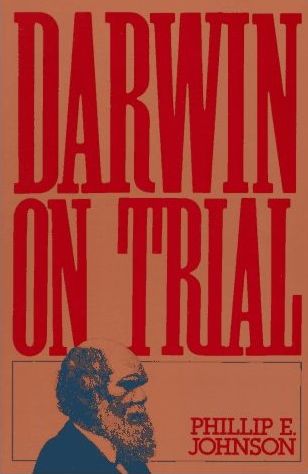
Probably Phillip E. Johnson's "Darwin on Trial" is still the best overall book on creation/evolution to start with, because it not only deals with some of the main evolutionist evidence, but more importantly Johnson, then a law professor at Berkeley University, whose "specialty [was] in analyzing the logic of arguments and identifying the assumptions that lie behind those arguments":

"Before undertaking this task I should say something about my qualifications and purpose. I am not a scientist but an academic lawyer by profession, with a specialty in analyzing the logic of arguments and identifying the assumptions that lie behind those arguments. This background is more appropriate than one might think, because what people believe about evolution and Darwinism depends very heavily on the kind of logic they employ and the kind of assumptions they make. Being a scientist is not necessarily an advantage when dealing with a very broad topic like evolution, which cuts across many scientific disciplines and also involves issues of philosophy. Practicing scientists are of necessity highly specialized, and a scientist outside his field of expertise is just another layman." (Johnson, P.E., "Darwin on Trial," [1991], InterVarsity Press: Downers Grove IL, Second Edition, 1993, p.13)

analysed the underlying naturalistic (i.e. nature is all there is-there is no supernatural) assumptions of evolutionists and the logic (or illogic) of their arguments.

The reason why that is more important than the actual evidence for evolution is that evolutionists' (like everyone's) fundamental metaphysical assumptions determine what counts as evidence.

For example, if one's fundamental assumption is that there is no God, then one has no option but to accept "the standard scientific theory" of evolution, "that `human beings have developed over millions of years from less advanced forms of life, but God had no part in this process'" (my emphasis):

"Facing such a reality, perhaps we should not be surprised at the results of a 2001 Gallup poll confirming that 45 percent of Americans believe `God created human beings pretty much in their present form at one time within the last 10,000 years or so'; 37 percent prefer a blended belief that `human beings have developed over millions of years from less advanced forms of life, but God guided this process'; and a paltry 12 percent accept the standard scientific theory that `human beings have developed over millions of years from less advanced forms of life, but God had no part in this process.'" (Shermer, M.B., "The Gradual Illumination of the Mind," Scientific American, February 2002. My emphasis)

Then, if presented with evidence and argument that God (or an Intelligent Designer) did have a part in this process, one would dismiss it out of hand as simply not possible and one would adopt the next most plausible (or least implausible) atheistic alternative.

Intelligent Design (ID) movement leaders, paleontologist Marcus Ross and philosopher Paul Nelson agree (as I do) with Johnson's point that, "The fundamental differences between the two theories," creation and evolution, "did not stem from any particular historical narrative but rather from what kinds of causes would be allowed in scientific explanation and what would count as evidence" and "that naturalism-that is, not the detailed narrative of evolution, but its underlying epistemology-had become the strongest commitment of modern science since Darwin's time" (their emphasis):

"Johnson, however, glimpsed something that others had missed. To borrow a metaphor from biological classification, we can say that Johnson discovered the popular taxonomy of theories of origins was wrong. In that classification those who accepted creation held the view of six-day special creation and a young earth, while others accepted `evolution,' a 4.5 billion-year-old earth and an even older universe. ... But Johnson's analysis in Darwin on Trial begins by jettisoning this familiar polarity. Setting aside the usual diagnostic markers, Johnson dissects creation and evolution by first inspecting what might be called their epistemological anatomy.
`Evolution' contradicts `creation,' ` he wrote, `only when it is explicitly or tacitly defined as fully naturalistic evolution-meaning evolution that is not directed by any purposeful intelligence. [Johnson, P.E., "Darwin on Trial," InterVarsity Press: Downers Grove IL, Second Edition, 1993, p.4]
The fundamental differences between the two theories, Johnson argued, did not stem from any particular historical narrative but rather from what kinds of causes would be allowed in scientific explanation and what would count as evidence. Epistemology-namely, what can be known empirically, and what counts as a scientific explanation-is what truly cuts the origins issue at its joints. At first glance this analysis seems to get it all wrong. Theistic evolutionists-those who accept a 4.5 billion-year-old earth and relatedness of all organisms in a tree of life (through divine purpose)-are sorted into the same group as young-earth creationists, with whom they appear to share only the theological premise of `divine purpose.' But Johnson presses on:
Persons who believe that the earth is billions of years old, and that simple forms of life evolved gradually to become more complex forms including humans, are `creationists' if they believe that a supernatural Creator not only initiated this process but in some meaningful sense controls it in furtherance of a purpose. As we shall see, `evolution' (in contemporary scientific usage) excludes not just creation-science but creationism in the broad sense. [Ibid.]
... The consequences of this reframing of the origins controversy, from a choice between two very different narratives to the question of which epistemology science should adopt, are still unfolding. But already, many years after Darwin on Trial, Johnson's approach has revolutionized the debate. ... This was one of Phillip Johnson's key insights, and it stemmed from his discovery that naturalism-that is, not the detailed narrative of evolution, but its underlying epistemology-had become the strongest commitment of modern science since Darwin's time. The evolutionary narrative changed from one year to the next, sometimes wildly so, depending on the latest discoveries or academic fashions; the naturalistic commitment was a constant, so deep that in most cases it was entirely tacit." (Ross, M. & Nelson, P., "A Taxonomy of Teleology," in Dembski, W.A., ed., "Darwin's Nemesis: Phillip Johnson and the Intelligent Design Movement," InterVarsity Press: Downers Grove IL, 2000, pp.262-264. Emphasis original)

>(I do happen to own a copy of Gerald Schroeder's "The Science of God" which I found put down rather quickly because it seemed so radical, but then again perhaps his view is close to your own?)

See my recent comment on Schroeder's "The Science of God." Basically I agree with many of his criticisms of evolution, and arguments for design, but I disagree with his proposed relativistic time-dilation harmony of the Genesis days with modern science.

>Blessings,
>
>AN

I hope this has helped.

One can get into this as deep, or as shallow, as one wants to, i.e. how important one sees it. One can (like me), regard it as very important (since if intelligent design is true - let alone Christianity which is true - then "the standard scientific theory" of fully naturalistic evolution would be false, and then the scientific and cultural implications of that will be immense) and try to keep abreast of most books and articles on the topics of creation, evolution and intelligent design and then contribute to the debate oneself. Or if one doesn't have the time or inclination to go that far, one can still keep up to date with the main issues by reading blogs like mine and those listed on its blogroll.

Stephen E. Jones, BSc (Biol).


Genesis 10:20b-31 20... The Semites21 Sons were also born to Shem, whose older brother was Japheth; Shem was the ancestor of all the sons of Eber.22The sons of Shem: Elam, Asshur, Arphaxad, Lud and Aram.23The sons of Aram: Uz, Hul, Gether and Meshech.24Arphaxad was the father of Shelah, and Shelah the father of Eber.25Two sons were born to Eber: One was named Peleg, because in his time the earth was divided; his brother was named Joktan.26Joktan was the father of Almodad, Sheleph, Hazarmaveth, Jerah, 27Hadoram, Uzal, Diklah, 28Obal, Abimael, Sheba, 29Ophir, Havilah and Jobab. All these were sons of Joktan. 30The region where they lived stretched from Mesha toward Sephar, in the eastern hill country. 31These are the sons of Shem by their clans and languages, in their territories and nations.

Saturday, November 11, 2006

What I believe about Creation, Evolution, Design and Christianity

I have decided to start an online list of the main things that I believe about Creation (including Christianity), Evolution and Design, in alphabetic order of topics. I will add to this list over time and (where applicable) add Bible references.

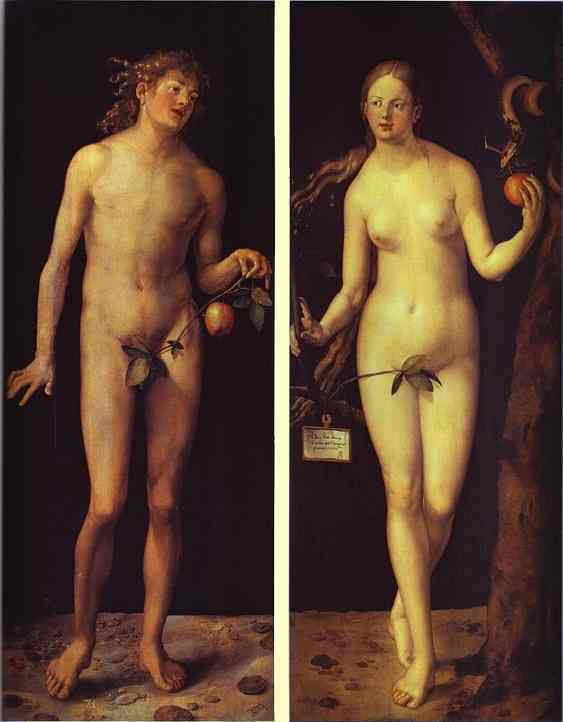
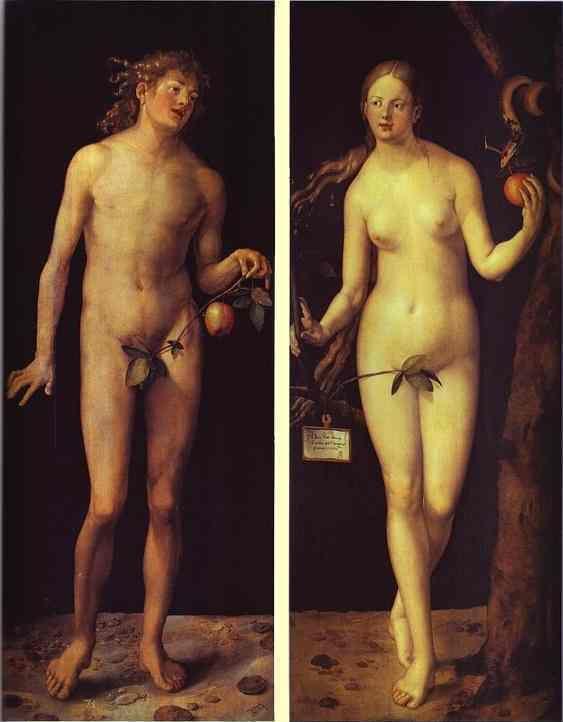
Adam & Eve. I regard the best fit of the Biblical and scientific data on Adam and Eve to be E.K.V. Pearce's "two `Adams'" model.

[Graphic: Albrecht Durer's Adam and Eve, Olga's Gallery.]

That is, there was both Genesis 1 "man" (Heb. 'adam in Gen. 1:26-28 is without the article and therefore is translated "man") and a Genesis 2 "Adam" (Heb. 'adam in Gen. 2:20 is with the article ("the man") and therefore is translated "Adam", i.e. an individual, a name). Genesis 1 "man" (male and female-Gen. 1:26-28) were the actual and/or symbolic common ancestors of all Homo sapiens. But Genesis 2 "Adam" (Gen. 2:4,20;3:17,20-21; 4:1, 25; 5:1,3-5; Hos 6:7; 1 Tim. 2:13-14; Jude 1:14) was a literal individual and/or symbol ("the pattern of the one [Christ] to come"-Rom. 5:14) and was/symbolised the common ancestor only of the line which led to Christ (Lk. 3:23,38) and therefore through Him, "the last Adam" (1 Cor. 15:45) was united back through Genesis 2 "Adam" and Genesis 1 "man," to all humans as their Representative (Rom. 5:12-14; 1 Cor. 15:22,45).

Bible. Is God's unique God-breathed (2 Tim. 3:15-17) revelation in human words, of Himself, His ways and His will, to man.

Big Bang. Was the origin event of the entire Universe. Time and space themselves came into existence with. Therefore there is no such thing as time (and therefore a "before") the Big Bang.

Christianity. Is the one true religion, in the sense of God's only way of salvation (Jn. 14:6; Acts 4:12; 1 Tim. 2:5). Is proven true beyond reasonable doubt by Jesus Christ fulfilling multiple prophecies of Messiah's time of coming (Dan 9:24-27), place of birth (Mic 5:2) His Virgin birth (Isa. 7:14; Mat. 1:23), sinless life (2 Cor. 5:21; Heb. 4:15; 1 Pet. 2:22; 1 Jn. 3:5), miracles (Mat. 8:23-27), suffering (Ps. 22:1,7-8,16,18; Mt 27:35-46; Isa. 53:3-12; Acts 8:32-35), death, resurrection and ascension.

Common ancestry. I accept universal common ancestry (but not evolution). That is, I accept that all life on Earth, both living and dead, shared a single common ancestor at the origin of life. And that thereafter all life has descended with modification from that single common ancestor. But that modification was by both supernatural and natural means. Common ancestry is therefore not necessarily evolution, since as Dawkins (quoting Darwin) pointed out, God could have intervened supernaturally "at any one stage of descent" in which case it "was not evolution at all" but was in fact "divine creation" (Dawkins, R., "The Blind Watchmaker," 1986, pp.248-249,317)! See my posts of 23-Sep-05, 04-Jan-06, 16-Nov-05, 27-May-06, 30-May-06, 20-Jun-06, 11-Aug-06, 02-Aug-06, 27-Aug-06, 04-Nov-06, 31-Dec-06, 17-Feb-07, 26-Mar-07 & 30-March-07.

Creation. According to my Progressive Mediate Creation position, this was the creatio ex nihilo (creation out of nothing) by God of the raw materials of Universe (Gen. 1:1), and thereafter (Gen. 1:2-31) was creatio ex materia (creation out of matter) by God making and forming those raw materials, both supernaturally and naturally. Therefore creation includes both 1. primary or immediate creation - God working supernaturally not through secondary causes; and 2. secondary or mediate creation - God working supernaturally and naturally through secondary causes.

Creationism. That the Universe and life was brought into being by a Creator. Includes Old-Earth/Progressive Creation (OEC/PC) and Young-Earth Creation (YEC), which hold that God supernaturally intervened to bring about the origin of the Universe, life, life's major groups and man. Also I regard as creationism those versions of Theistic or God-Guided Evolution (TE/GGE) in which God supernaturally intervened in or guided creation. Also versions of Deistic Evolution (DE) or Evolutionary Creationism (EC) which hold that God front-loaded the Universe so that life and man would inevitable appear, I also regard as a form of creationism. However those versions of TE/GGE, DE and EC which are just Naturalistic Evolution believed by those who are, or claim to be, Christians (NEC) I do not regard as creationism. See my position Progressive Mediate Creation.

Darwin, Charles. Founder of the modern theory of fully naturalistic evolution. A flawed genius, like Sigmund Freud. Committed plagiarism and other forms of dishonesty in seeking for himself "the bauble fame" (Darwin. F., ed., "The Life and Letters of Charles Darwin," 1898, p.i:452).

Darwinism. Is false, except as a limited theory of adaptation. In its general form is self-refuting, because of Darwin's "horrid doubt" that "the convictions of man's mind, which has been developed from the mind of the lower animals" i.e. by a purposeless process like the natural selection of random mutations "are of any value or at all trustworthy" (Darwin, 1898, p.i:285), which "convictions of man's mind" would include Darwinism itself (not to mention any theory of evolution that was fully materialistic and naturalistic and denied design, and indeed Materialism and Naturalism themselves).

Design. God's purpose, plan, and their execution. Argument from design to a Designer. Argument to design from a Designer. See Intelligent Design (ID).

Evolution. Cosmological and biological change over time in which God had no part. Does not actually exist, except in the sense of a counterfeit of the genuine article, creation.

Flood, Noah's. On the basis of Jesus' affirming that there was a Noah, an ark and a flood (Mat. 24:38; Lk. 17:27), and other evidence such as the credible design and dimensions of the Ark and the widespread ancient stories of a Great Flood, I accept that there really was a Noah's flood, but that it was probably a local symbolic act by God to represent His judgment on the entire world.

Genesis 1. Of the various main interpretative approaches to Genesis 1, including: Literalist, Gap theory, Day-age, Proclaimed days, Revealed days and Literary Framework; I consider the latter Literary Framework interpretation to be the best fit of the data of the text itself and the evidence from nature (general revelation). See my post of 31-Aug-06 for more details.

Genesis 1-11. I regard this as real history expressed partly (e.g. the talking snake of Genesis 3-Gen. 3:1-4; 13-14; Jn. 8:44; Rom. 16:20; 2 Cor. 11:3; Rev. 12:9,14-15; 20:2) in symbolic form.

Global warming. I believe that global warming is part of the Great Tribulation. Having once been a global warming sceptic, I now believe it is real and indeed going to be nearer the worst case than best case scenarios. I interpret some of the signs Jesus warned would precede His return, e.g.:

"Nation will rise against nation, and kingdom against kingdom. There will be famines and earthquakes in various places." (Mt. 24:7; Mk 13:8; Lk 21:11)

and:

25"There will be signs in the sun, moon and stars. On the earth, nations will be in anguish and perplexity at the roaring and tossing of the sea. 26Men will faint from terror, apprehensive of what is coming on the world, for the heavenly bodies will be shaken. (Lk 21:25-26)

as being fulfilled in the environmental and social upheaveals that will occur as consequences of global warming. See further some of my posts on this: 31 Mar 06; 28 Mar 06; 04 Mar 06; 04 Dec 05; 29 Nov 05 & 12 Aug 05.

Gnosticism. I believe that much of what passes for Christianity these days is a form of Gnosticism, in which God is regarded as radically separate from His creation such that He should not, would not, or could not intervene in it supernaturally, but should only, would only, or could only work through secondary causes (e.g. Demiurge, Evolution). Is marked by those who claim to be Christians but who are strongly opposed to God having intervened supernaturally in His creation and who seek to minimise or even deny Biblical miracles. Extreme hostility to the idea Intelligent Design, that there is empirically detectable evidence of design in nature, I regard as Gnostic.

God. Exists as Person who is infinite in power, knowledge, goodness and love. Revealed in Bible as Triune: Father, Son and Holy Spirit (Mat. 3:16-17; 28:19; 2 Cor. 13:14; 1 Pet. 1:2).

God, evidence. All humans intuitively know there is a God (Ps. 19:1-3; Rom. 1:18-20). Even atheists show by their attacks on God and His followers that they really know deep down that there is a God to whom they are accountable.

God existence. Arguments for existence of God include: Ontological, Cosmological, Teleological and Moral. These are cumulative.

God, hiddenness. God could have made it impossible to not believe but He has not done so.

Great Tribulation. I believe we are in or entering the period described by Jesus as the Great Tribulation (Mat. 24:21; Rev. 7:14 KJV), which is also "Satan's little season" in which he will be free once more to "go out to deceive the nations" (Rev. 20:1-3,7). That time will be marked by the Great Apostasy (2 Thess 2:3 KJV. "falling away" = Gk. apostasia); when there will be an "increase of wickedness" and "the love of most will grow cold" (Mat. 24:12) such that when Jesus returns, true Christian faith will be comparatively rare (Lk. 18:8). Christians will be increasingly persecuted (Mat. 24:9-14), Antichrist will appear (1 Jn. 2:18; 4:3; 2 Thess 2:3-11). and the Church would be destroyed (Rev. 11:3-10) were it not for Jesus' return (2 Thess 2:8). See also Global warming.

Hell. I am persuaded by the weight of Biblical evidence that Hell is not everlasting conscious punishment, but rather it is the final divine judgment whose results cannot be reversed, and which, after each person receives no more and no less than the just punishment due for their sins, terminates in their annihilation. See my "Re: Baxter, Darwin, predestination, damnation, etc." Also see Pinnock, C.H., 2005, "The Destruction of the Finally Impenitent," 11 May; Fudge, E., 1984, "The Final End of the Wicked," Journal of the Evangelical Theological Society, 27.3, September, pp.325-334; and "Annihilationism," Wikipedia, 19 October 2010.

Information. Not reducible to matter or energy.

Intelligent Design (ID). Scientific theory that there is empirically detectable evidence of intelligent causation in nature prior to the origin of humans. ID depends solely on the evidence of nature. Therefore ID cannot specify who the designer is. See Intelligent Designer & Irreducible complexity.

Intelligent Designer. As a Christian, I personally assume (but cannot prove) that the Designer is the God of the Bible. However, it is not necessary to identify the designer to correctly infer design.

Irreducible complexity. Darwin in his Origin of Species dishonestly proposed a test of his theory that he knew presented his critics with the impossible task of proving a universal negative:

"In Darwin's words, `if it could be demonstrated that any complex organ existed which could not possibly have been formed by numerous successive slight modifications, my theory would absolutely break down.' ... Darwin had to show only that the intermediates could possibly have existed. His critics had the more difficult task: they had to show that the intermediates could not have existed. It is very difficult to prove negative statements." (Ridley, M., "Evolution," Blackwell: Cambridge MA, Second Edition, 1996, p.342).

Therefore my definition of "irreducible complexity" is, to paraphrase Darwin:

"Any complex biological system which could not plausibly have been formed by numerous successive slight modifications."

Jesus Christ. Was and is God in human form (Mt 1:23; 28:19; Jn 1:1,14; 8:58-59; 10:32-33; 20:27-28; Acts 20:28; Rom 9:5; 2 Cor 13:14; Php 2:5-6, Col 2:9; Tit 2:13; 1 Pet 1:2; etc). That is, the pre-existent Christ, the Second Person of Trinity, took upon human nature of man Jesus. Died on the Cross for the sins of the word, resurrected from death and ascended to heaven, from where He will return to raise all humans who have ever lived and judge them according to their every thought, word and deed.

Jesus Christ's return (second coming). Jesus will return (Mat. 16:27; 24:30; 26:64; Acts 1:11; 1 Cor. 11:26; 1 Thess. 4:16; Heb. 9:28; Rev. 1:7)! My interpretation is that we are in the period predicted by Jesus in Lk 21:24-28, between

[Right: Jerusalem, after 1967: BBC]

Jerusalem being no longer under Gentile rule ("Jerusalem will be trampled on by the Gentiles until the times of the Gentiles are fulfilled" v.24b) which happened in 1967, and Jesus' return"with power and great glory" (v.27). That period will be characterised by "nations ... in anguish and perplexity" (v.25) and "Men ... faint[ing] from terror, apprehensive of what is coming on the world" (v.26). "When these things begin to take place" Jesus encouragement to His followers is to "stand up and lift up your heads, because your redemption is drawing near" (v.28). I assume (along with leading Christian theologians such as the late Anthony A. Hoekema and William Hendriksen) that the destruction of Jerusalem by the Romans in AD 70, predicted by Jesus in the Olivet discourse (Mt 23:37-24:51, Mk 13:1-37; Lk 21:5-36), was a `type' of the second coming of Jesus. And therefore Jesus' prediction that "this generation will certainly not pass away until all these things have happened" (Mt 24:34; Mk 13:30; Lk 21:32) applies also to the generation that will live to see Jesus' return. And since Jerusalem no longer being under Gentile rule in 1967 is one of the "all these things" that that generation living at the time of Jesus' return will experience, I therefore assume that Jesus will return before the bulk of that generation that lived in 1967 passes away, i.e. before 2037. See also my posts "Re: about your prediction of Jesus' return by 2037" and "Re: what would happen if I lived to 2037 and Jesus has not come?"

Life, origin of. I assume that a fully naturalistic origin of life from non-living chemicals is so improbable that it was effectively impossible. That is, I agree with the late Francis Crick, co-discoverer of the structure of DNA that:

"An honest man, armed with all the knowledge available to us now, could only state that in some sense, the origin life appears at the moment to be almost a miracle, so many are the conditions which would have had to have been satisfied to get it going." (Crick, F.H.C., "Life Itself: Its Origin and Nature," Simon & Schuster: New York NY, 1981, p.88. My emphasis)

except that on the basis of "all the knowledge available to us now," I accept that the origin of life was "a miracle"! That is, the origin of life required the intervention/guidance of an Intelligent Designer (who I assume is the Christian God)

Life, extraterrestrial. To paraphrase Richard Dawkins ("The Blind Watchmaker," 1986, p.288):

"`I predict that, if a form of life is ever discovered in another part of the universe ... it will be found to resemble life on Earth in one key respect: it will have' been created by an Intelligent Designer"! ("Smallest genome clocks in at 182 genes").

However, I assume that life has only ever existed on Earth in the entire Universe, with the possible exception of Mars (in the latter case it would then have been transported to Earth in bacterial form via meteorite ejecta). See also SETI.

Materialism. That is, "matter/energy is all there is." Materialism is equivalent to naturalism. Is false because there is a non-material God, spirits (e.g. angels and demons) mind, information, laws and numbers. Also materialism is self-refuting because:

"... if my mental processes are determined wholly by the motions of atoms in my brain I have no reason to suppose that my beliefs are true ... " (Haldane, J.B.S., "Possible Worlds," Chatto &
Windus: London, 1932, p.209).

Multiple Universes/Multiverse. Do not/does not exist. There is, and has been, only one Universe and this is it.

Mutation. The true cause of biological change. Included genetic (e.g. DNA point mutations) and chromosomal (e.g. duplications, inversions, translocations and deletions). Mutations can be directed or undirected (random). Major biological change.

Natural selection. Is nothing more than differential reproduction. Can of itself only negative eliminate the unfit and make minor adaptive changes (e.g. peppered moths and Galapagos finch beaks). Cannot of itself positively create. Requires the right mutations, at the right place at the right time to make major biological change. The latter therefore requires directed mutations.

Nature. God's general revelation to man. Book of nature that, with book of Scripture (Bible) has the same ultimate Author. Therefore the two books must ultimately agree and be complementary to each other.

Naturalism. That is "nature is all there is"-"there is no supernatural" and "all that exists can in principle be studied by the scientific method." Is false because supernatural God exists and so does supernatural beings angels and demons, as well as laws and numbers. In its dominant scientific form, naturalism is equivalent to materialism. Naturalism is self-refuting because:

"Naturalism, even if it is not purely materialistic ... discredits our processes of reasoning ... to such a humble level that it can no longer support Naturalism itself." (Lewis, C.S., "Miracles," Fontana: London, 1963, p.19).

Pascal's Wager My simplified form of Pascal's Wager that I employed in debates with atheists is:

Neither the atheist, nor the Christian, can absolutely prove that his position is true. Nevertheless the consequences for either the atheist or the Christian being right (or wrong) is clear. If atheism is true, then both the atheist and Christian will die and neither will know that the atheist was right. On the other hand, if Christianity is true, then the atheist and Christian will die (or Jesus will return) and both will know that the Christian was right. Morever, if the atheist was right, he would have gained nothing and the Christian would have lost nothing (I personally have had a great life since becoming a Christian in 1967). But if the Christian was right, the atheist would have lost everything and the Christian would have gained everything!

Progressive Mediate Creation (PMC). My position on the creation-evolution spectrum as what seems to me to be the best fit of the Biblical and scientfic evidence. It holds that, as per Genesis 1, God created ex nihilo (out of nothing) the raw materials of the Universe (Gen. 1:1). Thereafter (Gen. 1:2-31) God created by the making and forming of those raw materials, both supernaturally and naturally, through secondary causes. I took the name "Progressive Mediate Creation" to denote the position of the great evangelical Presbyterian theologian Charles Hodge, who wrote of a "a mediate, progressive creation":

"Mediate and Immediate Creation But while it has ever been the doctrine of the Church that God created the universe out of nothing by the word of his power, which creation was instantaneous and immediate, i. e., without the intervention of any second causes; yet it has generally been admitted that this is to be understood only of the original call of matter into existence. Theologians have, therefore, distinguished between a first and second, or immediate and mediate creation. The one was instantaneous, the other gradual; the one precludes the idea of any preexisting substance, and of cooperation, the other admits and implies both. There is evident ground for this distinction in the Mosaic account of the creation. ... It thus appears that forming out of preexisting material comes within the Scriptural idea of creating. ... There is, therefore, according to the Scriptures, not only an immediate, instantaneous creation ex nihilo by the simple word of God, but a mediate, progressive creation; the power of God working in union with second causes." (Hodge, C., "Systematic Theology," [1892], James Clark & Co: London, Vol. I, Reprinted, 1960, pp.556-557)

It follows, therefore, that after the original ex nihilo creation of the Universe God created only by modification, both supernaturally and naturally. Therefore Universal Common Ancestry is a corollary of PMC. See also my FAQ, Progressive (Mediate) Creation.

SETI. Since I believe that life only ever has existed on Earth or also possibly Mars (in the latter case only in bacterial form) I believe the search for extraterrestrial life beyond Mars and extraterrestrial intelligence (SETI), are doomed to failure.

Shroud of Turin. I am persuaded by the evidence that the Shroud of Turin is the actual linen cloth which covered the body of Jesus. And that the

[Left (click to enlarge): Face of the Man on the Shroud of Turin: Wilson, I. & Schwortz, B., 2000, "The Turin Shroud: The Illustrated Evidence," Michael O'Mara: London, p.28]

double-sided, photo- graphic negative, 3-D, x-ray, image of a naked, flogged, crowned with thorns, speared in the side, crucified, man, was the result of a flash of radiation as Jesus' body changed state at His resurrection (Jn. 20:19,26; 1 Cor. 15:42-44,50; Php. 3:21). See my series of posts from: Bogus: Shroud of Turin? #1 and my "A proposal to radiocarbon- date the pollen of the Shroud of Turin." See also my second blog, The Shroud of Turin.

Speciation. Reproductive isolation. Chromosomal mutations primary cause. With or without geographic isolation. Little, if anything, to do with natural selection.

Universe. Ultimately created by God from nothing (Gen. 1:1; Jn. 1:1-3; 2 Cor. 4:6; Heb. 11:3). Sustained and governed by God.

Created: 11 November, 2006. Last updated: 26 February, 2011.

Stephen E. Jones, BSc. (Biology).
My other blogs: The Shroud of Turin & Jesus is Jehovah!

Friday, November 10, 2006

My critique of Dawkins' "The God Delusion" #3

Dear Professor Dawkins,

Continuing from part #2

[Graphic: The Black Book of Communism, Amazon.ca]

with the Preface to your book, "The God Delusion" in which you wrote:

"But I was delighted with the advertisement that Channel Four put in the national newspapers. It was a picture of the Manhattan skyline with the caption `Imagine a world without religion.' What was the connection? The twin towers of the World Trade Center were conspicuously present. Imagine, with John Lennon, a world with no religion."

You don't have to "Imagine a world without religion" (my emphasis). There is today in the 21st century "a world without religion" in one of the last atheistic communist regimes still remaining, namely North Korea.

That `idyllic' "world with no religion" has "one of the worst human rights records of any nation," "ranks ... last out of 159 countries in terms of citizens' freedom." This "world without religion" has "detention camps with an estimated 150,000 to 200,000 inmates" in which "torture, starvation, rape, murder and forced labour" are routine policy, resulting in an "annual mortality rate" which "approaches 20% to 25%" with "An estimated two million civilians ... killed by the government." In "one camp, chemical weapons were tested on prisoners in a gas chamber" and "pregnant women inside the camps are often forced to have abortions or the newborn child is killed" (my emphasis):

"Human Rights Amnesty International and other human rights organizations, including the North American Free Speech Association, accuse North Korea of having one of the worst human rights records of any nation, severely restricting most freedoms, including freedom of speech and freedom of movement, both inside the country and abroad. The State of World Liberty Index ranks North Korea last out of 159 countries in terms of citizens' freedom. North Korean exiles have testified as to the existence of detention camps with an estimated 150,000 to 200,000 inmates, and have reported torture, starvation, rape, murder and forced labour. Japanese television aired what it said was footage of a prison camp. In some of the camps, US officials and former inmates say the annual mortality rate approaches 20% to 25%. An estimated two million civilians have been killed by the government. A former prison guard and army intelligence officer said that in one camp, chemical weapons were tested on prisoners in a gas chamber. According to a former prisoner, pregnant women inside the camps are often forced to have abortions or the newborn child is killed. The government of North Korea refuses to admit independent human rights observers to the state." ("North Korea," Wikipedia. References omitted).

Your fellow Oxford University professor, molecular biophysicist-turned theologian Alister McGrath

[Graphic: Revd Professor Alister McGrath, Wycliffe Hall, Oxford]

has noted that an even worse example of such "a world without religion," namely the "between 85 million and 100 million" `liquidated' by the atheist regimes of "Lenin and Stalin" and this "dark side of atheism" has been "airbrushed out of Dawkins' rather selective reading of history" and "Dawkins has curiously failed to mention, let alone engage with, the blood-spattered trail of atheism in the twentieth century" (my emphasis):

"Everyone would agree that some religious people do some very disturbing things. But the introduction of that little word `some' to Dawkins' argument immediately dilutes its impact. For it forces a series of critical questions. How many? Under what circumstances? How often? It also forces a comparative question: how many people with anti-religious views also do some very disturbing things? And once we start to ask that question, we move away from cheap and easy sniping at our intellectual opponents, and have to confront some dark and troubling aspects of human nature. Let's explore this one. I used to be anti-religious. In my teens, I was quite convinced that religion was the enemy of humanity, for reasons very similar to those that Dawkins sets out in his popular writings. But not now. And one of the reasons is my dreadful discovery of the dark side of atheism. Let me explain. In my innocence, I assumed that atheism would spread through the sheer genius of its ideas, the compelling nature of its arguments, its liberation from the oppression of religion, and the dazzling brilliance of the world it commended. Who needed to be coerced into such beliefs, when they were so obviously right? ... And yes, atheism liberated people from religious oppression, especially in France in the 1780s. But when atheism ceased to be a private matter and became a state ideology, things suddenly became rather different. The liberator turned oppressor. To the surprise of some, religion became the new liberator from atheist oppression. Unsurprisingly, these developments tend to be airbrushed out of Dawkins' rather selective reading of history. But they need to be taken with immense seriousness if the full story is to be told. The final opening of the Soviet archives in the 1990s led to revelations that ended any notion that atheism was quite as gracious, gentle, and generous a worldview as some of its more idealistic supporters believed. The Black Book of Communism, based on those archives, created a sensation when first published in France in 1997, not least because it implied that French communism - still a potent force in national life - was irreducibly tainted with the crimes and excesses of Lenin and Stalin. Where, many of its irate readers asked, were the `Nuremberg Trials of Communism'? Communism was a `tragedy of planetary dimensions' with a grand total of victims variously estimated by contributors to the volume at between 85 million and 100 million - far in excess of the excesses committed under Nazism. Now, one must be cautious about such statistics, and equally cautious about rushing to quick and easy conclusions on their basis. Yet the basic point cannot really be overlooked. One of the greatest ironies of the twentieth century is that many of the most deplorable acts of murder, intolerance, and repression were carried out by those who thought that religion was murderous, intolerant, and repressive - and thus sought to remove it from the face of the planet as a humanitarian act. Even his most uncritical readers should be left wondering why Dawkins has curiously failed to mention, let alone engage with, the blood-spattered trail of atheism in the twentieth century - one of the reasons, incidentally, that I eventually concluded that I could -no longer be an atheist.' (McGrath, A.E., "Dawkins' God: Genes, Memes, and the Meaning of Life,"Blackwell: Malden MA, 2005, pp.112-114. Emphasis original).

Remember that you claimed that, "I ... care passionately about what is true and ... never say anything that I do not believe to be right" and "I ... distance myself from professional advocates" (my emphasis):

"In one respect I plead to distance myself from professional advocates. A lawyer or a politician is paid to exercise his passion and his persuasion on behalf of a client or a cause in which he may not privately believe. I have never done this and I never shall. I may not always be right, but I care passionately about what is true and I never say anything that I do not believe to be right. I remember being shocked when visiting a university debating society to debate with creationists. At dinner after the debate, I was placed next to a young woman who had made a relatively powerful speech in favour of creationism. She clearly couldn't be a creationist, so I asked her to tell me honestly why she had done it. She freely admitted that she was simply practising her debating skills, and found it more challenging to advocate a position in which she did not believe. Apparently it is common practice in university debating societies for speakers simply to be told on which side they are to speak. Their own beliefs don't come into it. I had come a long way to perform the disagreeable task of public speaking, because I believed in the truth of the motion that I had been asked to propose. When I discovered that members of the society were using the motion as a vehicle for playing arguing games, I resolved to decline future invitations from debating societies that encourage insincere advocacy on issues where scientific truth is at stake." (Dawkins R., "The Blind Watchmaker: Why the Evidence of Evolution Reveals a Universe Without Design," W.W Norton & Co: New York NY, 1986, p.xiv).

yet you are presumably making a lot of money by being a professional advocate for atheism, calling and working for "a world without religion," yet completely ignoring what Jesus called, "the plank in your own eye":

Mat. 7:3-5. 3"Why do you look at the speck of sawdust in your brother's eye and pay no attention to the plank in your own eye? 4How can you say to your brother, 'Let me take the speck out of your eye,' when all the time there is a plank in your own eye? 5You hypocrite, first take the plank out of your own eye, and then you will see clearly to remove the speck from your brother's eye."

namely the far worse track record of such worlds "without religion," in the atheistic regimes of the 20th and indeed 21st centuries!

Even one of your Darwinist colleagues, Andrew Brown, comments in a review of your book about your excuse that "Individual atheists may do evil things but they don't do evil things in the name of atheism":

"Dawkins is inexhaustibly outraged by the fact that religious opinions lead people to terrible crimes. But what, if there is no God, is so peculiarly shocking about these opinions being specifically religious? The answer he supplies is simple: that when religious people do evil things, they are acting on the promptings of their faith but when atheists do so, it's nothing to do with their atheism. He devotes pages to a discussion of whether Hitler was a Catholic, concluding that `Stalin was an atheist and Hitler probably wasn't, but even if he was the bottom line is very simple. Individual atheists may do evil things but they don't do evil things in the name of atheism.' Yet under Stalin almost the entire Orthodox priesthood was exterminated simply for being priests, as were the clergy of other religions and hundreds of thousands of Baptists. The claim that Stalin's atheism had nothing to do with his actions may be the most disingenuous in the book, but it has competition from a later question, `Why would anyone go to war for the sake of an absence of belief [atheism]?'-as if the armies of the French revolution had marched under icons of the Virgin, or as if a common justification offered for China's invasion of Tibet had not been the awful priest-ridden backwardness of the Dalai Lama's regime. One might argue that a professor of the public understanding of science has no need to concern himself with trivialities outside his field like the French revolution, the Spanish civil war or Stalin's purges when he knows that history is on his side. `With notable exceptions, such as the Afghan Taliban and the American Christian equivalent, most people play lip service to the same broad liberal consensus of ethical principles.' Really? `The majority of us don't cause needless suffering; we believe in free speech and protect it even if we disagree with what is being said.' Do the Chinese believe in free speech? Does Dawkins think that pious Catholics or Muslims are allowed to? Does he believe in it himself? He quotes later in the book approvingly and at length a speech by his friend Nicholas Humphrey which argued that, `We should no more allow parents to teach their children to believe, for example, in the literal truth of the Bible or that planets rule their lives, than we should allow parents to knock their children's teeth out.' But of course, it's not interfering with free speech when atheists do it.' what Dawkins was famous for. It's a shame to see him reduced to one long argument from professorial incredulity. " (Brown, A., "Dawkins the dogmatist." Review of The God Delusion, by Richard Dawkins, Bantam. Prospect, October 2006).

which apart from being self-contradictory to your previous claim that, according to your "Darwinian View of Life," "there is, at bottom ... no evil..." (my emphasis):

"Theologians worry away at the `problem of evil' and a related `problem of suffering.' ... On the contrary, if the universe were just electrons and selfish genes, meaningless tragedies ... are exactly what we should expect, along with equally meaningless good fortune. Such a universe would be neither evil nor good in intention. It would manifest no intentions of any kind. In a universe of blind physical forces and genetic replication, some people are going to get hurt, other people are going to get lucky, and you won't find any rhyme or reason in it, nor any justice. The universe we observe has precisely the properties we should expect if there is, at bottom, no design, no purpose, no evil and no good, nothing but blind, pitiless indifference. As that unhappy poet A.E. Housman put it: `For Nature, heartless, witless Nature Will neither care nor know.' DNA neither cares nor knows. DNA just is. And we dance to its music." (Dawkins, R., "River out of Eden: A Darwinian View of Life," Phoenix: London, 1996, pp.154-155. Emphasis original).

it is a blatant example of the fallacy of special pleading, i.e. an "attempt" by people "to apply a `double standard', which makes an exception to the rule for themselves-or people like them-but applies it to others" (my emphasis):

"People are most tempted to engage in special pleading when they are subject to a law or moral rule that they wish to evade. People often attempt to apply a `double standard', which makes an exception to the rule for themselves-or people like them-but applies it to others. They usually do not argue that they, or their group, should be exempt from the rule simply because of who they are; this would be such obvious special pleading that no one would be fooled. Instead, they invoke some characteristic that they have that sets them apart; however, if the characteristic is not a relevant exception to the rule, then they are engaged in special pleading." (Curtis, G.N., "Special Pleading," The Fallacy Files, 10 June 2006).

Continued in part #4.

Stephen E. Jones, BSc (Biol).


Genesis 10:1-5a. 1This is the account of Shem, Ham and Japheth, Noah's sons, who themselves had sons after the flood. The Japhethites 2The sons of Japheth: Gomer, Magog, Madai, Javan, Tubal, Meshech and Tiras. 3The sons of Gomer: Ashkenaz, Riphath and Togarmah. 4The sons of Javan: Elishah, Tarshish, the Kittim and the Rodanim. 5(From these the maritime peoples spread out into their territories by their clans within their nations, each with its own language.)

Tuesday, November 07, 2006

Cicero (106-43 BC) the father of ID?

Here are two quotes from the Roman orator- philosopher- lawyer- statesman Marcus Tullius Cicero's (106-43 BC) "The Nature of the Gods" (De Natura Deorum).

[Graphic: Cicero and his "On Friendship and Old Age," Glyn Hughes]

They sound like they could have been written by a modern ID theorist (indeed Bill Dembski refers to both of them in his books).

They are from an oration that Cicero puts in the mouth of an imaginary Stoic philosopher, Quintus Lucius Balbus in a three-cornered dialogue between Gaius Valleius, an imaginary Epicurean, and Cicero himself.

The first quote foreshadows (and may have influenced) Paley's a-watch-implies-a-watchmaker design argument from contrivance. That is, when anyone sees the arrangement of parts for a purpose (e.g. when one sees "a sundial or a water-clock ... that it tells the time") then one intuitively infers it was put together "by design and not by chance." And this applies even to a "one of those barbarians " who had never seen that contrivance before, e.g. on seeing "a globe which in its revolution shows the movements of the sun and stars and planets" a barbarian would not "fail to see that it was the product of a conscious intelligence." Therefore, how can one "imagine that the universe as a whole is devoid of purpose and intelligence" given that "it embraces everything, including these artefacts themselves and their artificers?" (my emphasis):

"When you look at a picture or a statue, you recognize that it is a work of art. When you follow from afar the course of a ship, upon the sea, you do not question that its movement is guided by a skilled intelligence. When you see a sundial or a water-clock, you see that it tells the time by design and not by chance. How then can you imagine that the universe as a whole is devoid of purpose and intelligence, when it embraces everything, including these artefacts themselves and their artificers? Our friend Posidonius as you know has recently made a globe which in its revolution shows the movements of the sun and stars and planets, by day and night, just as they appear in the sky. Now if someone were to take this globe and show it to the people of Britain or Scythia would a single one of those barbarians fail to see that it was the product of a conscious intelligence?" (Cicero, "The Nature of the Gods," [1972], McGregor, H.C.P., transl., Penguin: Harmondsworth UK, 1986, reprint, pp.158-159)

Although I had at the time never heard of Cicero's (or any other design arguments) a version of this occurred to me in my late teens and converted me from atheism to deism. I stepped outside the chess club where I was playing one night to have a cigarette and I looked up at the night sky. The thought came to me with overwhelming force, how could there be so much design witin the Universe (e.g. the laws of nature), and yet the Universe as a whole be not designed? When the question came to me that way, my atheism (which I had become increasingly troubled with by its meaninglessness) seemed to be so implausible, that I there and then became what I later found out was a deist (i.e. I believed there was a God who created the Universe but could not see how one could know anything more about Him from the evidence of nature).

It is interesting that Darwin himself at times had the same "conviction in the existence of God, connected with the reason and not with the feelings" from "the ... impossibility of conceiving this immense and wonderful universe, including man ... as the result of blind chance or necessity" and at those times Darwin felt "compelled to look to a First Cause having an intelligent mind in some degree analogous to that of man (my emphasis):

"Another source of conviction in the existence of God, connected with the reason and not with the feelings, impresses me as having much more weight. This follows from the extreme difficulty or rather impossibility of conceiving this immense and wonderful universe, including man with his capacity of looking far back wards and far into futurity, as the result of blind chance or necessity. When thus reflecting I feel compelled to look to a First Cause having an intelligent mind in some degree analogous to that of man; and I deserve to be called a Theist." (Darwin, C.R., in Barlow, N., ed., "The Autobiography of Charles Darwin, 1809-1882: With Original Omissions Restored," [1958], W.W. Norton & Co: New York NY, 1969, reprint, pp.92-93).

The second quote is in some ways more remarkable than the first, in that against the Epicurean materialist claim that "if an infinite" (i.e. "countless" in other translations) "number of examples of the twenty-one letters of the alphabet ... were shaken together and poured out on the ground it would be possible for them to fall so as to spell out, say, the whole text of the Annals of Ennius," Cicero doubts "whether chance would permit them to spell out a single verse" (my emphasis):

"`Is it not a wonder that anyone can bring himself to believe that a number of solid and separate particles by their chance collisions and moved only by the force of their own weight could bring into being so marvellous and beautiful a world? If anybody thinks that this is possible, I do not see why he should not think that if an infinite number of examples of the twenty-one letters of the alphabet, made of gold or what you will, were shaken together and poured out on the ground it would be possible for them to fall so as to spell out, say, the whole text of the Annals of Ennius. In fact I doubt whether chance would permit them to spell out a single verse! `So how can these people bring themselves to assert that the universe has been created by the blind and accidental collisions of inanimate particles devoid of colour or any other quality? And even to assert that an infinite number of such worlds are coming into being and passing away all the time. If these chance collisions of atoms can make a world, why cannot they build a porch, or a temple, or a house or a city? A much easier and less laborious task.'" (Cicero, Ibid., pp.161-162).

What is so remarkable about this is that, as we shall see, Cicero's intuition was right, even though a physicist of the stature of Sir Arthur Eddington assumed that, "If an army of monkeys were strumming on typewriters they might write all the books in the British Museum" (his emphasis):

"There is a faint possibility that at one moment all the molecules might in this way happen to be visiting the one half of the vessel. You will easily calculate that if n is the number of molecules (roughly a quadrillion) the chance of this happening is (1/2)n. The reason why we ignore this chance may be seen by a rather classical illustration. If I let my fingers wander idly over the keys of a typewriter it might happen that my screed made an intelligible sentence. If an army of monkeys were strumming on typewriters they might write all the books in the British Museum. The chance of their doing so is decidedly more favourable than the chance of the molecules returning to one half of the vessel." (Eddington, A.S., "The Nature of the Physical World," [1928], The Gifford Lectures 1927, Cambridge University Press: Cambridge UK, 1933, reprint, p.72. Emphasis original)

as did a lesser but more recent physicist, Paul Davies (whose latest book, The Goldilocks Enigma I hope to get for my 60th birthday tomorrow!) assume that "a monkey tinkering with a typewriter will eventually type Shakespeare":

"However, just as a monkey tinkering with a typewriter will eventually type Shakespeare, so somewhere among that vast stack of realities will be worlds that are partially ordered, just by chance." (Davies, P.C.W., "The Unreasonable Effectiveness of Science," in Templeton, J.M., ed., "Evidence of Purpose: Scientists Discover the Creator," Continuum: New York NY, 1994, p.53)

But as origin of life theorist Robert Shapiro pointed out, for a chimpanzee at a normal 45-key typewriter, who "never gets tired, and types out one line per second, completely at random," to produce merely the 18-character phrase in Shakespeare's Hamlet, "to be or not to be," the odds would be "1 in 4518, or 1 in 6 x 109" which means "At one try per second, it will take ...more than 1022 years to do that number of tries," i.e. the chimp would "still be typing away long after the stars have ceased to shine and all the planets have been dispersed into space"!:

"J.B.S. Haldane recognized that the chances of obtaining a self-replicating machine depended on the number of parts to it. If the number was small, there was no problem: `"By mere shuffling you will get the letters ACEHIMN to spell 'machine' once in 5040 trials on an average.' If you could shuffle at the rate of once per second, it would require only 84 minutes to run that many tries. This analogy suggests that it should not be hard to put together a smallish replicator, so we must look more closely at it. We will stay with the metaphor of language, but set aside the letters on cards in favor of another much-used situation: the monkey at the typewriter. Let's call him Charlie the Chimp. Charlie is special. He never gets tired, and types out one line per second, completely at random. ... Now let us give Charlie a normal keyboard with, say, 45 keys. The odds suddenly escalate to 1 in 457, or 1 in 370 billion tries. It would take Charlie (or his descendants) 11,845 years to run that many attempts. The word `machine' does not arise as readily as Haldane's first analogy would suggest. Things get rapidly worse when we use longer messages. We will let Charlie try for a bit of Hamlet. The phrase `to be or not to be' has 18 characters, if we count the spaces as characters. The chances that our chimp will type this out are 1 in 4518, or 1 in 6 x 10⁹. At one try per second, it will take poor Charlie more than 1022 years to do that number of tries. Should the open model for the universe be correct, Charlie will still be typing away long after the stars have ceased to shine and all the planets have been dispersed into space through stellar near-collisions. But now we have developed a real thirst for Shakespeare. We want our monkey to type out `to be or not to be: that is the question,' which has 40 characters. The chances then become 4540, or about 1066, to 1. This is a number 10 million times greater than the number of trials maximally available for the random generation of a replicator on the early earth. There we have it. If the chances of getting the replicator at random from a prebiotic soup are less than that of striking `to be or not to be: that is the question' by chance on a typewriter, we had best forget it. The replicator would have about 600 atoms. The chances of Charlie typing a 600-letter message (twice the size of this paragraph) correctly are 1 in 10992." (Shapiro, R., "Origins: A Skeptic's Guide to the Creation of Life on Earth," Summit Books: New York NY, 1986, pp.168-169).

I have read (but don't have the time or space to quote) that Cicero's arguments for design in these quotes, may have influenced the design arguments of Aquinas and Paley. If that were the case, it would be arguable that Cicero (106-43 BC) was the father of ID!

These two quotes alone refute the Darwinists' claim that ID is simply "religion" or "creationism." These arguments above were written by Cicero in ~45 BC (i.e. nearly a century before Christianity existed) and presented by him in the mouth of a Stoic philosopher, Stoicism being not a religion but a "school of philosophy." If even ancient philosophy which makes arguments for design based solely on the evidence of nature, is eventually ruled to be "religion" and "creationism" by the US Supreme Court, then that effectively would confirm that Atheism is the established religion of America!

Stephen E. Jones, BSc (Biol).


Genesis 9:20-28. 20Noah, a man of the soil, proceeded to plant a vineyard. 21When he drank some of its wine, he became drunk and lay uncovered inside his tent. 22Ham, the father of Canaan, saw his father's nakedness and told his two brothers outside. 23But Shem and Japheth took a garment and laid it across their shoulders; then they walked in backward and covered their father's nakedness. Their faces were turned the other way so that they would not see their father's nakedness. 24When Noah awoke from his wine and found out what his youngest son had done to him, 25he said, "Cursed be Canaan! The lowest of slaves will he be to his brothers." 26He also said, "Blessed be the LORD, the God of Shem! May Canaan be the slave of Shem. 27May God extend the territory of Japheth; may Japheth live in the tents of Shem, and may Canaan be his slave." 28After the flood Noah lived 350 years. 29 Altogether, Noah lived 950 years, and then he died.