Monday, March 20, 2006

Best ever map of the early universe revealed

Best ever map of the early universe revealed, New Scientist, 17 March 2006, Stephen Battersby ... The universe went through a traumatic growth spurt before it was a billionth of a billionth of a second old, according to the latest data from the Wilkinson Microwave Anisotropy Probe (WMAP). The probe has also given physicists their first clues about what drove that frantic expansion, and revealed that the cosmic "dark age" before the first stars switched on was twice as long as previously thought. On Thursday, the WMAP team revealed the best map ever drawn of microwaves from the early universe, showing variations in the brightness of radiation from primordial matter. The pattern of these variations fits the predictions of a physical theory called inflation, which suggests that during the first split second of existence the universe expanded incredibly fast. The variations in the density of matter that the microwave map shows up were created by quantum fluctuations during the expansion, according to the theory. If so, then those fluctuations provided the seeds for the gravitational growth of galaxies and stars - without inflation the universe would still be a featureless cloud of gas. [So inflation is itself another fine-tuned parameter:

"A very remarkable case of fine-tuning has to do with the smoothness of the universe as it emerged from the Big Bang. The universe had to be extremely smooth, or else it would have been packed with nothing but black holes. At the same time, there had to be just the right amount of lumpiness to the early universe, to make the formation of stars and galaxies possible. Mathematician Roger Penrose (Penrose 1981) has estimated that the margin of error permitted here was less than 1 in 10 to the 10 to the 123rd power (that is, 1 followed by 10 to the 123rd power zeros, more zeros than there are particles in the universe!) One solution to the this smoothness problem is offered by the theory of an inflationary Big Bang, a Big Bang in which there is a very brief period of very rapid expansion at the very beginning. However, such expansion requires an even more impressive feat of fine-tuning. For inflation to take place, the value of the cosmological constant had to take a very small and very precise value. The cosmological constant is the result of the almost perfect cancellation of a very large number of comparatively very large physical constants. For example, a change in the strength of the gravitational or nuclear force as little as one part in 10 to the 100th could entirely ruin the cancellation, making space expand or contract furiously. There are many more coincidences of this kind than we can even mention in the short time available, coincidences involving the proton/electron mass ratio, the fine structure constant, the necessity for a universe with exactly 3 spatial dimensions, the necessity of Pauli's exclusion principle and the quantization of the energy levels of the atom, the electrical neutrality of matter, and so forth." (Koons R.C., "Post-Agnostic Science: How Physics is Reviving the Argument from Design," November 5, 1998. My emphasis)
"The fundamental boundary value (or initial condition) problem with the big bang is the criticality of the initial velocity. If this velocity is to fast, the matter in the universe expands too quickly and never coalesces into planets, stars, and galaxies. If the initial velocity is too slow, the universe expands only for a short time and then quickly collapses under the influence of gravity. Well-accepted cosmological models tell us that the initial velocity must be specified to a precision of 1/1055. This requirement seems to overwhelm chance and has been the impetus for creative alternatives, most recently the new inflationary model of the big bang. However, inflation itself seems to require fine-tuning for it to occur at all and for it to yield irregularities neither to small nor to large for galaxies to form. Early on it was estimated that two components of an expansion-driving cosmological constant must cancel each other with an accuracy better than 1 part in 1050. More recently in Scientific American (January 1999), the required accuracy is stated to be 1 part in 10123. Furthermore, the ratio of the gravitational energy to the kinetic energy must equal to 1.00000 with a variation of 1 part in 100,000. This is an active area of research at the moment and these values may change over time. However, it appears that the essential requirements of very highly specified boundary conditions will be present in whatever model is finally confirmed for the big bang origin of the universe.." (Bradley W.L., "The Designed 'Just So' Universe," Leadership U., 25 February 2005. Emphasis mine)]

Not everyone will be convinced, but this is the strongest evidence so far in support of inflation. "Galaxies are nothing but quantum mechanics writ large across the sky," says theoretical physicist Brian Greene at Columbia University, New York, US. So what force could actually have caused inflation? There have been hundreds of speculative physical models, postulating as yet unknown energy fields. But the new data are precise enough to rule out many of these ideas - especially some of the more complicated ones. "The simplest of the models fits the data well," says WMAP team member David Spergel at Princeton University, New Jersey, US. That simple model should generate strong gravitational waves, which would leave their own distinctive imprint on the polarisation of the microwave background. If either WMAP or ESA's upcoming Planck satellite can detect a gravitational-wave signal, physicists will begin to learn why inflation happened, and that could have profound implications for fundamental physics. Meanwhile, a slightly more prosaic puzzle has been solved. ... [See also ABC/Reuters, ABC News, CBC, Christian Science Monitor, CNN, Discovery News, New York Times, ScienceNOW, SPACE.com, The Australian, USA Today & Washington Post!

The problem is that when (or indeed if) scientists discover "what force could actually have caused inflation?" they will then have to explain "what caused that force that caused inflation"? And so on ...! And because man is finite, eventually he will have to give up, with theories that can never be tested.

This is John Horgan's "The End of Science" thesis, that the very success of science means it is in the final stages of a rapidly decreasing law of diminishing returns. In the context of cosmology and inflation, Horgan points out that it is becoming more and more speculative and more like aesthetics and philosophy than science:

"Nonetheless, by the early 1990s, inflation and many of the other exotic ideas that had emerged from particle physics in the previous decade had begun losing support from mainstream cosmologists. Even David Schramm, who had been quite bullish on inflation when I met him in Sweden, had his doubts when I spoke to him several years later. `I like inflation,' Schramm said, but it can never be thoroughly verified because it does not generate any unique predictions, predictions that cannot be explained in some other way. `You won't . see that for inflation,' Schramm continued, `whereas for the big bang itself you do see that. The beautiful, cosmic microwave background and the light-element abundances tell you, `This is it: There's no other way of getting these observations:' Schramm acknowledged that as cosmologists venture further back toward the beginning of time, their theories become more speculative. Cosmology needs a unified theory of particle physics to describe processes in the very early universe, but validating a unified theory may be extremely difficult. `Even if somebody comes up with a really beautiful theory, like superstring theory, there's not any way it can be tested. So you're not really doing the scientific method, where you make predictions and then check it. There's not that experimental check going on. It's more just mathematical consistency.' Could the field end up being like the interpretation of quantum mechanics, where the standards are primarily aesthetic? `That's a real problem I have with it,' Schramm replied, `that unless one comes up with tests, we are into the more philosophical rather than physics area. The tests have to give the universe as we observe it, but that's more of a post-diction rather than a pre-diction." (Horgan J., "The End of Science: Facing the Limits of Knowledge in the Twilight of the Scientific Age," [1996], Little, Brown & Co: London, 1997, pp.102-103. Emphasis in original)

Astronomer-Royal and current President of the Royal Society, Sir Martin Rees admits, in the context of a discussion of inflation, that there is a limit to science's explanations:

"Cosmologists sometimes claim that the universe can arise 'from nothing'. But they should watch their language, especially when addressing philosophers. We've realized ever since Einstein that empty space can have a structure such that it can be warped and distorted. Even if shrunk to a 'point', it is latent with particles and forces - still a far richer construct than the philosopher's 'nothing'. Theorists may, some day, be able to write down fundamental equations governing physical reality. But physics can never explain what 'breathes fire' into the equations, and actualizes them in a real cosmos. The fundamental question of 'Why is there something rather than nothing?' remains the province of philosophers. And even they may be wiser to respond, with Ludwig Wittgenstein, that 'whereof one cannot speak, one must be silent'." (Rees M.J., "Just Six Numbers: The Deep Forces that Shape the Universe," [1999], Phoenix: London, 2000, pp.145. Emphasis original)

This is also a teaching of Christianity. The Bible has a number of verses that teach God has made the Universe so that man can find out a lot, but also so that man will never be able to find out completely how God created:

Job 11:7-8 "7Can you fathom the mysteries of God? Can you probe the limits of the Almighty? They are higher than the heavens-what can you do? They are deeper than the depths of the grave - what can you know?"

Job 38:4-6 4"Where were you when I laid the earth's foundation? Tell me, if you understand. 5 Who marked off its dimensions? Surely you know! Who stretched a measuring line across it? 6 On what were its footings set, or who laid its cornerstone- "

Ecc 3:11 "He has made everything beautiful in its time. He has also set eternity in the hearts of men; yet they cannot fathom what God has done from beginning to end." (my emphasis)

Or at least not in this life:

1 Cor 13:9,12 "9For we know in part and we prophesy in part ... 12Now we see but a poor reflection as in a mirror; then we shall see face to face. Now I know in part; then I shall know fully, even as I am fully known."]

Stephen E. Jones, BSc (Biol).
"Problems of Evolution"


"NATURAL Selection,' simply and by itself, is potent to explain the maintenance or the further extension and development of favourable variations, which are at once sufficiently considerable to be useful from the first to the individual possessing them. But Natural Selection utterly fails to account for the conservation and development of the minute and rudimentary beginnings, the slight and insignificant commencements of structures, however useful those structures may afterwards become. Now, it is distinctly enunciated by Mr. Darwin, that the spontaneous variations upon which his theory depends are individually slight, minute, and insensible. He says, `Slight individual differences, however, suffice for the work, and are probably the sole differences which are effective in the production of new species.' And again, after mentioning the frequent sudden appearances of domestic varieties, he speaks of `the false belief as to the similarity of natural species in this respect.' ["Animals and plants under Domestication," vol. ii., p.414] In his work on the "Origin of Species," he also observes, `Natural Selection acts only by the preservation and accumulation of small inherited modifications.' ["Origin of Species," 5th edit., 1859, p.110] And 'Natural Selection, if it be a true principle, will banish the belief ... of any great and sudden modification in their structure.' [Ibid. p.111] Finally, he adds, `If it could be demonstrated that any complex organ existed, which could not possibly have been formed by numerous, successive, slight modifications, my theory would absolutely break down.' Ibid. p.227. Even in his recently published work, Mr. Darwin observes, `Slight fluctuating differences in the individual suffice for the work of natural selection.' See "Descent of Man," vol. ii, p.387." (Mivart S.J., "The Incompetency of `Natural Selection' to Account for the Incipient Stages of Useful Structures," Chapter II, "On the Genesis of Species," Macmillan & Co: London, Second edition, 1871, pp.26-27)

Sunday, March 19, 2006

Richard Dawkins, look away now

Richard Dawkins, look away now, The Guardian, John Harris, March 17, 2006 ... John D Barrow, professor of mathematical sciences at Cambridge University, must be a very happy man. On Wednesday, it was announced that he was being awarded the Templeton prize, an award totalling a cool £795,000 given "for progress toward research or discoveries about spiritual realities" by the Canyon Institute for Advanced Studies, a "Christian interdisciplinary research centre" based in Phoenix, Arizona. As opposed to the kind of organisations that would have you believe the world was created just the other week, this seems to be an intellectually respectable setup, dedicated to an ongoing quest to square cutting-edge science with Christian faith (though their list of forthcoming lectures includes "Reading Genesis I With Ancient Eyes - what does it mean to create?"). Whatever its inclinations, it obviously has a lot of money and prestige, too: the prize is to be handed to Professor Barrow in a private ceremony at Buckingham Palace by that well-known science expert, Prince Philip. According to the statement released in 54-year-old Barrow's honour, "the hallmark of his work is a deep engagement with those aspects of the structure of the universe and its laws that make life possible and which shape the views that we take of that universe when we examine it." So what is Barrow's work all about? His abiding point, it seems, is that science and religion need not clash in quite the manner that the likes of Richard Dawkins would suggest; as Barrow puts it, "Many of the deepest and most engaging questions that we grapple with about the nature of the universe have their origins in our purely religious quest for meaning. The concept of a lawful universe with order that can be understood and relied upon emerged largely out of religious beliefs about the nature of God." To ask the big scientific questions, he seems to suggest, is a quasi-religious enterprise - one that "has transformed the simple-minded, life-averse, meaningless universe of the sceptical philosophers" - and the mathematical aspects of astronomy are a perfect case in point. ... [See also British scientist wins $1.4 million religion prize, MSNBC and Math Professor Wins a Coveted Religion Award, The New York Times. But I must admit I liked this headline the best! The problem for Dawkins (and his atheistic ilk) is that, as Barrow indicates, "The concept of a lawful universe with order that can be understood and relied upon emerged largely out of [Christian Western European] religious beliefs about the nature of God." And science itself is diverging away from "the simple-minded, life-averse, meaningless universe of the sceptical [materialist = Darwinist] philosophers" and converging back towards a life-friendly, meaningful universe that Christianity teaches us to expect.

The lecture "Reading Genesis 1 with Ancient Eyes: What does it mean to create?" is by Wheaton College Old testament theologian Professor John Walton, whose Old Testament Introduction and commentary on Genesis I have. Walton's thesis is, as his lecture indicates, is that if we are to better understand Genesis 1 (and indeed Genesis 1-11, the most ancient part of the Bible), then we need to try to understand what it meant to its original hearers. Here is the outline of his lecture, which is not "forthcoming" in that, as the site says, it was scheduled for (and presumabkly delivered on) "January 19, 2006":

If we are to reach an understanding of an ancient text such as Genesis 1, we have to be able to think about the issues the way the ancients would have. A foundational issue is the way people think about existence. In the ancient world they believed that something existed when it had a role and a function in an ordered system. This is in stark contrast to our way of thinking, that something exists when it has material properties. In our world, to cause something to exist (i.e., to create) involves giving something material properties. In the ancient world, to cause something to exist involves giving it a function and a role. In Hebrew, the word translated "create" (bara') expresses this very idea. So, "In the beginning period (the Hebrew expresses a period, not a point, referring to the seven day period), God created (gave functions to) the cosmos. Thus in Gen. 1:2 the narrative starts with no functions (not with no matter), and assigns functions by separating and naming. After the major functions of human existence are established, he assigns functionaries to their various spheres. The cosmos is portrayed in the ancient world and in the Bible as a temple, and temples are designed to be micro-models of the cosmos. Temples are built in the ancient world for the gods to rest in, which does not refer to relaxing, but to enjoying and maintaining security and order. With the mention of God's rest on day seven, we can see that Genesis 1 is also thinking about the cosmos as a temple. God is creating his dwelling place, putting people into it as his images (representatives), and taking up his place at the helm to maintain the order he has established. The theology of the text presents God as the one who is the founder and CEO of the cosmos. He has brought order, established functions, and maintains the cosmos moment by moment. The insistence on his purposes and his engagement are the polar opposite of a naturalistic view of creation, which has no room for purpose or divine engagement. The theology also speaks to the real issue of creation: who is in charge? Dr. Walton is Professor of Old Testament in Biblical and Theological Studies at Wheaton Graduate School, Wheaton IL. He received his PhD in Hebrew and Cognate Studies from Hebrew Union College - Jewish Institute of Religion in 1981. ...

While I am not convinced of every detail of Prof. Walston's thesis (e.g. that "The cosmos is portrayed in the ancient world and in the Bible as a temple") nevertheless, for what it is worth, I think he is on the right track in seeking to first read Genesis 1-11 with ancient (i.e. ~21st century BC) eyes, rather with modern 21st century AD eyes.]

PS: I have include the following quote of Himmelfarb in a new section of my "Problems of Evolution" book outline, PE 2.8.17 "Fallacies used to support evolution ... Argument from ignorance (argumentum ad ignorantiam)", with the comment, "As pointed out by Himmelfarb, Darwin relied heavily on `an ingenious argument from ignorance' in his Origin of Species:"

Stephen E. Jones, BSc (Biol).
"Problems of Evolution"


"Somehow the fact that no adequate explanation suggested itself today seemed a warrant for the belief that such an explanation would suggest itself in the future, and that the explanation, moreover, would be bound to vindicate his theory. Thus the argument from ignorance was made the prelude to a confident affirmation: `We are far too ignorant, in almost every case, to be enabled to assert that any part or organ is so unimportant for the welfare of a species that modifications in its structure could not have been slowly accumulated by means of natural selection. But we may confidently believe...' [Origin, 1st edition, p.175] It may be objected, however, that in the logic of science, as in the logic of grammar, three negatives do not normally constitute a positive. To be sure, a scientific theory that explains equally well a variety of contradictory phenomena may still be true; there are reputable theories that cannot, in this sense, be falsified, [Polanyi, Personal Knowledge, p.47] and hypothetical reasoning is a legitimate, even necessary, scientific technique. The difficulty with natural selection, however, is that if it explains too much, it also explains too little, and that the more questionable of its hypotheses lie at the heart of its thesis. Posing as a massive deduction from the evidence, it ends up as an ingenious argument from ignorance." (Himmelfarb G., "Darwin and the Darwinian Revolution," [1959], Elephant Paperbacks: Chicago IL, 1996, reprint, p.336)

Saturday, March 18, 2006

High school student recites 8,784 digits of pi

High school student recites 8,784 digits of pi: Math memorization feat likely to land teen on world ranking list, MSNBC/AP, March 17, 2006 SALEM, Va. - A high school student Tuesday recited 8,784 digits of pi - the non-repeating and non-terminating decimal - likely placing him among the top Pi-reciters in the world. Gaurav Rajav, 15, had hoped to recite 10,790 digits and set a new record in the United States and North America. But he remembered enough to potentially place third in national and North American pi recitation and 12th in the world. His ranking should be verified by the Pi World Ranking List within two months. "I'm kind of disappointed, but I guess I did OK," said Gaurav, a junior at Salem High School. But his mathematical feat won the praise of others, including the math and computer science teacher who got Gaurav interested in it. "I'm still stunned," said Linda Gooding, one of three contest judges. She then joked, "That's a couple more than I can do." Gaurav began memorizing pi while a student in Gooding's class. Gooding holds the competition every year, and said she expected students to learn about 40 digits. Gaurav recited nearly 2,990 the first time. ... He will try for the record again in May. ... ... [Darwinists are fond of comparing the highest mental feats of animals with the lowest of humans and then declaring that this is evidence that man is just another ape cobbled together by `the blind watchmaker.' So I have been collecting the highest mental feats of humans for my "Problems of Evolution" book outline, under a section PE 14.1.1.2 "Man Uniqueness ... Intelligence ... Mental feats."

I was about to add this to that section, even though it says memorising 8,784 digits of pi is not the world record, nor is it even the USA record, which is 10,790 digits. So I thought I should check out what was the world record memorisation of Pi, thinking it would be something slightly above the USA record. Well, it is nearly eight times the USA record, 83,431 decimal places, held by a Akira Haraguchi of Japan:

Japanese breaks pi memory record, BBC, 2 July, 2005 ... Pi The symbol used for pi is a letter from the Greek alphabet A Japanese mental health counsellor has broken the world record for reciting pi, the ratio of the circumference of a circle to its diameter, from memory. Akira Haraguchi, 59, managed to recite the number's first 83,431 decimal places, almost doubling the previous record held by another Japanese. He had to stop three hours into his recital after losing his place, and had to start from the beginning. Pi is an infinite decimal whose numbers never repeat in a pattern. Mr Haraguchi, from Chiba, east of Tokyo, took several hours reciting the numbers, finishing in the early hours of Saturday. "I thank you all for your support," he told reporters and onlookers at the public hall in Tokyo. He hopes to be listed in the Guinness Book of World Records to replace his fellow countryman Hiroyuki Goto, who managed to recite 42,195 numbers as a 21-year-old student in 1995. Mr Haraguchi had already recited the ratio up to about 54,000 digits last September, but was forced to drop the challenge when the facility hosting the event closed for the night. So far, pi has been calculated to 1.24 trillion decimal places with the aid of a supercomputer. Conventionally, 3.14159 is used as pi. ...
Man said to recite pi to 83,431 digits, The Boston Globe, July 2, 2005 ... TOKYO --A Japanese psychiatric counselor has recited pi to 83,431 decimal places from memory, breaking his own personal best of 54,000 digits and setting an unofficial world record, a media report said Saturday. Akira Haraguchi, 59, had begun his attempt to recall the value of pi -- a mathematical value that has an infinite number of decimal places -- at a public hall in Chiba city, east of Tokyo, on Friday morning and appeared to give up by noon after only reaching 16,000 decimal places, the Tokyo Shimbun said on its Web site. But a determined Haraguchi started anew and had broken his old record on Friday evening, about 11 hours after first sitting down to his task, the paper said. He reached the 80,000-digit mark after midnight early Saturday, according to the paper, which had a photo showing Haraguchi with his eyes closed, his face contorted in concentration. If verified and recognized by the Guinness Book of Records, Haraguchi's feat would beat his own previous best -- currently under review -- of 54,000 digits. The official current record-holder, also Japanese, calculated pi from memory to 42,195 decimal places in 1995. Pi, usually given as an abbreviated 3.14, is the ratio of the circumference to the diameter of a circle. The number has fascinated and confounded mathematicians for centuries. Aided by a supercomputer, a University of Tokyo mathematician set the world record for figuring out pi to 1.24 trillion decimal places in 2002. Researchers say that calculating pi to more than about 1,000 decimal places has not much purpose in math or engineering, though mathematicians have done so to test the accuracy and limits of supercomputers. ....

So instead I have added the above two excerpts to PE 14.1.1.2!

Christian geneticist David Wilcox (who like me accepts common ancestry), nevertheless suggests that the vast mental gulf between man and his nearest living relative, the chimp, warrants the conclusion that "a kingdom level `speciation' event has occurred, the first since the Cambrian":

"If then we are so like the chimp, why are we not crossing bridges built by chimp engineers or singing hymns written by chimp poets? Obviously because the above measures of likeness told us very little about who we are. What we have discovered from these molecular and anatomical studies is apparently a long list of things irrelevant to being human - or to being a chimpanzee. Note that all the above studies are based on comparisons of characteristics described on the lower levels of the blueprint hierarchy. If, as we concluded in the last chapter, such measures can be useful for deducing ancestry, it would be logical to suggest that chimps and humans are descended from a common ancestor (at about 7 MYA). If so, however, it also follows that the nature of that common ancestor is irrelevant to understanding the difference between chimps and humans. ... perhaps a description of how humans differ from other forms of life would be more fruitful.... All primates, but especially hominoids, have manipulative hands and large brains, but not to the extent that the human species does. .... Subtle differences are also to be found in the human airway and tongue, changes which allow for the complex shaping of sounds, (changes which make swallowing and breathing more difficulty. How significant would a extra terrestrial biologist consider these morphological variants? What taxonomic status would he give us? ... By frog standards, human and chimp should belong to different orders. ... it seems clear that, morphologically at least, the human race merits its family level distinction from the apes, despite its molecular similarity. .... Adaptive complexes (as in the panda) are usually considered functions of an ecological niche. Our theoretical extra-terrestrial investigator therefore might also compare the human and chimp niches. He would certainly have no trouble differentiating the human `niche' from the rather narrow arboreal niches and limited habitats of the other hominoids. No species on earth lives in more habitats, uses more resources, has more diverse ecological roles or shows greater societal plasticity. This is despite the fact that as a species, humans are anatomically uniform and reproductively cohesive. ... Thus, man's niche is far less determined by the environment than is the niche of the chimpanzee. Our extra terrestrial friend would probably conclude that the human species has indeed recently penetrated a radically new adaptive plane, one as great as the `invention' of photosynthesis or multicellular life. Perhaps he would conclude that a kingdom level `speciation' event has occurred, the first since the Cambrian." (Wilcox D.L., "Created in Eternity, Unfolded in Time," Eastern College: St. Davids PA, 1990, Unpublished manuscript, Chapter 7, p.3. Emphasis original)

A human mind that can remember and recite in perfect sequence to 83,431 numbers that have no rhyme or reason, taking 11 hours just to say them, supports that conclusion!]

Stephen E. Jones, BSc (Biol).
"Problems of Evolution"


"As possibilities were promoted into probabilities, and probabilities into certainties, so ignorance itself was raised to a position only once removed from certain knowledge. When imagination exhausted itself and Darwin could devise no hypothesis to explain away a difficulty, he resorted to the blanket assurance that we were too ignorant of the ways of nature to know why one event occulted rather than another, and hence ignorant of the explanation that would reconcile the facts to his theory. When one botanist argued that his theory was contradicted by the fact that some forms remained unaltered through long periods of time and wide expanse of space, Darwin admitted the objection to be `formidable in appearance, and to a certain extent in reality.' But this did not deter him: `Does not the difficulty rest much on our silently assuming that we know more than we do? I have literally found nothing so difficult as to try and always remember our ignorance. I am never weary, when walking in any new adjoining district or country, of reflecting how absolutely ignorant we are why certain old plants are not there present, and other new ones are, and others in different proportions.... Certainly a priori we might have anticipated that all the plants anciently introduced into Australia would have undergone some modification; but the fact that they have not been modified does not seem to me a difficulty of weight enough to shake a belief grounded on other arguments.' [Darwin to Bentham, May 22, 1863: Life and Letters, II, 24-25]" (Himmelfarb G., "Darwin and the Darwinian Revolution," [1959], Elephant Paperbacks: Chicago IL, 1996, reprint, pp.335-336)

Evolution for everyone

Evolution for everyone: For biologist David Sloan Wilson, evolution is the core curriculum for all academic disciplines, Science & Theology News, Liz Kemmerer , March 17, 2006 . In Wilson's Evolution Studies track, evolution is the "common language" that unites all areas of academic inquiry. Evolution is famously controversial, despite being an established scientific theory. Many who accept the theory of evolution don't relate it to matters of importance in their own lives. There appears to be two walls of resistance, one denying the theory altogether and the other denying its relevance to human affairs. But according to David Sloan Wilson, an evolutionary biologist at Binghamton University in New York, everyone can be a good evolutionist - at least if you take Wilson's interdisciplinary classes in evolution. Wilson initiated, developed and directs the university's new Evolutionary Studies track, or "EvoS" for short, which seeks to explore all of creation with the basic principles of evolution. According to Wilson, it is "perhaps the first program that attempts to make evolution a common language for the study of all human-related subjects, in addition to the natural world, at a campuswide scale." EvoS, which began in 2002, includes more than 50 faculty members representing 15 departments. Wilson hopes that the program becomes a model for evolution education that can be copied at other colleges and universities. Wilson, who is jointly appointed in the biology and anthropology departments at Binghamton, describes himself as "an evolutionary biologist who studies humans as part of the rest of life." He designed his program based upon the discussions and publications of his fellow evolutionary-minded colleagues. He hopes to teach students the basics and implications of evolution so that they can continue to develop their interests throughout their college career. In doing so, students will learn how to study every subject, no matter their major or profession, "through the lens of evolution," he said. ... [Here is a good (bad?) example of an evolutionist committing the Fallacy of Equivocation (i.e. using "the same word in different meanings in an argument, implying that the word means the same each time round") by playing on that most flexible word, "evolution". In one breath "evolution" it is just "an established scientific theory" and in the next breath "evolution" is "the `common language' that unites all areas of academic inquiry", the "lens" through which "students will learn how to study every subject, no matter their major or profession" (my emphasis)! But I can think of at least one "subject" that cannot be studied "through the lens of evolution," if by "evolution" is meant:

"the standard scientific theory that `human beings have developed over millions of years from less advanced forms of life, but God had no part in this process.'" (Shermer M.B., "The Gradual Illumination of the Mind," Scientific American, February 2002. My emphasis)

It is obvious that that is the "evolution" Wilson has in mind, because he describes the course as "explain[ing] the incredible diversity and functionality of life without invoking a deity" and "Virtually every discipline in the human sciences ... and the humanities" including "religion ... can be approached from an evolutionary perspective" making "Evolution ... truly a passport for the study of ... all things human" (my emphasis):

INTRODUCTION TO THE EVOS PROGRAM Evolution is increasingly being used to explain the pageant of human life in addition to the rest of life on earth. BU's Evolutionary Studies Program is the first of its kind to teach evolution in a truly integrated fashion, beginning with core principles and extending in all directions, from molecular biology to art and religion. The program is available to all undergraduate and graduate students and is designed to be taken in parallel with one's existing major. Discover how evolutionary theory provides a way to think about such a broad range of subjects, including what already interests you. Before Darwin, there was no way to explain the incredible diversity and functionality of life without invoking a deity. Darwin showed how a diversity of forms well adapted to their environments could evolve by a natural process. The elements of his theory--variation, heritability, and selection--are so simple that anyone can understand them, yet their consequences are so profound that they are still being worked out today. Evolution can be used to understand the human condition in addition to the rest of life on earth. Virtually every discipline in the human sciences (e.g., psychology, anthropology, sociology, economics, political science, the health sciences) and the humanities (e.g., philosophy, history, religion, art, literature) can be approached from an evolutionary perspective. Even more important, evolutionary theory is dissolving the traditional disciplinary boundaries, for example, by making knowledge of humans in relation to their ancestral environments (anthropology, archaeology) essential for understanding the nature of the human mind (psychology) or modern health problems (medicine). Evolution is truly a passport for the study of all things animate and their productions, therefore all things human, in addition to other organisms. (my emphasis)

Indeed, this opposing and exalting evolution over everything that is called God, so that evolutionists set themselves up in God's place, effectively proclaiming themselves to be God, is more evidence that we are well into the Great Apostasy predicted by the Apostle Paul in 2 Thess. 2:1-4, which will culminate in the coming of Antichrist, before Jesus returns:

"1Concerning the coming of our Lord Jesus Christ and our being gathered to him, we ask you, brothers, 2not to become easily unsettled or alarmed by some prophecy, report or letter supposed to have come from us, saying that the day of the Lord has already come. 3Don't let anyone deceive you in any way, for (that day will not come) until the rebellion [Gk. apostasia] occurs and the man of lawlessness is revealed, the man doomed to destruction. 4He will oppose and will exalt himself over everything that is called God or is worshiped, so that he sets himself up in God's temple, proclaiming himself to be God." (my emphasis)

But that one subject is Christianity, which if it is true (and it is), then the two main supporting metaphysical pillars of evolution, Materialism (i.e. matter is all there is = there is no God) and Naturalism (i.e. nature is all there is = there is no supernatural), are false!

I have added the above item to my "Problems of Evolution" book outline, PE 2. 8.1. "Fallacies used to support evolution ... Equivocation"]

Stephen E. Jones, BSc (Biol).
"Problems of Evolution"


"This technique for the conversion of possibilities into probabilities and liabilities into assets was the more effective the longer the process went on. In the chapter entitled `Difficulties on Theory' the solution of each difficulty in turn came more easily to Darwin as he triumphed over-not simply disposed of-the preceding one. The reader was put under a constantly mounting obligation; if he accepted one explanation, he was committed to accept the next. Having first agreed to the theory in cases where only some of the transitional stages were missing, the reader was expected to acquiesce in those cases where most of the stages were missing, and finally in those where there was no evidence of stages at all. Thus, by the time the problem of the eye was under consideration, Darwin was insisting that anyone who had come with him so far could not rightly hesitate to go further. In the same spirit, he rebuked those naturalists who held that while some reputed species were varieties rather than real species, other species were real. Only the blindness of preconceived opinion," [Origin, 1st edition, p.409] he held, could make them balk at going the whole way-as if it was not precisely the propriety of going the whole way that was at issue." (Himmelfarb G., "Darwin and the Darwinian Revolution," [1959], Elephant Paperbacks: Chicago IL, 1996, reprint, pp.334-335)

Ear's spiral responds to bass

Ear's spiral responds to bass: New theory explains why our hearing machinery is coiled up, Nature News, 13 March 2006, Philip Ball Why is our cochlea, the key organ of hearing, curled into a spiral? It has been often thought to be a space-saving measure. But researchers in the United States have shown that the spiral could be vital for increasing our ear's sensitivity to sound, particularly at low frequencies. Daphne Manoussaki of Vanderbilt University in Nashville, Tennessee, and her colleagues believe that the snail-shell curve of the cochlea focuses sound waves at the spiral's outer edge, making it easier for vibration-sensitive cells to detect them. If the researchers are right, then the ear is more sophisticated than we thought. "It would show we need to take a step back from the cell biology and see how the cochlea works as an integrated system", says Karl Grosh of the University of Michigan in Ann Arbor, who studies the ear's structure. The findings also suggest that artificial cochlear implants for the hard of hearing could be improved. Grosh, who is working on such microscopic devices, says that the work will encourage him to think about mimicking the coiled structure, which was thought previously to have no real function. The cochlea is a fluid-filled, coiled tube, about one cubic centimetre in volume, that narrows towards one end. Sitting in the inner ear, it separates the different frequencies of a sound, picking up sound waves from 20 to 20,000 hertz. Different frequencies peak at different positions along the tube: high frequencies near the spiral's broad mouth, and low frequencies further up the tube. The tube also carries nerve cells that fire in response to vibrations in the watery cochlear fluid. The separation of frequencies happens just as effectively in a straight tube, and so until now it hadn't been clear that the cochlea's coiling did anything other than keep it compact. Some designs for an artificial cochlea have represented it as a straight, tapering channel. But Manoussaki and her colleagues have calculated the way that sound waves travel in a cochlear tube with a realistic coiled shape. They find that the wave energy is not evenly distributed throughout the tube, but becomes concentrated along the outer wall, the more so the further up the duct the wave travels. The researchers say this is similar to the way sound in a cylindrical space such as St Paul's cathedral in London, UK, gets concentrated around the walls; known as the 'whispering gallery' effect, it allows a listener at one part of the wall to hear a murmuring speaker on the other side of the cathedral. Turn up the volume The concentration of energy in one part of the tube could help the membrane cells to detect sound, if they are clustered in that region. Thus the cochlea may be more sensitive further up the tube, where lower frequencies are detected. The researchers estimate that this amplification means that sound at the inner tip of the spiral is boosted by 20 decibels relative to sound at the outer face: the difference between the volume of a normal conversation and that of a vacuum cleaner. A boost of 20 decibels would be significant in an artificial cochlea, says Grosh: "we'd love that." He says that it would be relatively easy to make miniaturized channels in the shape of a coil. ... [Note the teleological sub-headline: "New theory explains why our hearing machinery is coiled up"! But since "The separation of frequencies happens just as effectively in a straight tube" it would be hard for even Dawkins to think of the selective advantage an originally straight tube beginning to coil up when it would take a lot more coils (perhaps the whole coiled structure) to better hear bass sounds. Yet that is what happened, as the late Gordon Rattray Taylor (an agnostic engineer), in one of my favourite quotes, points out (note the "progressive series of changes which certainly look more like the refinement of a plan than the result of a series of happy accidents":

"With all this, of course, went improvements in the brain, most notably the power to compare the times at which signals from one source reach each ear, thus providing a method of estimating the direction in which the source lies. Thus, in the course of evolution, there were six major developments, two of which occurred in the fishes, two in the amphibia and two in mammals. Such, at least, is the account given by people like Willem van Bergeijk, of Bell Telephone Laboratories who is the acknowledged authority. But the eminent morphologist J.W. Torrey is not convinced. 'The evolutionary origin of the inner ear is entirely unknown,' he insists. In contrast with the case of the eye, where undifferentiated cells were specialised into the required forms, here existing structures have been profoundly modified and even shifted to another position in a progressive series of changes which certainly look more like the refinement of a plan than the result of a series of happy accidents. But the insoluble problem is how and why did a balance organ become an organ of hearing? As van Bergeijk pointedly asks: 'What prompts the fish to begin developing a sensory apparatus that will respond to a stimulus about the very existence of which the fish knows nothing?' Van Bergeijk believes that the original balance organ would never have evolved mechanisms for hearing but for the emergence of the swim bladder. The original purpose of this organ is to enable the fish to adjust its density to the density of the ambient water and so control the depth at which it swims. Since the bladder is sensitive to changes in external pressure, it vibrates in harmony with pressure changes in the water. In time these vibrations came to excite the ear. Hearing as distinct from the mere detection of pressure waves, was born. After describing the last part of this process, the adaptation of the bones linking the jaw to the skull into a chain of ossicles linking the eardrum to the inner ear, Ernst Mayr sweepingly remarks: 'Not all the steps in this process are yet entirely apparent, but I think little doubt is left as to the principle involved.' If by 'principle' one means merely progressive remodelling, the statement is a truism. But if 'principle' means that chance selection brought about these elaborate changes, then there must be very great doubt indeed. Like de Beer, Mayr does not seem to appreciate the elementary point that demonstrating the occurrence of a sequence of events does not explain why they happened. But what kind of mutations could bring about the major changes I have described? Could cause a tube to roll up into a helix? Could cause other tubes to form semi-circular canals accurately set at right angles to each other. Could grade sensory hairs according to length? Could cause the convenient deposit of a crystal in the one place it will register gravity? Even more amazingly, some fishes do not trouble to secrete a crystal but incorporate a bit of sand or stone. What kind of mutation could achieve this - when and only when a natural crystal is not formed? The purpose is fulfilled, the means are unimportant. It just doesn't make sense." (Taylor G.R., "The Great Evolution Mystery," Abacus: London, 1983, pp.105-106. My emphasis)

My answer to Taylor's, "But what kind of mutations could bring about the major changes described?" is, intelligently directed mutations! I will add both this article and the above quote to a new section of my "Problems of Evolution" book outline, PE 13. 2.3. "Animals Organs Ear."

PS: Those who are interested in the issue of whether the Bible in 1 Kings 7:23 (and in the parallel passage 2 Chronicles 4:2) claimed that pi = 3, might check out the later note in my post, The life of pi.

Stephen E. Jones, BSc (Biol).
"Problems of Evolution"


"Like many revolutionaries, Darwin embarked upon this revolutionary enterprise in the most innocent and reasonable spirit. He started out by granting the hypothetical nature of his theory and went on to defend the use of hypotheses in science, such hypotheses being justified if they explained a sufficiently large number of facts. His own theory, he continued, was `rendered in some degree probable' by one set of facts and could be tested and confirmed by another-among which he included the geological succession of organic beings. It was because it `explained' both these bodies of facts that it was removed from the status of a mere hypothesis and elevated to the rank of a well-grounded theory.' [Darwin C.R., "The Variation of Animals and Plants under Domestication," John Murray: London, 1868, Vol. 1, pp.8-9] This procedure, by which one of the major difficulties of the theory was made to bear witness in its favor, can only be accounted for by a confusion in the meaning of `explain'-between the sense in which facts are `explained' by a theory and the sense in which difficulties may be `explained away.' It is the difference between compliant facts which lend themselves to the theory and refractory ones which do not and can only be brought into submission by a more or less plausible excuse. By confounding the two, both orders of explanation, both orders of fact, were entered on the same side of the ledger, the credit side. Thus the `difficulties' he had so candidly confessed to were converted into assets." (Himmelfarb G., "Darwin and the Darwinian Revolution," [1959], Elephant Paperbacks: Chicago IL, 1996, reprint, p.334)

Thursday, March 16, 2006

Court dismisses lawsuit targeting evolution website

Court dismisses lawsuit targeting evolution website, UC Berkeley News, Robert Sanders, 15 March 2006 BERKELEY - A lawsuit by a Santa Rosa couple who claimed that a University of California, Berkeley, website used evolution to promote religion was dismissed Monday, March 13, in San Francisco federal court. "Understanding Evolution" website at evolution.berkeley.edu Without ruling on the merits of the suit, Judge Phyllis J. Hamilton of the U.S. District Court for the Northern District of California granted the University of California's motion to dismiss the case on the grounds that the plaintiffs lacked standing - that is, they did not have a sufficiently strong personal interest in the outcome of the case. "We are very pleased with the judge’s decision and are hopeful that the defendants can now concentrate on helping to educate students about science," said Christopher M. Patti, university counsel with the UC Office of the President. The lawsuit named not only two UC Berkeley professors, but also an administrator at the National Science Foundation (NSF), which partly funded the website. Judge Hamilton has yet to rule on NSF's motion to dismiss. "The lawsuit cost us a lot of time, in terms of preparation and reviewing and Xeroxing a lot of paper, plus the legal fees," said Roy Caldwell, one of the UC Berkeley professors named in the suit. "I'm glad the court saw that the case should be dismissed." Larry Caldwell, who is no relation to Roy Caldwell, filed the lawsuit on Oct. 14, 2005, on behalf of his wife, Jeanne, claiming that several pages of a website called "Understanding Evolution," created by UC Berkeley's Museum of Paleontology two years ago, "impermissibly endorse, advance and proselytize certain religious beliefs." Larry Caldwell is with an organization called Quality Science Education for All, dedicated, in its own words, to "science education that exposes students to the scientific strengths and weaknesses of evolutionary theory." The "Understanding Evolution" website is intended as a resource for teaching evolution. Larry and Jeanne Caldwell took issue specifically with one web page that says it's a misconception that science and religion are incompatible. "Basically, what we have is a page that deals with the misconceptions and challenges to the teaching of evolution, and we provided resources to teachers to answer them," said Roy Caldwell. "One of those questions is, 'Aren't religion and evolution incompatible?' and we say, 'no,' and point to a number of sites by clerics and others who make that point." The plaintiffs alleged that these statements constituted a preference for certain religious viewpoints in violation of the Establishment Clause of the First Amendment. The suit singled out Roy Caldwell and David Lindberg, both UC Berkeley professors of integrative biology, as the principle investigators on the NSF grant that funded the website. While UC's Patti and lawyer William Carroll of the firm Morgenstein & Jubelirer argued that the website does not violate the Constitution's First Amendment, they also filed a motion to dismiss for lack of standing. The judge chose to rule on the latter, dismissing the Caldwells' claim that accessing the website offended their religious beliefs enough to constitute an injury, thus allowing them to sue in federal court. Roy Caldwell noted that the evolution website becomes more popular every day, drawing nearly 2 million hits per month from a range of users, from "third graders to college students. Ninety-nine point nine percent of the comments we get are positive or glowing." ... [I notice that on this Berkeley website there are attacks on both creationism and ID (which the recent Dover ruling has held to be a religious position). If evolutionists use taxpayer's funds to argue any religious position, including: 1) attacking religious positions; 2) preferring one religious position over another; and/or 3) stating or implying that there is no God who intervenes in nature (which Darwinism does), then to be consistent with court rulings, that should also be prohibited under the USA's First Amendment. This is the thrust of Darwinist philosopher Michael Ruse's argument that, "if evolution did disprove the existence of God, it shouldn't be taught in US schools since that would mean teaching atheism, which would infringe the constitutional separation of church and state":

"Hell hath no fury like a philosopher scorned - even one who doesn't believe in hell. Two of the leading philosophers of evolution have been caught in an email slanging match that has been printed on the blog of their mutual enemy William Dembski, a supporter of the rebranded creationism known as intelligent design. There is a poetic justice to this, since the row started with an argument over how to combat creationism. In one camp is the British-born philosopher Michael Ruse, who testified against creationism in an important trial in Arkansas in 1989, but who has always argued that evolution, though true, does not compel atheism. In his last and most controversial book, The Evolution-Creation Struggle, he argued that if evolution did disprove the existence of God, it shouldn't be taught in US schools since that would mean teaching atheism, which would infringe the constitutional separation of church and state. Ruse distinguishes between evolution as a scientific theory that contradicts some religious doctrines and `evolutionism', which is a philosophy that claims that evolution has made religion obsolete. On the other side is Darwinian Daniel Dennett, philosopher and friend of Richard Dawkins. Dennett's latest book, Breaking the Spell, is a vigorous attempt to preach atheism to the unconverted. When a long piece about the struggle against creationism in the New York Times Book Review suggested there was some truth to Ruse's belief that `evolutionism' is being pushed by people like Dennett as a substitute for religion, Dennett was aggrieved, denouncing Ruse's ideas as `a transparent example of a well-known cheap trick'.' (Brown A., `When evolutionists attack,' The Guardian, March 6, 2006)

The "motion to dismiss for lack of standing" should not hold water because Berkeley University (not to mention the NSF) is a taxpayer-funded institution and the website is public, "drawing nearly 2 million hits per month from a range of users " and by their own admission, 200 per month (0.1% of 2 million - and I bet it is a lot more than that) find the site objectionable, presumably mostly because it "offended their religious beliefs". I hope this ruling will be appealed all the way to the Supreme Court and eventually a ruling is obtained that: 1) either science says (or implies) nothing about religion; or 2) it is not unconstitutional to argue/defend a religious position in the public square, including taxpayer-funded schools and universities.]

Stephen E. Jones, BSc (Biol).
"Problems of Evolution"


"At one point in his autobiography Darwin objected to the criticism that he was a good observer but a poor reasoner. The Origin, he protested with justice, was "one long argument from the beginning to the end" and could only have been written by one with "some power of reasoning." [Darwin F., Life and Letters, 1887, I, p.103] He also remarked that he had a "fair share of inventiveness"-which erred only in being too modest. For his essential method was neither observing nor the more prosaic mode of scientific reasoning, but a peculiarly imaginative, inventive mode of argument. It was this that Whewell objected to in the Origin: `For it is assumed that the mere possibility of imagining a series of steps of transition from one condition of organs to another, is to be accepted as a reason for believing that such transition has taken place. And next, that such a possibility being thus imagined, we may assume an unlimited number of generations for the transition to take place in, and that this indefinite time may extinguish all doubt that the transitions really have taken place.' [Whewell W., Astronomy and General Physics, 1864 pp.xvii-xviii] What Darwin was doing, in effect, was creating a 'logic of possibility.' Unlike conventional logic, where the compound of possibilities results not in a greater possibility, or probability, but in a lesser one, the logic of the Origin was one in which possibilities were assumed to add up to probability." (Himmelfarb G., "Darwin and the Darwinian Revolution," [1959], Elephant Paperbacks: Chicago IL, 1996, reprint, pp.332-333)

New fossil complicates picture of feather evolution

New fossil complicates picture of feather evolution, San Diego Union-Tribune/AP, March 15, 2006 NEW YORK - A 150 million-year-old fossil from southern Germany has paleontologists ruffled over how feathers arose in the line of dinosaurs that eventually produced birds. The fossil is a juvenile carnivorous dinosaur about 2 1/2 feet long that paleontologists have named Juravenator for the Jura mountains in southern Germany where it was found. ... The fossil's exceptionally well-preserved bone structure clearly puts it among feathered kin on the dinosaur family tree. Because all of its close relatives are feathered, paleontologists would expect Juravenator to follow suit. But a small patch of skin on Juravenator's tail shows no sign of feathers. And the skin also doesn't have the follicles that are typical of feathered dinosaurs, said Luis Chiappe, director of the Dinosaur Institute at the Natural History Museum of Los Angeles County. He and Ursula B. Gohlich of the University of Munich describe the fossil in Thursday's issue of the journal Nature. "It has a typical scaly dinosaurian skin," Chiappe said. The paleontologists believe Juravenator's closest known relative may have been a fully feathered dinosaur from China, Sinosauropterix [sic]. There are a number of possible explanations for Juravenator's nakedness. Feathers could have been lost on the evolutionary line leading to Juravenator after arising in an ancestor to both it and its feathered relatives. Or feathers could have evolved more than once in dinosaurs, cropping up in sister species at different times and places. It is also possible that this particular fossil of Juravenator, which appears to be a juvenile, only grew feathers as an adult or lost its feathers for part of the year. But there is another possibility as well, said Mark Norell, curator of paleontology at the American Museum of Natural History: It is entirely possible that Juravenator did have feathers, but they simply failed to fossilize. "Feathers are really just difficult things to preserve," Norell said. To support his hypothesis he pointed out that several fossils of the oldest known bird, archaeopteryx [sic], lack feathers. [See also: "German dino find clouds picture of feather evolution," CBC; "Dinosaur Find Raises Questions about the Origin of Feathers," Livescience; Fossil prompts rethink on dinosaur feathers," MSNBC; "Scaly New Dinosaur Creates Flap Over Feathers' Evolution," National Geographic, etc.

Here we have "a small patch of skin" where feathers would be if this dinosaur had feathers, on a close relative of the claimed `feathered dinosaur' Sinosauropteryx which is claimed to have feathers on its tail, yet "Juravenator's tail shows no sign of feathers"! This is further support for ornithologist Alan Feduccia's theory that "these structures are not down or feathers but collagen fibers that support a frill or skin flap running along the back." Norell (since he is a - if not the - major proponent of the `feathered dinosaur' theory) does not mention yet another possibility, that no dinosaur has feathers, they being the paleontology equivalent of the canals on Mars that eminent 19th/early 20th century astronomers could see with their own eyes (because that is what they wanted to be there)!]

Whether or not the new specimen raises interesting questions about how feathers - and thus birds - evolved, most experts do not see it as a challenge to the widely accepted view that modern birds are descended from dinosaurs. ... [Since I accept universal common ancestry I would have no problem if birds did descent from dinosaurs (although I regard it as more likely that birds shared an earlier reptile common ancestor with dinosaurs). But that is not the issue here, which is whether dinosaurs had true feathers. And this featherless patch of skin on a dinosaur where feathers should be if the `feathered dinosaur' theory was true, is strong (if not conclusive) evidence against that theory.]

Stephen E. Jones, BSc (Biol).
"Problems of Evolution"


"The inconclusiveness of Darwin's argument escaped neither his friends nor his critics. Huxley summed up the matter precisely. `What,' he asked, `does an impartial survey of the positively ascertained truths of paleontology testify in relation to the common doctrines of progressive modification?' To which he frankly replied: `It negatives these doctrines; for it either shows us no evidence of such modification, or demonstrates such modification as has occurred to have been very slight; and, as to the nature of that modification, it yields no evidence whatsoever that the earlier members of any long-continued group were more generalized in structure than the later ones.' [Huxley T.H., "Paleontology and the Doctrine of Evolution," [1870], "Critiques and Addresses," Macmillan: London, 1883, pp.182-83.]" (Himmelfarb G., "Darwin and the Darwinian Revolution," [1959], Elephant Paperbacks: Chicago IL, 1996, reprint, p.332)

Wednesday, March 15, 2006

The life of pi

The life of pi, [See "Later note" below] The Independent, 13 March 2006, Steve Connor ... The United States accords pi the ultimate accolade tomorrow, its own national day, charts its history and celebrates a number that is irrational, transcendental ... and unique. In case it has escaped your attention, tomorrow is 14 March which, in American notation, is written 3/14. If you have a certain type of mind you will immediately notice that these digits bear a close approximation to one of the most important numbers in mathematics - pi. Tomorrow has therefore been declared World Pi Day in honour of the mathematical constant that has beguiled and bewildered successive generations of numerate scholars since the days of ancient Babylon. Every schoolchild is told pi is the ratio of the circumference of a circle to its diameter. In other words, divide the distance around the edge of a circle by its diameter and you always get the same or "constant" number - pi. It's a nice bit of trigonometry that we learn by gradual osmosis and forget by rapid diffusion. Yet its simple truth has provided mathematicians - ancient and modern - with a cornucopia of conundrums. The first and most interesting is working out the precise value of pi. That has proved something of a challenge since the decimal places of pi can theoretically run on for ever. .. A supercomputer in Tokyo once calculated pi to more than 2 billion digits. It could not, however, reach the final decimal place because as every mathematician knows, that lies somewhere beyond infinity, a place they go only in their dreams. ... A less exact value was given by another early reference to pi, this time in the Bible (Kings 7:23), which described a round basin with the dimensions: 10 cubits in diameter and 30 cubits in circumference. Scholars point out that, although this gives us a neat and tidy value to pi of exactly three, it is unfortunately quite inaccurate ... It was however Archimedes who is credited as being the first to elevate the calculation of pi to a more theoretical discipline. It is for that reason the number is sometimes known as Archimedes' constant. . If William Jones, a Welsh mathematician, is remembered for one thing it is his suggestion to call Archimedes's constant "pi" after the Greek letter. ... In 1761, Johann Lambert demonstrated the irrational nature of pi. In its simplest terms, that meant you could not describe the number as a simple ratio of two whole numbers. ... The second major discovery came in 1882 when Ferdinand von Lindemann proved that pi had another unusual feature: it was transcendental. In mathematical terms, it means pi is not the root of any algebraic equation with rational coefficients. ... A life-long obsessive called William Shanks spent 20 years calculating pi to 707 decimal places. Unfortunately, his achievement was discredited when the first digital computers found that he had made a mistake at the 528th decimal place - rendering all subsequent digits meaningless. . ... [There is a lesson in poor Shanks' making a mistake, not realising it was a mistake, and thereafter unwittingly wasting his life working out the consequences of that mistake.

It is simply false the oft-repeated claim by so-called `sceptics', that the Bible in 1 Kings 7:23 (and in the parallel passage 2 Chronicles 4:2):

"He [Huram ... a man of Tyre and a craftsman in bronze] made the Sea of cast metal, circular in shape, measuring ten cubits from rim to rim and five cubits high. It took a line of thirty cubits to measure around it."

claims that the value of "PI is exactly 3":

"In I Kings 7:23, an altar font in Solomon's Temple was ten cubits across and thirty cubits around. This means that the mathematical constant PI (pi) is exactly 3. All school children know that PI is not 3 but 3.14159 and there is nothing to suggest that the Hebrew author was approximating. If PI is equal to exactly 3, then no machine, aeroplane, ship, motor vehicle etc. could be designed or would operate. The Bible's mathematics is consistent and in II Chronicles 4:2, we also read that PI is exactly 3. There are only two possible alternatives. Either the Bible is wrong and that PI is equal to 3.14159 or that the biblical PI is only approximate. Accordingly the Bible must be in error. Little wonder that many theologians argue that creationists who attempt to literally interpret the Bible mock the Bible, and by so mocking the Bible, they are anti-Christian. The creationist solution to the biblical approximation to the value of PI is to interpret only parts of the Bible as literal. A selective literal interpretation of the Bible is a common creationist contradiction." (Plimer I.R., "Telling lies for God," Random House: Sydney NSW, Australia, 1994, pp.17-18)

But the Bible makes no claim about the value of pi. It simply records that the circular basin built for Solomon's temple in fact measured "ten cubits from rim to rim and thirty cubits around it," a cubit being about 17.5 inches (or ~44.45 cm):

"The cubit was the distance from elbow to finger tip. ... This standard Hebrew cubit was 17.5 inches (44.45 cm), slightly shorter than the common Egyp. cubit of 17.6 inches (44.7 cm). This generally accepted figure compares closely with the length given for the Siloam tunnel as `1,200 cubits', equivalent to a measured 1,749 feet (533.1 m), giving a cubit of 17.49 inches or 44.42 cm. Excavated buildings at Megiddo, Lachish, Gezer and Hazor reveal a plan based on multiples of this measure. Also Solomon's bronze laver of 1,000 bath capacity (i.e. 22,000 litres; 1 Ki. 7:23-26; 2 Ch. 4:2, 5), when calculated for the capacity of a sphere, gives a cubit of 17.51 inches or 44.48 cm ." (Wiseman D.J., "Weights and Measures," in Douglas J.D., et al., eds., "New Bible Dictionary," [1962], Inter-Varsity Press, Leicester UK, Second edition, 1982, Reprinted, 1988, p.1247)

Now these were whole numbers, rounded to the nearest ten. So if the basin was a simple cylinder with actual dimensions of (say) diameter 9.7 and circumference 30.4 cubits, then the nearest whole numbers are 10 and 30, yet that is a ratio to the third decimal place (which neither the Hebrews then in ~970 BC, or anyone, had) of ~3.134, which is 0.008 (i.e. 8 thousandths) different from pi (3.142). Also, pi itself is an approximation - it is not as though there was an exact number of pi that the Bible got wrong. So there is no need to go any further. To the nearest whole number pi is in fact 3 and the Bible account is only concerned here with measurements to the nearest whole number (indeed, to the nearest multiple of ten).

But in fact, by considering what else the passage says about this basin in 1 Kings 7:24-26:

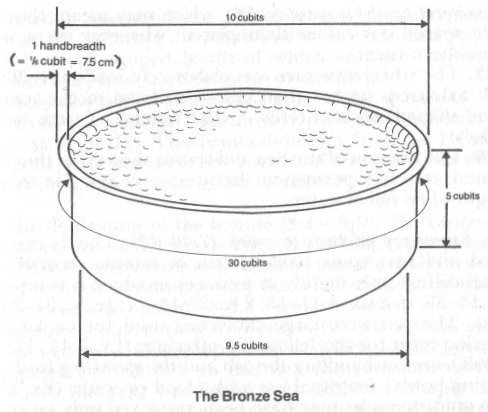
23He made the Sea of cast metal, circular in shape, measuring ten cubits from rim to rim and five cubits high. It took a line of thirty cubits to measure around it. 24Below the rim, gourds encircled it-ten to a cubit. The gourds were cast in two rows in one piece with the Sea. 25The Sea stood on twelve bulls, three facing north, three facing west, three facing south and three facing east. The Sea rested on top of them, and their hindquarters were toward the center. 26It was a handbreadth in thickness, and its rim was like the rim of a cup, like a lily blossom. It held two thousand baths.

it "was a handbreadth in thickness" and it had a "rim" that turned out "like the rim of a cup, like a lily blossom." A "handbreadth" (or palm) was one-sixth of a cubit:

"The long or `royal' cubit was a handbreadth (`palm') longer than the standard cubit of 6 palms (Ezk. 40:5), i.e. 20.4 inches or 51.81 cm. With this compare the Babylonian cubit of 50.3 cm (of 30 fingers length marked on a statue of Gudea) which was `3 fingers' shorter than the Egyp. cubit of 52.45 cm (Herodotus, Hist. 1. 178). ... The palm (tepah; topah) or `handbreadth' was the width of the hand at the base of the 4 fingers (hence Vulg. quattuor digitis), i.e. 7.37 cm. Thus was measured the thickness of the bronze laver (I Ki. 7:26 = 2 Ch. 4:5), the edge of the tabernacle table (Ex. 25:25; 37:12), and of that in Ezekiel's Temple (40:5; 43:13). A man's life is but (a few) handbreadths in length (Ps. 39:5)." (Wiseman, Ibid., p.1247).

Now if: 1) the width of the cup-like rim was a "handbreadth", i.e. the same as the thickness of the wall of the basin; 2) the diameter "measuring ten cubits from rim to rim" was taken from the outer edge of the cup-like rim; and 3) the circumference measurement of "a line of thirty cubits around it") was taken was around the main body of the basin; all of which is entirely reasonable, then the actual dimensions (using cubits because there is no need to convert it into modern units-the result is the same) of the main cylindrical body of the basin would be: a) diameter 10 cubits, less two handbreadths of 1/6th each, i.e. 10 - 1/3 = 9 2/3 = 9.67 cubits; and b) circumference of 30 cubits. That yields a ratio of 30/9.67 = 3.102, which is only 0.04 (i.e. four hundredths) less than pi (3.142), again to the third decimal place.

There are in fact other ways to reconcile the measurements of this basin with pi (and I have posted some of them on various Internet forums, e.g. June 4, 2000 & May 3, 2005), but they usually rely on the inside circumference of the basin being measured, which on reconsideration I find less plausible. I regard this solution (which is my own-as far as I am aware) to be more plausible.

Later note: Yesterday (17 March 2006), I was in a Christian bookstore and I saw a commentary on 1 and 2 Kings, which I had never read before. I opened it at 1 Kings 7:23 to see what it said about the dimensions of the basin and about pi. It said nothing about pi, but it did have a drawing of the basin, which agrees with my proposal, except it makes a small mistake in giving the diameter of its cylinder body as 9.5 cubits, when 10 - (2 x 1/6) = 9 2/3 or 9.67 cubits. Indeed, that it did not even mention pi is evidence that that really is the best dimensions and measurements of the basin, independent of any question about pi. I also had since realised that being a casting, the width of the cup-like rim would almost certainly be a flared-out continuation of the thickness of the main body wall, which was 1/6th of a cubit (see above). Here is what the commentary said about this passage:

"1 KINGS 7:19-26 ... `The Bronze Sea' (7:23-26). This huge basin or reservoir was one of the great Hebrew technical works, corresponding in modern metallurgy to the casting of the largest church bell. It was viewed as a large expanse and volume of water (Heb. yam, `sea' is only used figuratively here, v. 23) and corresponded with the bronze basin in the tabernacle (Ex. 30:17-21). It was used by priests for cleansing their hands and feet and perhaps also to supply water to the standing basins for the rinsing of offerings (2 Ch. 4:10).
23. The size is given as five metres in diameter and two and a half metres in height and a handbreadth (v. 26, a sixth of a cubit = 7.5 cm.) thick. The capacity was about ten thousand gallons (two thousand baths is a measure, cf. the post-exilic `three thousand', 2 Ch. 4:5). [The bath is attested archaeologically as varying locally between 18 and 45 litres.] Its form has been reconstructed with the circumference given generally as thirty cubits." (Wiseman D.J., "1 and 2 Kings: An Introduction and Commentary," Tyndale Old Testament Commentaries," [1993], InterVarsity Press: Leicester UK, Reprinted, 2003, p.115)]

Stephen E. Jones, BSc. (Biol).
"Problems of Evolution"


"The difficulties which appear to oppose themselves to the reception of `Natural Selection' or `the survival of the fittest,' as the one explanation of the origin of species, have no doubt been already considered by Mr. Darwin. Nevertheless, it may be worth while to enumerate them, and to state the considerations which appear to give them weight; and there is no doubt but that a naturalist so candid and careful as the author of the theory in question, will feel obliged, rather than the reverse, by the suggestion of al the difficulties which can be brought against it. What is to be brought forward may be summed up as follows: That `Natural Selection' is incompetent to account for the incipient stages of useful structures. That it does not harmonize with the co-existence of closely similar structures of diverse origin. That there are grounds for thinking that specific differences may be developed suddenly instead of gradually. That the opinion that species have definite though very different limits to their variability is still tenable. That certain fossil transitional forms are absent, which might have been expected to be present. That some facts of geographical distribution intensify other difficulties. That the objection drawn from the physiological difference between `species' and `races' still exists unrefuted. That there are many remarkable phenomena in organic forms upon which `Natural Selection' throws no light whatever, but the explanations of which, if they could be attained, might throw light upon specific origination." (Mivart S.J., "On the Genesis of Species," Macmillan & Co: London & New York, Second edition, 1871, pp.24-25)

Gallup: More Than Half of Americans Reject Evolution, Back Bible

Gallup: More Than Half of Americans Reject Evolution, Back Bible, Editor & Publisher, March 08, 2006 ... NEW YORK A Gallup report released today reveals that more than half of all Americans, rejecting evolution theory and scientific evidence, agree with the statement, "God created man exactly how Bible describes it." Another 31% says that man did evolve, but "God guided." Only 12% back evolution and say "God had no part." Gallup summarized it this way: "Surveys repeatedly show that a substantial portion of Americans do not believe that the theory of evolution best explains where life came from." They are "not so quick to agree with the preponderance of scientific evidence." The report was written by the director of The Gallup Poll, Frank Newport. ... Newport wraps it up: "Several characteristics correlate with belief in the biblical explanation for the origin of humans. Those with lower levels of education, those who attend church regularly, those who are 65 and older, and those who identify with the Republican Party are more likely to believe that God created humans 'as is,' than are those who do not share these characteristics." Gallup has asked this question, in different forms, going back to 1982, but has consistently shown support at 45% or higher for the notion that "God created man in present form." The most recent poll, last September, posed the question this way: "Which of the following statements comes closest to your views on the origin and development of human beings." This produced the 53% who chose "God created man exactly how Bible describes it," the 31% who said man did evolve but "God guided," and the 12% who backed evolution with God playing "no part." ... [The first alternative, "God created man exactly how Bible describes it" is ambiguous, and the 53% would include Old Earth/Progressive Creationists who don't like the other two alternatives. Newport is correct that "Only 12% back evolution," since "God guided" evolution is "not evolution at all", as Darwin, Dawkins and the scientific community understand "evolution" to mean, "God had no part":

"Darwin wrote in a letter to Sir Charles Lyell, the leading geologist of his day: `If I were convinced that I required such additions to the theory of natural selection, I would reject it as rubbish...I would give nothing for the theory of Natural selection, if it requires miraculous additions at any one stage of descent.' This is no petty matter. In Darwin's view, the whole point of the theory of evolution by natural selection was that it provided a non-miraculous account of the existence of complex adaptations. For what it is worth, it is also the whole point of this book. For Darwin, any evolution that had to be helped over the jumps by God was not evolution at all." (Dawkins R., "The Blind Watchmaker," W.W. Norton: New York NY, 1986, pp.248-249. Emphasis Dawkins')

Therefore, those who reject evolution (in that all-important "standard scientific theory" sense):

"In one of the most existentially penetrating statements ever made by a scientist, Richard Dawkins concluded that `the universe we observe has precisely the properties we should expect if there is, at bottom, no design, no purpose, no evil and no good, nothing but blind, pitiless indifference.' Facing such a reality, perhaps we should not be surprised at the results of a 2001 Gallup poll confirming that 45 percent of Americans believe `God created human beings pretty much in their present form at one time within the last 10,000 years or so'; 37 percent prefer a blended belief that `human beings have developed over millions of years from less advanced forms of life, but God guided this process'; and a paltry 12 percent accept the standard scientific theory that `human beings have developed over millions of years from less advanced forms of life, but God had no part in this process.'" (Shermer M.B., "The Gradual Illumination of the Mind," Scientific American, February 2002. My emphasis)

are the vast majority totalling 84%!]

Stephen E. Jones, BSc. (Biol).
"Problems of Evolution"


"Admitting, then, organic and other evolution, and that new forms of animals and plants (new species, genera, etc.) have from time to time been evolved from preceding animals and plants, it follows, if the views here advocated are true, that this evolution has not taken place by the action of `Natural Selection' alone, but through it (amongst other influences) aided by the concurrent action of some other natural law or laws, at present undiscovered. It is probable also that the genesis of species takes place partly, perhaps mainly, through laws which may be most conveniently spoken of as special powers and tendencies existing in each organism; and partly through influences exerted on each such organism by surrounding conditions and agencies organic and inorganic, terrestrial and cosmical, among which the `survival of the fittest' plays a certain but subordinate part." (Mivart S.J., "On the Genesis of Species," Macmillan & Co: London & New York , Second edition, 1871, p.23. Emphasis original)

Tuesday, March 14, 2006

Study Explores Why Some Individuals Sacrifice To Help Others Reproduce, etc

Study Explores Why Some Individuals Sacrifice To Help Others Reproduce, ScienceDaily, March 9, 2006. In a new study forthcoming in the April 2006 issue of The American Naturalist, Peter Nonacs [et al.] explore a theory of social behavior that seeks to explain why some individuals willingly sacrifice their own reproduction to help raise others' offspring. "Transactional Skew" (TS) theory proposes that such cooperation is possible through "shared reproduction," making it worthwhile to help close relatives because some of the same genes are getting passed along. Thus, the degree of shared reproduction should vary across groups by the degree to which they are related. However, in a study across four species of paper wasps -- long considered one of the best examples supporting this theory -- the researchers found that not only was there cooperation and shared reproduction between sisters but also between distantly related or unrelated wasps. "This result strongly rejects the unique TS prediction that the level of cooperation should vary across groups according to the attributes of individual group members," says Nonacs. "[We] propose an alternative explanation in which wasps seek to cooperate with close kin, but less related groups sometimes form due to recognition errors." ... [So even in "one of the best examples supporting this theory," the Darwinist `selfish genes' explanation fails. If "wasps seek to cooperate with ...less related groups ...due to recognition errors" then those so-called "recognition errors" are the norm and that undermines the entire Darwinist `selfish genes' theory explanation of "why some individuals willingly sacrifice their own reproduction to help raise others' offspring"!]

Destroying Astrobiology Would be a `Disaster', SPACE.com, Rocco Mancinelli, SETI Institute, 4 March 2006 ...Astrobiology is the study of the origin, evolution, distribution, and future of life in the universe. As part of that, it seeks to understand the origin of the building blocks of life, how these building blocks combine to create life, how life affects and is affected by the environment from which it arose, and finally, whether and how life expands beyond its planet of origin. It requires studying fundamental concepts of life and habitable environments that will help us to recognize biospheres that might be quite different from our own. This includes studying the limits of life, life's phylogeny and effects of the space environment on living systems. Such fundamental questions require long term stable funding for the science community. This means keeping the NASA Astrobiology Institute (NAI) and the grants programs funded at healthy levels. The search for potentially inhabited planets beyond our solar system includes laboratory and field investigations of the origins and early evolution of life, and studies of the potential of life to adapt to future challenges, both on earth and in space. As such, astrobiology has never been, nor should it ever be, uniquely tied to a Mars Sample return mission, or human exploration of Mars. The broad interdisciplinary character of astrobiology compels us to strive for the most comprehensive and inclusive understanding of biological, planetary, and cosmic phenomena. NASA essentially developed astrobiology as a whole new interdisciplinary scientific field from scratch. It now has thousands of researchers, many international affiliates, multiple peer reviewed journals and is growing. Even NSF has been amazed by what NASA's astrobiology program has accomplished. Abandoning this field now would undermine some of the most exciting science NASA has going. ... [The fact is that astrobiology (i.e. exobiology renamed to make it sound like a new science), despite the billions spent on it, still "has yet to demonstrate that its subject matter exists", as Simpson pointed out over 40 years ago in 1964. The "thousands of researchers, many international affiliates, multiple peer reviewed journals and ... growing" is a byproduct of what origin of life researcher Jeffrey Bada noted of astrobiology that "one of the field's attractions was money--and lots of it." Indeed, such a large group of researchers dependent on ever-increasing amounts of taxpayer funding with no hard evidence "its subject matter exists," is a recipe to generate hyped claims about the existence of extraterrestrial life on various planets and moons (e.g. Saturn Moon Has Geysers, Hinting Life Is a Possibility, New York Times, March 10, 2006) both within and outside our Solar System. But personally I hope astrobiology does continue because its continual failure is evidence that life is unique to Earth!]

The Growing Habitable Zone: Locations for Life Abound, SPACE.com, Ker Than, 7 February 2006 ... In a galaxy filled with billions of stars, scientists searching for alien life need some way to pick out those which are most likely to harbor habitable planets and moons. For more than 150 years, an important tool in this screening process has been the concept of a "circumstellar habitable zone." Traditionally, this zone has been defined as a narrow disk around a star where temperatures are moderate enough that water on the surface of a planet can exist in a liquid form. The idea is that where liquid water exists, life might arise. Beginning in the latter half of the 20th century, new information began to emerge that challenged the traditional view. Scientists on Earth began finding rugged organisms thriving in harsh conditions that were off-limits to most other creatures. Meanwhile, images beamed back by robotic probes in space revealed that other moons within our solar system were much more interesting geologically-and perhaps biologically-than our own. However, beginning a decade ago, planets discovered around other stars began to reveal a diversity of planetary systems that was beyond expectations. More recently, scientists have gone back and reexamined their ideas about the possibility of habitable planet forming around red dwarf stars. Despite being the most abundant stars in the galaxy, red dwarfs have traditionally been shunned by scientists as being too small and too dim to support life. Those prejudices are beginning to fade and the recent discovery of a small, rocky world in orbit around a red dwarf 28,000 light-years from our corner of the solar system has refueled speculations that these stars might harbor planets with life ... [This older item from my backlog is a good (bad?) example of how astrobiology hypes up the case for extraterrestrial life. As pointed out in my post of 22-Feb-06, this "small, rocky world in orbit around a red dwarf" was "Just over five times heavier than Earth" and even "planets only a few times heavier than Earth ... the extra gravity ... would crush these minerals into ... semi-conductors or metals" resulting in "enhanced heat flow from the planet's core to the surface, which means more volcanoes and more `planetquakes':

"Astronomers have detected more than 150 planets orbiting nearby stars, raising hopes of finding another Earth ... But there may be more to finding that `goldilocks' planet, just the right size and distance from its star to match Earth, warns one research team. Last month, an international team reported in Nature that it had detected the smallest extrasolar planet orbiting a normal star yet. Just over five times heavier than Earth, OGLE- 2005-BLG-390Lb, is 28,000 light years away. It orbits two-and-a-half times further away from its star than Earth does the sun, and enjoys chilly temperatures of -364 degrees because of the dimness of its star. A few earlier discoveries of similarly-sized `extra solar' planets had also occurred, but all those orbit very close to their stars. But the discoveries show that astronomers are closing in on a planet in the `habitable zone' where temperatures are neither too cold or too hot for life ... But it may not be so easy, suggests University of Minnesota physicist Renata Wentzcovitch and colleagues in the current Science magazine. For `Super Earth' planets only a few times heavier than Earth, the interior chemistry of the planet's core may have a big effect on whether future space tourists will ever want to vacation there. In the study, the team looked at the `Super Earth' orbiting the star Gliese 876, 15 light years away. The researchers analyzed the chemistry of perovskite, an electronically inert mineral made of oxygen, silicon and magnesium, found in the mantle covering the iron cores of planets. On Earth, there is a thin layer of the stuff in the mantle. Through computer simulations, the study team found the extra gravity of a `Super Earth' (twice as strong on its surface as Earth's) would crush these minerals into new forms, ones that would take on the properties of semi-conductors or metals ...The result there would be enhanced heat flow from the planet's core to the surface, which means more volcanoes and more `planetquakes.' The effects on the planet's magnetic field, which on Earth shields the surface from solar radiation, of increased electrical activity in the mantle are more difficult to figure out, she says. The larger point is there is more to finding another Earth than detecting a planet the same size and same distance from its star, she says. Venus and Earth are very similar, she notes, but have significant differences in their interior chemistry. Venus has a more viscous interior that lead to a planet-sized earthquake hundreds of millions of years ago, she says, and that likely also explains the hellish conditions there, where 800-degree winds are lashed by sulfuric acid rain." (Vergano D., "Finding 'Super Earth' is a 'Goldilocks' errand," USA Today, February 19, 2006)

So from the failure to find truly Earth-like planets in a "circumstellar habitable zone," i.e. "a narrow disk around a star where temperatures are moderate enough that water on the surface of a planet can exist in a liquid form," astrobiology is now trying to make a virtue out of necessity by appealing to "a diversity of planetary systems that was beyond expectations" and ... rugged organisms thriving in harsh conditions that were off-limits to most other creatures". But these "harsh conditions" on Earth are still moderate compared with those on other planets and exoplanets. And that some organisms can adapt to extreme conditions (by Earth's standards) does not mean they could originate in such conditions. Such extremophiles have very complex genetic repair systems:

"How do they do it? What defenses do these frequently diminutive creatures (many are microbial, although not all - think penguins) mount against environmental conditions that would either pickle or pyrolize you and me? There are two fundamental strategies: erect a barrier against the elements, or change your metabolism. For example, some halophiles protect themselves from a saline environment by increasing the concentration of salts in their innards. With salinity about the same both within and without the cell, the halophile needn't fear that runaway osmosis will drain it of its precious water. If you can't defend against a brutal habitat, you can learn to love it. For example, psychrophiles come equipped with special proteins to adapt their lifestyle to the cold. Some of these proteins act as antifreeze to lower the freezing point of water, to prevent its congealing, expanding, and sundering the cell. Other proteins (enzymes) are specially formulated to ensure that chemistry continues even when the temperature dips to the single digits or lower. Many researchers are looking for ways to exploit the Darwinian inventiveness that has produced these extremophile defense mechanisms. For example, Deinococcus radiodurans, which boasts a highly sophisticated DNA repair shop within its tiny cell walls, is able to recover from exposure to massive doses of molecule-busting, high energy radiation by simply fixing the damage. It's hoped that this talent will prove useful in engineering microbes that can clean up radioactive spills, or possibly even protect us from skin cancer." (Shostak S., "Extremophiles: Not So Extreme?," SPACE.com/SETI Institute, 4 August 2005)

which would be an even greater problem for evolution if the original living organism "boasts a highly sophisticated DNA repair shop within its tiny cell walls"! Mind you, as it is, even simplest living organism has "a highly sophisticated DNA repair shop within its tiny cell walls"! In fact this very morning in my first draft of my book, "Problems of Evolution," I added to chapter 11 Major Transitions, 11.1 "Non-living to prokaryote," sections 11.1.6 "Error-checking" and 11.1.7 "Self-repair" to the necessary capabilties that the earliest living organisms would need to have.]

Stephen E. Jones, BSc (Biol).
"Problems of Evolution"


"Now we will revert simply to the consideration of the theory of `Natural Selection' itself. ... If the theory of Natural Selection can be shown to be quite insufficient to explain any considerable number of important phenomena connected with the origin of species, that theory, as the explanation, must be considered as so far discredited. If other causes than Natural (including sexual) Selection can be proved to have acted-if variation can in any cases be proved to be subject to certain determinations in special directions by different means than Natural Selection, it then becomes antecedently probable that it is so in other cases, and that Natural Selection depends upon, and only supplements, such means; which conception is opposed to the pure Darwinian position." (Mivart S.J., "On the Genesis of Species," Macmillan & Co: London & New York , Second edition, 1871, pp.21-22. Emphasis original)