Friday, October 17, 2008

Re: Fred Hoyle about the 747, the tornado and the junkyard

AN

Thanks for your message. As is my usual policy when I receive a private message on evolution, I will answer it via my blog,


[Above: Boeing 747 assembly at Everett, near Seattle: USA Today]

CreationEvolutionDesign, minus your personal identifying information. Your words are bold to distinguish them from my comments.

----- Original Message -----
From: AN
To: Stephen E. Jones
Sent: Thursday, October 09, 2008 3:42 AM
Subject: RE: origin of life #2- a question

>... My question concerns the famous statement of Sir Fred Hoyle about the 747, the tornado, and the junkyard. I have the page from your site with the exact quote from "The Intelligent Universe".

Here is the relevant part of that quote by Hoyle:

"If you stir up simple nonorganic molecules like water, ammonia, methane, carbon dioxide and hydrogen cyanide with almost any form of intense energy ... some of the molecules reassemble themselves into amino acids ... demonstrated ... by Stanley Miller and Harold Urey. The ... building blocks of proteins can therefore be produced by natural means. But this is far from proving that life could have evolved in this way. No one has shown that the correct arrangements of amino acids, like the orderings in enzymes, can be produced by this method. .... A junkyard contains all the bits and pieces of a Boeing 747, dismembered and in disarray. A whirlwind happens to blow through the yard. What is the chance that after its passage a fully assembled 747, ready to fly, will be found standing there? So small as to be negligible, even if a tornado were to blow through enough junkyards to fill the whole Universe." (Hoyle, F., "The Intelligent Universe," Michael Joseph: London, 1983, pp.18-19).

The first instance that I am aware of Hoyle's use of that metaphor was reported in the science journal Nature in 1981:

"Hoyle said last week that ... the origin of life ... the information content of the higher forms of life is represented by the number 1040 000 - representing the specificity with which some 2,000 genes, each of which might be chosen from 1020 nucleotide sequences of the appropriate length .... The chance that higher life forms might have emerged in this way is comparable with the chance that `a tornado sweeping through a junk-yard might assemble a Boeing 747 from the materials therein'. " (Hoyle, F., in "Hoyle on evolution," Nature, Vol. 294, 12 November 1981, p.105).

The above quote is a bit confusing because it conflates "the origin of life" with "the higher forms of life."

This conflation originates with Hoyle, because his 1 in "1040 000" chance of "2,000 genes" of "1020 nucleotide ... length" arising spontaneously refers to the "about two thousand" "enzymes ... across the whole of biology" and "the chance of obtaining them all in a random trial" in an "organic soup":

"... enzymes are a large class of molecule that for the most part runs across the whole of biology, without there being any hint of their mode of origin. ... Enzymes are polypeptides (proteins) .... their function. ... is determined by the particular sequence of amino acids in the polypeptide structure. .. There are ... twenty distinct amino acids ... and these simply must be in the correct position in the polypeptide structure. ... The chance of obtaining a suitable backbone can hardly be greater than one part in 1015, and the chance of obtaining the appropriate active site can hardly be greater than one part in 105. .... The two small probabilities ...have to be multiplied, when they yield a chance of one part in 1020 of obtaining the required enzyme in a functioning form. .... there are about two thousand enzymes, and the chance of obtaining them all in a random trial is only one part in (1020)2000 = 1040,000, an outrageously small probability .... this simple calculation wipes the idea entirely out of court." (Hoyle & Wickramasinghe, "Evolution from Space," 1981, pp.19-21).

But Hoyle is right in requiring an explanation of where all the enzymes or proteins that exist "across the whole of biology" came from, given that the probability of even one small enzyme/protein of 100 amino acids arranged in a necessarily specific sequence would be 20100 = ~10130, when there are ~1080 protons in the entire universe:

"... for a relatively small protein of 100 amino acids, selection of this correct sequence had to be made by chance from 10130 alternative choices. ... The probability of such a chance occurrence leading to the formation of one of the smallest protein molecules is unimaginably small. Within the boundary conditions of time and space which we are considering, it is effectively zero." (Brooks, "Origins of Life," 1985, pp.84-85).

".. why the random self-assembly of proteins seems a non-starter. .... Proteins ... are very specific amino acid sequences ... the number of alternative permutations ... of amino acids is super-astronomical. A small protein may typically contain 100 amino acids of 20 varieties. There are about 10130 ... different arrangements of the amino acids in a molecule of this length. .... Getting a useful configuration of amino acids from the squillions of useless combinations ... [would be] like trying to track down a site on the internet without a search engine." (Davies, "The Fifth Miracle," 1998, p.61).

"... the entire mass of the universe, expressed as a multiple of the mass of the hydrogen atom, amounts to about 1080 units. ... Even the smallest catalytically active protein molecules of the living cell consist of at least a hundred amino acid residues, and they thus already possess more than 10130 sequence alternatives ... ... a primitive organism has about the same chance of arising by pure chance ... as a general textbook of biochemistry has of arising by the random mixing of a sufficient number of letters." (Kuppers, "Information and the Origin of Life," 1986, p.60).

But minimal cell experiments have shown that the simplest (albeit parasitic) living organism requires "between 250 and 350 different proteins to carry out its most basic operations" but "this bare form of life cannot survive long without a source of sugars, nucleotides, amino acids, and fatty acids":

"Theoretical and experimental studies designed to discover the bare minimum number of gene products [proteins and RNAs] necessary for life all show significant agreement. Life seems to require between 250 and 350 different proteins to carry out its most basic operations. That this bare form of life cannot survive long without a source of sugars, nucleotides, amino acids, and fatty acids is worth noting." (Rana, F.R. & Ross, H.N., "Origins of Life: Biblical And Evolutionary Models Face Off," Navpress: Colorado Springs CO, 2004, pp.162-163).

Between "250 and 350 different proteins" is bad enough for a spontaneous naturalistic origin of life, but the "microbial database" shows that the "smallest known genomes and capable of living independently in the environment ... requires a minimum genome size of about 1,500 to 1,900 gene products":

"Genome Size ... The data indicate that the microbes possessing the smallest known genomes ... seems to suggest that, to exist independently, life requires a minimum genome size of about 1,500 to 1,900 gene products. ... all microbial genomes that fall below 1,500 belong to parasites." (Rana & Ross, Ibid, 2004, pp.161-162).

The late Prof. Colin Patterson acknowledged that:

"the ... free-living bacterium, Methanococcus, which has 1.7 million base-pairs and about 1700 genes, [is] perhaps close to the minimum necessary for independent life." (Patterson, "Evolution,"1999, p.23).

>In Dawkins book (God Delusion) on Pg. 117, he mentions this statement of Hoyle's and implies that it was referring to natural selection and evolution.

Here is the relevant part of that quote by Richard Dawkins:

"Fred Hoyle was a brilliant physicist and cosmologist, but his Boeing 747 misunderstanding, and other mistakes in biology ... suggest that he needed to have his consciousness raised by some good exposure to the world of natural selection. At an intellectual level, I suppose he understood natural selection. But perhaps you need to be steeped in natural selection, immersed in it, swim about in it, before you can truly appreciate its power." (Dawkins, R., "The God Delusion," Bantam Press: London, 2006, p.117).

This is Dawkins at his deceptive best (or worst). Dawkins had not shown that it was Hoyle's "Boeing 747 misunderstanding," nor that it had anything to do with "natural selection" (see below). And Dawkins admits of Hoyle that "At an intellectual level ... he understood natural selection" but one "need[s] to be steeped in natural selection" to "truly appreciate its power." Hoyle would no doubt respond that Dawkins has so "steeped" himself "in natural selection" that he cannot "truly appreciate" natural selection's lack of "power"!

In fact Hoyle, being a mathematician, completely re-worked out from scratch the fundamental mathematics of Neo-Darwinism and found that "the Darwinian theory ... does not work at broader taxonomic levels; it cannot explain the major steps in evolution":

"As it became clear that the Darwinian theory could not be broadly correct, a question still remained, however, for I found it difficult to accept that the theory could be wholly incorrect. ... The issue was a mathematical one ... .... Eventually therefore, I decided to tackle this mathematics myself working de novo ... Although my results were all arrived at independently, some-perhaps most-have been obtained before. Their arrangement, however, is I believe original. ... And the outcome of this essay? Well as common sense would suggest, the Darwinian theory is correct in the small but not in the large. ... the theory works at the level of varieties and species ... the theory does not work at broader taxonomic levels; it cannot explain the major steps in evolution." (Hoyle, F., "Mathematics of Evolution," [1987], Acorn Enterprises: Memphis TN, 1999, pp.5-6, 10).

>It seemed clear to me that Hoyle was referring to origin of the first living organism,

Yes. Earlier in his book Dawkins cites "Hoyle's ... image of the Boeing 747 and the scrapyard" as referring to "the probability of life originating on Earth":

"The name comes from Fred Hoyle's amusing image of the Boeing 747 and the scrapyard. ... Hoyle said that the probability of life originating on Earth is no greater than the chance that a hurricane, sweeping through a scrapyard, would have the luck to assemble a Boeing 747. ... This, in a nutshell, is the creationist's favourite argument - an argument that could be made only by somebody who doesn't understand the first thing about natural selection ..." (Dawkins, 2006, Ibid, p.113).

Note Dawkins' self-contradiction, that Hoyle, "doesn't understand the first thing about natural selection," yet four pages later Hoyle, "At an intellectual level ... understood natural selection"!

>and Dawkins is clearly misleading his readers to blunt what he knows is a devastating attack on a "naturalistic" origin of life.

Agreed. But Dawkins forgets that as he once admitted, that in:

"... the problem of how life originated on Earth. .... we cannot escape the need to postulate a single-step chance event in the origin of cumulative selection itself ... cumulative selection cannot work unless there is some minimal machinery of replication and replicator power, and the only machinery of replication that we know seems too complicated to have come into existence by means of anything less than many generations of cumulative selection!." (Dawkins, "The Blind Watchmaker," 1986, pp.139-141)

Dawkins then answered his own question:

"... how much luck are we allowed to assume in a theory of the origin of life on Earth? ... when both DNA and its protein-based replication machinery spontaneously chanced to come into existence. We can allow ourselves ...such an extravagant theory ... provided that the odds against this coincidence occurring on a planet do not exceed 100 billion billion to one." (Dawkins, Ibid, 1986, pp.143,146).

But unfortunately for Dawkins, "1 in 100 billion billion" is only 1 in 1020 (i.e. 102*109*109 = 102+9+9). That is not enough for the chance assembly of a specific chain of 15 (2015 = ~1019.5) amino acids, i.e. not even enough for one protein!

>Dawkins by his own admission understands that all origin of life theories are nothing more than speculation. Do you think I understood it correctly?

I cannot see where in the quote you refer to from page 117 of his "The God Delusion," that Dawkins admits that "all origin of life theories are nothing more than speculation." However, elsewhere in his writings Dawkins effectively does admit that:

"The account of the origin of life that I shall give is necessarily speculative; by definition, nobody was around to see what happened." (Dawkins, "The Selfish Gene," 1989, pp.14-15).

"So, can we come up with any speculations about relatively probable ways in which cumulative selection might have got its start? .... We can hope for nothing more than speculation when the events we are talking about took place four billion years ago ... in a world that must have been radically different from that which we know today." (Dawkins, Ibid, 1986, p.147).

"But how did the whole process start? .... Most, though not all, of the informed speculation begins in what has been called the primeval soup .... Nobody knows how it happened but, somehow ... a molecule arose that just happened to have the property of self-copying...." (Dawkins, "Climbing Mount Improbable," 1996, p.259).

"Life may be common in the universe, but we are also at liberty to speculate that it is exceedingly rare. It therefore follows that the kind of event we are seeking, when we speculate about the origin of life, could be a very very improbable event ... my intuition is still that the arising of life on a planet is not all that unexpected an event" (Dawkins, Ibid, 1996, p.261).

>I did not see this particular quote on your site, but it's cute so I'm sending it to you. In an article found on American Scientist Online ["The Beginnings of Life on Earth"] Nobel Prize winner Dr. Christian DeDuve writes "how this momentous event [origin of life] happened is still highly conjectural, though no longer purely speculative.."
>
>I found the statement to be slightly confusing so I looked up "conjecture" on WordNet, an online dictionary and found the following: noun: a hypothesis that has been formed by speculation (syn-speculation) verb: to believe on uncertain or tentative grounds (syn.- speculate)
>
>I guess what he really meant was that it's highly speculative, though no longer purely conjectural.

Thanks for the link. My take is that Christian de Duve, like Dawkins, is another dogmatic materialist extremist. So what is not "speculative" to him is that the origin of life must have been materialistic and naturalistic. What is "conjectural" to De Duve is which particular "spontaneously by natural processes" way it happened. This is evident in de Duve's dogmatic requirement that "life arose spontaneously by natural processes" is "a necessary assumption "and "Any hint of teleology must be avoided":

"... life arose spontaneously by natural processes-a necessary assumption if we wish to remain within the realm of science .... An important rule in this exercise is to reconstruct the earliest events in life's history without assuming they proceeded with the benefit of foresight. .... Each must stand on its own and cannot be viewed as a preparation for things to come. Any hint of teleology must be avoided." (de Duve, "The Beginnings of Life on Earth," 1995, p.428)

In other words, de Duve and his materialistic-naturalistic ilk would rather believe a false explanation of the origin of life that avoided "teleology," than a true explanation that "proceeded with the benefit of foresight" by God!

[...]

Stephen E. Jones, BSc. (Biology).
My other blogs: TheShroudofTurin & Jesus is Jehovah!


"This generalized proposition-that processes of chance and natural law led to living organisms emerging on Earth from the relatively simple organic molecules in 'primordial soups'-is valid only if there is a finite probability of the correct assembly of molecules occurring within the time-scale envisaged. Here there is another great problem. In the above example for a relatively small protein of 100 amino acids, selection of this correct sequence had to be made by chance from 10130 alternative choices. The operation of pure chance would mean that within a maximum of about 500 million years (or somewhat less), the organic molecules in the 'primordial soup' might have to undergo 10130 trial assemblies to hit on the correct sequence. The probability of such a chance occurrence leading to the formation of one of the smallest protein molecules is unimaginably small. Within the boundary conditions of time and space which we are considering, it is effectively zero." (Brooks, J., "Origins of Life," Lion: Tring, Hertfordshire UK, 1985, pp.84-85).

"There is a more fundamental reason why the random self-assembly of proteins seems a non-starter. This has to do not with the formation of the chemical bonds as such, but with the particular order in which the amino acids link together. Proteins do not consist of any old peptide chains; they are very specific amino acid sequences that have specialized chemical properties needed for life. However, the number of alternative permutations available to a mixture of amino acids is super-astronomical. A small protein may typically contain 100 amino acids of 20 varieties. There are about 10130 (which is I followed by a 130 zeros) different arrangements of the amino acids in a molecule of this length. Hitting the right one by accident would be no mean feat. Getting a useful configuration of amino acids from the squillions of useless combinations on offer can be thought of as a mammoth information retrieval problem, like trying to track down a site on the internet without a search engine." (Davies, P.C.W., "The Fifth Miracle: The Search for the Origin of Life," Penguin: Ringwood Vic, Australia, 1998, p.61).

"The account of the origin of life that I shall give is necessarily speculative; by definition, nobody was around to see what happened. ... The simplified account I shall give is probably not too far from the truth. We do not know what chemical raw materials were abundant on earth before the coming of life, but among the plausible possibilities are water, carbon dioxide, methane, and ammonia ... Chemists have tried to imitate the chemical conditions of the young earth. They have put these simple substances in a flask and supplied a source of energy such as ultraviolet light or electric sparks-artificial simulation of primordial lightning. After a few weeks of this, something interesting is usually found inside the flask: a weak brown soup containing a large number of molecules more complex than the ones originally put in. In particular, amino acids have been found-the building blocks of proteins ... More recently, laboratory simulations of the chemical conditions of earth before the coming of life have yielded organic substances called purines and pyrimidines. These are building blocks of the genetic molecule, DNA itself. Processes analogous to these must have given rise to the 'primeval soup' which biologists and chemists believe constituted the seas some three to four thousand million years ago. The organic substances became locally concentrated, perhaps in drying scum round the shores, or in tiny suspended droplets. Under the further influence of energy such as ultraviolet light from the sun, they combined into larger molecules. ... At some point a particularly remarkable molecule was formed by accident. We will call it the Replicator. It ... had the extraordinary property of being able to create copies of itself." (Dawkins, R., "The Selfish Gene," [1976], Oxford University Press: Oxford UK, New edition, 1989, pp.14-15. Emphasis original).

"This example is the problem of how life originated on Earth. .... Cumulative selection is the key to all our modern explanations of life. ... but it had to get started, and we cannot escape the need to postulate a single-step chance event in the origin of cumulative selection itself. ... And that vital first step was a difficult one because, at its heart, there lies what seems to be a paradox. The replication processes that we know seem to need complicated machinery to work. ... . The theory of the blind watchmaker is extremely powerful given that we are allowed to assume replication and hence cumulative selection. But if replication needs complex machinery, since the only way we know for complex machinery ultimately to come into existence is cumulative selection, we have a problem. ... So, cumulative selection can manufacture complexity while single-step selection cannot. But cumulative selection cannot work unless there is some minimal machinery of replication and replicator power, and the only machinery of replication that we know seems too complicated to have come into existence by means of anything less than many generations of cumulative selection!." (Dawkins, R., "The Blind Watchmaker: Why the Evidence of Evolution Reveals a Universe Without Design," W.W. Norton & Co: New York NY, 1986, pp.139-141).

"Our question was, how much luck are we allowed to assume in a theory of the origin of life on Earth? ... . Therefore we have at our disposal, if we want to use it, odds of 1 in 100 billion billion as an upper limit (or 1 in however many available planets we think there are) to spend in our theory of the origin of life. This is the maximum amount of luck we are allowed to postulate in our theory. Suppose we want to suggest, for instance, that life began when both DNA and its protein-based replication machinery spontaneously chanced to come into existence. We can allow ourselves the luxury of such an extravagant theory provided that the odds against this coincidence occurring on a planet do not exceed 100 billion billion to one." (Dawkins, 1986, pp.143,146) .

"If the theory that DNA and its copying machinery arose spontaneously is so improbable that it obliges us to assume that life is very rare in the universe, and may even be unique to Earth, our first resort is to try to find a more probable theory. So, can we come up with any speculations about relatively probable ways in which cumulative selection might have got its start? The word 'speculate' has pejorative overtones, but these are quite uncalled for here. We can hope for nothing more than speculation when the events we are talking about took place four billion years ago and took place, moreover, in a world that must have been radically different from that which we know today." (Dawkins, 1986, p.147).

"But how did the whole process start? To answer that, we have to go back a very long time, more than 3,000 million years, probably as long as 4,000 million years. In those days the world was very different. There was no life, no biology, only physics and chemistry, and the details of the Earth's chemistry were very different. Most, though not all, of the informed speculation begins in what has been called the primeval soup, a weak broth of simple organic chemicals in the sea. Nobody knows how it happened but, somehow, without violating the laws of physics and chemistry, a molecule arose that just happened to have the property of self-copying - a replicator." (Dawkins, R., "Climbing Mount Improbable," Penguin: London, 1996, p.259).

"Life may be common in the universe, but we are also at liberty to speculate that it is exceedingly rare. It therefore follows that the kind of event we are seeking, when we speculate about the origin of life, could be a very very improbable event: not the kind of event that we can expect to duplicate in the laboratory and not the kind of event that a chemist will deem `plausible'. This is an interesting paradox ...We could be actively seeking a theory with the specific property that, when we find it, we shall judge it highly implausible! Looking at the matter in one way, we might even be positively worried if a chemist manages to support a theory of the origin of life which, using ordinary standards of probability, we judge to be plausible. On the other hand life seems to have arisen during the first half billion of the Earth's 4.5 billion years; we've been here for eight parts in nine of the Earth's age and my intuition is still that the arising of life on a planet is not all that unexpected an event." (Dawkins, 1996, p.261).

"The name comes from Fred Hoyle's amusing image of the Boeing 747 and the scrapyard. I am not sure whether Hoyle ever wrote it down himself, but it was attributed to him by his close colleague Chandra Wickramasinghe and is presumably authentic. Hoyle said that the probability of life originating on Earth is no greater than the chance that a hurricane, sweeping through a scrapyard, would have the luck to assemble a Boeing 747. Others have borrowed the metaphor to refer to the later evolution of complex living bodies, where it has a spurious plausibility. The odds against assembling a fully functioning horse, beetle or ostrich by randomly shuffling its parts are up there in 747 territory. This, in a nutshell, is the creationist's favourite argument - an argument that could be made only by somebody who doesn't understand the first thing about natural selection: somebody who thinks natural selection is a theory of chance whereas - in the relevant sense of chance - it is the opposite." (Dawkins, R., "The God Delusion," Bantam Press: London, 2006, p.113).

"It is surprising how necessary such consciousness-raising is, even in the minds of excellent scientists in fields other than biology. Fred Hoyle was a brilliant physicist and cosmologist, but his Boeing 747 misunderstanding, and other mistakes in biology such as his attempt to dismiss the fossil Archaeopteryx as a hoax, suggest that he needed to have his consciousness raised by some good exposure to the world of natural selection. At an intellectual level, I suppose he understood natural selection. But perhaps you need to be steeped in natural selection, immersed in it, swim about in it, before you can truly appreciate its power." (Dawkins, 2006, p.117).

"It is now generally agreed that if life arose spontaneously by natural processes-a necessary assumption if we wish to remain within the realm of science-it must have arisen fairly quickly, more in a matter of millennia or centuries, perhaps even less, than in millions of years. Even if life came from elsewhere, we would still have to account for its first development. Thus we might as well assume that life started on earth. How this momentous event happened is still highly conjectural, though no longer purely speculative. The clues come from the earth, from outer space, from laboratory experiments, and, especially, from life itself. The history of life on earth is written in the cells and molecules of existing organisms. Thanks to the advances of cell biology, biochemistry and molecular biology, scientists are becoming increasingly adept at reading the text. An important rule in this exercise is to reconstruct the earliest events in life's history without assuming they proceeded with the benefit of foresight. Every step must be accounted for in terms of antecedent and concomitant events. Each must stand on its own and cannot be viewed as a preparation for things to come. Any hint of teleology must be avoided." (de Duve, C., "The Beginnings of Life on Earth," American Scientist, Vol. 83, September-October 1995, pp.428-437).

"Hoyle said last week that, although content in the mid-1960s to give the supposed connection between the microwave background radiation and the big bang a `good run for its money' he had now lost patience with this approach. Two of his reasons involve the origin of life-the calculated time since the origin of the Universe of 10,000 million years or so is not enough to account for the evolution of living forms, while adiabatic expansion of the Universe would have been inimical to the evolution of highly ordered forms. But Hoyle also said that new evidence in support of the big-bang hypothesis was emerging only slowly. Yet `when people are on the right track, new facts emerge quickly', Hoyle said he would change his view if it turned out that neutrinos have a mass of between 20 and 30 electron volts. The essence of his argument last week was that the information content of the higher forms of life is represented by the number 1040 000 - representing the specificity with which some 2,000 genes, each of which might be chosen from 1020 nucleotide sequences of the appropriate length, might be defined. Evolutionary processes would, Hoyle said, require several Hubble times to yield such a result. The chance that higher life forms might have emerged in this way is comparable with the chance that `a tornado sweeping through a junk-yard might assemble a Boeing 747 from the materials therein'. Hoyle acknowledged that steady-state theories of cosmologies, of which he was one of the chief exponents in the 1950s, are not now tenable because of the evidence for evolutionary galactic and stellar processes. But the big-bang view is similarly not tenable because of the way in which it implies the degradation of information. Of adherents of biological evolution, Hoyle said he was at a loss to understand `biologists' widespread compulsion to deny what seems to me to be obvious'. (Hoyle, F., in "Hoyle on evolution," Nature, Vol. 294, 12 November 1981, p.105).

"The popular idea that life could have arisen spontaneously on Earth dates back to experiments that caught the public imagination earlier this century. If you stir up simple nonorganic molecules like water, ammonia, methane, carbon dioxide and hydrogen cyanide with almost any form of intense energy, ultraviolet light for instance, some of the molecules reassemble themselves into amino acids, a result demonstrated about thirty years ago by Stanley Miller and Harold Urey. The amino acids, the individual building blocks of proteins can therefore be produced by natural means. But this is far from proving that life could have evolved in this way. No one has shown that the correct arrangements of amino acids, like the orderings in enzymes, can be produced by this method. No evidence for this huge jump in complexity has ever been found, nor in my opinion will it be. Nevertheless, many scientists have made this leap-from the formation of individual amino acids to the random formation of whole chains of amino acids like enzymes-in spite of the obviously huge odds against such an event having ever taken place on the Earth, and this quite unjustified conclusion has stuck. In a popular lecture I once unflatteringly described the thinking of these scientists as a `junkyard mentality'. As this reference became widely and not quite accurately quoted I will repeat it here. A junkyard contains all the bits and pieces of a Boeing 747, dismembered and in disarray. A whirlwind happens to blow through the yard. What is the chance that after its passage a fully assembled 747, ready to fly, will be found standing there? So small as to be negligible, even if a tornado were to blow through enough junkyards to fill the whole Universe." (Hoyle, F., "The Intelligent Universe," Michael Joseph: London, 1983, pp.18-19).

"In particular, the enzymes are a large class of molecule that for the most part runs across the whole of biology, without there being any hint of their mode of origin. There are about two thousand of them. Enzymes are polypeptides (proteins) that specialize in speeding up biological reactions, which they do with far greater efficiency than man-made catalysts. They act both to build up and to break down a wide range of biosubstances. The surface shapes of enzymes are critical to their function. ... Surface shape is determined by the particular sequence of amino acids in the polypeptide structure. One can think of getting the surface shape right in two stages of approximation. There are some ten to twenty distinct amino acids which determine the basic backbone of the enzyme and these simply must be in the correct position in the polypeptide structure. The rest of the amino acids, usually numbering a hundred or more, then control the finer details of the surface shape. There are also the active sites that eventually promote the biochemical reactions in question, and these too must be correct in their atomic forms and locations. Consider now the chance that in a random ordering of the twenty different amino acids which make up the polypeptides it just happens that the different kinds fall into the order appropriate to a particular enzyme. The chance of obtaining a suitable backbone can hardly be greater than one part in 1015, and the chance of obtaining the appropriate active site can hardly be greater than one part in 105. Because the fine details of the surface shape can be varied we shall take the conservative line of not 'piling on the agony' by including any further small probability for the rest of the enzyme. The two small probabilities we are including are quite enough. They have to be multiplied, when they yield a chance of one part in 1020 of obtaining the required enzyme in a functioning form. By itself, this small probability could be faced, because one must contemplate not just a single shot at obtaining the enzyme, but a very large number of trials such as are supposed to have occurred in an organic soup early in the history of the Earth. The trouble is that there are about two thousand enzymes, and the chance of obtaining them all in a random trial is only one part in (1020)2000 = 1040,000, an outrageously small probability that could not be faced even if the whole universe consisted of organic soup. If one is not prejudiced either by social beliefs or by a scientific training into the conviction that life originated on the Earth, this simple calculation wipes the idea entirely out of court." (Hoyle, F. & Wickramasinghe, N.C., "Evolution from Space," Paladin: London, 1981, Reprinted, 1983, pp.19-21).

"In this way, amino acids can become linked together into long chains, named polypeptides or proteins. A chain of 100 links would be considered rather short in biology. Yet with 20 possible choices for R at each link, the total number of chains with 100 links is 20100, or 10130, to the nearest order of magnitude. The longest protein chains run to about 2000 links, for which the number of possibilities is 202000, or about l02600, truly a big number. Journalists like to use the phrase `astronomical numbers' for what they considered to be immensely large, but these numbers are 'super-astronomical' in their largeness. Big numbers in astronomy usually have about 40 zeros, as have those in physics. Even the ratio of the largest distances in astronomy to the smallest lengths in physics has only about 60 zeros." (Hoyle, F. & Wickramasinghe, N.C., "Our Place in the Cosmos: The Unfinished Revolution," Phoenix: London, 1993, Reprinted, 1996, pp.151-152).

"Even in the simple case of a bacterium, the genome consists of some 4 x 10⁶ nucleotides, and the number of combinatorially possible sequences is 44 million = 102.4 million The expectation probability for the nucleotide sequence of a bacterium is thus so slight that not even the entire space of the universe would be enough to make the random synthesis of a bacterial genome probable. For example, the entire mass of the universe, expressed as a multiple of the mass of the hydrogen atom, amounts to about 1080 units. Even if all the matter in space consisted of DNA molecules of the structural complexity of the bacterial genome, with random sequences, then the chances of finding among them a bacterial genome or something resembling one would still be completely negligible. It can naturally be objected that our statistical arguments are based upon the assumption of an entity with the complexity of a bacterial genome, while the historical process of the origin of life possibly took place by way of simpler forms of life. However, an appropriate analysis, based on probability theory, shows that not even an optimised enzyme molecule can arise in a random synthesis. Even the smallest catalytically active protein molecules of the living cell consist of at least a hundred amino acid residues, and they thus already possess more than 10130 sequence alternatives ... These striking numerical examples allow us to conclude with Monod that the design of a primitive organism has about the same chance of arising by pure chance, in a molecular roulette, as a general textbook of biochemistry has of arising by the random mixing of a sufficient number of letters." (Kuppers, B-O., "Information and the Origin of Life," MIT Press: Cambridge MA, 1986, Reprinted, 1990, p.60).

"In July 1995 the entire DNA sequence of the bacterium Haemophilus influenzae, 1.8 million base-pairs, was elucidated, followed three months later by the sequence of a second parasitic bacterium. In April 1996 the complete sequence (12 million base-pairs) of yeast was announced, and in August 1996 the first complete sequence of a free-living bacterium, Methanococcus, which has 1.7 million base-pairs and about 1700 genes, perhaps close to the minimum necessary for independent life." (Patterson, C., "Evolution," [1978], Cornell University Press: Ithaca NY, Second edition, 1999, p.23).

"Genome Size One way to explore the minimum complexity of independent life is to survey the microbial database for the smallest genome. ... The data indicate that the microbes possessing the smallest known genomes and capable of living independently in the environment are extremophilic archaea and eubacteria. ... These organisms also happen to represent what many scientists consider to be the oldest life on Earth. This crude estimate seems to suggest that, to exist independently, life requires a minimum genome size of about 1,500 to 1,900 gene products. (A gene product refers to proteins and functional RNAs, such as ribosomal and transfer RNA.) ... ... So far, as scientists have continued their sequencing efforts, all microbial genomes that fall below 1,500 belong to parasites. Organisms capable of permanent independent existence require more gene products. A minimum genome size (for independent life) of 1,500 to 1,900 gene products comports with what the geochemical and fossil evidence ... reveals about the complexity of Earth's first life. Earliest life forms displayed metabolic complexity that included:

  • photosynthetic and chemoautotrophic processes
  • protein synthesis
  • the capacity to produce amino acids, nucleotides, fatty acids, and sugars
  • the machinery to reproduce

Some 1,500 different gene products would seem the bare minimum to sustain this level of metabolic activity. For instance, the Methanococcus jannaschii genome (the first to be sequenced for the archaea domain) possesses about 1,738 gene products. This organism contains the enzymatic machinery for energy metabolism and for the biosynthesis and processing of sugars, nucleotides, amino acids, and fatty acids. In addition, the M. jannaschii genome can encode for repair systems, DNA replication, and the cell division apparatus. The genes for protein synthesis and secretion and the genes that specify the construction and activity of the cell membrane and envelope also belong as part of this organism's genome." (Rana, F.R. & Ross, H.N., "Origins of Life: Biblical And Evolutionary Models Face Off," Navpress: Colorado Springs CO, 2004, pp.161-162).

Saturday, October 04, 2008

Theory goes to water as fish finger found

The following article appeared the other day in Australia's national newspaper. My comments are bold.

Theory goes to water as fish finger found, The Australian, September 23, 2008. PARIS: Scientists have traced the origin of

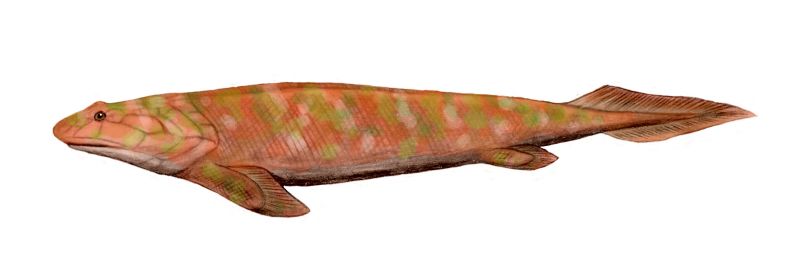
[Above (click to enlarge): Reconstruction of Panderichthys: Wikipedia]

fingers and toes to fish-like creatures that roamed the seas 380 million years ago, a new study has found. Panderichthys was not "fish-like." It was a fish!

The findings, published yesterday in the science journal Nature, upend the prevailing theory on the evolution of digits. It had long been assumed that the first creatures to develop primitive fingers were tetrapods, air-breathing animals that crawled from sea to land about 10 to 20 million years later. So fingers arose under water, 10-20 million years (or more) before they were needed on land.

The need to adapt to swampy marshlands and terra firma, so the theory went, is what drove the gradual shift through natural selection from fish fins suitable only for swimming to weight-bearing limbs with articulated joints. This is based on the original Darwinian `just-so' story:

"Origin of tetrapods ... The Devonian, during which land adaptations originated, was seemingly a time of seasonal droughts when life in fresh waters must have been difficult. ... if the water dried up altogether, the amphibian had the better of it. The fish, incapable of land locomotion, must stay in the mud and, if the water did not soon return, must die. But the amphibian, with his short and clumsy but effective limbs, could crawl out of the pool and walk overland ... and reach the next pool where water still remained. Once this process had begun, it is easy to see how a land fauna might eventually have been built up." (Romer, A.S., 1945, "Vertebrate Paleontology," pp.140-141. My emphasis).

Which shows that this major transition had little, if anything to do with the Darwinian natural selection of random micromutations.

But the study reveals rudimentary fingers were already present inside the fins

[Right (click to enlarge): Computerized 3D reconstruction of the fin bones of Panderichthys, showing precursors of fingers: FOX News]

of the shallow-water metre-long Panderichthys, a transitional species that was more fish than tetrapod. Note that these "rudimentary fingers," complete with precursors of all the fore- and hind-leg bones:

"Panderichthys ... the internal, endochondral bones of the fin are closely comparable to those of terrestrial vertebrates. There is a single proximal humerus and more distal ulna and radius in the forelimb, and the femur, tibia and fibula in the hind limb. They are succeeded distally by bones that are homologous with proximal elements of the wrist (intermedium, ulnare, and centralia) and ankle (fibulare, intermedium, and possibly distal tarsals) of land vertebrates..." (Carroll, 1997, "Patterns and Processes of Vertebrate Evolution," pp.230-232. My emphasis).

were "present inside the fins" of this "species that was more fish than tetrapod" and therefore "they could not have functioned in the manner of these joints in terrestrial vertebrates":

"... but they could not have functioned in the manner of these joints in terrestrial vertebrates because they are extensively overlapped by the radius and the tibia. The entire endochondral skeleton is within a functionally continuous fin structure" (Carroll, 1997, Ibid, pp.230-232. My emphasis).

That is, they could not be `seen' by the environment and so were `invisible' to natural selection. So natural selection cannot, even in principle, explain these major features of the fish-tetrapod transition.

"What we have shown is that the hand and the foot emerge from pre-existing bits of the fin skeleton that were just reshaped, rather than being entirely new bits that were bolted onto the existing fin skeleton," said co-author Per Ahlberg, a researcher at Uppsala University in Sweden. Again, note that "the hand and foot" of all subsequent land vertebrates (amphibians, reptiles, mammals and birds) "were already present inside the fins of" a "fish"!

The discovery did not come from a new archeological find but from a re-examination of the existing fossils, he said. Previous research, it turns out, simply overlooked what was there. "The problem is that all good specimens of Panderichthys come from one location" -- a brick quarry in Latvia -- "where the clay is almost exactly the same colour as the bones," Dr Ahlberg said. "If you are interested in tiny, fragile bones at the outer end of the fin skeleton, it's nearly impossible to see what is going on." Clearly, these "tiny, fragile" finger and toe "bones at the outer end of the fin skeleton," conferred no selective advantage to:

"Panderichthys ... quite a large fish, with ... a total body length of over a meter" (Clack, 2002, "Gaining Ground," p.64. My emphasis).

So Dr Ahlberg and two colleagues ran a specimen, still embedded in clay, through a CT scanner at a hospital. The image shows stubby bones at the end of the fin skeleton clearly arrayed like four fingers, called distal radials. There are no joints, and the bones are quite short, but there could be no doubt as to what they were. That there were "no joints" in these "fingers" shows that they could not function as fingers, nor would they be rigid. Therefore they could have no selective advantage for Panderichthys but would be a selective advantage to its descendants millions of years in the future which had functional fingers with joints. But in that case it would be a "part of the structure of any one species had been formed for the exclusive good of another species" and so "would annihilate" Darwin's "theory" (Darwin, 1872, "Origin of Species," p.162)!

Primitive Fingers Found in Prehistoric Fish, FOX News, September 23, 2008, Jeanna Bryner. An ancient fish sported something like fingers that were the precursors to our own digits, according to an analysis of a new fossil skeleton. Since I accept Universal Common Ancestry (but not Evolution), I agree that these fish "fingers ... were the precursors to our own digits." And also that:

"... all tetrapods [and therefore all land vertebrates-amphibians, reptiles, birds and mammals] had a single common ancestor" (Clack, 2002, Ibid, p.66. My emphasis).

And therefore if that one fish "single common ancestor" (out of uncountable trillions of fish) had not by one, or a series of, `lucky' mutations which created precursors of: 1) both forelimbs and hindlimbs, complete with "humerus ... ulna and radius" and "femur, tibia and fibula," as well as "wrist (intermedium, ulnare, and centralia) and ankle (fibulare, intermedium, and ... tarsals)" and "our own digits"; and 2) "pectoral and pelvic girdles" attached to the spine for those limbs to articulate to, neither we, nor any land vertebrate, would be here. But according to my Progressive Mediate Creation general theory, God supernaturally intervened in the genome of that "single common ancestor" to create the:

"blueprint of terrestrial limb structure [in] the genome... of the ["single common ancestor"] osteolepiform fish" (Wilcox, 1990, "Created in Eternity, Unfolded in Time," pp.6:23-24).

"It's really the last piece of evidence to say fingers are not new. They were really present in fish," said lead researcher Catherine Boisvert, an evolutionary biologist at Uppsala University in Sweden. The fossilized skeleton belonged to Panderichthys, a predatory fish that spanned up to 4 feet (130 cm) and likely dwelled in shallow waters where it inched along the muddy bottom about 385 million years ago. The problem for Darwinian `blind watchmaker' evolution by the natural selection of random mutations is to explain:

"How can the world of an aquatic predator quickly select, collect and individuate the information for a highly coherent adaptive blueprint of terrestrial limb structure?" (Wilcox, Ibid, pp.6:23-24. My emphasis)

by inching "along the muddy bottom" of "shallow waters".

While the fossil was discovered in the 1990s by chance in a brick quarry in Latvia in northern Europe, scientists only recently analyzed the fins with computed tomography (CT) and found that the right paddle is tipped with four bony extensions. If you were to turn back the clocks to the Devonian period when Panderichthys lived and spied the fish, you would not have noticed its "fingers," Boisvert explained. Neither would natural selection "have noticed its `fingers'" being that tiny in proportion to Panderichthys' "4 feet (130 cm)" body.

The fan-like array of fingers, however, would have made Panderichthys' paddles broader at the ends. The broad fins would have made for stronger supports for the fish to lean on rather than for all-out swimming. This sounds like yet another Darwinian `just-so' story. But it is gross overkill for "a predatory fish that ... dwelled in shallow waters where it inched along the muddy bottom" to develop "inside" two pairs of fish fins all the fore- and hind-limb bones of "terrestrial vertebrates".

"It was probably using its front fins as supports to be able to look up, kind of doing push-ups at the bottom of the river looking outside with its eyes," Boisvert said, adding that the fish's eyes were on the top of its skull and thus probably good for looking above the mud for fish food. Though Panderichthys was not made for landlubbing, if the need to hop from the water arose, the fish had the means. "So if it was stuck in a pool and it was drying out, [the fish] would have been able to get itself out to the next water body," Boisvert told LiveScience. "It's doing push-ups on land with its big fins and then its pelvic fins (hind fins) are used for an anchor in the mud." That the proto- fore- and hind-limb bones of future terrestrial vertebrates, after they had appeared, may have had some use for Panderichthys (and originally "the single common ancestor") does not thereby explain why they appeared. To just assume that would commit the post hoc ergo propter hoc fallacy.

Basically, Panderichthys would have dragged its body along land. "It wouldn't have been pretty," she added. The way that Boisvert puts this indicates she has no evidence that Panderichthys (or "the single common ancestor") ever "dragged its body along land." The fossil finding, detailed in the Sept. 21 issue of the journal Nature, fills in a gap in the evolution of tetrapods, or four-legged animals. About 380 million years ago, our fishy ancestors crept onto land. And here we have a time problem, the time-frame of the fish-tetrapod transition was only 5-15 million years (my emphasis below):

"Panderichthys and Elpistostege flourished in the early Frasnian and are some of the nearest relatives of tetrapods. But tetrapods appear only about 5 to 10 million years later in the late Frasnian, by which time they were widely distributed and had evolved into several groups ... This suggests that the transition from fish to tetrapod occurred rapidly within this restricted time span." (Clack, Ibid, 2002, p.96).

"The transition from fish to crawling four-legged tetrapod occurred ... about 360 million years ago during a relatively short geological interval-no more than probably 15 or 20 million years ..." (Strickberger, 2000, "Evolution," p.410).

"At least 377 million years ago a lineage of lobefins arose that was more tetrapodlike than Eusthenopteron. One of these was an animal called Panderichthys... In 10 or 15 million years, however, relatives of Panderichthys reworked their bodies into tetrapod form." (Zimmer, 1998, "At the Waters Edge," pp.104-105).

Which is a chronospecies problem, i.e. each change had to be "locked up":

"morphological change may accumulate anywhere along the geological trajectory of a species. But unless that change be `locked up' by ... speciation ... it cannot persist ... and must be washed out ... among varying populations of a species. Thus, species ... provide the only mechanism for protecting change" (Gould & Eldredge, 1993, "Punctuated Equilibrium Comes of Age," pp.226-227)

in a sequence of separate species, "align[ed], end-to-end" i.e. a "chronospecies":

"If an average chronospecies lasts nearly a million years, or even longer, and we have at our disposal only ten million years, then we have only ten or fifteen chronospecies to align, end-to-end ..... This is clearly preposterous. Chronospecies, by definition, grade into each other, and each one encompasses very little change. A chain of ten or fifteen of these might move us from one ... form to a slightly different one..." (Stanley, 1981, "The New Evolutionary Timetable," pp.93-94. My emphasis).

But as with mammals, "A chain of ten or fifteen of these might move us from one ... form to a slightly different one."

Fossil evidence has continued to refine scientists' understanding of this transition, though they still have many questions regarding the fin-to-limb transition and development of other locomotion features. For instance, one such transitional fish called Tiktaalik roseae lived about 375 million years ago and showed signs of both water living and land trekking. However, Boisvert said, even though Tiktaalik is closer evolutionarily to tetrapods, its specimens lack the distinct finger precursors seen on Panderichthys. Therefore these "distinct finger precursors seen on Panderichthys" cannot be explained by natural selection for locomotion on land, including land underwater.

I agree with former atheist Antony Flew that:

"The only satisfactory explanation for the origin of ... life ... is an infinitely intelligent Mind" (Flew, 2007, "There Is a God," p.123ff).

But I see no reason why such an "infinitely intelligent Mind" (who I assume is the God of the Bible), would stop at the origin of life and not continue to supernaturally intervene at other strategic points in life's history, including the fish-to-tetrapod transition.

Stephen E. Jones, BSc. (Biology).
My other blogs: TheShroudofTurin & Jesus is Jehovah!


"Neither the fossil record nor study of development in modern genera yet provides a complete picture of how the paired limbs in tetrapods evolved ... The closest comparison between the paired fins of obligatorily aquatic fish and animals that were at least facultatively terrestrial is provided by the osteolepiform sarcopterygians Eusthenopteron and Panderichthys and the stem tetrapods Acanthostega and Ichthyostega. ... Superficially, the paired fins of the fish appear typical of strictly aquatic vertebrates. They are small relative to the body; they narrow at the base that articulated with the pectoral and pelvic girdles, but broaden distally to form an effective surface for locomotion or directional control in the water. ... In contrast, the internal, endochondral bones of the fin are closely comparable to those of terrestrial vertebrates. There is a single proximal humerus and more distal ulna and radius in the forelimb, and the femur, tibia and fibula in the hind limb. They are succeeded distally by bones that are homologous with proximal elements of the wrist (intermedium, ulnare, and centralia) and ankle (fibulare, intermedium, and possibly distal tarsals) of land vertebrates, but they could not have functioned in the manner of these joints in terrestrial vertebrates because they are extensively overlapped by the radius and the tibia. The entire endochondral skeleton is within a functionally continuous fin structure, as seen from its scaly covering. There is no trace of endochondral skeletal elements comparable with the distal carpals or digits of terrestrial vertebrates. ... In contrast with the clear homology of the more proximal limb bones in osteolepiform fish and early tetrapods, no obvious homologues of the digits is evident in any sarcopterygian. These bones appear de novo in the Upper Devonian tetrapods. How can this be explained?" (Carroll, R.L., 1997, "Patterns and Processes of Vertebrate Evolution," Cambridge University Press: Cambridge UK, pp.230-232).

"Panderichthys was quite a large fish, with a skull about 300 mm long, and a total body length of over a meter ... . Its body and skull were flattened and the snout rather pointed. The eyes were placed quite close together on the top of its head and were set beneath ridges, giving the impression of eyebrows and creating a subjectively tetrapodlike appearance. Other characters of the skull were also very tetrapodlike (Vorobyeva and Schultze 1991). Elpistostege is still relatively poorly known, and for understanding the story of the origin of tetrapods, Panderichthys will provide a satisfactory guide. By comparing its skull with that of a very early tetrapod such as Acanthostega, those tetrapodlike features that were present already in Panderichthys can be contrasted with those that had yet to evolve. This gives some ideas about the order and timing of the appearance of some tetrapod characters ..." (Clack, J.A., 2002, "Gaining Ground: The Origin and Evolution of Tetrapods," Indiana University Press: Bloomington IN, p.64).

"This review of the lobe-finned fish groups is not complete without the tetrapods, because this is where, evolutionarily speaking, they (and humans) belong. Modern tetrapods include on the one hand the amphibians-frogs, newts, caecilians, and their kin-and on the other the amniotes-mammals plus the `reptile' groups, including turtles, lizards and snakes, and crocodiles and their closest living relatives, the birds. It includes creatures that, although they do not have legs (limbs with digits) themselves, are descended from some that did. So bats and whales are tetrapods, as are birds and snakes. It also includes all the fossil forms such as dinosaurs, flying or swimming reptiles, and many other more bizarre and less well-known kinds, so long as they are descended from ancestors with legs ... Most current views maintain that tetrapods are a natural group, tied together by numerous unique characters that show that the group had a single common ancestor. Among the unique features that tetrapods share is the possession of limbs with digits ..." (Clack, 2002, p.66).

"Some things are clear, however. Both Elginerpeton and Obruchevichthys appear more closely related to tetrapods than was Panderichthys. They are also very closely related to each other, sharing some details that cause them to be placed in the same family (Ahlberg 1995). This family was widely distributed in the Frasnian. They were also different from the slightly later Devonian tetrapods, which will be described in the next chapter. They may represent an early and specialized offshoot from the tetrapod branch. Panderichthys and Elpistostege flourished in the early Frasnian and are some of the nearest relatives of tetrapods. But tetrapods appear only about 5 to 10 million years later in the late Frasnian, by which time they were widely distributed and had evolved into several groups, including the lineage leading to the tetrapods of the Famennian. This suggests that the transition from fish to tetrapod occurred rapidly within this restricted time span. Neither fishlike tetrapods nor tetrapodlike fish body fossils occur in the record before this (Clack 1997a). Indeed, the osteolepiforms as a whole are not found before the Middle Devonian. This lends weight to the suggestion that the tracks from the supposed Late Silurian or Early Devonian are not those of a tetrapod, and those from the Middle Devonian are unlikely to be so. Given our current understanding of phylogeny, tracks made by a terrestrial tetrapod are unlikely to be found before the late Frasnian, and the body fossil evidence conflicts with the interpretation of any pre-Famennian track as terrestrial." (Clack, 2002, p.96).

"Natural selection cannot possibly produce any modification in a species exclusively for the good of another species; though throughout nature one species incessantly takes advantage of and profits by, the structures of others. But natural selection can and does often produce structures for the direct injury of other animals, as we see in the fang of the adder, and in the ovipositor of the ichneumon, by which its eggs are deposited in the living bodies of other insects. If it could be proved that any part of the structure of any one species had been formed for the exclusive good of another species, it would annihilate my theory, for such could not have been produced through natural selection." (Darwin, C.R., 1872, "The Origin of Species By Means of Natural Selection," [1859], John Murray: London, Sixth Edition, Reprinted, 1882, p.162).

"But continuing unhappiness, justified this time, focuses upon claims that speciation causes significant morphological change, for no validation of such a position has emerged .. but why then? For the association of morphological change with speciation remains as a major pattern in the fossil record. We believe that the solution to this dilemma may be provided in a brilliant but neglected suggestion of Futuyma [Futuyma, D.J., "On the role of species in anagenesis," American Naturalist, Vol. 130, 1987, pp.465-473)] He holds that morphological change may accumulate anywhere along the geological trajectory of a species. But unless that change be `locked up' by acquisition of reproductive isolation (that is speciation), it cannot persist or accumulate and must be washed out during the complexity of interdigitation through time among varying populations of a species. Thus, species are not special because their origin permits a unique moment for instigating change, but because they provide the only mechanism for protecting change. Futuyma writes: `In the absence of reproductive isolation, differentiation is broken down by recombination. Given reproductive isolation, however, a species can retain its distinctive complex of characters as its spatial distribution changes along with that of its habitat or niche...Although speciation does not accelerate evolution within populations, it provides morphological changes with enough permanence to be registered in the fossil record. Thus, it is plausible to expect many evolutionary changes in the fossil record to be associated with speciation.' By an extension of the same argument, sequences of speciation are then required for trends: `Each step has had a more than ephemeral existence only because reproductive isolation prevented the slippage consequent on interbreeding other populations...Speciation may facilitate anagenesis by retaining, stepwise, the advances made in any one direction.' Futuyma's simple yet profound insight may help to heal the remaining rifts and integrate punctuated equilibrium into an evolutionary theory hierarchically enriched in its light" (Gould, S.J. & Eldredge, N., 1993, "Punctuated Equilibrium Comes of Age," Nature, 18 November, Vol 366, pp.223-227, pp.226-227. Ellipses original).

"When the mass media first reported the change in my view of the world, I was quoted us saying that biologists' investigation of DNA has shown, by the almost unbelievable complexity of the arrangements needed to produce life, that intelligence must have been involved. I had previously written that there was room for a new argument to design in explaining the first emergence of living from nonliving matter-especially where this first living matter already possessed the capacity to reproduce itself genetically. I maintained that there was no satisfactory naturalistic explanation for such a phenomenon. ... The philosophical question that has not been answered in origin-of-life studies is this: How can a universe of mindless matter produce beings with intrinsic ends, self-replication capabilities, and `coded chemistry'? ... The origin of self-reproduction is a second key problem. ... A third philosophical dimension to the origin of life relates to the origin of the coding and information processing that is central to all life-forms. ... So how do we account for the origin of life? The Nobel Prize-winning physiologist George Wald once famously argued that `we choose to believe the impossible: that life arose spontaneously by chance.' In later years, he concluded that a preexisting mind ... composed a physical universe that breeds life ... This, too, is my conclusion. The only satisfactory explanation for the origin of such `end-directed, self-replicating' life as we see on earth is an infinitely intelligent Mind." (Flew, A.G.N., 2007, "There Is a God: How the World's Most Notorious Atheist Changed His Mind," HarperCollins: New York NY, pp.123-125, 131-132).

"Origin of tetrapods.-The `why' of tetrapod origin has been often debated. Many of the earliest amphibians appear to have been fairly large forms of carnivorous habits, still spending a large portion of their time in fresh-water pools. Alongside them lived their close relatives, the crossopterygians, similar in food habits and in many structural features and differing markedly only in the lesser development of the paired limbs. Why did the amphibians leave the water? Not to breathe air, for that could be done by merely coming to the surface of the pool. Not because they were driven out in search of food-they were carnivores for whom there was little food on land. Not to escape enemies, for they were among the largest of vertebrates found in the fresh waters from which they came. Their appearance on land seems to have resulted as an adaptation for remaining in the water. The earliest-known amphibians lived much the same sort of life as the related contemporary crossopterygians. Both lived normally in the same streams and pools and both fed on the same fish food. As long as there was plenty of water, the crossopterygian probably was the better off of the two, for he was obviously the better swimmer-legs were in the way. The Devonian, during which land adaptations originated, was seemingly a time of seasonal droughts when life in fresh waters must have been difficult. Even then, if the water merely became stagnant and foul, the crossopterygian could come to the surface and breathe air as well as the amphibian. But if the water dried up altogether, the amphibian had the better of it. The fish, incapable of land locomotion, must stay in the mud and, if the water did not soon return, must die. But the amphibian, with his short and clumsy but effective limbs, could crawl out of the pool and walk overland (probably very slowly and painfully at first) and reach the next pool where water still remained. Once this process had begun, it is easy to see how a land fauna might eventually have been built up. Instead of seeking water immediately, the amphibian might linger on the banks and devour stranded fish. Some types might gradually take to eating insects (primitive ones resembling cockroaches and dragon flies were already abundant) and, finally, plant food. The larger carnivores might take to eating their smaller amphibian relatives. Thus a true terrestrial fauna might be established." (Romer, A.S., 1945, "Vertebrate Paleontology," [1933], University of Chicago Press: Chicago IL, Second edition, Fifth Impression, 1953, pp.140-141. Emphasis original).

"Darwin was spared a confrontation with the extraordinarily rapid origins of modern groups of mammals. He knew that the history of mammals extended back to the early part of the Mesozoic, but the record was not well enough studied in his day for him to recognize that the adaptive radiation of modern mammals did not commence until the start of the Cenozoic. Today, our more detailed knowledge of fossil mammals lays another knotty problem at the feet of gradualism. Given a simple little rondentlike animal as a starting point, what does it mean to form a bat in less than ten million years, or a whale in little more time? We can approach this question by measuring how long species of mammals have persisted in geological time. The results are striking; we can now show that fossil mammal populations assigned to a particular Cenozoic lineage typically span the better part of a million years without displaying sufficient net change to be recognized as a new species. The preceding observations permit us to engage in another thought experiment. Let us suppose that we wish, hypothetically, to form a bat or a whale without invoking change by rapid branching. In other words, we want to see what happens when we restrict evolution to the process of gradual transformation of established species. If an average chronospecies lasts nearly a million years, or even longer, and we have at our disposal only ten million years, then we have only ten or fifteen chronospecies to align, end-to-end, to form a continuous lineage connecting our primitive little mammal with a bat or a whale. This is clearly preposterous. Chronospecies, by definition, grade into each other, and each one encompasses very little change. A chain of ten or fifteen of these might move us from one small rodentlike form to a slightly different one, perhaps representing a new genus, but not to a bat or a whale!" (Stanley, S.M., 1981, "The New Evolutionary Timetable: Fossils, Genes, and the Origin of Species," Basic Books: New York NY, pp.93-94).

"Although the details are not yet fully known ... many paleontologists agree that land vertebrates, however they first evolved, were related to sarcopterygian lobe-finned fishes. The transition from fish to crawling four-legged tetrapod occurred by the end of the Devonian period, about 360 million years ago during a relatively short geological interval-no more than probably 15 or 20 million years-and encompassed perhaps three or more separate lineages (Carroll 1995)." (Strickberger, M.W., 2000, "Evolution," Jones & Bartlett: Sudbury MA, 1990, Third edition, p.410).

"All in all, Ichthyostega is a mystery of the first water. The theory that the direct application of environmental selection can `collect' the necessary morphological information, integrate it into individuated error checked blueprints, and thus create novel structures in organisms seems impossible to apply to Ichthyostega. How can the world of an aquatic predator quickly select, collect and individuate the information for a highly coherent adaptive blueprint of terrestrial limb structure? The theory that the blueprint already existed in some form in the genomes of the osteolepiform fish sounds more reasonable, but sorting it out under water is still difficult. However, if it were true, and if a life style of living on fish stranded on the edge of the swamp could provide a mild selective pressure, the previous encoding of a individuated blueprint could at least explain its tight coherence when it first appears." (Wilcox, D.L., 1990, "Created in Eternity, Unfolded in Time," Eastern College: St. Davids PA, Unpublished manuscript, Chapter 6, pp.23-24).

"Found in Latvia, this two-foot-long fish had a skull as flat as a coffee table and a smooth back that lacked the dorsal fins of other lobe-fins. Its shoulders-and the fins that attached to them-were so sturdy that it might have been able to move on them like crutches out of the water for short distances. Like coelacanths and lungfish, it probably could move with the left-right, left-right movements that would become our walk. Still, it would be impossible to mistake Panderichthys for a tetrapod. Its toeless limbs were buried inside a ring of fin rays, its braincase was still hinged, and instead of a stapes Panderichthys had a hyomandibular bone that was linked to its jaws and gills. In 10 or 15 million years, however, relatives of Panderichthys reworked their bodies into tetrapod form. Elginerpeton, the beast that Per Ahlberg found hiding in museum drawers, is not only the oldest tetrapod known but the most primitive as well. Its snout turned into a massive snapping trap, ligaments joined its pelvis to its spine. With only fragments of its limbs, it's impossible to know if there were toes yet, but Elginerpeton shows many signs of being an intermediate between lobe-fins like Panderichthys and later tetrapods. Its rear legs were twisted so much that its knees (if it had them) would have pointed to the ground, making the legs useless for walking but good for rowing. Judging from the fact that Elginerpeton was five feet long and hunted on river bottoms, one can assume that the first tetrapods must have been moderately successful at living like a lobe-fin. Within a few million years Elginerpeton was gone, but new kinds of tetrapods were evolving all around the world." (Zimmer, C., 1998, "At the Waters Edge: Fish with Fingers, Whales with Legs, and How Life Came Ashore but Then Went Back to Sea," Touchstone: New York NY, Reprinted, 1999, pp.104-105).

Tuesday, August 12, 2008

PoE: 1.1.3. Herbert Spencer's meaning of "evolution"

Continuing my book outline, "Problems of Evolution,"

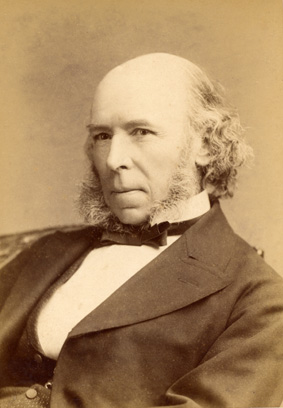
[Right: Herbert Spencer (1820-1903), Wikipedia]

with subsection, 1.1.3. Herbert Spencer's meaning of "evolution."

References cited are supported by the `tagline' quotes below (emphasis italics original, emphasis bold mine).


PROBLEMS OF EVOLUTION
© Stephen E. Jones, BSc. (Biology).

CONTENTS

BIBLIOGRAPHY

1. INTRODUCTION

1.1. What is "evolution"?

1.1.2. The original meaning of "evolution"

1.1.3. Herbert Spencer's meaning of "evolution."

The word "evolution" was first used by the English philosopher Herbert Spencer (1820-1903) in the sense of the progress of life from lower to higher forms (Gould, 1978, pp.36-37). It was also Spencer who most popularized the term "evolution" in that sense (Bowler, 1989, p.8; Gould, 2002, p.245).

Spencer defined "evolution" as "an integration of matter and concomitant dissipation of motion; during which the matter passes from an indefinite, incoherent homogeneity to a definite, coherent heterogeneity" (Spencer, 1945, p.358; Gould, 1978, pp.36-37; Mayr, 1982, pp.385-386). But Spencer's "evolution" was "a metaphysical principle" that "has nothing to do with real biology" (Mayr, 1982, pp.385-386). Although Spencer "was not a specialist in biology, and his speculations on biological problems have not advanced that science to any very great extent" nevertheless "he became one of the most influential promoters of the new doctrine of evolution." (Nordenskiold, 1928, p.493).

It was Spencer's a priori belief in universal natural causation that led him to accept evolution, in the absence of scientific proof (Burrow, 1966, pp.205-206). But once Spencer had accepted this metaphysical naturalism, his only alternative was some form of evolution (Pearcey,1998, pp.79-80).

To Spencer there were only "two hypotheses" to choose between, either "the hypothesis of Special Creation" or "the hypothesis of Evolution" (Spencer, 1910, p.415). The "only alternative to the hypothesis of Evolution is the hypothesis of Special Creation" (Spencer, 1910, pp.453-454). That is, either the many different "kinds of organisms ... have been from time to time separately made; or they have arisen by insensible steps, through actions such as we see habitually going" (Spencer, 1910, p.416). But then Spencer dismissed special creation as "not even a thinkable hypothesis" (Spencer, 1910, p.554) and "illegitimate" (Spencer, 1910, pp.420; 435).

Therefore, by "evolution" Spencer meant the very antithesis of supernatural creation. Spencer regarded "the hypothesis of evolution" and "the hypothesis of special creation" as "antagonist hypotheses" (Spencer, 1910, pp.416; 439-440).

Spencer defined "special creation" as "the belief that each species of organism was specially created" (Spencer, 1910, p.419), by a supernatural act" (Spencer, 1910, pp.431-432), such that"a new organism, when specially created, is created out of nothing" (Spencer, 1910, p.420). Evolution on the other hand was defined by Spencer as all the different "kinds of organisms" have "arisen by insensible steps, through actions such as we see habitually going on" (Spencer, 1910, p.415).

Therefore Spencer had set up a Fallacy of False Dilemma, which "presumes that only two alternatives exist when in actuality there are more than two" (Schick & Vaughn, 1995, pp.285-286). According to Spencer, it was "as if there were nothing in heaven and earth except an omnipotent deity acting as his own agent or natural selection of chance variations." (Fix, 1984, p.195). But there is a third alternative, that God did not separately create whole "organisms" but rather supernaturally guided and/or supernaturally intervened in those "insensible steps" to bring about genetic changes that would not have otherwise occurred naturalistically.Having thus set up a straw man caricature of the creationist position, "set up only to be knocked down" (Gale, 1982, p.139); "misrepresenting an opponent's position ... then ... arguing against the imputed position as though it were really that of your opponent" (Honderic, 1995, p.854), "in order to improve the appearance of his own case" (Gillespie, 1979, pp.19-20), Creation to Spencer was "absolutely without evidence to give it external support" (Spencer, 1910, p.420, 430).

So Spencer coined the word "evolution" to mean fully naturalistic evolution, the opposite of supernatural creation.

The quotes below are hyperlinked from inline references above. Emphasis in italics are original and in bold are mine.

Stephen E. Jones, BSc. (Biology).
My other blogs: TheShroudofTurin & Jesus is Jehovah!


"The progressionist implication was retained in a rather different form by the philosopher Herbert Spencer, the person who did most to popularize the term `evolution' in its modern context. Spencer advocated a system of cosmic progress, which included a theory of the inevitable evolution of life toward higher forms. Darwin's theory came to be tagged `evolution,' even though he seldom used the term himself; and most people still imagine that evolution is an essentially progressive process" (Bowler, P.J., 1989, "Evolution: The History of an Idea," [1983], University of California Press: Berkeley CA, Revised edition, p.8).

"Spencer's belief in the universality of natural causation was, together with his laissez-faire political creed, the bedrock of his thinking. It was this belief, more than anything else, that led him to reject Christianity, long before the great conflict of the eighteen-sixties. Moreover, it was his belief in natural causation that led him to embrace the theory of evolution, not vice versa. ... His faith was so strong that it did not wait on scientific proof. Spencer became an ardent evolutionist at a time when a cautious scientist would have been justified at least in suspending judgement. ... for him the belief in natural causation was primary, the theory of evolution derivative." (Burrow, J.W., 1966, "Evolution and Society: A Study in Victorian Social Theory," Cambridge University Press: London, Reprinted, 1968, pp.205-206).

"It is easy enough to set up a straw man, to point to the whale's vestigial pelvic bones, for example, and to say that if God had created the whale, directly and from nothing, he wouldn't have included these useless parts. Typically, neo-Darwinists then argue that it simply does not make sense to attribute the whale to divine creation-as if there were nothing in heaven and earth except an omnipotent deity acting as his own agent or natural selection of chance variations." (Fix, W.R. , 1984, "The Bone Peddlers: Selling Evolution," Macmillan: New York NY, p.195).

"Darwin's contrast of the explanatory powers of his theory with the Creationist, especially in the areas of geographical distribution, morphology embryology, and rudimentary organs, represents, I think, the strongest line of arguments in the Origin. ... Yet even here, where Darwin's arguments are strongest, nagging questions remain. For example, a reader of the Origin might be justified in wondering what Creationist view Darwin is referring to. Perhaps this is a problem more for the present-day reader. Darwin's contemporaries may have known exactly what he meant, though I doubt it. Often the Creationist position seems merely a straw man-set up only to be knocked down. The constraints on space in the Origin, which led Darwin to abandon his original intention of arguing on both sides of the mutability issue, add to this feeling. The result is that the Creationist position is never clearly defined in the Origin." (Gale, B.G., 1982, "Evolution Without Evidence: Charles Darwin and The Origin of Species," University of New Mexico Press: Albuquerque NM, p.139).

"Charles Darwin's hostile preoccupation with the belief that God had separately and individually created each of the animal and plant species in the world is one of the most intriguing but neglected features of the Origin of Species. Historians have disagreed about what to make of it. ... Some have accused Darwin of setting up a straw man in order to improve the appearance of his own case. Lastly, there are those who believe, correctly I think, that Darwin's rejection of special creation was part of the transformation of biology into a positive science, one committed to thoroughly naturalistic explanations based on material causes and the uniformity of the laws of nature, a change to which the Origin was a signally important contribution. ... Consequently, it was not a harmless straw man, but a traditional bias found among scientists and laymen alike and one that stood in the path of any novel way of viewing the problem of species. Darwin, then, was not engaged in anachronistic shadowboxing, but had selected his target well and knew exactly what he was doing. His attack on special creation was a response to the crisis and an attempt to resolve it by helping to promote the restructuring of biology along positivist lines. The critique of special creation in the Origin was systematically organized to that end. ... There were then, in 1859, a minority of naturalists, some of them influential, who believed in miraculous creation; others, of shifting number, who believed in direct divine intervention in some mysterious but lawful manner to create each new species; a third group, a small minority, who had accepted the descent theory; a fourth, larger group who were moving away from a belief in direct divine intervention in favor of a natural cause, but who were either skeptical of its being found or who were engaged in a quest for laws rather than true causes; and, lastly, a group that busied itself with practical work and renounced theory altogether. All of these save the third combined willy-nilly to create a genuine obstacle in the path of the project Charles Darwin had undertaken." (Gillespie, N.C., 1979, "Charles Darwin and the Problem of Creation," University of Chicago Press: Chicago IL, pp.19-20,39).

"Evolution entered the English language as a synonym for `descent with modification' through the propaganda of Herbert Spencer, that indefatigable Victorian pundit of nearly everything. Evolution, to Spencer, was the overarching law of all development. And, to a smug Victorian, what principle other than progress could rule the developmental processes of the universe? Thus, Spencer defined the universal law in his First Principles of 1862: `Evolution is an integration of matter and concomitant dissipation of motion; during which the matter passes from an indefinite, incoherent homogeneity to a definite coherent heterogeneity.' Two other aspects of Spencer's work contributed to the establishment of evolution in its present meaning: First, in writing his very popular Principles of Biology (1864-67), Spencer constantly used `evolution' as a description of organic change. Second, he did not view progress as an intrinsic capacity of matter, but as a result of `cooperation' between internal and external (environmental) forces. This view fit nicely with most nineteenth-century concepts of organic evolution, for Victorian scientists easily equated organic change with organic progress. Thus evolution was available when many scientists felt a need for a term more succinct than Darwin's descent with modification." (Gould, S.J., 1978, "Ever Since Darwin: Reflections in Natural History," Penguin: London, Reprinted, 1991, pp.36-37).

"Herbert Spencer's progressivist view of natural change probably exerted most influence in establishing `evolution' as the general name for Darwin's process-for Spencer held a dominating status as Victorian pundit and grand panjandrum of nearly everything conceptual. In any case, Darwin had too many other fish to fry, and didn't choose to fight a battle about words rather than things. He felt confident that his views would eventually prevail, even over the contrary etymology of word imposed upon his process by popular will. (He knew, after all, that meanings of words can transmute within new climates of immediate utility, just as species transform under new local environments of life and ecology!) Darwin never used the `E' word extensively in his writings, but he did capitulate to a developing consensus by referring to his process as `evolution' for the first time in The Descent of Man, published in 1871. (Still, Darwin never cited `evolution' in the title of any book-and he chose, in labeling his major work on our species, to emphasize our genealogical `descent,' not our `ascent' to higher levels of consciousness.)" (Gould, S.J., 2002, "I Have Landed: Splashes and Reflections in Natural History," Vintage: London, Reprinted, 2003, p.245).

"The straw man fallacy is the tactic in argument of misrepresenting an opponent's position, making it appear more implausible, so that it can more easily be refuted, then going ahead and arguing against the imputed position as though it were really that of your opponent." (Honderic, T., ed., 1995, "The Oxford Companion to Philosophy," Oxford University Press: Oxford UK, p.854).

"Herbert Spencer is often cited as having anticipated Darwin in propounding a theory of evolution, but there is little validity in this assertion. Evolution, for Spencer, was a metaphysical principle. The vacuousness of Spencer's theory is evident from his definition: `Evolution is an integration of matter and concomitant dissipation of motion; during which the matter passes from an indefinite, incoherent homogeneity to a definite, coherent heterogeneity; and during which the retained motion undergoes a parallel transformation' ([Spencer, H., "First Principles,"Williams & Norgate: London, Second edition, [1870: 396). The stress on matter, movement, and forces in this and other discussions of evolution is a typical example of an inappropriate eighteenth-century-type physicalist interpretation of ultimate causations in biological systems, and has nothing to do with real biology." (Mayr, E.W., 1982, "The Growth of Biological Thought: Diversity, Evolution, and Inheritance," Belknap Press: Cambridge MA, pp.385-386).

"Spencer's idea of evolution HERBERT SPENCER was not a specialist in biology, and his speculations on biological problems have not advanced that science to any very great extent. He nevertheless deserves a place in the history of biology as a rare example of a consummate and typical representative of that evolutional mode of thought which was awakened to life by the general tendency of the times in the middle of last century and which was promoted by Darwinism. He is commonly called the most consistent philosopher of evolution which that period produced - evolution forms the very groundwork of his system. In its essential features this system was already pretty definite before the advent of Darwin; it was promulgated in a number of small articles in periodicals, often characterized by masterly penetration and lucidity, afterwards brought together to form an imposing work entitled A System of Synthetic Philosophy, which was the fruits of thirty years' work and which gives `a broad, often too broad, development of what is recorded in the short treatises' (Hoffding). When Darwin produced his theory, Spencer associated himself with it, although he interprets it after his own mind, and he became one of the most influential promoters of the new doctrine of evolution. Otherwise he is said not to have been in favour of extensive studies; he preferred to think for himself and was very jealous of his independence." (Nordenskiold, E., 1928, "The History of Biology: A Survey," [1920-24], Eyre, L.B., transl., Tudor Publishing Co: New York NY, p.493. Emphasis original).

"In his autobiography Herbert Spencer recounts in excruciating detail the process by which he developed a naturalistic outlook, beginning when he was a boy. Over time, he writes, `a breach in the course of [physical] causation had come to be, if not an impossible thought, yet a thought never entertained' (Spencer 1904, 1:172). As in Darwin's case, members of Spencer's family described his adherence to naturalism in near-religious terms. His father drew a parallel between the son's naturalism and the father's own religion: `From what I see of my son's mind, it appears to me that the laws of nature are to him what revealed religion is to us, and that any wilful infraction of those laws is to him as much a sin as to us is disbelief in what is revealed' (Spencer 1904, 1:655). This semireligious attachment to naturalism explains why Spencer eventually became a tireless promoter of Darwinism. It was not because he was persuaded by Darwin's scientific theory; he rejected Darwinism and embraced Lamarckianism. Yet Spencer saw clearly that once he had embraced philosophical naturalism, he had no alternative but to accept some form of naturalistic evolution. As he puts it, having discarded orthodox Christianity, he developed an `intellectual leaning towards belief in natural causation everywhere operating.' And in that naturalistic leaning, `doubtless ... a belief in evolution at large was then latent.' Why latent? Because `anyone who, abandoning the supernaturalism of theology, accepts in full the naturalism of science, tacitly asserts that all things as they now exist have been evolved.' Spencer accepted naturalism first and then accepted evolution as a logical consequence. He goes on: `The doctrine of the universality of natural causation, has for its inevitable corollary the doctrine that the Universe and all things in it have reached their present forms through successive stages physically necessitated' (Spencer 1904, 2:7). Just so: Once one accepts the philosophy of naturalism, some form of naturalistic evolution is an `inevitable corollary.' Finding a plausible scientific theory is secondary. In Spencer's writings we get a glimpse of the intellectual pressure that impelled him toward a naturalistic view of evolution. `I cheerfully acknowledge,' he writes in The Principles of Psychology, that the hypothesis of evolution is beset by `serious difficulties' scientifically. Yet, `save for those who still adhere to the Hebrew myth, or to the doctrine of special creations derived from it, there is no alternative but this hypothesis or no hypothesis.' And no one can long remain in `the neutral state of having no hypothesis' (Spencer 1896, 1:466n). Similarly, in an 1899 letter, he writes that already decades earlier, `in 1852 the belief in organic evolution had taken deep root'-not for scientific reasons but because of `the necessity of accepting the hypothesis of Evolution when the hypothesis of Special Creation has been rejected.' He concludes with these telling words: `The Special Creation belief had dropped out of my mind many years before, and I could not remain in a suspended state: acceptance of the only conceivable alternative was peremptory' (Duncan 1908, 2:319). Here is a candid admission that Spencer was driven by a sense of philosophical necessity-naturalistic evolution was `the only conceivable alternative' to creation- more than by a dispassionate assessment of the scientific evidence." (Pearcey, N.R., "You Guys Lost: Is Design a Closed Issue?," in Dembski, W.A., ed., "Mere Creation: Science, Faith & Intelligent Design," InterVarsity Press: Downers Grove IL, 1998, pp.79-80).

"An argument proposes a false dilemma when it presumes that only two alternatives exist when in actuality there are more than two. For example, `Either science can explain how she was cured or it was a miracle. Science can't explain how she was cured. So it must be a miracle.' These two alternatives do not exhaust all the possibilities. It's possible, for example, that she was cured by some natural cause that scientists don't yet understand. Because the argument doesn't take this possibility into account, it's fallacious. Again: `Either have your horoscope charted by an astrologer or continue to stumble through life without knowing where you're going. You certainly don't want to continue your wayward ways. So you should have your horoscope charted by an astrologer.' If someone is concerned about the direction his or her life is taking, there are other things he or she can do about it than consult an astrologer. Since there are other options, the argument is fallacious." (Schick, T. & Vaughn, L., 1995, "How to Think About Weird Things: Critical Thinking for a New Age," Mayfield: Mountain View CA, California, Second edition, pp.285-286).

"We have to choose between two hypotheses-the hypothesis of Special Creation and the hypothesis of Evolution. Either the multitudinous kinds of organisms which now exist, and the far more multitudinous kinds which have existed during past geologic eras, have been from time to time separately made; or they have arisen by insensible steps, through actions such as we see habitually going on. Both hypotheses imply a Cause. The last, certainly as much as the first, recognizes this Cause as inscrutable. The point at issue is, how this inscrutable Cause has worked in the production of living forms. This point, if it is to be decided. at all, is to be decided only by examination of evidence. Let us inquire which of these antagonist hypotheses is most congruous with established facts." (Spencer, H., 1910, "The Principles of Biology," [1864], D. Appleton & Co: New York NY, Vol. I, Revised, pp.415-416).

"If, then, of this once-numerous family of beliefs the immense majority have become extinct, we may not unreasonably expect that the few remaining members of the family will become extinct. One of these is the belief we are here considering-the belief that each species of organism was specially created. Many who in all else have abandoned the aboriginal theory of things, still hold this remnant of the aboriginal theory. Ask any well-informed man whether he accepts the cosmogony of the Indians, or the Greeks, or the Hebrews, and he will regard the question as next to an insult. Yet one element common to these cosmogonies he very likely retains: not bearing in mind its origin. For whence did he get the doctrine of special creations? Catechise him, and he is forced to confess that it was put into his mind in childhood, as one portion of a story which, as a whole, he has long since rejected. Why this fragment is likely to be right while all the rest is wrong, he is unable to say. May we not then expect that the relinquishment of all other parts of this story, will by and by be followed by the relinquishment of this remaining part of it?" (Spencer, 1910, p.419).

"The belief which we find thus questionable; both as being a primitive belief and as being a belief belonging to an almost-extinct family, is a belief not countenanced by a single fact. No one ever saw a special creation; no one ever found proof of an indirect kind that a special creation had taken place. It is significant, as Dr. Hooker remarks, that naturalists who suppose new species to be miraculously originated, habitually suppose the origination to occur in some region remote from human observation. Wherever the order of organic nature is exposed to the view of zoologists and botanists, it expels this conception; and the conception survives only in connexion with imagined places, where the order of organic nature is unknown." (Spencer, 1910, pp.419-420).

"Besides being absolutely without evidence to give it external support, this hypothesis of special creations cannot support itself internally-cannot be framed into a coherent thought. It is one of those illegitimate symbolic conceptions which are mistaken for legitimate symbolic conceptions (_First Principles_, § 9), because they remain untested. Immediately an attempt is made to elaborate the idea into anything like a definite shape, it proves to be a pseud-idea, admitting of no definite shape. Is it supposed that a new organism, when specially created, is created out of nothing? If so, there is a supposed creation of matter; and the creation of matter is inconceivable-implies the establishment of a relation in thought between nothing and something-a relation of which one term is absent-an impossible relation. Is it supposed that the matter of which the new organism consists is not created for the occasion, but is taken out of its pre-existing forms and arranged into a new form? If so, we are met by the question-how is the re-arrangement effected? Of the myriad atoms going to the composition of the new organism, all of them previously dispersed through the neighbouring air and earth, does each, suddenly disengaging itself from its combinations, rush to meet the rest, unite with them into the appropriate chemical compounds, and then fall with certain others into its appointed place in the aggregate of complex tissues and organs? Surely thus to assume a myriad supernatural impulses, differing in their directions and amounts, given to as many different atoms, is a multiplication of mysteries rather than the solution of a mystery. For every one of these impulses, not being the, result of a force locally existing in some other form, implies the creation of force; and the creation of force is just as inconceivable as the creation of matter. It is thus with all attempted ways of representing the process." (Spencer, 1910, pp.420-421).

"The belief in special creations of organisms arose among men during the era of profoundest darkness; and it belongs to a family of beliefs which have nearly all died out as enlightenment has increased. It is without a solitary established fact on which to stand; and when the attempt is made to put it into definite shape in the mind, it turns out to be only a pseud-idea. This mere verbal hypothesis, which men idly accept as a real or thinkable hypothesis, is of the same nature as would be one, based on a day's observation of human life, that each man and woman was specially created -an hypothesis not suggested by evidence but by lack of evidence-an hypothesis which formulates ignorance into a semblance of knowledge. Further, we see that this hypothesis, failing to satisfy men's intellectual need of an interpretation, fails also to satisfy their moral sentiment. It is quite inconsistent with those conceptions of the divine nature which they profess to entertain. If infinite power was to be demonstrated, then, either by the special creation of every individual, or by the production of species by some method of natural genesis, it would be better demonstrated than by the use of two methods, as assumed by the hypothesis. And if infinite goodness was to be demonstrated, then, not only do the provisions of organic structure, if they are specially devised, fail to demonstrate it, but there is an enormous mass of them which imply malevolence rather than benevolence. Thus the hypothesis of special creations turns out to be worthless by its derivation; worthless in its intrinsic incoherence; worthless as absolutely without evidence; worthless as not supplying an intellectual need; worthless as not satisfying a moral want. We must therefore consider it as counting for nothing, in opposition to any other hypothesis respecting the origin of organic beings." (Spencer, 1910, pp.429-430).

"A kindred antithesis exists between the two families of beliefs, to which the beliefs we are comparing severally belong. While the one family has been dying out the other family has been multiplying. As fast as men have ceased to regard different classes of phenomena as caused by special personal agents, acting irregularly; so fast have they come to regard these different classes of phenomena as caused by a general agency acting uniformly-the two changes being correlatives. And as, on the one hand, the hypothesis that each species resulted from a supernatural act, having lost nearly all its kindred hypotheses, may be expected soon to die; so, on the other hand, the hypothesis that each species resulted from the action of natural causes, being one of an increasing family of hypotheses, may be expected to survive." (Spencer, 1910, pp.431-432).

"The hypothesis of evolution is contrasted with the hypothesis of special creations, in a further respect. It is not simply legitimate instead of illegitimate, because representable in thought instead of unrepresentable; but it has the support of some evidence, instead of being absolutely unsupported by evidence. Though the facts at present assignable in direct proof that by progressive modifications, races of organisms which are apparently distinct from antecedent races have descended from them, are not sufficient; yet there are numerous facts of the order required. Beyond all question unlikenesses of structure gradually arise among the members of successive generations. We find that there is going on a modifying process of the kind alleged as the source of specific differences: a process which, though slow, does, in time, produce conspicuous changes-a process which, to all appearance, would produce in millions of years, any amount of change." (Spencer, 1910, pp.435-436).

"In all respects, then, the hypothesis of evolution contrasts favourably with the hypothesis of special creation. It has arisen in comparatively-instructed times and in the most cultivated class. It is one of those beliefs in the uniform concurrence of phenomena, which are gradually supplanting beliefs in their irregular and arbitrary concurrence; and it belongs to a genus of these beliefs which has of late been rapidly spreading. It is a definitely-conceivable hypothesis; being simply an extension to the organic world at large, of a conception framed from our experiences of individual organisms; just as the hypothesis of universal gravitation was an extension of the conception which our experiences of terrestrial gravitation had produced. This definitely-conceivable hypothesis, besides the support of numerous analogies, has the support of direct evidence. We have proof that there is going on a process of the kind alleged; and though the results of this process, as actually witnessed, are minute in comparison with the totality of results ascribed to it, yet they bear to such totality a ratio as great as that by which an analogous hypothesis is justified. Lastly, that sentiment which the doctrine of special creations is thought necessary to satisfy, is much better satisfied by the doctrine of evolution; since this doctrine raises no contradictory implications respecting the Unknown Cause, such as are raised by the antagonist doctrine." (Spencer, 1910, pp.439-440).

"Von Baer lived in the days when the Development Hypothesis was mentioned only to be ridiculed, and he joined in the ridicule. What he conceived to be the meaning of these groupings of organisms and these relations among their embryological histories, is not obvious. The only alternative to the hypothesis of Evolution is the hypothesis of Special Creation; and as he did not accept the one it is inferable that he accepted the other. But if he did this he must in the first place have found no answer to the inquiry why organisms specially created should have the embryological kinships he described. And in the second place, after discovering that his alleged law was traversed by many and various nonconformities, he would have been without any explanation of these." (Spencer, 1910, pp.453-454).

"On considering the `General Aspects of the Special-creation hypothesis,' we discovered it to be worthless. Discredited by its origin, and wholly without any basis of observed fact, we found that it was not even a thinkable hypothesis; and, while thus intellectually illusive, it turned out to have moral implications irreconcilable with the professed beliefs of those who hold it. Contrariwise, the `General Aspects of the Evolution-hypothesis' begot the stronger faith in it the more nearly they were considered. By its lineage and its kindred, it was found to be as closely allied with the proved truths of modern science, as is the antagonist hypothesis with the proved errors of ancient ignorance. We saw that instead of being a mere pseud-idea, it admits of elaboration into a definite conception: so showing its legitimacy as an hypothesis. Instead of positing a purely fictitious process, the process which it alleges proves to be one actually going on around us. To which add that, morally considered, this hypothesis presents no radical incongruities. Thus, even were we without further means of judging there could be no rational hesitation which of the two views should be entertained." (Spencer, 1910, pp.554-555).

"Our formula, therefore, needs an additional clause. To combine this satisfactorily with the clauses as they stand in the last chapter, is scarcely practicable; and for convenience of expression it will be best to change their order. Doing this, and making the requisite addition, the formula finally stands thus:-Evolution is an integration of matter and concomitant dissipation of motion; during which the matter passes from an indefinite, incoherent homogeneity to a definite, coherent heterogeneity; and during which the retained motion undergoes a parallel transformation." (Spencer, H., 1945, "First Principles," [1862], Watts & Co: London, Sixth edition, Revised, 1945, p.358).