Friday, November 25, 2005

"Intelligent Design and the new McCarthyism"

Here, with permission, is an email from the editor of an Australian magazine (with identifying information removed and minor changes), and my reply which was a week ago. In a follow-up message, the editor indicated that the article, "Intelligent Design and the new McCarthyism" should be in the magazine's 30 November issue.

----- Original Message -----
From: AN
To: Stephen E. Jones
Sent: Thursday, November 17, 2005 9:07 AM
Subject: Intelligent Design and the new McCarthyism


Dear Mr. Jones:

My name is AN and I'm the editor of [...] magazine [...]. We're doing a feature on "Intelligent Design and the New McCarthyism", basically about how ID has become the theory that dare not speak its name in Australian universities as proponents of the theory get shouted down and shunned within the academy for expressing these views. I ran across your site in the course of my research, and I was hoping you might be able to help and point me in the direction of pro-ID academics in Australia who would be willing to speak, either on or off the record.

I can be reached on this e-mail ([...]) or on [...] at your convenience. Hope you can help!

Best regards,
AN

----- Original Message -----
From: Stephen E. Jones
To: AN
Sent: Friday, November 18, 2005 9:10 AM
Subject: Re: Intelligent Design and the new McCarthyism


AN

Thanks for your message.

The only Australian academic that I am aware of who has come out publicly in support of Intelligent Design is Professor Graeme Clark, FRACS, chair of otorhinolaryngology (ENT) surgery at the University of Melbourne. See articles in The Melbourne Age, "Evolving argument creates new battle" and "Creation crusade marches again, under new banner," both on August 6, 2005, in which he is mentioned as supporting ID.

I expect there are many more closet Australian academic supporters of ID , but as you are no doubt aware, it would be professional suicide for an academic to come out in support of ID, or even to advocate that it receive a fair hearing, in a modern science dominated by scientists whose personal philosophy is scientific naturalism.

According to Dembski's assessment of Schopenhauer's three, or Haldane's four, stages of acceptance of new ideas:

"Revolutions are messy affairs. They are also far from inevitable. For there to be a revolution, there must be revolutionaries willing to put their necks on the line. They must be willing to take the abuse, ridicule and intimidation that the ruling elite can and will inflict. The ruling elite in this case are the dogmatic Darwinists and scientific naturalists. Rigidly committed to keeping intelligent causation outside the natural sciences, they misrepresent intelligent design at every step, charging that its critique of Darwinism (and of naturalistic theories of evolution more generally) is utterly misguided and groundless. Accordingly, the public is informed that intelligent design is religion masquerading as science or `Creationism in a Cheap Tuxedo' (the title of a newspaper headline). Moreover, the public is warned that intelligent design spells the death of science and that to teach intelligent design is intellectually (if not morally) in the same boat as teaching that the Holocaust didn't happen. The acceptance of radical ideas that challenge the status quo (and Darwinism is as status quo as it gets) typically runs through several stages. According to Arthur Schopenhauer, `All truth passes through three stages. First, it is ridiculed. Second, it is violently opposed. Third, it is accepted as being self-evident.' Similarly, evolutionist J.B.S. Haldane remarked, `Theories pass through four stages of acceptance: (i) this is worthless nonsense; (ii) this is an interesting, but perverse, point of view; (iii) this is true, but quite unimportant; (iv) I always said so.' I like to flesh out Haldane's four stages as follows. First, the idea is regarded as preposterous: the ruling elite feel little threat and, as much as possible, ignore the challenge, but when pressed they confidently assert that the idea is so absurd as not to merit consideration. Second, it is regarded as pernicious: the ruling elite can no longer ignore the challenge and must take active measures to suppress it, now loudly proclaiming that the idea is confused, irrational, reprehensible and even dangerous (thus adding a moral dimension to the debate). Third, it is regarded as possible: the ruling elite reluctantly admits that the idea is not entirely absurd but claims that at best it is of marginal interest; meanwhile, the mainstream realizes that the idea has far-reaching consequences and is far more important than previously recognized. And fourth, it is regarded as plausible: a new status quo has emerged, with the ruling elite taking credit for the idea and the mainstream unable to imagine how people in times past could have thought otherwise. With intelligent design, we are now at the transition from stage two to stage three-from pernicious to possible. This is the hardest transition." (Dembski W.A., "The Design Revolution: Answering the Toughest Questions About Intelligent Design," Intervarsity Press: Downers Grove IL, 2004, p.20).

(and bear in mind in case you quote this in your article that, as with many widespread unreferenced quotations, it is doubtful that Schopenhauer and Haldane said it exactly that way), ID is progressing through something like Haldane's stages one and two, from being largely ignored by the science establishment, to now being attacked (which includes Schopenhauer's "ridiculed" and "violently opposed"), in an attempt to suppress it as much as possible.

But if the Schopenhauer and Haldane sayings are generally true (as I believe they are), then the attacks will just increase the Australian public's (including scientists and future scientists) interest in ID, and pave the way for its eventual acceptance within mainstream science.

I would be interested in hearing from you if and when you publish your article on ID. May I also have your permission to post your message (minus any identifying information) and my reply, to my blog CED? Thanks.

Stephen E. Jones, BSc (Biol).
"Problems of Evolution"

Univ. of Kansas Takes Up Creation Debate, etc

My comments bolded and in square brackets, on articles about University of Kansas Chair and Associate Professor of Religious Studies Paul Mirecki's proposed course on "Special Topics in Religion: Intelligent Design, Creationism and other Religious Mythologies" :

Univ. of Kansas Takes Up Creation Debate: Univ. of Kansas Religion Course Seeks to Debunk Creationism, Intelligent Design As 'Mythology', ABC News/AP, ... LAWRENCE, Kan. Nov 22, 2005 - Creationism and intelligent design are going to be studied at the University of Kansas, but not in the way advocated by opponents of the theory of evolution. [Also at CNN, San Francisco Chronicle & Seattle Post-Intelligencer.] A course being offered next semester by the university religious studies department is titled "Special Topics in Religion: Intelligent Design, Creationism and other Religious Mythologies." [It will be most interesting to see how, in a scholarly and objective way, this course will make the case that "creationism" and "intelligent design" are "mythologies." But apart from ID being based solely on the empirical evidence of nature:

"The first misunderstanding is that intelligent design is based on religion rather than science. Design theory is a scientific inference based on empirical evidence, not religious texts. The theory proposes that some features of the natural world are best explained as the product of an intelligent cause as opposed to an undirected process such as natural selection. Although controversial, design theory is supported by a growing number of scientists in scientific journals, conference proceedings and books. While intelligent design may have religious implications (just like Darwin's theory), it does not start from religious premises." (West J.G., "Intelligent design is sorely misunderstood," Seattle Post- Intelligencer, August 9, 2005).
Christian "creationism" is based on Christianity being true (which it is). So to claim that Christian "creationism" is "mythology" would necessitate demonstrating that Christianity is false. I look forward to seeing that demonstration!] "The KU faculty has had enough," said Paul Mirecki, department chairman. "Creationism is mythology," Mirecki said. [This is necessarily a claim that that Christianity is false. It seems that the separation of Church and State only works one way in the USA these days? BTW Mirecki is an atheist/agnostic:
Challenging worldviews Atheists and agnostics group battles misconceptions, The Lawrence Journal-World, Jim Baker, May 1, 2004 Got God? Members of the Kansas University Society of Open- Minded Atheists and Agnostics don't. The 20 to 30 students who belong to the group don't believe in God or think there's any way human beings can know whether God exists or not. ... Paul Mirecki, professor of religious studies at KU, says he is happy to serve as faculty sponsor for the group so it can have meetings and events such as "Religiously Incorrect." "I have been their faculty sponsor for three or four years, and I haven't received anything negative about it. Part of it is because the group hasn't gotten much attention," Mirecki says. "As soon as they start getting media attention, opposition will come from those people who like to oppose people who are not like them."
Evidently Mirecki exempts himself from his own criticism that "opposition will come from those people who like to oppose people who are not like them."!] "Intelligent design is mythology. It's not science. They try to make it sound like science. It clearly is not." [As I said, I look forward to Mirecki demonstrating that in a scholarly and objective manner in this course!] Earlier this month, the state Board of Education adopted new science teaching standards that treat evolution as a flawed theory, defying the view of science groups. Although local school boards still decide how science is taught in the classrooms, the vote was seen as a major victory for proponents of intelligent design, which says that the universe is so complex that it must have been created by a higher power. [It is false this oft-repeated claim that "intelligent design ... says that the universe is so complex that it must have been created by a higher power." All that ID claims is that "certain features of the universe and of living things are best explained by an intelligent cause" and "Intelligent design theory does NOT claim that ... the intelligent cause must be a `divine being' or a `higher power' or an `all-powerful force'":
"1. What is the theory of intelligent design? The scientific theory of intelligent design holds that certain features of the universe and of living things are best explained by an intelligent cause, not an undirected process such as natural selection. Note: Intelligent design theory does NOT claim that science can determine the identity of the intelligent cause. Nor does it claim that the intelligent cause must be a `divine being' or a `higher power' or an `all-powerful force.' All it proposes is that science can identify whether certain features of the natural world are the products of intelligence." (Crowther R., "Discovery Institute gives overview of intelligent design," Baptist Press, December 17, 2004).]
Critics say intelligent design is merely creationism a literal reading of the Bible's story of creation as the handiwork of God camouflaged in scientific language as a way to get around court rulings that creationism injects religion into public schools. [This is patently false. ID says nothing about "the Bible", let alone its "story of creation," and those who keep saying it will discredit themselves in the eyes of the general public as either dishonest or deluded.] John Calvert, an attorney and managing director of the Intelligent Design Network in Johnson County, said Mirecki will go down in history as a laughingstock. "To equate intelligent design to mythology is really an absurdity, and it's just another example of labeling anybody who proposes (intelligent design) to be simply a religious nut," Calvert said. "That's the reason for this little charade." [I disagree that "Mirecki will go down in history" (he is not important enough for that) but I agree that he is "a laughingstock"!] Mirecki said his course, limited to 120 students, would explore intelligent design as a modern American mythology. Several faculty members have volunteered to be guest lecturers, he said. [Again, I would be very interested in seeing Mirecki's evidence and argument that "intelligent design [is] ... a modern American mythology."] University Chancellor Robert Hemenway said Monday said he didn't know all the details about the new course. "If it's a course that's being offered in a serious and intellectually honest way, those are the kind of courses a university frequently offers," he said. ... [I wonder what Hemenway will do if "it's a course that's" not "being offered in a serious and intellectually honest way"? In fact, it is significant that he even mentioned that criteria!]

Use of `mythologies' questioned: Intelligent design backers criticize KU course title, The Kansas City Star, Nov. 23, 2005, Laura Bauer ... Months before a University of Kansas religion course is even taught, its title has riled some who say the school is acting the spoil sport in the evolution debate. The course, "Special Topics in Religion: Intelligent Design, Creationism and other Religious Mythologies," will be offered next semester. [What if the boot was on the other foot and a course was proposed with the title, "Darwinism, Evolutionism and other anti-Religious Mythologies"? Would not the Darwinists be "riled" (to put it mildly)?] The goal, university officials say, is to open students up to the many cross-cultural stories of how the world was created. [But, apart from ID not being a "stor[y] of how the world was created", labelling as "mythologies" all those "stories of how the world was created," means that Christian creation, and therefore Christianity itself, is a "mythology", when Christianity explicitly claims that it is not:

2 Peter 1:16 (RSV) - "For we did not follow cleverly devised myths [Gk. mythos] when we made known to you the power and coming of our Lord Jesus Christ, but we were eyewitnesses of his majesty." (my emphasis).
It would then be most interesting to see the result of a separation of Church and State case brought by (say) the Thomas More Law Center against Mirecki and the University of Kansas!] Those in the intelligent design camp believe it is just KU's way of degrading the concept. Intelligent design is the belief that some aspects of nature show evidence of being designed by a creator. ". All of a sudden, just from the title, intelligent design is being put in there with mythology," said Bruce Simat, an associate biology professor at Minnesota's Northwestern College, who testified on behalf of intelligent design at Kansas hearings in May. "I think it's reactionary. I think it's defensive. I think they are unwilling to study intelligent design head-on." [Good point. But the more the Darwinists employ these "defensive" tactics, the more the public will assume that they are "afraid to encounter the best arguments against their theory":
"In the final analysis, it is not any specific scientific evidence that convinces me that Darwinism is a pseudoscience that will collapse once it becomes possible for critics to get a fair hearing. It is the way the Darwinists argue their case that makes it apparent that they are afraid to encounter the best arguments against their theory. A real science does not employ propaganda and legal barriers to prevent relevant questions from being asked, nor does it rely on enforcing rules of reasoning that allow no alternative to the official story. If the Darwinists had a good case to make, they would welcome the critics to an academic forum for open debate, and they would want to confront the best critical arguments rather than to caricature them as straw men. Instead they have chosen to rely on the dishonorable methods of power politics." (Johnson P.E., "The Wedge of Truth: Splitting the Foundations of Naturalism," Intervarsity Press: Downers Grove IL, 2000, p.141).]
For months, Kansas has been embroiled in controversy over what the state should teach its children in the science classroom. Earlier this month, the state board of education adopted new standards that allow for nonnatural explanations and cast doubt on Charles Darwin's theory of evolution. [Obviously the reporter realizes that this is a `payback' (see also last article)!] The course title is not meant to offend any religion or belief, KU Provost David Shulenburger said Tuesday. He explained in a written statement that "myth" and "mythology" are common in the academic study of religion. [This is just disingenuous damage control. The singling out of "Intelligent Design" and "[Christian] Creationism" with "other Religious Mythologies" at the University of Kansas, following the Kansas Board of Education's adoption of new science standards, let alone Mirecki's statement, "The KU faculty has had enough ... Creationism is mythology", makes it obvious that this is just a payback (see also last article)!] The course will accommodate as many as 120 students. They will be introduced to many different creation stories and be able to make up their own minds on what they believe, university officials say. [I look forward to Mirecki's depiction of "Intelligent Design" and "[Christian] Creationism", which is "offered in a serious and intellectually honest way!] What worries John Calvert, an attorney and managing director of Johnson County's Intelligent Design Network, is whether the course instructor will be educated in the science behind intelligent design. " People will be misled and buy the lie," Calvert said. [Well, if "the course instructor" is not "educated in the science behind intelligent design" such that students "will be misled" then presumably action (up to and including legal) can be taken against Mirecki and the University of Kansas?] "But the public is going to see what's going on. We're not all fools. Misinformation has a finite life." [Agreed. It is Mirecki and his ilk who are the "fools", continually employing "misinformation." The public will increasingly wonder why, if the Darwinists have truth on their side, they "would [not] want to confront the best critical arguments [of ID] rather than to caricature them as straw men".] But some, in addition to faculty members at KU, think the class is a good thing. Boo Tyson of the Mainstream Coalition said she likes that the topic is being taught in a religion curriculum. "It may be right way to go about this. Let's have this discussion in religion classes," Tyson said. "I don't think creationism or intelligent design belongs in a science classroom. I think it's a sign of weak faith to try to prove your faith." [This last is pure Gnosticism. Christianity is a "faith" based on facts , in particular the fact that Jesus rose from the dead, "if Christ has not been raised, our preaching is useless and so is your faith":
1 Cor. 15:12-20 NIV: " But if it is preached that Christ has been raised from the dead, how can some of you say that there is no resurrection of the dead? If there is no resurrection of the dead, then not even Christ has been raised. And if Christ has not been raised, our preaching is useless and so is your faith. For if the dead are not raised, then Christ has not been raised either. And if Christ has not been raised, your faith is futile; you are still in your sins. But Christ has indeed been raised from the dead, the firstfruits of those who have fallen asleep." (my emphasis)]
Tyson said that after the course, students should be able to decide for themselves where they fall in the debate. The nonpartisan coalition, based in Johnson County, works to maintain the separation of church and state. [Well, then they should be against Christian "creationism", and therefore Christianity itself, being classified by the State as a "mythology"! But of course, "the separation of church and state" is these days (when there is no prospect of a State religion being established) just a tactic to attack and marginalize Christianity. Those doing it don't realize that they are unwittingly proving Christianity to be true (2 Thess. 2:3 ;Luke 18:8 ; Rev. 11:3-10; 20:1-9)!] Shulenburger said the course allows the university to fulfill its obligation to the community and students. "My concern is that our faculty feels free to go to their disciplines and teach from them on any subject," Shulenburger said. "Regardless of the controversy associated with it." ... [ID has no problem with ID and "the controversy associated with it" being taught. In fact that is ID's "teach the controversy" position. But to prejudge ID (and "creationism") as "mythology" is hardly "being offered in a serious and intellectually honest way"!]

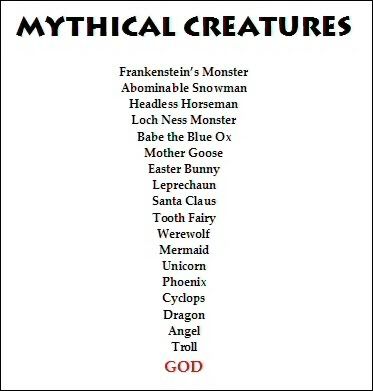
Critics: E-mail reveals intent: KU professor says note about creationism course wasn't public, The Capital-Journal , November 24, 2005, Ric Anderson. A University of Kansas instructor has inflamed conservatives with comments he made in announcing plans to teach a course examining intelligent design as mythology. Paul Mirecki, chairman of KU's Religious Studies Department, wrote in an e-mail that the course was his response to religious fundamentalists promoting the study of intelligent design and creationism in the state's public schools. "The fundies want it all taught in a science class, but this will be a nice slap in their big fat face by teaching it as a religious studies class under the category 'mythology,' " the message said. [See above on "payback"! So much for this course "being offered in a serious and intellectually honest way"!] The message was sent Saturday to a list-serve group for the Society of Open-Minded Atheists and Agnostics, a student organization for which Mirecki serves as faculty adviser. [This `society of open-minded atheists' has a T-shirt for sale which has on it, "MYTHICAL CREATURES", then a list starting with "Frankenstein's Monster" and ending with "GOD" (thanks to Krauze at Telic Thoughts for the idea of showing the graphic).] Mirecki addressed the message to "my fellow damned" and signed off with: "Doing my part to (tick) of(f) the religious right, Evil Dr. P." [Mirecki's designating himself "damned" and "Evil" (like Dawkins' "A Devil's Chaplain") illustrates C.S. Lewis' point that, "the doors of hell are locked on the inside" and that what "rebels" against God most want in this life, "God to ... leave them alone", is "what He does" in the next life:

"I willingly believe that the damned are, in one sense, successful, rebels to the end; that the doors of hell are locked on the inside. ... They enjoy forever the horrible freedom they have demanded, and are therefore self-enslaved: just as the blessed, forever submitting to obedience, become through all eternity more and more free. In the long run the answer to all those who object to the doctrine of hell, is itself a question: `what are you asking God to do?' To wipe out their past sins and, at all costs, to give them a fresh start, smoothing every difficulty and offering every miraculous help? But He has done so, on Calvary. To forgive them? They will not be forgiven. To leave them alone? Alas, I am afraid that is what He does." (Lewis C.S., "The Problem of Pain," [1940], Fount: London, 1977, reprint, pp.101-102. Emphasis in original).]
John Altevogt, a conservative columnist and activist in Kansas City, Kan., said Mirecki had accomplished his goal. "When somebody writes a letter like this and says, 'I'm going to go out and slap them in their fat faces, I'm going to go out and (tick) them off,' congratulations, you've succeeded," he said. Altevogt said he would send a copy of the message to every Kansas legislator as an example of religious intolerance and hate-mongering at the university. He said he thought Mirecki should step down as department chairman. [Clearly Mirecki has forfeited any claim to be an objective scholar in this area. If his course still goes ahead, which now seems unlikely, it would now have no credibility.] Sen. Kay O'Connor, a conservative Republican from Olathe, said she saw the message as a "slap in the face of every Judeo-Christian religion." O'Connor declined to say whether she thought the Legislature would consider withholding funds over the issue. "But Public Relations 101 is you don't kick sand in the face of a person you're asking for money," she said. [This raises a good point. Why should the vast majority of theists provide their taxpayer's money to fund the tiny minority of atheists, so the latter can use those funds to advance their atheistic religious position and attack the theists' religious position?] Mirecki didn't deny writing the message but suggested it wasn't meant to be seen by the general public. He said Wednesday that a "mole" who had been monitoring the student organization's list-serve sent the message to a fundamentalist organization. "It's their version of ethics -- one citizen spying on another and reporting to authorities," he said. [What about the "ethics" of pretending that one is proposing a course for "The goal ... to open students up to the many cross-cultural stories of how the world was created" when really one is trying to get back at "The fundies" to give them "a nice slap in their big fat face by teaching it as a religious studies class under the category 'mythology'"?] Mirecki said he had received more than 250 e-mail messages and phone calls since news of the course broke earlier this week. The vast majority were supportive, he said. Mirecki declined to discuss the issue further, saying he would give no interviews until after the holidays. Andrew Stangl, president of the Society of Open-Minded Atheists and Agnostics, said the list-serve was designed to provide an open and informal forum for discussion. The list-serve is open to the public, but users must register with a username and a password. "This was just supposed to be SOMA members and people who want to openly discuss these issues," Stangl said. "That's who he thought he was making the comments to." Altevogt said the privacy argument was groundless. "That's silly," he said. "There's no expectation of privacy on the Internet. That's basically saying, 'Shame on you, you caught me.' " [Agreed-anyone who thinks a "list-serve ... open to the public" is confidential, is either naive, or a fool. But it could have been a SOMA atheist/agnostic member who was disgusted by nasty Mirecki's email.] David Shulenburger, KU provost and executive vice chancellor, said he didn't believe Mirecki intended the message to go beyond the list- serve recipients. "I certainly regret the choice of wording in it, and it doesn't reflect the attitude of the university toward individuals who hold certain beliefs," Shulenburger said. [More damage control. Mirecki himself said of the "more than 250 e-mail messages and phone calls" he received about it, "The vast majority were supportive" and presumably many, if not most, of these were from the faculty.] Shulenburger said Mirecki had compiled a good record as a teacher and scholar. He said the course had a legitimate, educational purpose at a time when Kansas is drawing worldwide attention for debate over the teaching of intelligent design in public schools. "This is a scholarly course that will look at the various creation stories that are peculiar to many different religions," he said. "Students will be able to hear the lectures, read the literature, discuss issues in class and form their own opinions. There's a scholarly intent." [Mirecki's email refutes that. I would be very surprised if the course goes ahead now, which is a pity!] John Bacon, a conservative Republican member of the Kansas State Board of Education, said the tone of Mirecki's message suggested the course would be biased against creationism and Christianity. "As a taxpayer, I take exception (to Mirecki's message)," he said. "I think it has the potential of alienating a lot of the supporters of KU." [Mirecki forgot his fellow atheist William Provine's point that, "prominent atheistic or agnostic scientists publicly deny that there is any conflict between science and religion" because "funding for science might suffer if the atheistic implications of modern science were widely understood":
"My observation is that the great majority of modern evolutionary biologists now are atheists or something very close to that. Yet prominent atheistic or agnostic scientists publicly deny that there is any conflict between science and religion. Rather than simple intellectual dishonesty, this position is pragmatic. In the United States, elected members of Congress all proclaim to be religious. Many scientists believe that funding for science might suffer if the atheistic implications of modern science were widely understood." (Provine W.B., Review of "Trial and Error: The American Controversy over Creation and Evolution," by Edward J. Larson, Oxford University Press: New York, 1985, Academe, Vol. 73, January/February 1987, pp.51-52, in Morris H.M., "That Their Words May Be Used Against Them: Quotes from Evolutionists Useful for Creationists," Master Books: Green Forest AR, 1997, p.396)]
Mirecki, who joined the KU faculty in 1989, said in the list-serve message that six faculty members had signed up for the course, "Special Topics in Religion: Intelligent Design, Creationisms and other Religious Mythologies." ... [I hope that the course does go ahead, because it will be instructive (and fun!) to refute Mirecki's claims that Christian "creationism" (and therefore Christianity itself) and "intelligent design", are mythological.]

PS: See tagline quote that is my next installment of Paley's design argument.

Stephen E. Jones, BSc (Biol).
"Problems of Evolution"


"Nor, fifthly, would it yield his inquire more satisfaction to be answered that there existed in things a principle of order, which had disposed the parts of the watch into their present form and situation. He never knew a watch made by the principle of order; nor can he even form to himself an idea of what is meant by a principle of order, distinct from the intelligence of the watch-maker." (Paley W., "Natural Theology: or, Evidences of the Existence and Attributes of the Deity, Collected from the Appearances of Nature," [1802], St. Thomas Press: Houston, TX, 1972, reprint, p.5)

Wednesday, November 23, 2005

Vatican Astronomer: Intelligent Design is Not Science

My comments, bolded and in square brackets, on an article about Vatican astronomer George Coyne's recent attack on ID:

Vatican Astronomer: Intelligent Design is Not Science, Livescience/AP, Nicole Winfield, 18 November 2005 ... VATICAN CITY (AP) -- The Vatican's chief astronomer said Friday that "intelligent design'' isn't science and doesn't belong in science classrooms, the latest high-ranking Roman Catholic official to enter the evolution debate raging in the United States. [Also at CBS, MSNBC & Washington Times . The claim that "`intelligent design' isn't science" presupposes that there is some principled set of demarcation criteria of what is, and is not "science", such that an objective application of those criteria would rule out everything that is not "science" and rule in everything that is "science". But in fact this has proved to be impossible. Some things that are thought not to be science (e.g. astrology) meet all the usual demarcation criteria, e.g. testable, falsifiable, in that they have been tested and found to be false, and so they qualifiy as "science" but are wrong. OTOH, some things that are thought to be science, e.g. Darwinian evolution, are difficult, if not impossible to test and falsify:

"Our theory of evolution has become, as Popper described, one which cannot be refuted by any possible observations. Every conceivable observation can be fitted into it. It is thus `outside of empirical science' but not necessarily false. No one can think of ways in which to test it. Ideas, either without basis or based on a few laboratory experiments carried out in extremely simplified systems, have attained currency far beyond their validity. They have become part of an evolutionary dogma accepted by most of us as part of our training." (Birch L.C. & Ehrlich P.R., "Evolutionary History and Population Biology", Nature, Vol. 214, 22 April 1967, p.352).
Therefore, as leading philosopher of science Larry Laudan (in the context of the question of whether young-Earth creationism was "science"), pointed out that the question, "what makes a belief scientific? ... is both uninteresting and ... intractable":
"Through certain vagaries of history, some of which I have alluded to here, we have managed to conflate two quite distinct questions: What makes a belief well founded (or heuristically fertile)? And what makes a belief scientific? The first set of questions is philosophically interesting and possibly even tractable, the second question is both uninteresting and, judging by its checkered past, intractable. If we would stand up and be counted on the side of reason, we ought to drop terms like `pseudoscience' and `unscientific' from our vocabulary; they are just hollow phrases which do only emotive work for us. As such, they are more suited to the rhetoric of politicians and Scottish sociologists of knowledge than to that of empirical researchers. Insofar as our concern is to protect ourselves and our fellows from the cardinal sin of believing what we wish were so rather than what there is substantial evidence for (and surely that is what most forms of `quackery' come down to), then our focus should be squarely on the empirical and conceptual credentials for claims about the world. The `scientific' status of those claims is altogether irrelevant." (Laudan L., "The Demise of the Demarcation Problem," in Ruse M., ed., "But is it Science?: The Philosophical Question in the Creation/Evolution Controversy," Prometheus Books: Amherst NY, 1996, p.349).
The right question therefore is not, "is intelligent design science"? but rather "is intelligent design true"? Opponents of ID seem to desperately want to avoid having to answer that question, which itself is an example on their part of "the cardinal sin of believing what [they] wish were so rather than what there is substantial evidence for"!] The Rev. George Coyne, the Jesuit director of the Vatican Observatory, said placing intelligent design ideas alongside the theory of evolution in school programs was "wrong'' and was akin to mixing apples with oranges. [It needs to be made clear that "intelligent design" is not necessarily opposed to everything in "the theory of evolution." For example, leading ID theorist Bill Dembski has stated that, "intelligent design is compatible with ... the most far-ranging evolution (e.g., God seamlessly melding all organisms together into one great tree of life)":
"Where does intelligent design fit within the creation-evolution debate? Logically, intelligent design is compatible with everything from utterly discontinuous creation (e.g., God intervening at every conceivable point to create new species) to the most far-ranging evolution (e.g., God seamlessly melding all organisms together into one great tree of life). For intelligent design the primary question is not how organisms came to be (though, as we've just seen, this is a vital question for intelligent design) but whether organisms demonstrate clear, empirically detectable marks of being intelligently caused. In principle an evolutionary process can exhibit such `marks of intelligence' as much as any act of special creation." (Dembski W.A., "Intelligent Design: The Bridge Between Science and Theology," InterVarsity Press: Downers Grove IL, 1999, pp.109-110)
and another leading ID theorist, Mike Behe, (as well as yours truly) accepts "common descent (that all organisms share a common ancestor)":
"Evolution is a controversial topic, so it is necessary to address a few basic questions at the beginning of the book. Many people think that questioning Darwinian evolution must be equivalent to espousing creationism. As commonly understood, creationism involves belief in an earth formed only about ten thousand years ago, an interpretation of the Bible that is still very popular. For the record, I have no reason to doubt that the universe is the billions of years old that physicists say it is. Further, I find the idea of common descent (that all organisms share a common ancestor) fairly convincing, and have no particular reason to doubt it. I greatly respect the work of my colleagues who study the development and behavior of organisms within an evolutionary framework, and I think that evolutionary biologists have contributed enormously to our understanding of the world. Although Darwin's mechanism-natural selection working on variation-might explain many things, however, I do not believe it explains molecular life. I also do not think it surprising that the new science of the very small might change the way we view the less small." (Behe M.J., "Darwin's Black Box: The Biochemical Challenge to Evolution," Free Press: New York NY, 1996, pp.5-6)
ID is only necessarily opposed to the Darwinian "theory of evolution" in its claim that there is no design in nature:
"Paley's argument is made with passionate sincerity and is informed by the best biological scholarship of his day, but it is wrong, gloriously and utterly wrong. The analogy between telescope and eye, between watch and living organism, is false. All appearances to the contrary, the only watchmaker in nature is the blind forces of physics, albeit deployed in a very special way. A true watchmaker has foresight: he designs his cogs and springs, and plans their interconnections, with a future purpose in his mind's eye. Natural selection, the blind, unconscious, automatic process which Darwin discovered, and which we now know is the explanation for the existence and apparently purposeful form of all life, has no purpose in mind. It has no mind and no mind's eye. It does not plan for the future. It has no vision, no foresight, no sight at all. If it can be said to play the role of watchmaker in nature, it is the blind watchmaker." (Dawkins R., "The Blind Watchmaker: Why the Evidence of Evolution Reveals a Universe Without Design," W.W Norton & Co: New York NY, 1986, p.5. Emphasis original)
If the claim of Darwinian theory of evolution that there is no design in nature is science, then the counter claim of the theory of intelligent design that there is design in nature is also science:
"Clearly if you have a question, the answer yes and the answer no to the question are still in the same subject area. So if the affirmation `Yes, natural selection can create as much as is needed,' is science, then the no answer -- `No, the evidence does not support that' -- is science, too. I vigorously assert that this is not two subjects but one subject: what does the evidence show and not show about natural processes? .... It can't be that the yes answer is science and the no answer is religion.'" (Johnson P.E., "Evolution and the Curriculum: A Conversation with Phillip Johnson and Gregg Easterbrook," Center Conversations No. 4, September 1999, Ethics and Public Policy Center, Washington DC)
That this is so is seen in my biology textbook, where there is a two-page interview with Dawkins, in which he discussed Paley's argument from design, and admitted that, "Paley ... at least put the question right. ... the only thing Paley got wrong ... was the answer to the question":
"One of your books, The Blind Watchmaker, argues the case for the cumulative power of natural selection in the adaptation of organisms. Tell us about the metaphorical title of that book. The `watchmaker' comes from William Paley, the eighteenth-and early nineteenth-century theologian who was one of the most famous exponents of the argument of design. Paley famously said that if you are wandering along and stumble upon a watch and you pick it up and open it, you realize that the internal mechanism-the way in which it's all meshed together-is detailed perfection. Add this to the fact that the watch mechanism has a purpose-namely, telling the time-then this compels you to conclude that the watch had to have a designer. Paley then went on throughout his book giving example after example of detailed structure of living organisms-eyes, heart, bowels, joints, and everything about animals-showing how beautifully designed they apparently are, how well they work, how intricately the parts mesh together, just like the cog wheels of a watch. And if the watch had to have a watchmaker, then of course these biological structures also had to have a designer. My reason for beginning The Blind Watchmaker was Paley. He really saw the magnitude of the problem of adaptation when most people just didn't see how elegant, how beautiful, apparent design in life is. Paley saw that, and Darwin saw that. And Darwin was introduced to it at least partly by Paley. All undergraduates at Cambridge had to read William Paley. He at least put the question right. So the only thing Paley got wrong, which is quite a big thing, was the answer to the question. And nobody got the right answer until Charles Darwin in the nineteenth century." (Dawkins R., "Mechanisms of Evolution," in Campbell N.A., Reece J.B. & Mitchell L.G., "Biology," [1987], Benjamin/Cummings: Menlo Park CA, Fifth Edition, 1999, p.412).
So comparing the Darwinian "theory of evolution" and the theory of "intelligent design," on the question of whether or not there is design in nature, is comparing apples with apples.] "Intelligent design isn't science even though it pretends to be," the ANSA news agency quoted Coyne as saying on the sidelines of a conference in Florence. "If you want to teach it in schools, intelligent design should be taught when religion or cultural history is taught, not science.'' [Like most ID critics, Coyne is ignorant of what ID's position on its teaching in schools actually is. The fact is that the ID movement is not at this stage wanting ID to be taught in schools, as Discovery Institute Vice President Mark Ryland made clear, "we always tell people: don't teach intelligent design" (my emphasis):
"MARK RYLAND (DI): .... Let me back up first and say: The Discovery Institute never set out to have a school board, schools, get into this issue. We've never encouraged people to do it, we've never promoted it. We have, unfortunately, gotten sucked into it, because we have a lot of expertise in the issue, that people are interested in. When asked for our opinion, we always tell people: don't teach intelligent design. There's no curriculum developed for it, you're teachers are likely to be hostile towards it, I mean there's just all these good reasons why you should not to go down that path. If you want to do anything, you should teach the evidence for and against Darwin's theory. Teach it dialectically. And despite all the hoopla you've heard today, there is a great deal of -- many, many problems with Darwin's theory, in particular the power of NS and RV to do the astounding things that are attributed to them. .... So that's the background. And what's happened in the foreground was, when it came to the Dover school district, we advised them not to institute the policy they advised. In fact, I personally went and met with them, and actually Richard [Thompson] was there the same day, and they didn't listen to me, that's fine, they can do what they want, I have no power and control over them. But from the start we just disagreed that this was a good place, a good time and place to have this battle -- which is risky, in the sense that there's a potential for rulings that this is somehow unconstitutional." (Ryland M., "Discovery Institute and Thomas More Law Center Squabble in AEI Forum," National Center for Science Education, October 23, 2005. My emphasis).
The ID movement's position is not "teach ID" but "teach the controversy" (my emphasis), i.e. "teach students about the main scientific arguments for and against Darwinian theory":
"When two groups of experts disagree about a controversial subject that intersects the public school curriculum students should learn about both perspectives. In such cases teachers should not teach as true only one competing view, just the Republican or Democratic view of the New Deal in a history class, for example. Instead, teachers should describe competing views to students and explain the arguments for and against these views as made by their chief proponents. Educators call this `teaching the controversy.' Recently, while speaking to the Ohio State Board of Education, I suggested this approach as a way forward for Ohio in its increasingly contentious dispute about how to teach theories of biological origin, and about whether or not to introduce the theory of intelligent design alongside Darwinism in the Ohio biology curriculum. I also proposed a compromise involving three main provisions: (1) First, I suggested--speaking as an advocate of the theory of intelligent design--that Ohio not require students to know the scientific evidence and arguments for the theory of intelligent design, at least not yet. (2) Instead, I proposed that Ohio teachers teach the scientific controversy about Darwinian evolution. Teachers should teach students about the main scientific arguments for and against Darwinian theory. And Ohio should test students for their understanding of those arguments, not for their assent to a point of view. (3) Finally, I argued that the state board should permit, but not require, teachers to tell students about the arguments of scientists, like Lehigh University biochemist Michael Behe, who advocate the competing theory of intelligent design." (Meyer S.C., "Teach the Controversy," Cincinnati Enquirer, March 30, 2002. Discovery Institute - Center for Science and Culture : Seattle WA).
This approach is in fact embodied in the Santorum amendment to the "No Child Left Behind [Education] Act" which was passed overwhelmingly by the US Senate, that "Where biological evolution is taught, the curriculum should help students to understand why this subject generates so much continuing controversy":
"In 2001, I offered an amendment to the No Child Left Behind Act concerning science education. The amendment expressed the sense of the Senate `'that good science education should prepare students to distinguish the data or testable theories of science from philosophical or religious claims that are made in the name of science. Where biological evolution is taught, the curriculum should help students to understand why this subject generates so much continuing controversy, and prepare them to be informed participants in public discussions.' My amendment serves as a guide for those implementing education policy. It does not force schools to teach a certain curriculum. In the science classroom, public schools should not teach intelligent design and they should certainly not teach biblical creationism. Rather, my amendment encourages educators to help students distinguish theory from fact. On June 13, 2001, the Senate approved my amendment by an overwhelming, bipartisan vote of 91-8 and the amendment was included in the conference report accompanying the No Child Left Behind Act." (Santorum R., "A Balanced Approach to Teach Evolution," The Morning Call, January 23, 2005. Discovery Institute News).]
His comments were in line with his previous statements on "intelligent design'' -- whose supporters hold that the universe is so complex that it must have been created by a higher power. Critics say intelligent design is merely creationism -- a literal reading of the Bible's story of creation -- camouflaged in scientific language and say it does not belong in science curriculum. [Those "Critics [who] say intelligent design is merely ... a literal reading of the Bible's story of creation -- camouflaged in scientific language" are wrong. ID is based solely on the evidence of design in nature and says nothing about "the Bible's story of creation."] In a June article in the British Catholic magazine The Tablet, Coyne reaffirmed God's role in creation, but said science explains the history of the universe. "If they respect the results of modern science, and indeed the best of modern biblical research, religious believers must move away from the notion of a dictator God or a designer God, a Newtonian God who made the universe as a watch that ticks along regularly,'' he wrote. [Coyne's "dictator God" that he says "religious believers must move away from" is evidently the omnipotent, sovereign God of the Bible:
"The sovereignty of God is strongly emphasized in Scripture. He is represented as the Creator, and His will as the cause of all things. In virtue of His creative work heaven and earth and all that they contain belong to Him. He is clothed with absolute authority over the hosts of heaven and the inhabitants of the earth. He upholds all things with His almighty power, and determines the ends which they are destined to serve. He rules as King in the most absolute sense of the word, and all things are dependent on Him and subservient to Him. There is a wealth of Scripture evidence for the sovereignty of God, but we limit our references here to a few of the most significant passages: Gen. 14:19; Ex. 18:11; Deut. 10:14,17; I Chron. 29:11,12; II Chron. 20:6; Neh. 9:6; Ps. 22:28; 47:2,3,7,8; Ps. 50:10- 12; 95:3-5; 115:3; 135:5,6; 145:11-13; Jer. 27:5; Luke 1:53; Acts 17:24-26; Rev. 19:6. Two attributes call for discussion under this head, namely (1) the sovereign will of God, and (2) the sovereign power of God." (Berkhof L., "Systematic Theology," [1932], Banner of Truth: London, British Edition, 1958, Third printing, 1966, p.76)
"The Scriptures abundantly teach that God is sovereign in the universe: `Indeed everything that is in the heavens and the earth; Thine is the dominion, O Lord' (1 Chron. 29:11); `But our God is in the heavens; He does whatever He pleases' (Ps. 115:3); `Woe to the one who quarrels with his Maker-an earthenware vessel among the vessels of earth! Will the clay say to the potter, 'What are you doing?' Or the things you are making say, 'He has no hands'?' (Isa. 45:9); `Behold, all souls are Mine; the soul of the father as well as the soul of the son is Mine. The soul who sins will die' (Ezek. 18:4) ; `All the inhabitants of the earth are accounted as nothing, but He does according to His will in the host of heaven and among the inhabitants of earth; and no one can ward off His hand or say to Him, "What hast Thou done?"' (Dan. 4:35); and `Is it not lawful for me to do what I wish with what is my own?' (Matt. 20:15; cf. Rom. 9:14-21; 11:36; Eph. 1:11; 1 Tim. 6:15f.; Rev. 4:11). God's sovereignty involves preservation and providence." (Thiessen H.C. & Doerksen V.D., "Lectures in Systematic Theology," [1949], Eerdmans: Grand Rapids MI, Revised, 1977, p.119).
If so, Coyne is just another in a long line of apostate "wolves ... in sheep's clothing" (Mat. 7:15), who Jesus warned His flock about. If Coyne denies "a designer God" then that is, as Harvard botanist and Christian evolutionist, Asa Gray conceded, "tantamount to atheism":
"Dr. Gray goes further. He says, `The proposition that the things and events in nature were not designed to be so, if logically carried out, is doubtless tantamount to atheism.' Again, `To us, a fortuitous Cosmos is simply inconceivable. The alternative is a designed Cosmos... If Mr. Darwin believes that the events which he supposes to have occurred and the results we behold around us were undirected and undesigned; or if the physicist believes that the natural forces to which he refers phenomena are uncaused and undirected, no argument is needed to show that such belief is atheistic.' We have thus arrived at the answer to our question, `What is Darwinism'? It is Atheism. This does not mean, as before said, that Mr. Darwin himself and all who adopt his views are atheists; but it means that his theory is atheistic, that the exclusion of design from nature is, as Dr. Gray says, tantamount to atheism." (Hodge C., in Noll M.A. & Livingstone D.N., eds., "What Is Darwinism?," [1874], Baker: Grand Rapids MI, 1994, reprint, p.156).
It sounds to me that Coyne is yet another `theistic naturalistic' Gnostic. If so, and if Pope Benedict XVI implements his vision (as Cardinal Ratzinger) for "a leaner, smaller, purer church", then the days of Coyne and his ilk to speak as Roman Catholics may be numbered?] Rather, he argued, God should be seen more as an encouraging parent. "God in his infinite freedom continuously creates a world that reflects that freedom at all levels of the evolutionary process to greater and greater complexity,'' he wrote. "He is not continually intervening, but rather allows, participates, loves.'' [ID does not claim that "God ... is ... continually intervening" and in fact ID does not claim anything about God at all. But presumably what Coyne means by this is the Gnostic view that God has never intervened in the world?] The Vatican Observatory, which Coyne heads, is one of the oldest astronomical research institutions in the world. It is based in the papal summer residence at Castel Gandolfo south of Rome. Last week, Pope Benedict XVI waded indirectly into the evolution debate by saying the universe was made by an "intelligent project'' and criticizing those who in the name of science say its creation was without direction or order. Questions about the Vatican's position on evolution were raised in July by Austrian Cardinal Christoph Schoenborn. In a New York Times op-ed piece, Schoenborn seemed to back intelligent design and dismissed a 1996 statement by Pope John Paul II that evolution was "more than just a hypothesis.'' Schoenborn said the late pope's statement was "rather vague and unimportant.''... [Significantly, Coyne himself points out in his "The Tablet" article that, "Cardinal Christoph Schönborn of Vienna [was] a one-time student of Benedict XVI and [is] a high-profile and influential figure in the Church..." (my emphasis). So there can be little doubt that Schönborn is reflecting Pope Benedict's views on both ID and evolution.]

PS: See tagline quote that is my next installment of Paley's design argument.

Stephen E. Jones, BSc (Biol).
"Problems of Evolution"


"Nor, fourthly, would any man in his senses think the existence of the watch, with its various machinery, accounted for, by being told that it was one out of possible combinations of material forms; that whatever he had found in the place where he found the watch, must have contained some internal configuration or other; and that this configuration might be the structure now exhibited, viz. of the works of a watch, as well as a different structure." (Paley W., "Natural Theology: or, Evidences of the Existence and Attributes of the Deity, Collected from the Appearances of Nature," [1802], St. Thomas Press: Houston, TX, 1972, reprint, p.4)

Monday, November 21, 2005

Butterfly `invents' advanced light-emitting device (LED)

Excerpts of articles, all on the one topic, the amazing (that word occurs a lot in the articles) discovery that a group of butterflies, the swallowtails, has "evolved" [sic] an advanced type of light-emitting device (LED)!

How butterfly wings use living colour, The Independent, 20 November 2005, Steve Connor ... The brilliant colours of a butterfly's wing are generated in the same way as the high-definition pictures of the trendiest plasma-screen TVs, scientists have found. [This is just the latest example of what Macbeth called the "Not Enough Mindlessness" and "too much perfection" failure of the two main logical corollaries of Darwinian evolution:

"MY basic definition of classical Darwinism in Chapter 1 included two corollaries stemming straight from Darwin himself. First, in the evolution of any structure of function, every intermediate stage must be of advantage to the species. [Darwin C., "The Origin of Species," [1859], Harvard University Press, First edition, 1966, reprint, pp.199-201] Second, natural selection tends only to make each organic being as perfect as, or slightly more perfect than, the other inhabitants of the same country with which it has to struggle for existence. [Ibid., p.201] These were described as logical corollaries because they are derived from thinking about the implications of the theory, rather than from observation of nature. They are really predictions. ... First Corollary-Not Enough Mindlessness Why must every intermediate step be advantageous to the species? Because Darwin conceived natural selection as a mindless process, as the impersonal operation of purely natural forces. If it is mindless, it cannot plan ahead; it cannot make sacrifices now to attain a distant goal, because it has no goals and no mind with which to conceive goals. Therefore every change must be justified by its own immediate advantages, not as leading to some desirable end. ... Second Corollary-Too Much Perfection. Darwin formulated this himself in the first edition of The Origin of Species: `Natural selection tends only to make each being as perfect as, or slightly more perfect than, the other inhabitants of the same area.' [Ibid., p.201]" (Macbeth N., "Darwin Retried: An Appeal to Reason," Gambit: Boston MA, 1971, pp.97,99-100, 102. Emphasis original).
How would a "mindless process" (such as the natural selection of random mutations) produce the machinery to generate colours "in the same way as the high-definition pictures of the trendiest plasma-screen"? And why would it do it, when it only needs to make it "as perfect as, or slightly more perfect than, the other inhabitants of the same area"?] For the past 30 million years, African swallowtail butterflies have used the principles of light-emitting devices to generate the vivid colours of their wings, says Peter Vukusic, a physicist at Exeter University. A new study shows butterflies' wings are coated with an ultra-thin layer of molecules that form microscopic air spaces where fluorescent pigments absorb ultraviolet light and re-emit it as vivid patches of blue and green. The air spaces themselves have complex, multi-layered mirrors at the bottom to force light out through the top surface of the wings. Further analysis, published in the journal Science, has found that the airspaces are arranged in such a precisely uniform manner that the fluorescent light is prevented from leaking out sideways, to make sure the colours are even brighter and clearer. [Again, how and why would a `blind watchmaker' go to all this trouble to give colour to butterfly wings? OTOH, an Intelligent Designer would do it to send us a biotic message, that: 1) all life was made by a single Designer; and 2) the Designer did not make life fully naturalistically:
"Why would a designer create life to look like evolution? What possible m could a designer have to be misleading? Is the designer trying to trick us? This is now the evolutionists' standard argument. This book responds by showing they do not truly know their own theory. Life was designed to look unlike evolution, and to see this, one must understand evolutionary theory deeply. ... message theory ... claims that life was intentionally designed to communicate a message. .... Life was made by no ordinary designer, but by one with unusual intentions. Identifying these intentions resolves the difficulties. Features of life that seemed inexplicable become understandable once the designer's goal is recognized. That goal was consistently pursued by the designer. Throughout nature it guided design choices and shaped the pattern of life. The data admit to no other solution. The pattern is intricate, yet so consistent it could not result from thoughtlessness. The pattern was premeditated. It was designed intentionally to meet a single-minded goal. The designer's goal was a reasonable one, carried out in a reasonable way and with meticulous care. Ironically, evolution is central to that goal. Life was designed to thwart evolutionary explanation. ... The biotic message is the sum of the unifying and non-naturalistic messages. The Unifying Message: `This system of living objects was constructed by a single source (e.g., a common designer).' ... The Non- naturalistic Message: `This system of living objects did not result from a naturalistic (evolutionary) process.'" (ReMine W.J., "The Biotic Message: Evolution Versus Message Theory," St. Paul Science: Saint Paul MN, 1993, pp.17-18, 22. Emphasis original).]
Dr Vukusic said that the butterfly had essentially invented a biological version of the light-emitting diode (LED) millions of years before they were developed by electrical engineers. "It's amazing that butterflies have evolved such sophisticated design features which can so exquisitely manipulate light and colour. Nature's design and engineering is truly inspirational," Dr Vukusic said. [Note the language of intelligent design, for a system which is supposed to have been cobbled together by a `blind watchmaker': "the butterfly had essentially invented a biological version of the light-emitting diode" and "such sophisticated design features which can so exquisitely manipulate light and colour. Indeed, nature's design and engineering is truly inspirational"!] The wings of African swallowtails are coated in micro-scales - regular air-pockets within the stiff material that makes up the insect's external skeleton. "The function of the micro-scales is identical to those in the LED; they prevent the fluorescent colour from being trapped inside the structure and from being emitted sideways," Dr Vukusic said. [Not just "similar to ... the LED" but "identical to ... the LED"!] "The scales on the wing also have a specialised mirror underneath, again very similar in design to that in the LED. [Again "very similar in design"!] This mirror upwardly reflects all the fluorescent light that gets emitted down towards it." The result is a very efficient system for the fluorescent emission of light that gives the butterfly significant control of the direction in which the light is emitted, Dr Vukusic said. "The fact that nature and technology have converged on this pretty analogous device is amazing," he said. ... [The reason why Vukusic calls it "amazing" is because intuitively he feels that this "technology" of nature was just that: technology - "the practical application of knowledge" not the mindless tinkering of a `blind watchmaker'! I have added a quote of this first article excerpt to my "Problems of Evolution" book outline, PE 13.3.1 "Insects ... Butterfly's wing colours".]

Butterflies Beat Humans to Photonic Crystals, Discovery News , Larry O'Hanlon, Discovery News Nov. 18, 2005- African swallowtail butterflies have been found using what was thought to be exclusively human advanced technology: high-efficiency photonic crystals like those of light-emitting diodes, or LEDs. [In fact it is "advanced technology ... high-efficiency photonic crystals like those of light-emitting diodes"!] A microscopic study of the wing scales of the butterflies has uncovered arrays of two-dimensional, light-controlling "photonic" crystals and fluorescent pigments. These not only allow the reflection of very particular shades of blue and blue-green, but they actually absorb some other colors and change them into the same blues and blue-greens. That accounts for how the small group of African butterflies, and others found elsewhere in the world, can give off such strikingly brighter-than-bright color. "It's just amazing," said optics researcher Pete Vukusic of Exeter University in the UK. [If it is only "a small group of ... butterflies" that have this "advanced technology", this would indicate it has no great advantage over the less "advanced technology" of other butterflies, especially if this small group have had this "advanced technology" for "the past 30 million years"! But it may be that some other butterflies will be found to have this system. Either way, it seems clearly to be an unnecessary "tour de force by a virtuoso ... exercising his own fantasy rather than adapting himself to mundane conditions in a utilitarian way (note that Macbeth cites this same "swallowtail butterfly" but for another reason):

"Third, many animals behave in incredibly complicated and mysterious ways. The life course of the swallowtail butterfly is a familiar example (though few laymen know the remarkable details such as the total dissolution and reconstitution of the organs and even of the cells), but other insects are equally striking. These are marvels, beyond any doubt; but there is no compelling reason to regard them as adaptations. Each is a tour de force by a virtuoso, but the virtuoso seems to be exercising his own fantasy rather than adapting himself to mundane conditions in a utilitarian way. The books are full of examples of this virtuoso work, which is especially common among insects." (Macbeth N., "Darwin Retried: An Appeal to Reason," Gambit: Boston MA, 1971, p.70)
and so would be consistent with this being a deliberate `biotic message' sent to us from life's Designer, that life's origins was not fully naturalistic:
"Message theory would not be especially enlightening, however, if its sole statement were the unity of nature. Nature's unity has been known for millennia. Message theory embraces this unity, but its real challenge is to go further, and the needed insight is the non-naturalistic message. Life was designed to look unlike the result of natural processes-it was designed to look unlike evolution. ... Yet evolutionary theory is the centerpiece of message theory. Evolutionary theory is itself data - data of pivotal importance. ... Life was designed to resist all naturalistic interpretations, not just Darwin's." (ReMine W.J., "The Biotic Message: Evolution Versus Message Theory," St. Paul Science: Saint Paul MN, 1993, pp.24-25. Emphasis original).]
"We got to it one way and nature got to it another way." Only nature did it 30 million years earlier, he added. Vukusic and his colleague Ian Hopper have a short paper on the discovery in the Nov. 18 issue of Science. In the case of manufactured LEDs, it's electricity that makes the light, which is then controlled by photonic crystals. In butterflies, sunlight makes the colored light by being used in two ways: first by pigments that reflect only the desired color; second by fluorescent pigments absorbing other wavelengths of light to power up emission of the same preferred color. What makes LEDs and butterfly wings so strikingly similar is that both use photonic crystals to control where the light goes. Artificial photonic crystals are usually made in neat arrays, using silica. Butterflies grow photonic crystals like hair or fingernails, said Vukusic. Once grown, they are no longer living tissue and they continue to work long after a butterfly is dead and pinned in a sample case. As for why swallowtails need to be so extraordinarily flashy - the function seems to be for territorial signaling to other butterflies of the same species, said Vukusic. [The "function [of] ... territorial signaling to other butterflies of the same species" is clearly a case of `a sledgehammer to crack a nut'. unction" ] Other researchers have found that the butterflies have receptors in their eyes for the same colors they flash. [So the `blind watchmaker' would not only have had to have made the LED's, he would also have had to make the "receptors in their eyes for the same colors they flash"!] So by reflecting, fluorescing and aiming that color with photonic crystals, butterflies are just sending light signals as loudly and clearly as they can. "It's showing us what a biological system can do," said Helen Ghiradella of State University of New York at Albany. Ghiradella has studied how fireflies make use of color which are of exactly the same wavelength they see best. "(These butterflies) show a control of light that is absolutely unbelievable," said Ghiradella.... [Agreed that it "is absolutely unbelievable" that a `blind watchmaker' would have, and could have, made this "advanced technology". So why believe it? Here's why:
"So now the Emperor walked under his high canopy in the midst of the procession, through the streets of his capital; and all the people standing by, and those at the windows, cried out, `Oh! How beautiful are our Emperor's new clothes! What a magnificent train there is to the mantle; and how gracefully the scarf hangs!' in short, no one would allow that he could not see these much- admired clothes; because, in doing so, he would have declared himself either a simpleton or unfit for his office. Certainly, none of the Emperor's various suits, had ever made so great an impression, as these invisible ones. `But the Emperor has nothing at all on!' said a little child. `Listen to the voice of innocence!' exclaimed his father; and what the child had said was whispered from one to another. `But he has nothing at all on!' at last cried out all the people. The Emperor was vexed, for he knew that the people were right; but he thought the procession must go on now! And the lords of the bedchamber took greater pains than ever, to appear holding up a train, although, in reality, there was no train to hold." (Hans Christian Andersen, "The Emperor's New Clothes," Andersen's Fairy Tales, 1837).]

Butterfly wings work like LEDs, BBC, 18 November 2005 ... When scientists developed an efficient device for emitting light, they hadn't realised butterflies have been using the same method for 30 million years. Fluorescent patches on the wings of African swallowtail butterflies work in a very similar way to high emission light emitting diodes (LEDs). These high emission LEDs are an efficient variation on the diodes used in electronic equipment and displays. The University of Exeter, UK, research appears in the journal Science. In 2001, Alexei Erchak and colleagues at the Massachusetts Institute of Technology (MIT) demonstrated a method for building a more efficient LED. Most light emitted from standard LEDs cannot escape, resulting in what scientists call a low extraction efficiency of light. ... The LED developed at MIT used a two-dimensional (2D) photonic crystal - a triangular lattice of holes etched into the LED's upper cladding layer - to enhance the extraction of light. ... The butterflies use the fluorescent patches to signal each other And layered structures called Bragg reflectors were used to control the emission direction. These high emission devices potentially offer a huge step up in performance over standard types. Pete Vukusic and Ian Hooper at Exeter have now shown that swallowtail butterflies evolved an identical method for signalling to each other in the wild. [There's that "identical method" again! Note what it was: "a two-dimensional (2D) photonic crystal ... to enhance the extraction of light. ... layered structures called Bragg reflectors ... to control the emission direction. ... a huge step up in performance over standard types"!] Swallowtails belonging to the Princeps nireus species live in eastern and central Africa. They have dark wings with bright blue or blue-green patches. The wing scales on these swallowtails act as 2D photonic crystals, infused with pigment and structured in such a way that they produce intense fluorescence. Pigment on the butterflies' wings absorbs ultra-violet light which is then re-emitted, using fluorescence, as brilliant blue-green light. ... Most of this light would be lost were it not for the pigment being located in a region of the wing which has evenly spaced micro-holes through it. ... This slab of hollow air cylinders in the wing scales is essentially mother nature's version of a 2D photonic crystal. [It seems that "mother nature" is the scientific naturalists' version of the Intelligent Designer?] Like its counterpart in a high emission LED, it prevents the fluorescent colour from being trapped inside the structure and from being emitted sideways. The scales also have a type of mirror underneath them to upwardly reflect all the fluorescent light that gets emitted down towards it. Again, this is very similar to the Bragg reflectors in high emission LEDs. "Unlike the diodes, the butterfly's system clearly doesn't have semiconductor in it and it doesn't produce its own radiative energy," Dr Vukusic [said] "That makes it doubly efficient in a way. "But the way light is extracted from the butterfly's system is more than an analogy - it's all but identical in design to the LED." [Note that again: "more than an analogy - it's all but identical in design to the LED"! One of the defenses against Paley's `watch implies a watchmaker' argument is that "a very weak analogy argument". But as Behe points out, the closer that life's machinery gets to humanly designed machinery, the stronger Paley-type arguments are:

"A modern philosopher, Elliott Sober of the University of Wisconsin in his book Philosophy of Biology, explains Hume's reasoning for us in more detail: `Hume believes...we must ask how similar watches and organisms really are. A moment's reflection shows that they are very dissimilar. Watches are made of glass and metal; they do not breathe, excrete, metabolize, or reproduce.... The immediate consequence, of course, is that the design argument is a very weak analogy argument. It is preposterous to infer that organisms have a given property simply because watches happen to have it.' [Sober E., "Philosophy of Biology," Westview Press: Boulder CO, 1993, p.34]. But Sober does not agree with Hume: `Although Hume's criticism is devastating if the design argument is an argument from analogy, I see no reason why the design argument must be construed in this way. Paley's argument about organisms stands on its own, regardless of whether watches and organisms happen to be similar The point of talking about watches is to help the reader see that the argument about organisms is compelling.' [Ibid., pp.34-35] In other words, David Hume thought that the design argument depended on a close similarity in accidental details of biological organisms to other designed objects. But this line of thinking would destroy all analogies, since any two nonidentical objects will differ in more ways than they are similar. For example, by Hume's thinking you could not liken a car to an airplane, even though both are transportation devices, because an airplane has wings and a car does not, and so forth. Sober rejects Hume's thinking because he says the intelligent design argument is really something called an inference to the best explanation. This simply means that, given a choice between the competing explanations of intelligent design versus unguided natural forces, Paley's argument would seem more likely (at least, says Sober, before Darwin came along). Sober's conclusion is fine as far as it goes, but he could also have noted that the argument from analogy is still valid; it was just twisted out of shape by Hume. Analogies always are set up so that they either explicitly or (more frequently) implicitly propose that A is like B in a restricted subset of properties. Rust is like tooth decay in that they both start from small spots and work outward, even though tooth decay takes place in living materials, is caused by bacteria, can be inhibited by fluoride, and so on. A Rube Goldberg machine is like the blood-clotting system in that they are both irreducibly complex, even though they have many differences. In order to reach a conclusion based on an analogy, it is only necessary that the deduction flow out of the shared properties: The irreducibly complex Rube Goldberg machine required an intelligent designer to produce it; therefore the irreducibly complex blood-clotting system required a designer also. Incidentally, even by Hume's criteria, the analogy between a watch and a living organism could be made very strong. Modern biochemistry probably could make a watch, or a time-keeping device, out of biological materials-if not now, then certainly in the near future. Many biochemical systems keep time, including the cells that pace the heart, the system that initiates puberty, and the proteins that tell the cell when to divide. Moreover, biochemical components are known that can act as gears and flexible chains, and feedback mechanisms (which are necessary to regulate a watch) are common in biochemistry. Hume's criticism of the design argument that asserts a fundamental difference between mechanical systems and living systems is out of date, destroyed by the advance of science which has discovered the machinery of life. Sober continues his analysis of Hume: `I now tum to Hume's second criticism of the design argument, which is no more successful than the first...[Hume] contends that if we are to have good reason to think that the organisms in our world are the products of intelligent design, then we must have looked at lots of other worlds and observed intelligent designers producing organisms there. [Ibid., p.35] Hume is criticizing design as an inductive argument. An example of an induction is the argument that because no pigs have ever been observed to fly, pigs in all probability cannot fly. A conclusion of design based on induction would require that we have experience of living things being designed. Hume thinks that since we have not observed such designing in our world, we must look to other worlds for such an experience. Since we have no knowledge of other worlds, however, then we have no experience to make an induction. Sober believes that Hume's argument is invalid because, again, Sober thinks that intelligent design is actually an inference to the best explanation, not an inductive argument. And again Sober is right as far as he goes, but he could have gone further. Although Hume's objection to the inductive argument might have been valid in his day, it has been destroyed by the advance of science. Modern biochemistry routinely designs biochemical systems, which are now known to be the basis of life. Therefore we do have experience in observing the intelligent design of components of life. There have probably been tens of thousands of experiments in which new biochemical systems were put together, and in the future there will be many, many more." (Behe M.J., "Darwin's Black Box: The Biochemical Challenge to Evolution," Free Press: New York NY, 1996, pp.217-219).]
Dr Vukusic agreed that studying natural designs such as this could help scientists improve upon manmade devices. "When you study these things and get a feel for the photonic architecture available, you really start to appreciate the elegance with which nature put some of these things together," he said. ... [If Vukusic said, "you really start to appreciate the elegance with which" the `blind watchmaker' "put ... these things together", the "emperor's new clothes" absurdity would be evident!]

The Secret of Bright Butterfly Wings: LED Technology, Livescience , Ker Than, LiveScience, 17 November 2005 ... Science was way behind nature in developing LED light technology, a new study finds. The beautifully colored wings of African swallowtail butterflies manipulate light using engineering tricks similar to those found in digital displays. [Again the language of intelligent design: "manipulate light using engineering tricks".] The butterflies have black wings with bright patches of green and blue, which they use to communicate across long distances. Microscopic scales covering the wings absorb ultraviolet light and then re-emit it. The re-emitted light interacts with fluorescent pigments found on the butterflies' wings to produce the vibrant green-blue color. ... Researchers investigating how the scales work found that they have many similarities to digital devices known as light emitting diodes, also known as LEDs, which are found in everything from computer and television screens to traffic lights. The first LEDs invented in the late 1960s weren't very bright. They produced a lot of light but most of it tended to either become trapped inside the device or to spread sideways and become diluted. In the early 1990s, engineers came up with ways to get around these problems. They outfitted LEDs with tiny mirrors that could reflect and channel the light and made microscopic holes in them to help the light escape. ... While studying the wings of swallowtail butterflies, researchers discovered that there were a lot of similarities between the scale coverings and LEDs. The scales that cover the butterflies' wings contain tiny structures called "photonic crystals," which act very much like the microholes found in LEDs. "[The scales] prevent the fluorescent light from being trapped inside the scales and from being emitted sideways," said Pete Vukusic of Exeter University, a researcher in the study. The scales on the wing also have a specialized mirror underneath them, which act very much like the tiny mirrors found in LEDs. [Note: "a specialized mirror underneath them"] The mirror reflects all the scattered fluorescent light it receives upward, giving the butterflies control over the direction in which in the light is emitted. The study was reported in the Nov. 18 issue of the journal Science.... [Here is an apt, even prophetic (1985), quote by Michael Denton:

"But it is not just the complexity of living systems which is so profoundly challenging, there is also the incredible ingenuity that is so often manifest in their design. Ingenuity in biological design is particularly striking when it is manifest in solutions to problems analogous to those met in our own technology. Without the existence of the camera and the telescope, much of the ingenuity in the design of the eye would not have been perceived. Although the anatomical components of the eye were well known by scientists in the fifteenth century, the ingenuity of its design was not appreciated until the seventeenth century when the basic optics of image formation were first clearly expressed by Kepler and later by Descartes. However, it was only in the eighteenth and nineteenth centuries, as the construction of optical instruments became more complicated, utilizing a movable iris, a focusing device, and corrections for spherical and chromatic aberration, all features which have their analogue in the eye, that the ingenuity of the optical system could at last be appreciated fully by Darwin and his contemporaries. We now know the eye to be a far more sophisticated instrument than it appeared a hundred years ago. Electro-physiological studies have recently revealed very intricate connections among the nerve cells of the retina, which enable the eye to carry out many types of preliminary data processing of visual information before transmitting it in binary form to the brain. The cleverness of these mechanisms has again been underlined by their close analogy to the sorts of image intensification and clarification processes carried out today by computers, such as those used by NASA, on images transmitted from space. Today it would be more accurate to think of a television camera if we are looking for an analogy to the eye. There are dozens of examples where advances in technology have emphasized the ingenuity of biological design. ... But it is at a molecular level where the analogy between the mechanical and biological worlds is so striking, and the genius of biological design and the perfection of the goals achieved are most pronounced." (Denton M.J., "Evolution: A Theory in Crisis," Burnett: London, 1985, pp.332-333).]

Glowing Butterflies Shine With Natural LEDs, National Geographic News, John Roach, November 17, 2005 For 30 million years African swallowtail butterflies have dazzled their mates with glowing splashes of color on their wings (see photo). And the process they use to control the flow of light in their wings is strikingly similar to a technology that humans only recently developed, physicists report. [Again this "strikingly similar to a technology that humans ... developed" is evidence that the analogy of design is strong. Here is another quote on that by Michael Behe:

"The 18th-century clergyman William Paley likened living things to a watch, arguing that the workings of both point to intelligent design. Modern Darwinists disagree with Paley that the perceived design is real, but they do agree that life overwhelms us with the appearance of design. ... The resemblance of parts of life to engineered mechanisms like a watch is enormously stronger than what Reverend Paley imagined. In the past 50 years modern science has shown that the cell, the very foundation of life, is run by machines made of molecules. There are little molecular trucks in the cell to ferry supplies, little outboard motors to push a cell through liquid. In 1998 an issue of the journal Cell was devoted to molecular machines, with articles like `The Cell as a Collection of Protein Machines' and `Mechanical Devices of the Spliceosome: Motors, Clocks, Springs and Things.' Referring to his student days in the 1960's, Bruce Alberts, president of the National Academy of Sciences, wrote that `the chemistry that makes life possible is much more elaborate and sophisticated than anything we students had ever considered.' In fact, Dr. Alberts remarked, the entire cell can be viewed as a factory with an elaborate network of interlocking assembly lines, each of which is composed of a set of large protein machines. He emphasized that the term machine was not some fuzzy analogy; it was meant literally. ...The strong appearance of design allows a disarmingly simple argument: if it looks, walks and quacks like a duck, then, absent compelling evidence to the contrary, we have warrant to conclude it's a duck. Design should not be overlooked simply because it's so obvious." (Behe M.J., "Design for Living," The New York Times, February 7, 2005).]
From the lasers used to read information on CDs and DVDs to the data carried across oceans along optical fibers, the control of light is essential to modern living. One way scientists control light is through the use of light emitting diodes (LEDs). These electronic devices are made out of semiconductor material-a type of solid substance that can conduct electricity- that lights up when a current passes through them. LEDs are found in traffic lights, computer screens, car brake lights, and many other gadgets that flash color without the use of a conventional light bulb. But physicists had long deemed traditional LEDs inefficient, because most of the light they created was unable to escape the semiconductor material. All the generated light rays that went sideways or downward, for example, were essentially lost. Improved LEDs After years of research, physicists recently overcame these limitations with "high-efficient LEDs." The new breed of LEDs uses specialized mirrors and tiny structures called photonic crystals to generate more usable light from the semiconductor materials. Pete Vukusic and Ian Hooper, physicists at the University of Exeter in the U.K., report that nature perfected this method in the African swallowtail butterfly long ago. The butterfly has natural versions of these specialized mirrors and photonic crystals, which brighten the fluorescent blue and green splotches on their wings. "The analogy is to the way light is extracted from both systems, which is really exciting, it is amazing," Vukusic said. He and Hooper report the discovery in tomorrow's issue of the journal Science. Alexei Erchak is the founder of Luminus Devices in Woburn, Massachusetts. While a graduate student at the Massachusetts Institute of Technology in Cambridge, he developed the first prototype high-efficient LED in 2001. Erchak said he is "amazed" at the similarity between the structure in the butterfly wing and his own LEDs. "We must have been doing something right," he said. "Knowing that nature can confirm the inventions we came up with certainly gives a good feeling." [There's that word "amazed" (again). Also note (again) that "Erchak [who] ... developed the first prototype high-efficient LED" does not say, "We must have been doing something right ... Knowing that" a mindless, purposeless process "can confirm the inventions we came up with." Because then it may be seen that the Darwinian Emperor has no clothes!] Mirrors and Crystals High-efficient LEDs reflect and direct light outward, including light that would be lost with traditional LEDs. The first trick is the use of specialized mirrors called distributed Bragg reflectors (DBRs), which are multilayered mirrors that bounce back light of a specific wavelength or color. This multilayer mirror is placed underneath the LED, meaning that any light of the desired wavelength directed downward is reflected upward. The second trick is the use of photonic crystals, which prevent light of the desired wavelength from going sideways or getting "trapped." The result is better control over the flow of light and thus a more efficient LED, Vukusic said. ... Wondering how the swallowtail butterfly controls the flow of light, study authors Vukusic and Hooper examined a wing under powerful microscopes. They found that each wing contains hundreds of thousands of tiny scales. Each scale has a slab on it where fluorescent pigment is stored. Fluorescence is the process by which high-energy ultraviolet radiation is absorbed and reemitted as a lower-energy visible radiation. In the case of the butterflies, sunlight is reemitted as blue or green light. Underneath the pigment slab are layers of reflective surfaces-natural versions of DBR mirrors. The butterfly's "mirrors" are tuned to reflect blue-green light. Like the photonic crystals in high-efficient LEDs, the pigment slabs are structured so that blue-green light does not radiate sideways from the slab. As in high-efficient LEDs, the light is directed up and out. The combined effect of the reflectors and the structure of the slab, explained Vukusic, is a much brighter blue-green fluorescence than could be achieved with pigment alone. The brighter wings allow the butterflies to better signal to each other, he added. "Nature has had to come up with very elegant and ingenious design protocols in order to achieve a significant control over the flow of light," Vukusic said. "Those are design protocols which may point the way to newer, better, more efficient systems." Erchak, the high-efficient-LED pioneer, quipped that the finding "means that butterflies are smarter than MIT students."... [Again, if instead of "nature" Vukusic said, "a `blind watchmaker' ... has had to come up with very elegant and ingenious design protocols in order to achieve a significant control over the flow of light," the absurdity would be evident. ]

Butterfly Wings Share Light Tricks with TV Science, Scientific American, November 18, 2005, David Biello ... The wings of a butterfly are a thing of beauty as they shimmer and dance in the breeze.They are also a marvel of light-directing properties. [Another word "marvel" that indicates an intuitive recognition of design.] Researchers have discovered that the swallowtail butterfly of eastern and central Africa, Papilio nireus, has fluorescent wings that reflect and direct light in much the same way that the modern light- emitting diodes in high-end computer screens and televisions do. Pete Vukusic and Ian Hooper of Exeter University in England studied the colored parts of the swallowtail's wings and found that the scales that comprised them contain photonic crystals whose atoms are spaced so precisely that only certain wavelengths of light can pass through. The crystals are also saturated with fluorescent pigments that help them create specific wavelengths of light, visible to us as bright colors. Tiny, mirrorlike structures known as distributed Bragg reflectors reflect this fluorescent light as well as all the other light the photonic crystal allows to pass through. The result: butterfly wings that transform ordinary sunlight into brilliant greens and blues incredibly efficiently. Thus what the butterflies evolved to do, scientists have built light-emitting diodes to do, employing the exact same components--photonic crystals and Bragg reflectors--in search of ever better ways to project and direct light. The findings are published in the current issue of Science. ... [Note the use of that thought-stopper "evolved". If the journalist Biello was more specific and wrote, "evolved by the natural selection of random mutations" then maybe he, or at least some of his readers, might be skeptical about that.]

30 million years ahead - how the butterfly beat technology to it, PhysOrg.com, November 19, 2005 ... Butterflies have evolved a unique mechanism to create a dazzling display of colour which puts physicists in the shade. ... [If this really is "unique" to a small group of butterflies, then that will be that much harder for the Darwinists to explain.] Modern light emitting devices have traditionally been inefficient because most of the light created can't escape, but now in a paper published in Science, University of Exeter scientists have discovered the butterfly has been doing what physics couldn't, for more than 30 million years. ... In order for LEDs (light emitting diodes) to function efficiently physicists have spent years analysing their design to come up with features which help to maximise the amount of light released. These include a specialised mirror to reflect light and micro holes which stop light from being trapped inside the device or from spreading sideways. But it seems anything we can do nature can do better. When Dr Pete Vukusic studied African Swallowtail butterflies he found the creatures had evolved to include exactly these adaptations. [This may be another example of irreducible complexity, i.e. all the components of the system have to be in place for it to work. ] This butterfly emits blue-green light, which it uses for signalling, using a fluorescent pigment on its wings. Dr Pete Vukusic, of the School of Physics said: "It's amazing that butterflies have evolved such sophisticated design features which can so exquisitely manipulate light and colour. [Again the same intuitive recognition that "such sophisticated design features" could not plausibly be put together by unintelligent natural processes.] Nature's design and engineering is truly inspirational. [See previous comment] Pigment on the butterflies' wings absorbs ultra-violet light which is then re-emitted, using fluorescence, as brilliant blue-green light. This adds to the colour intensity of the wing. Much of this light would be lost, resulting in a much duller effect, but the pigment is located in a region of the wing which has evenly spaced micro-holes through it." [If this LED system started as a non-LED precursor system with "a much duller effect" and it did not work (e.g. "for territorial signaling to other butterflies of the same species"), then natural selection would have eliminated it. OTOH, if the non-LED system did work, then why would it need to be improved (especially if other butterflies with the non-LED system are doing just fine with it (especially if it is only a small group that has had this "sophisticated design"for "more than 30 million years"!] He continues: "The function of the micro- scales is identical to those in the LED; they prevent the fluorescent colour from being trapped inside the structure and from being emitted sideways. The scales on the wing also have a specialised mirror underneath them, again very similar in design to that in the LED. This mirror upwardly reflects all the fluorescent light that gets emitted down towards it. The result is a very efficient system for fluorescent emission that gives the butterfly significant control of the direction in which the light is emitted." Source: University of Exeter ... [See previous comments on "identical".]

PS: See tagline quote being my next installment of Paley's design argument.

Stephen E. Jones, BSc (Biol).
"Problems of Evolution"


"Nor, thirdly, would it bring any uncertainty into the argument, if there were a few parts of the watch concerning which we could not discover, or had not yet discovered, in what manner they conduced to the general effect; or even some parts, concerning which we could not ascertain, whether they conduced to that effect in any manner whatever. For, as to the first branch of the case; if, by the loss, or disorder, or decay of the parts in question, the movement of the watch were found in fact to be stopped, or disturbed, or retarded, no doubt would remain in our minds as to the utility or intention of these parts, although we should be unable to investigate the manner according to which, or the connection by which, the ultimate effect depended upon their action or assistance: and the more complex is the machine, the more likely is this obscurity to arise. Then, as to the second thing supposed, namely, that there were parts, which might be spared without prejudice to the movement of the watch, and that we had proved this by experiment, -these superfluous parts, even if we were completely assured that they were such, would not vacate the reasoning which we had instituted concerning other parts. The indication of contrivance remained, with respect to them, nearly as it was before" (Paley W., "Natural Theology: or, Evidences of the Existence and Attributes of the Deity, Collected from the Appearances of Nature," [1802], St. Thomas Press: Houston, TX, 1972, reprint, p.4)